


Passive Components Blog
No Result
View All Result
  • Home
  • NewsFilter
    • All
    • Aerospace & Defence
    • Antenna
    • Applications
    • Automotive
    • Capacitors
    • Circuit Protection Devices
    • electro-mechanical news
    • Filters
    • Fuses
    • Inductors
    • Industrial
    • Integrated Passives
    • inter-connect news
    • Market & Supply Chain
    • Market Insights
    • Medical
    • Modelling and Simulation
    • New Materials & Supply
    • New Technologies
    • Non-linear Passives
    • Oscillators
    • Passive Sensors News
    • Resistors
    • RF & Microwave
    • Telecommunication
    • Weekly Digest

    Samsung Introduced Low ESL 3-Terminal Reverse-Geometry MLCCs for High-Performance ADAS

    Würth Elektronik Presents New Bidirectional Digital Isolators

    Using Stress–Strain Curves to Diagnose Tantalum Powders for Capacitors

    Coilcraft Introduces SMT Current Sense Transformers for High‑Performance Power Electronics

    Samsung Launches Ultra-Compact 008004 High Q MLCC for Next-Generation RF Applications

    Nichicon Extends Rechargeable Batteries Temperature to Rival Supercapacitors

    Two‑capacitor paradox explained for engineers

    YAGEO Releases Compact RJ45 Connector for Multi‑Gigabit Ethernet

    Circuit Protection Technology Annual Dossier

    Trending Tags

    • Ripple Current
    • RF
    • Leakage Current
    • Tantalum vs Ceramic
    • Snubber
    • Low ESR
    • Feedthrough
    • Derating
    • Dielectric Constant
    • New Products
    • Market Reports
  • VideoFilter
    • All
    • Antenna videos
    • Capacitor videos
    • Circuit Protection Video
    • Filter videos
    • Fuse videos
    • Inductor videos
    • Inter-Connect Video
    • Non-linear passives videos
    • Oscillator videos
    • Passive sensors videos
    • Resistor videos

    Two‑capacitor paradox explained for engineers

    Capacitances of Nonlinear MLCCs: What Datasheets Don’t Tell You

    Tapped Inductor Buck Converter Fundamentals

    Planar vs Conventional Transformer: When it Make Sense

    Modeling Fringing Field Losses in Inductors & Transformers

    Why Power Inductors Use a Ferrite Core With an Air Gap

    Transformer-Based Power-Line Harvester Magnetic Design

    Thermal Modeling of Magnetics

    Standard vs Planar LLC transformers Comparison for Battery Chargers

    Trending Tags

    • Capacitors explained
    • Inductors explained
    • Resistors explained
    • Filters explained
    • Application Video Guidelines
    • EMC
    • New Products
    • Ripple Current
    • Simulation
    • Tantalum vs Ceramic
  • Knowledge Blog
  • DossiersNew
  • Suppliers
    • Who is Who
  • PCNS
    • PCNS 2025
    • PCNS 2023
    • PCNS 2021
    • PCNS 2019
    • PCNS 2017
  • Events
  • Home
  • NewsFilter
    • All
    • Aerospace & Defence
    • Antenna
    • Applications
    • Automotive
    • Capacitors
    • Circuit Protection Devices
    • electro-mechanical news
    • Filters
    • Fuses
    • Inductors
    • Industrial
    • Integrated Passives
    • inter-connect news
    • Market & Supply Chain
    • Market Insights
    • Medical
    • Modelling and Simulation
    • New Materials & Supply
    • New Technologies
    • Non-linear Passives
    • Oscillators
    • Passive Sensors News
    • Resistors
    • RF & Microwave
    • Telecommunication
    • Weekly Digest

    Samsung Introduced Low ESL 3-Terminal Reverse-Geometry MLCCs for High-Performance ADAS

    Würth Elektronik Presents New Bidirectional Digital Isolators

    Using Stress–Strain Curves to Diagnose Tantalum Powders for Capacitors

    Coilcraft Introduces SMT Current Sense Transformers for High‑Performance Power Electronics

    Samsung Launches Ultra-Compact 008004 High Q MLCC for Next-Generation RF Applications

    Nichicon Extends Rechargeable Batteries Temperature to Rival Supercapacitors

    Two‑capacitor paradox explained for engineers

    YAGEO Releases Compact RJ45 Connector for Multi‑Gigabit Ethernet

    Circuit Protection Technology Annual Dossier

    Trending Tags

    • Ripple Current
    • RF
    • Leakage Current
    • Tantalum vs Ceramic
    • Snubber
    • Low ESR
    • Feedthrough
    • Derating
    • Dielectric Constant
    • New Products
    • Market Reports
  • VideoFilter
    • All
    • Antenna videos
    • Capacitor videos
    • Circuit Protection Video
    • Filter videos
    • Fuse videos
    • Inductor videos
    • Inter-Connect Video
    • Non-linear passives videos
    • Oscillator videos
    • Passive sensors videos
    • Resistor videos

    Two‑capacitor paradox explained for engineers

    Capacitances of Nonlinear MLCCs: What Datasheets Don’t Tell You

    Tapped Inductor Buck Converter Fundamentals

    Planar vs Conventional Transformer: When it Make Sense

    Modeling Fringing Field Losses in Inductors & Transformers

    Why Power Inductors Use a Ferrite Core With an Air Gap

    Transformer-Based Power-Line Harvester Magnetic Design

    Thermal Modeling of Magnetics

    Standard vs Planar LLC transformers Comparison for Battery Chargers

    Trending Tags

    • Capacitors explained
    • Inductors explained
    • Resistors explained
    • Filters explained
    • Application Video Guidelines
    • EMC
    • New Products
    • Ripple Current
    • Simulation
    • Tantalum vs Ceramic
  • Knowledge Blog
  • DossiersNew
  • Suppliers
    • Who is Who
  • PCNS
    • PCNS 2025
    • PCNS 2023
    • PCNS 2021
    • PCNS 2019
    • PCNS 2017
  • Events
No Result
View All Result
Passive Components Blog
No Result
View All Result

KYOCERA AVX Provided Space Tantalum Capacitors for the Historic Chandrayaan-3 Lunar Mission

27.10.2023
Reading Time: 4 mins read
A A

KYOCERA AVX contributed several components to the Pragyaan lunar rover, including stacked TCH Series surface-mount tantalum capacitors that became the first polymer capacitors to ever be used in a space mission.

KYOCERA AVX, a leading global manufacturer of advanced electronic components engineered to accelerate technological innovation and build a better future, is proud to announce that it provided several key components for the Indian Space Research Organization’s (ISRO’s) historic Chandrayaan-3 lunar mission.

RelatedPosts

KYOCERA 10 µF 0201 MLCC Brings High‑Capacitance into Mobile Designs

KYOCERA AVX Extends MLV Varistors for 48V Automotive Protection

Kyocera Developed Multilayer Ceramic Core Substrate for AI Packages

On August 23, 2023, the Chandrayaan-3 mission’s Vikram lander cemented India’s status as the first country to soft-land a spacecraft near the South Pole of the Moon and the fourth to successfully achieve a lunar landing. The lander also deployed the ISRO’s Pragyaan lunar rover and joined in its mission to study the Moon’s geology, assess its potential water resources, and evaluate its suitability for future human exploration.

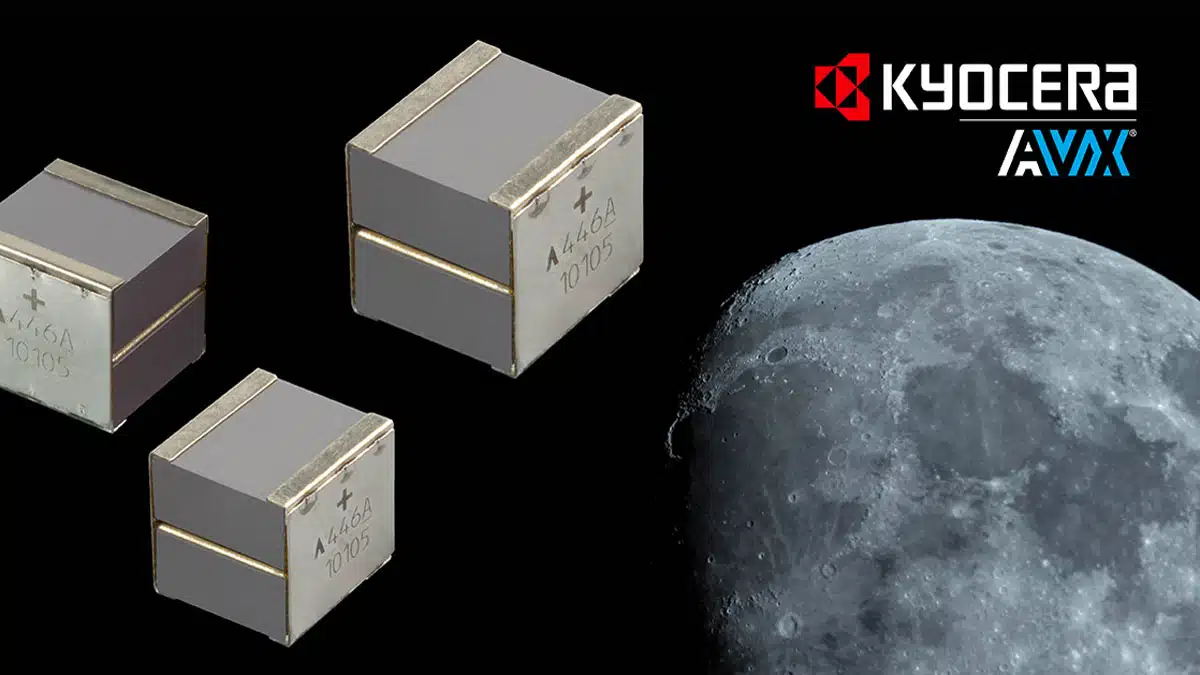
KYOCERA AVX contributed several components to the Pragyaan lunar rover, including stacked TCH Series surface-mount tantalum polymer capacitors that were especially designed to suit ISRO specifications, miniature CWR15 MIL-PRF-55365 / 12 tantalum chip capacitors engineered to downsize military and aerospace circuits, high-capacitance and low-ESR TES Series ESCC QPL tantalum chip capacitors, space-level TAZ Series/CWR29 MIL-PRF-55365/11 molded tantalum chip capacitors, and high-reliability MLCCs and EMI feedthrough filters.

KYOCERA AVX began developing the stacked TCH (TCHS) Series surface-mount tantalum polymer capacitors to ISRO specifications back in 2015 and released the series 2016. The TCHS Series is based on the same high-voltage, low-ESR design as its high-reliability TCH Series capacitors. Both have a hermetically sealed ceramic case equipped with conductive polymer electrodes, but the TCHS Series delivers the 44µF/100V capability the ISRO required by stacking two 22µF/100V parts to achieve high-CV performance in the same footprint as single-layer devices. It also exhibits the same stability, reliability, and low leakage as the standard TCH Series but with remarkably low ESR values.

The TCHS Series capacitors designed for use in the Pragyaan lunar rover are rated for use in operating temperatures extending from -55°C to +125°C and exhibit excellent stability in ambient atmosphere environments. They also have the highest voltage rating of any space-grade polymer capacitor available on the market, which makes them ideal for power supplies and hold-up, power filtration, and pulse power circuits in aerospace, defense, and other high-reliability applications with high-capacitance, low-ESR, long-lifetime requirements.

To ensure suitability in high-reliability applications, TCHS Series capacitors are screened using KYOCERA AVX’s patented Q-Process, which effectively eliminates components with operational instability or excessive parametric shifts, and in the midst of the ESA and NASA qualification process. The series is also available with surge current testing and other testing based on high-reliability ESA, NASA, and MIL screening requirements.

Before the TCHS Series capacitors were deployed in the Pragyaan lunar rover, they were used in several other space projects to prove their ruggedness, reliability, and performance.

Most of the 44 TCHS Series capacitors used in the ISRO’s Pragyaan lunar rover were integrated into the power card to help warm the electronics box with energy supplied by the equipped solar panel. This was vital to mission success since the electronics box contains the instruments designed to analyze the chemical composition of the lunar surface, examine the lunar soil and rocks, measure the ions, electron density, and thermal properties of the lunar surface near the South Pole, and transmit solar power to the rover wheels.

“We’re extremely proud to be a small part of the Indian Space Research Organization’s historic Chandrayaan-3 lunar mission,” said Allen Mayar, Global Product Manager – Electrolytic Capacitors, KYOCERA AVX. “Developing space-grade components proven to satisfy challenging application, reliability, and regulatory requirements is a feat of engineering, so we are very proud to see our stacked TCH products fulfill their first critical mission.”

Mayar continued, “KYOCERA AVX has a well-established history of developing electronic components proven to satisfy the highest quality and reliability standards of a range of critical missions and applications. Now that our space-level stacked TCH Series capacitors have proven themselves in the Pragyaan lunar rover, we’re discussing future missions with the ISRO and other global space organizations and looking forward to continuing our proud tradition.”

Related

Source: KYOCERA AVX

Recent Posts

Samsung Introduced Low ESL 3-Terminal Reverse-Geometry MLCCs for High-Performance ADAS

20.5.2026
16

Würth Elektronik Presents New Bidirectional Digital Isolators

20.5.2026
11

Using Stress–Strain Curves to Diagnose Tantalum Powders for Capacitors

20.5.2026
18

Samsung Launches Ultra-Compact 008004 High Q MLCC for Next-Generation RF Applications

20.5.2026
9

Nichicon Extends Rechargeable Batteries Temperature to Rival Supercapacitors

19.5.2026
24

Two‑capacitor paradox explained for engineers

18.5.2026
49

ESA SPCD 26 Registration Open

15.5.2026
25

Capacitances of Nonlinear MLCCs: What Datasheets Don’t Tell You

14.5.2026
89

How a Digital Structural Twin Can Predict Tantalum Capacitor Reliability

14.5.2026
64

Upcoming Events

Jun 2
16:00 - 17:00 CEST

Calculation, Simulation and Measurement of 800V EMC Filters

Jun 16
16:00 - 17:00 CEST

EMC with EMC – EMC‑compliant design with electromechanical connectors

View Calendar

Popular Posts

  • Buck Converter Design and Calculation

    0 shares
    Share 0 Tweet 0
  • Boost Converter Design and Calculation

    0 shares
    Share 0 Tweet 0
  • Flyback Converter Design and Calculation

    0 shares
    Share 0 Tweet 0
  • LLC Resonant Converter Design and Calculation

    0 shares
    Share 0 Tweet 0
  • MLCC and Ceramic Capacitors

    0 shares
    Share 0 Tweet 0
  • Capacitor Charging and Discharging

    0 shares
    Share 0 Tweet 0
  • What Electronics Engineer Needs to Know About Passive Low Pass Filters

    0 shares
    Share 0 Tweet 0
  • Dual Active Bridge (DAB) Topology

    0 shares
    Share 0 Tweet 0
  • Ripple Current and its Effects on the Performance of Capacitors

    3 shares
    Share 3 Tweet 0
  • Samsung Electro-Mechanics Releases High-Capacitance MLCCs for AI Server Applications

    0 shares
    Share 0 Tweet 0

Newsletter Subscription


Passive Components Blog

© EPCI - Leading Passive Components Educational and Information Site

  • Home
  • Privacy Policy
  • EPCI Membership & Advertisement
  • About

No Result
View All Result
  • Home
  • Knowledge Blog
  • PCNS

© EPCI - Leading Passive Components Educational and Information Site

This website uses cookies. By continuing to use this website you are giving consent to cookies being used. Visit our Privacy and Cookie Policy.
Go to mobile version