









Passive Components Blog
No Result
View All Result
  • Home
  • NewsFilter
    • All
    • Aerospace & Defence
    • Antenna
    • Applications
    • Automotive
    • Capacitors
    • Circuit Protection Devices
    • electro-mechanical news
    • Filters
    • Fuses
    • Inductors
    • Industrial
    • Integrated Passives
    • inter-connect news
    • Market & Supply Chain
    • Market Insights
    • Medical
    • Modelling and Simulation
    • New Materials & Supply
    • New Technologies
    • Non-linear Passives
    • Oscillators
    • Passive Sensors News
    • Resistors
    • RF & Microwave
    • Telecommunication
    • Weekly Digest

    Exxelia to Exhibit at APEC 2026 in San Antonio, Texas

    Würth Elektronik Presents Differential Pressure Sensor for HVAC and Medical

    Thermal Modeling of Magnetics

    ESA SPCD 26 Call for Papers Extended to 30th March

    Wk 11 Electronics Supply Chain Digest

    Binder Extends NCC Circular Connectors for Harsh Environments

    Standard vs Planar LLC transformers Comparison for Battery Chargers

    Würth Elektronik and Grinn Launch Edge AI Cooperation

    Bourns Expanded Semi-Shielded Low Profile Automotive Power Inductor

    Trending Tags

    • Ripple Current
    • RF
    • Leakage Current
    • Tantalum vs Ceramic
    • Snubber
    • Low ESR
    • Feedthrough
    • Derating
    • Dielectric Constant
    • New Products
    • Market Reports
  • VideoFilter
    • All
    • Antenna videos
    • Capacitor videos
    • Circuit Protection Video
    • Filter videos
    • Fuse videos
    • Inductor videos
    • Inter-Connect Video
    • Non-linear passives videos
    • Oscillator videos
    • Passive sensors videos
    • Resistor videos

    Thermal Modeling of Magnetics

    Standard vs Planar LLC transformers Comparison for Battery Chargers

    How Modern Tools Model Magnetic Components for Power Electronics

    Advanced Loss Modeling for Planar Magnetics in the Frenetic Planar Tool

    2026 Power Magnetics Design Trends: Flyback, DAB and Planar

    Enabling Software‑Defined Vehicle Architectures: Automotive Ethernet and Zonal Smart Power

    Calculating Resistance Value of a Flyback RC Snubber 

    One‑Pulse Characterization of Nonlinear Power Inductors

    Thermistor Linearization Challenges

    Trending Tags

    • Capacitors explained
    • Inductors explained
    • Resistors explained
    • Filters explained
    • Application Video Guidelines
    • EMC
    • New Products
    • Ripple Current
    • Simulation
    • Tantalum vs Ceramic
  • Knowledge Blog
  • DossiersNew
  • Suppliers
    • Who is Who
  • PCNS
    • PCNS 2025
    • PCNS 2023
    • PCNS 2021
    • PCNS 2019
    • PCNS 2017
  • Events
  • Home
  • NewsFilter
    • All
    • Aerospace & Defence
    • Antenna
    • Applications
    • Automotive
    • Capacitors
    • Circuit Protection Devices
    • electro-mechanical news
    • Filters
    • Fuses
    • Inductors
    • Industrial
    • Integrated Passives
    • inter-connect news
    • Market & Supply Chain
    • Market Insights
    • Medical
    • Modelling and Simulation
    • New Materials & Supply
    • New Technologies
    • Non-linear Passives
    • Oscillators
    • Passive Sensors News
    • Resistors
    • RF & Microwave
    • Telecommunication
    • Weekly Digest

    Exxelia to Exhibit at APEC 2026 in San Antonio, Texas

    Würth Elektronik Presents Differential Pressure Sensor for HVAC and Medical

    Thermal Modeling of Magnetics

    ESA SPCD 26 Call for Papers Extended to 30th March

    Wk 11 Electronics Supply Chain Digest

    Binder Extends NCC Circular Connectors for Harsh Environments

    Standard vs Planar LLC transformers Comparison for Battery Chargers

    Würth Elektronik and Grinn Launch Edge AI Cooperation

    Bourns Expanded Semi-Shielded Low Profile Automotive Power Inductor

    Trending Tags

    • Ripple Current
    • RF
    • Leakage Current
    • Tantalum vs Ceramic
    • Snubber
    • Low ESR
    • Feedthrough
    • Derating
    • Dielectric Constant
    • New Products
    • Market Reports
  • VideoFilter
    • All
    • Antenna videos
    • Capacitor videos
    • Circuit Protection Video
    • Filter videos
    • Fuse videos
    • Inductor videos
    • Inter-Connect Video
    • Non-linear passives videos
    • Oscillator videos
    • Passive sensors videos
    • Resistor videos

    Thermal Modeling of Magnetics

    Standard vs Planar LLC transformers Comparison for Battery Chargers

    How Modern Tools Model Magnetic Components for Power Electronics

    Advanced Loss Modeling for Planar Magnetics in the Frenetic Planar Tool

    2026 Power Magnetics Design Trends: Flyback, DAB and Planar

    Enabling Software‑Defined Vehicle Architectures: Automotive Ethernet and Zonal Smart Power

    Calculating Resistance Value of a Flyback RC Snubber 

    One‑Pulse Characterization of Nonlinear Power Inductors

    Thermistor Linearization Challenges

    Trending Tags

    • Capacitors explained
    • Inductors explained
    • Resistors explained
    • Filters explained
    • Application Video Guidelines
    • EMC
    • New Products
    • Ripple Current
    • Simulation
    • Tantalum vs Ceramic
  • Knowledge Blog
  • DossiersNew
  • Suppliers
    • Who is Who
  • PCNS
    • PCNS 2025
    • PCNS 2023
    • PCNS 2021
    • PCNS 2019
    • PCNS 2017
  • Events
No Result
View All Result
Passive Components Blog
No Result
View All Result

Minimization of Crystal Oscillator Cosmic Radiation Effects

28.4.2025
Reading Time: 3 mins read
A A

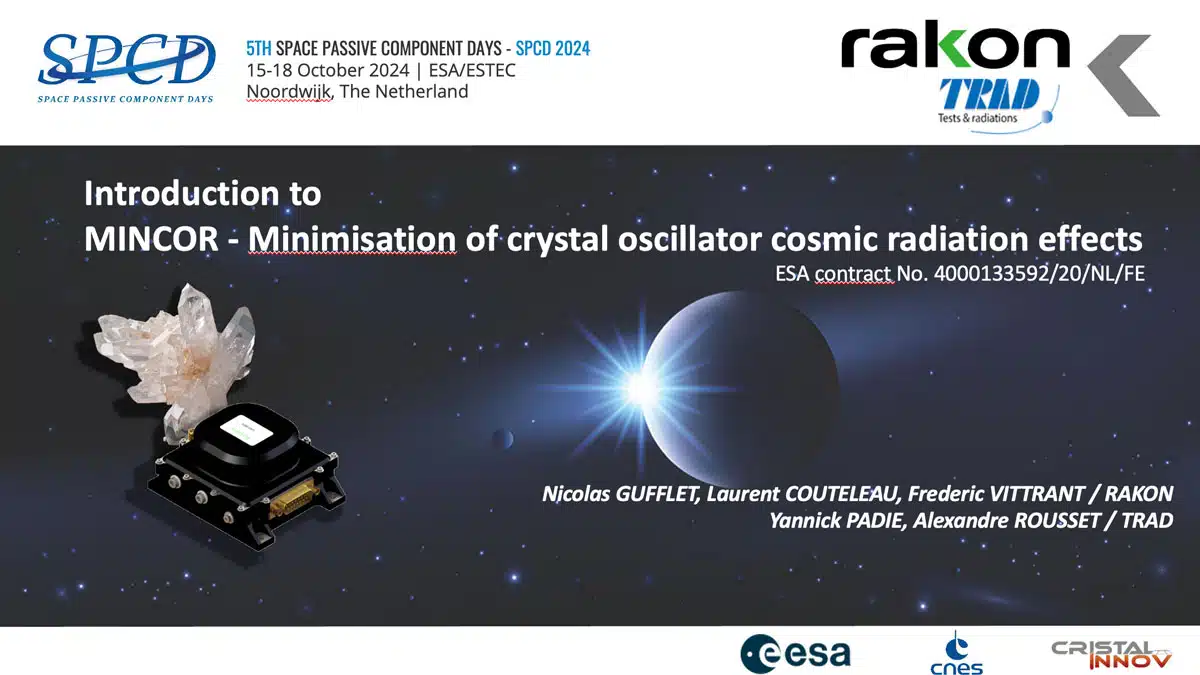
This paper MINCOR – Minimization Of Crystal Oscillator Cosmic Radiation Effects  was prepared by Nicolas GUFFLET, Laurent COUTELEAU, Frederic VITTRANT / RAKON  Yannick PADIE, Alexandre ROUSSET / TRAD  and presented during the 5th Space Passive Component Days (SPCD), an International Symposium held from October 15th to 18th, 2024, at ESA/ESTEC in Noordwijk, the Netherlands. Published under permission from ESA SPCD organizers.

Introduction:

RelatedPosts

ESA SPCD 26 Call for Papers Extended to 30th March

High-Density PCB Assemblies For Space Applications

Solid State Polymer Multilayer Capacitors For High Temperature Application

The MINCOR project, funded by the European Space Agency (ESA), aims to mitigate the effects of cosmic radiation on quartz crystal oscillators used in space applications.

These oscillators are vital for navigation systems, telecommunications, and scientific instruments due to their exceptional frequency stability and signal purity.

However, space environments expose them to ionizing radiation, which can lead to frequency drifts. The project seeks to balance performance needs with cost-efficiency, particularly for low Earth orbit (LEO) satellites under the New Space paradigm.

Key Points:

  • Objective: Reduce radiation sensitivity of quartz crystal oscillators.
  • Project Partners: RAKON France and TRAD.
  • Target Applications: Navigation systems, telecom satellites, and scientific missions.
  • Challenges: Managing total ionizing dose (TID) and non-ionizing energy loss (NIEL) effects.
  • Methodology: Radiation simulations, material tests, and process optimizations.

Extended Summary:

Quartz crystal oscillators are designed to maintain precision under varied environmental stresses, including ionizing radiation in space. Traditionally, for geostationary satellites (GEO), components are selected based on proven heritage and reliability, often leading to higher costs and longer development timelines. The emergence of cost-sensitive LEO missions necessitates re-evaluating manufacturing processes to maintain performance without excessive expenditures.

The MINCOR project addresses these needs by analyzing radiation impacts such as dose rate, TID, and displacement damage. Using the OMERE software, radiation simulations were conducted for various mission profiles, including GEO, LEO, MEO, and deep space missions, considering factors like solar activity and material shielding.

A comprehensive review of quartz resonator technology highlighted radiation-induced changes in frequency stability. Key factors include mass loading, mechanical stress, and intrinsic material properties. Historical studies on radiation effects since the early 20th century informed the research, emphasizing the role of impurities and manufacturing techniques like ion sweeping to reduce radiation sensitivity.

RAKON focused on various resonator configurations, exploring different quartz materials, electrode compositions, and manufacturing processes. Test plans were devised to simulate LEO radiation profiles, emphasizing low-dose rate behavior. Custom test oscillators were designed to isolate the resonator during exposure, ensuring precise measurements.

Resonators were produced on an ESCC3501 space-qualified line, with rigorous screening and material characterization. Notably, Cristal Innov’s quartz showed superior qualities, with minimal impurities and excellent frequency stability under radiation tests.

Conclusion:

The MINCOR project has advanced understanding of radiation effects on quartz crystal oscillators. By identifying optimal materials and processes, the project aims to enhance the reliability of oscillators in space while reducing costs for New Space applications. Ongoing tests will further evaluate low-dose rate behaviors, with initial results expected by late 2024. Continuous support from ESA, CNES, and industry partners like Cristal Innov has been instrumental in the project’s progress.

Read the full paper:

ORAL_Day 2_25_RAKON France_MINCOR Radiation effects on crystal oscillatorsDownload

Related

Source: ESA SPCD

Recent Posts

Exxelia to Exhibit at APEC 2026 in San Antonio, Texas

17.3.2026
20

ESA SPCD 26 Call for Papers Extended to 30th March

16.3.2026
80

Binder Extends NCC Circular Connectors for Harsh Environments

13.3.2026
2

Peak Nano to Develop Fusion Grade High Energy Film Capacitors

11.3.2026
30

Kyocera Releases 30fs Jitter Differential Clock Oscillator

10.3.2026
15

ECIA February 2026 Industry Pulse Signals Strong Component Growth

6.3.2026
36

Samtec ANSI/VITA 90 Connectors: Rugged Small Form Factor Standard

5.3.2026
13

Würth Elektronik IQD Awarded by EcoVadis Gold Sustainability Medal

4.3.2026
4

SCHURTER Introduces 2410 SMD Fuse for Robust AC/DC Protection

17.2.2026
20

Upcoming Events

Mar 19
13:00 - 14:00 CDT

Smart Consideration of Inductor Thermal Performance

Mar 21
All day

PSMA Capacitor Workshop 2026

Mar 24
9:00 - 10:00 CET

Power protection in the digital age – eFuse and hot-swap strategies for modern data center design

View Calendar

Popular Posts

  • Buck Converter Design and Calculation

    0 shares
    Share 0 Tweet 0
  • Boost Converter Design and Calculation

    0 shares
    Share 0 Tweet 0
  • Flyback Converter Design and Calculation

    0 shares
    Share 0 Tweet 0
  • LLC Resonant Converter Design and Calculation

    0 shares
    Share 0 Tweet 0
  • MLCC Manufacturers Consider Price Increase as AI Demand Outpaces Supply

    0 shares
    Share 0 Tweet 0
  • Dual Active Bridge (DAB) Topology

    0 shares
    Share 0 Tweet 0
  • Ripple Current and its Effects on the Performance of Capacitors

    3 shares
    Share 3 Tweet 0
  • MLCC and Ceramic Capacitors

    0 shares
    Share 0 Tweet 0
  • MLCC Case Sizes Standards Explained

    0 shares
    Share 0 Tweet 0
  • 3-Phase EMI Filter Design, Simulation, Calculation and Test

    0 shares
    Share 0 Tweet 0

Newsletter Subscription


Passive Components Blog

© EPCI - Leading Passive Components Educational and Information Site

  • Home
  • Privacy Policy
  • EPCI Membership & Advertisement
  • About

No Result
View All Result
  • Home
  • Knowledge Blog
  • PCNS

© EPCI - Leading Passive Components Educational and Information Site

This website uses cookies. By continuing to use this website you are giving consent to cookies being used. Visit our Privacy and Cookie Policy.
Go to mobile version