












Passive Components Blog
No Result
View All Result
  • Home
  • NewsFilter
    • All
    • Aerospace & Defence
    • Antenna
    • Applications
    • Automotive
    • Capacitors
    • Circuit Protection Devices
    • electro-mechanical news
    • Filters
    • Fuses
    • Inductors
    • Industrial
    • Integrated Passives
    • inter-connect news
    • Market & Supply Chain
    • Market Insights
    • Medical
    • Modelling and Simulation
    • New Materials & Supply
    • New Technologies
    • Non-linear Passives
    • Oscillators
    • Passive Sensors News
    • Resistors
    • RF & Microwave
    • Telecommunication
    • Weekly Digest

    Molecular Memristor Shows Record 145 kH Emergent Inductance

    Planar vs Conventional Transformer: When it Make Sense

    Researchers Propose Next‑Gen Compact Memory Using Ultra-thin Ferroelectric Capacitors

    Nichicon ADN Automotive Hybrid Aluminum Capacitors Now Available in EMEA

    Wk 19 Electronics Supply Chain Digest

    Electrocaloric Multilayer Capacitors: Towards Quiet, Solid‑State Cooling Around Room Temperature

    High-Crystallinity Nanocrystalline Composites for MHz Chip Inductors

    European Components Distribution Shows Strong Q1 2026 Growth Amid Geopolitical Uncertainty

    Stackpole Expanded its AlN Thick Film Chip Resistors

    Trending Tags

    • Ripple Current
    • RF
    • Leakage Current
    • Tantalum vs Ceramic
    • Snubber
    • Low ESR
    • Feedthrough
    • Derating
    • Dielectric Constant
    • New Products
    • Market Reports
  • VideoFilter
    • All
    • Antenna videos
    • Capacitor videos
    • Circuit Protection Video
    • Filter videos
    • Fuse videos
    • Inductor videos
    • Inter-Connect Video
    • Non-linear passives videos
    • Oscillator videos
    • Passive sensors videos
    • Resistor videos

    Planar vs Conventional Transformer: When it Make Sense

    Modeling Fringing Field Losses in Inductors & Transformers

    Why Power Inductors Use a Ferrite Core With an Air Gap

    Transformer-Based Power-Line Harvester Magnetic Design

    Thermal Modeling of Magnetics

    Standard vs Planar LLC transformers Comparison for Battery Chargers

    How Modern Tools Model Magnetic Components for Power Electronics

    Advanced Loss Modeling for Planar Magnetics in the Frenetic Planar Tool

    2026 Power Magnetics Design Trends: Flyback, DAB and Planar

    Trending Tags

    • Capacitors explained
    • Inductors explained
    • Resistors explained
    • Filters explained
    • Application Video Guidelines
    • EMC
    • New Products
    • Ripple Current
    • Simulation
    • Tantalum vs Ceramic
  • Knowledge Blog
  • DossiersNew
  • Suppliers
    • Who is Who
  • PCNS
    • PCNS 2025
    • PCNS 2023
    • PCNS 2021
    • PCNS 2019
    • PCNS 2017
  • Events
  • Home
  • NewsFilter
    • All
    • Aerospace & Defence
    • Antenna
    • Applications
    • Automotive
    • Capacitors
    • Circuit Protection Devices
    • electro-mechanical news
    • Filters
    • Fuses
    • Inductors
    • Industrial
    • Integrated Passives
    • inter-connect news
    • Market & Supply Chain
    • Market Insights
    • Medical
    • Modelling and Simulation
    • New Materials & Supply
    • New Technologies
    • Non-linear Passives
    • Oscillators
    • Passive Sensors News
    • Resistors
    • RF & Microwave
    • Telecommunication
    • Weekly Digest

    Molecular Memristor Shows Record 145 kH Emergent Inductance

    Planar vs Conventional Transformer: When it Make Sense

    Researchers Propose Next‑Gen Compact Memory Using Ultra-thin Ferroelectric Capacitors

    Nichicon ADN Automotive Hybrid Aluminum Capacitors Now Available in EMEA

    Wk 19 Electronics Supply Chain Digest

    Electrocaloric Multilayer Capacitors: Towards Quiet, Solid‑State Cooling Around Room Temperature

    High-Crystallinity Nanocrystalline Composites for MHz Chip Inductors

    European Components Distribution Shows Strong Q1 2026 Growth Amid Geopolitical Uncertainty

    Stackpole Expanded its AlN Thick Film Chip Resistors

    Trending Tags

    • Ripple Current
    • RF
    • Leakage Current
    • Tantalum vs Ceramic
    • Snubber
    • Low ESR
    • Feedthrough
    • Derating
    • Dielectric Constant
    • New Products
    • Market Reports
  • VideoFilter
    • All
    • Antenna videos
    • Capacitor videos
    • Circuit Protection Video
    • Filter videos
    • Fuse videos
    • Inductor videos
    • Inter-Connect Video
    • Non-linear passives videos
    • Oscillator videos
    • Passive sensors videos
    • Resistor videos

    Planar vs Conventional Transformer: When it Make Sense

    Modeling Fringing Field Losses in Inductors & Transformers

    Why Power Inductors Use a Ferrite Core With an Air Gap

    Transformer-Based Power-Line Harvester Magnetic Design

    Thermal Modeling of Magnetics

    Standard vs Planar LLC transformers Comparison for Battery Chargers

    How Modern Tools Model Magnetic Components for Power Electronics

    Advanced Loss Modeling for Planar Magnetics in the Frenetic Planar Tool

    2026 Power Magnetics Design Trends: Flyback, DAB and Planar

    Trending Tags

    • Capacitors explained
    • Inductors explained
    • Resistors explained
    • Filters explained
    • Application Video Guidelines
    • EMC
    • New Products
    • Ripple Current
    • Simulation
    • Tantalum vs Ceramic
  • Knowledge Blog
  • DossiersNew
  • Suppliers
    • Who is Who
  • PCNS
    • PCNS 2025
    • PCNS 2023
    • PCNS 2021
    • PCNS 2019
    • PCNS 2017
  • Events
No Result
View All Result
Passive Components Blog
No Result
View All Result

Inductors Modeling with LTSpice

18.12.2024
Reading Time: 7 mins read
A A

This article published by All About Circuits authored by Ignacio de Mendizábal discusses how to model inductors using LTSpice circuit simulation software.

Inductors are pillars among electronic components. In this article, we’ll learn how we can model inductors using LTspice, a circuit simulation program where the accuracy of the simulations depends on the accuracy of the models used.

RelatedPosts

Molecular Memristor Shows Record 145 kH Emergent Inductance

Planar vs Conventional Transformer: When it Make Sense

Researchers Propose Next‑Gen Compact Memory Using Ultra-thin Ferroelectric Capacitors

Here, we’ll discuss three different simulation models, starting with the lowest complexity (linear), discussing a middle ground (non-linear), and moving to the highest complexity (the CHAN model). Along the way, you’ll also learn some tricks about LTspice.

Inductor Saturation Current and Hysteresis

Inductors present an upper limit to the storage of magnetic energy. When the saturation current is reached, the inductor loses magnetic properties such as permeability. When this happens, inductors are not able to continue storing energy.

This situation is reversed as soon as the current circulating through the inductor is reduced. This concept of saturation must be considered in models in order to have accurate simulations for applications such as power supplies, where magnetic components are crucial.

A particularity of inductors is that even if we remove the magnetizing current circulating through an inductor, the magnetic flux density associated with the inductor’s core material does not decrease to zero on its own. We need to apply current in the opposite direction to restore the inductor to a non-magnetized state. This phenomenon is called hysteresis and is one of the main characteristics that determine the application of a magnetic material.
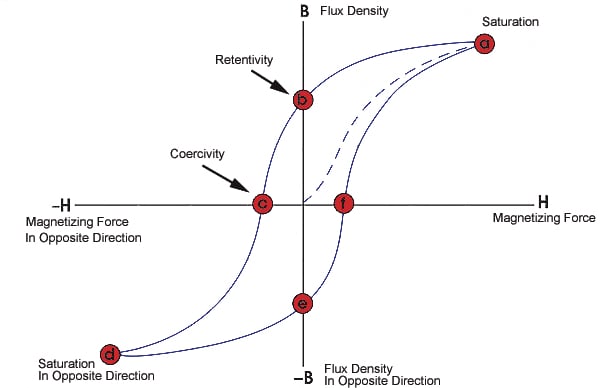
Hysteresis loop of an inductor
Hysteresis loop of an inductor. Image used courtesy of the NDT Resource Center

As demonstrated in the visual above, we can see that the amount of flux present in an inductor depends not only on the applied current but also on the previous state of the inductor. 

Resistance, Capacitance, and Temperature in Inductors

Ideally, inductors present only inductance, which is measured in henries (H). In the real world, however, we must content with parasitics which are always present in inductive components. Because these parasitics make an inductor’s behavior non-ideal, we can’t overlook them when simulating an inductor.

While we won’t spend much time in this article discussing the magnetic properties of inductors, here’s a list of relevant parameters that will help us improve the accuracy of our model when we simulate inductors in LTspice:

  • Rseries: Series resistance due to the finite resistivity of the copper (also known as DC resistance)
  • Rparallel: Parallel resistance caused by core losses
  • Cparallel: Capacitance of consecutive windings
  • Temperature coefficient: A consideration to account for the fact that inductors can alter their magnetic properties by self-heating (due to the current that circulates through them and parasitic resistance)

Adding these values into a simulation will help you yield more realistic results that will more closely correspond to the real-life behavior of a given inductor.

Simulation Option 1: A Simple Linear Model

A first model includes all the parameters listed above and executes a simulation as it happens in a linear circuit.

Luckily, it’s not necessary for us to add each parasitic component by hand. In order to make simulations run faster, LTspice includes internal models.

If you right-click on an inductor, you will see the following window:
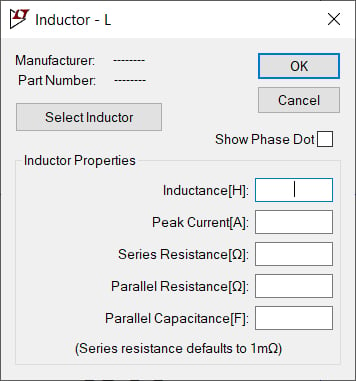
Parasitic components of inductors in LTspice

Here’s a trick for LTspice! If you do not introduce any value for the parallel resistance, LTspice will include a default value. If you’d like to deactivate this option, go through the Tools menu and select the Control Panel. From here, select the Hacks! tab, as shown below.

Option for default parallel resistance (Rpar) in LTSpice
Option for default parallel resistance (Rpar) in LTspice

You’ll want to uncheck the box that says “Supply a min. inductor damping if no Rpar is given”.

Simulation Option 2: A Non-Linear Model

When linear models are not enough, LTspice provides the means to consider inductor saturation. We can define the function that determines the inductor flux.

In order to define the inductor flux, we need to modify the netlist. This can be done by pressing the “CTRL” key and then right-clicking an inductor. This will bring up the following window:
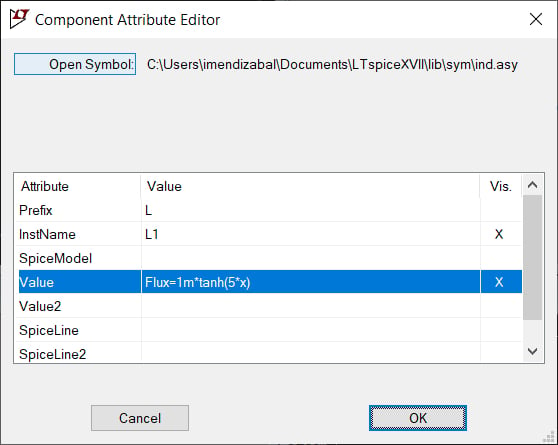
The variable “x” refers to the inductor current. We can enter our own information into the “Value” field and then press the “OK” button. Now, in order to verify our input, we select “View” in the menu and then select “SPICE Netlist”. This brings us to the schematic editor.
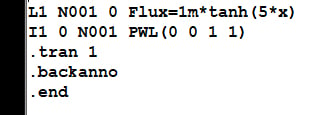
In our example here, our simulated circuit consists of an inductor in series with a current source.
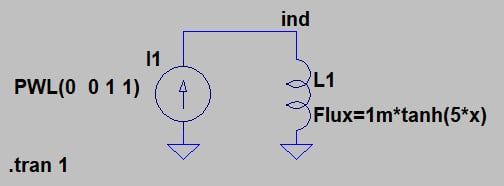
The voltage across an inductor follows can be expressed as

V=−Ldldt

So since what we are representing is the changes in the current, the inductance can be obtained directly by measuring the voltage of the inductor (node ind).

For clarity, we plot the expression: V(ind)/1V to remove voltage units. Don’t forget to set the vertical scale to linear.
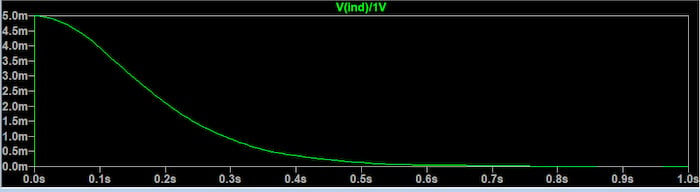
We can see why the inductance decreases in this way if we recall that the inductor’s magnetic flux is equal to inductance times current. Current increases at a steady rate during the 1-second simulation—but, because of saturation, the magnetic flux does not increase steadily. The decrease in inductance reflects this change in the relationship between current and magnetic flux. 

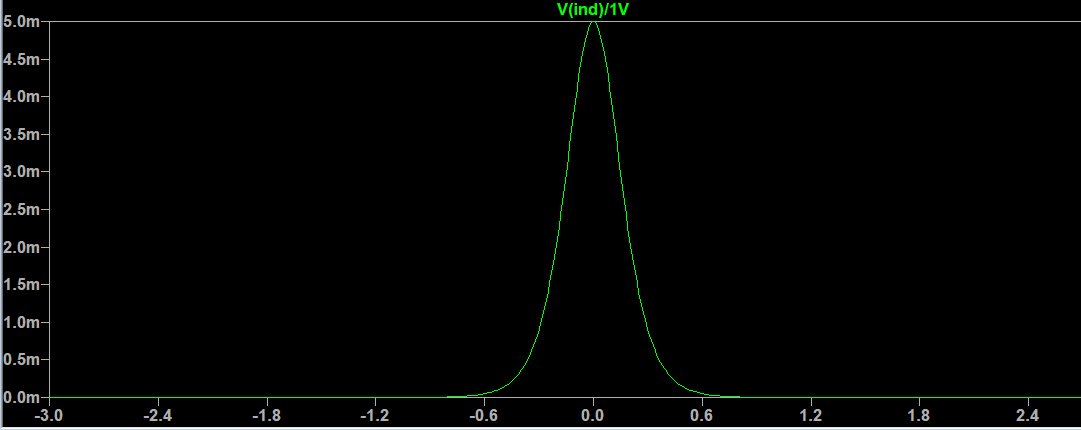
For further analysis, we can plot the inductance as a function of the current. We make the current increase from -3 amps to 3 amps in steps of 0.01.
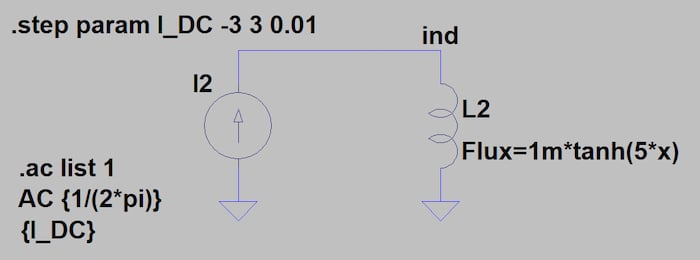
This circuit yields the following plot:
Simulation Option 3: The CHAN Model

When designing our magnetics, we need to control all the parameters of the inductors we discussed earlier. Sometimes it can be difficult to model all of them in LTspice or any other simulation tool.

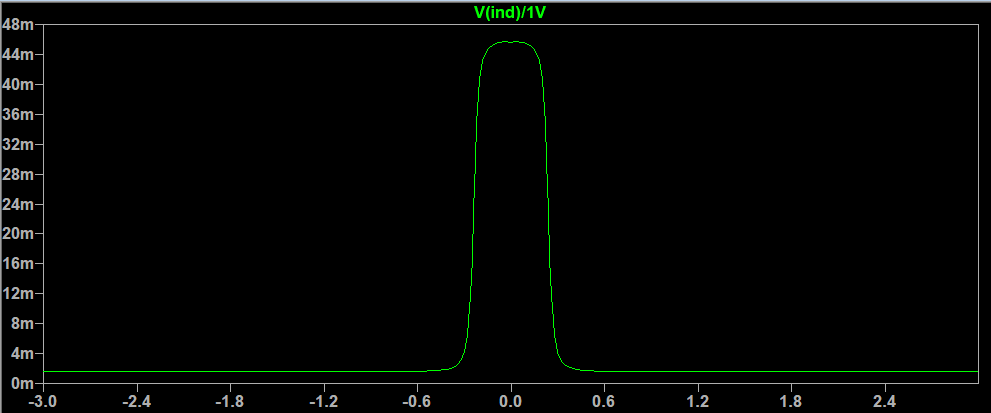
There is a third model available in LTspice, the CHAN model, created by John Chan and discussed in a research paper entitled “Nonlinear transformer model for circuit simulation.” The accuracy of this model has been widely proven and it can perform the modelization of the hysteresis loop with only three parameters:

  • Coercive force (Hc), in Amp-turns/meter
  • Residual flux density (Br), in Tesla
  • Saturation flux density (Bs), in Tesla

Also, the mechanical aspects of the inductor need to be added:

  • Magnetic Length (Lm), in meters
  • Length of the gap (Lg), in meters
  • Cross-sectional area (A), in square meters
  • Number of turns (N)

Let’s see what happens to the same circuit we used before if we include all these parameters.

And now we plot the inductance as a function of current:
Conclusion

Inductors are complex and critical components in electronics. LTspice allows designers to make the design cycle easier by providing fast and accurate methods to simulate them. Depending on the complexity of your circuit, you can use one of the three models presented here.

The circuits in this article are quite basic, but they are a good starting point for further analysis. There is a tradeoff between speed and accuracy, but LTspice is generally quite fast, so it is always advisable to use the most precise model when possible.

Inductor Simulation with LTSpice

Related

Source: All About Circuits

Recent Posts

Molecular Memristor Shows Record 145 kH Emergent Inductance

12.5.2026
8

Planar vs Conventional Transformer: When it Make Sense

11.5.2026
30

High-Crystallinity Nanocrystalline Composites for MHz Chip Inductors

7.5.2026
63

Würth Elektronik Introduces Compact Flat-wire SMT Power Inductors for Automotive

5.5.2026
49

Energy Localization in Tantalum Anode Formation: A Structural Perspective

4.5.2026
46

Modeling Fringing Field Losses in Inductors & Transformers

30.4.2026
51

Miniaturization of Tantalum Capacitors: Structural Limit Under Constant Rating

27.4.2026
54

Heatsink Design and Thermal Interface Materials for Reliable Electronics

27.4.2026
34

Murata New MLCC Bulk Case Packaging Cuts Packaging Material by 99%

27.4.2026
99

Upcoming Events

May 13
17:00 - 17:30 CEST

Winding Loss Modeling for Toroidal Magnetics – Including Gapped Cores

May 19
16:00 - 17:00 CEST

Designing Qi2 Wireless Power Systems: Practical Development and EMC Optimization

Jun 2
16:00 - 17:00 CEST

Calculation, Simulation and Measurement of 800V EMC Filters

View Calendar

Popular Posts

  • Buck Converter Design and Calculation

    0 shares
    Share 0 Tweet 0
  • Boost Converter Design and Calculation

    0 shares
    Share 0 Tweet 0
  • Flyback Converter Design and Calculation

    0 shares
    Share 0 Tweet 0
  • LLC Resonant Converter Design and Calculation

    0 shares
    Share 0 Tweet 0
  • MLCC and Ceramic Capacitors

    0 shares
    Share 0 Tweet 0
  • Dual Active Bridge (DAB) Topology

    0 shares
    Share 0 Tweet 0
  • What Electronics Engineer Needs to Know About Passive Low Pass Filters

    0 shares
    Share 0 Tweet 0
  • Capacitor Charging and Discharging

    0 shares
    Share 0 Tweet 0
  • Ripple Current and its Effects on the Performance of Capacitors

    3 shares
    Share 3 Tweet 0
  • MLCC Case Sizes Standards Explained

    0 shares
    Share 0 Tweet 0

Newsletter Subscription


Passive Components Blog

© EPCI - Leading Passive Components Educational and Information Site

  • Home
  • Privacy Policy
  • EPCI Membership & Advertisement
  • About

No Result
View All Result
  • Home
  • Knowledge Blog
  • PCNS

© EPCI - Leading Passive Components Educational and Information Site

This website uses cookies. By continuing to use this website you are giving consent to cookies being used. Visit our Privacy and Cookie Policy.
Go to mobile version