








Passive Components Blog
No Result
View All Result
  • Home
  • NewsFilter
    • All
    • Aerospace & Defence
    • Antenna
    • Applications
    • Automotive
    • Capacitors
    • Circuit Protection Devices
    • electro-mechanical news
    • Filters
    • Fuses
    • Inductors
    • Industrial
    • Integrated Passives
    • inter-connect news
    • Market & Supply Chain
    • Market Insights
    • Medical
    • Modelling and Simulation
    • New Materials & Supply
    • New Technologies
    • Non-linear Passives
    • Oscillators
    • Passive Sensors News
    • Resistors
    • RF & Microwave
    • Telecommunication
    • Weekly Digest

    Würth Elektroniks Flexible EMI Shielding Sheets Provides Quick and Easy Schielding Solution

    Samsung Introduces Automotive 1206 100uF X7T MLCC for Power Rails in ADAS and SoCs

    Hirose Releases Ultra‑low Profile FPC‑to‑board Connector

    YMIN Hybrid Aluminum Capacitors for Automotive LiDAR Power Rails

    Samsung Presents Ultra‑Thin Silicon Capacitors for AI and Server PDN

    YAGEO Introduces 310VAC SMD Y2 Safety MP Capacitors for Compact EMI Filtering

    DMASS: European Components Distribution Returns To Growth In Q1 2026

    German Component Distribution Market Rebounds in Q1 2026 According to FBDi

    Nippon Chemi-Con Announces New Capacitor series for AI, Automotive and Immersion Cooling

    Trending Tags

    • Ripple Current
    • RF
    • Leakage Current
    • Tantalum vs Ceramic
    • Snubber
    • Low ESR
    • Feedthrough
    • Derating
    • Dielectric Constant
    • New Products
    • Market Reports
  • VideoFilter
    • All
    • Antenna videos
    • Capacitor videos
    • Circuit Protection Video
    • Filter videos
    • Fuse videos
    • Inductor videos
    • Inter-Connect Video
    • Non-linear passives videos
    • Oscillator videos
    • Passive sensors videos
    • Resistor videos

    Why Isolated DC/DC Power Supplies Fail Late, Würth Elektronik Podcast

    Designing 800 V DC EMC Filters: Calculation, Simulation and Measurement

    Current Sense Transformer Datasheet and Design‑in Guide

    Designing a USB Type‑C Flyback Planar Transformer with Frenetic’s Planar Tool

    Magnetics Design in High‑Frequency GaN Converters

    Qi2 Wireless Charging: Inductors, Capacitors and EMC Filters

    Two‑capacitor paradox explained for engineers

    Capacitances of Nonlinear MLCCs: What Datasheets Don’t Tell You

    Tapped Inductor Buck Converter Fundamentals

    Trending Tags

    • Capacitors explained
    • Inductors explained
    • Resistors explained
    • Filters explained
    • Application Video Guidelines
    • EMC
    • New Products
    • Ripple Current
    • Simulation
    • Tantalum vs Ceramic
  • Knowledge Blog
  • DossiersNew
  • Suppliers
    • Who is Who
  • PCNS
    • PCNS 2025
    • PCNS 2023
    • PCNS 2021
    • PCNS 2019
    • PCNS 2017
  • Events
  • Home
  • NewsFilter
    • All
    • Aerospace & Defence
    • Antenna
    • Applications
    • Automotive
    • Capacitors
    • Circuit Protection Devices
    • electro-mechanical news
    • Filters
    • Fuses
    • Inductors
    • Industrial
    • Integrated Passives
    • inter-connect news
    • Market & Supply Chain
    • Market Insights
    • Medical
    • Modelling and Simulation
    • New Materials & Supply
    • New Technologies
    • Non-linear Passives
    • Oscillators
    • Passive Sensors News
    • Resistors
    • RF & Microwave
    • Telecommunication
    • Weekly Digest

    Würth Elektroniks Flexible EMI Shielding Sheets Provides Quick and Easy Schielding Solution

    Samsung Introduces Automotive 1206 100uF X7T MLCC for Power Rails in ADAS and SoCs

    Hirose Releases Ultra‑low Profile FPC‑to‑board Connector

    YMIN Hybrid Aluminum Capacitors for Automotive LiDAR Power Rails

    Samsung Presents Ultra‑Thin Silicon Capacitors for AI and Server PDN

    YAGEO Introduces 310VAC SMD Y2 Safety MP Capacitors for Compact EMI Filtering

    DMASS: European Components Distribution Returns To Growth In Q1 2026

    German Component Distribution Market Rebounds in Q1 2026 According to FBDi

    Nippon Chemi-Con Announces New Capacitor series for AI, Automotive and Immersion Cooling

    Trending Tags

    • Ripple Current
    • RF
    • Leakage Current
    • Tantalum vs Ceramic
    • Snubber
    • Low ESR
    • Feedthrough
    • Derating
    • Dielectric Constant
    • New Products
    • Market Reports
  • VideoFilter
    • All
    • Antenna videos
    • Capacitor videos
    • Circuit Protection Video
    • Filter videos
    • Fuse videos
    • Inductor videos
    • Inter-Connect Video
    • Non-linear passives videos
    • Oscillator videos
    • Passive sensors videos
    • Resistor videos

    Why Isolated DC/DC Power Supplies Fail Late, Würth Elektronik Podcast

    Designing 800 V DC EMC Filters: Calculation, Simulation and Measurement

    Current Sense Transformer Datasheet and Design‑in Guide

    Designing a USB Type‑C Flyback Planar Transformer with Frenetic’s Planar Tool

    Magnetics Design in High‑Frequency GaN Converters

    Qi2 Wireless Charging: Inductors, Capacitors and EMC Filters

    Two‑capacitor paradox explained for engineers

    Capacitances of Nonlinear MLCCs: What Datasheets Don’t Tell You

    Tapped Inductor Buck Converter Fundamentals

    Trending Tags

    • Capacitors explained
    • Inductors explained
    • Resistors explained
    • Filters explained
    • Application Video Guidelines
    • EMC
    • New Products
    • Ripple Current
    • Simulation
    • Tantalum vs Ceramic
  • Knowledge Blog
  • DossiersNew
  • Suppliers
    • Who is Who
  • PCNS
    • PCNS 2025
    • PCNS 2023
    • PCNS 2021
    • PCNS 2019
    • PCNS 2017
  • Events
No Result
View All Result
Passive Components Blog
No Result
View All Result

Researchers Believe that Antiferroelectric Superlattice Materials Can Yield in Next Gen of High Energy Capacitors

11.8.2022
Reading Time: 5 mins read
A A
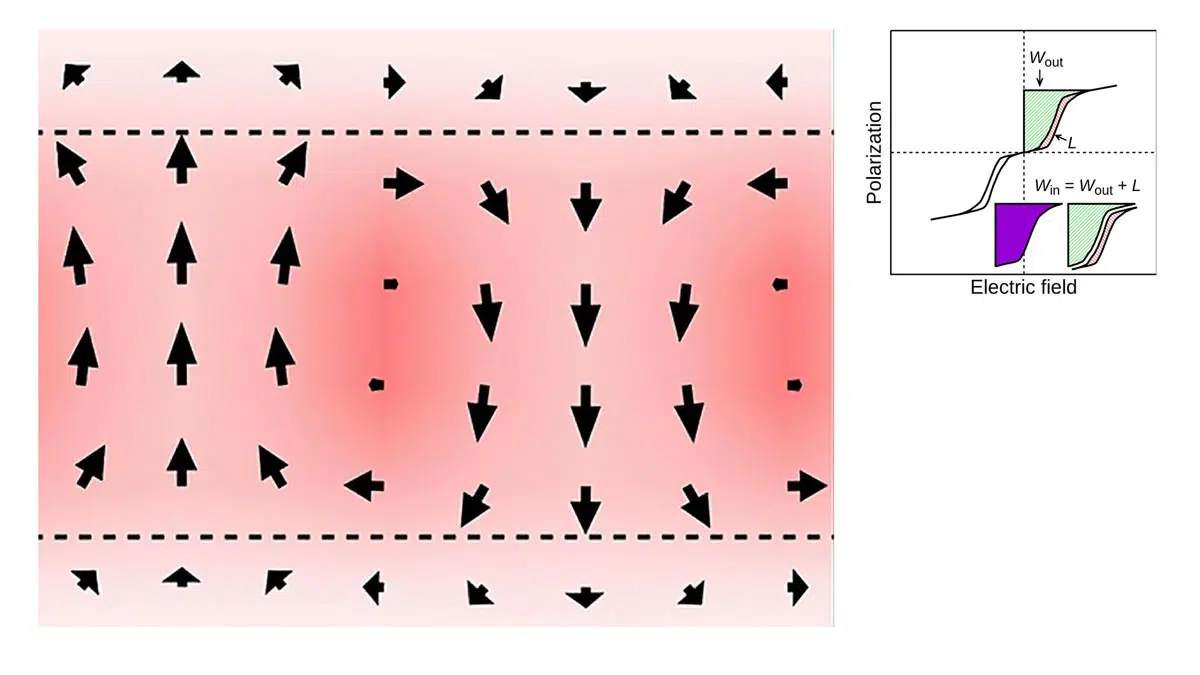
In artificial antiferroelectric structures, electric dipoles are normally arranged in ways that lead to zero electric polarization. Source: Luxembourg Institute of Science and Technology

In artificial antiferroelectric structures, electric dipoles are normally arranged in ways that lead to zero electric polarization. Source: Luxembourg Institute of Science and Technology

Scientists from Luxemberg Institute of Science and Technology have developed new “superlattices” that might help build next generation of high energy density capacitors as small as one-hundredth the size of conventional ones.

Since capacitor energy density is somewhat low, they are difficult to miniaturize. Antiferroelectric dielectric materials could help solve this problem. Like magnets, which possess north and south poles, electric charges within materials become separated into positive and negative poles. Antiferroelectrics are materials in which these “electric dipoles” are generally oriented in opposing directions, leading to an overall zero electric polarization. However, when antiferroelectrics are exposed to a strong enough electric field, they can switch to become highly polarized, resulting in large energy densities.

RelatedPosts

Researchers Propose New Lead-Free Antiferroelectric Material for High Energy Capacitors

Researchers Introduced New NBST-based Ferroelectric Dielectric Material with Excellent Energy Storage Performance

Low Curie Temperature Materials, The Next Generation of High Energy Density Ceramic Dielectrics?

“Capacitors made out of antiferroelectrics could be much smaller than conventional ones, which would help to miniaturize electronic circuitry,” says Hugo Aramberri, a materials physicist at the Luxembourg Institute of Science and Technology.

However, relatively few natural antiferroelectric materials are known. In a new study, Aramberri and his colleagues sought to engineer artificial structures that could act like antiferroelectrics.

The scientists turned to ferroelectric and paraelectric materials. Ferroelectrics are materials in which the electric dipoles are all normally oriented in the same direction, resulting in electric polarization. In contrast, paraelectrics are materials in which the electric dipoles align only in the presence of an electric field.

The team then constructed superlattices made of ferroelectric lead titanate (PbTiO3) and paraelectric strontium titanate (SrTiO3). The superlattices are called such because the lead titanate and strontium titanate, themselves arrayed in lattice structures, are also placed in thin, alternating layers with each other.

The scientists sought to optimize their energy storage densities and energy release efficiencies at room temperature by experimenting with different features of the materials, including layer thicknesses, layer stiffnesses, and the strain that layers might feel from the foundations on which they rested.
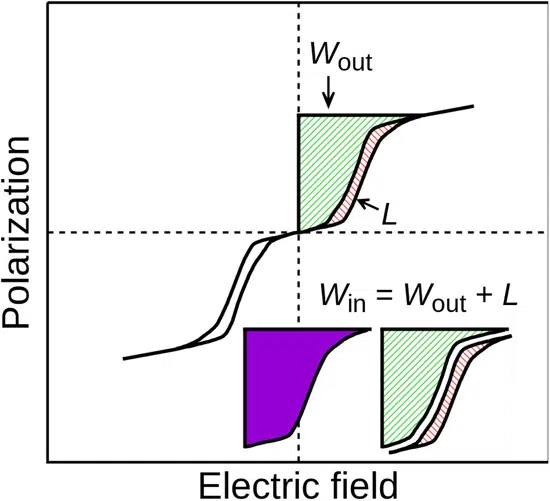
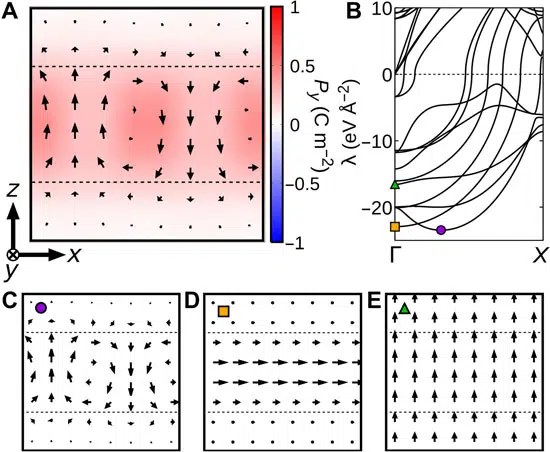
Fig. 1. Energy storage in P-ε loops. The energy density required to charge the system (Win) is equal to the recovered energy density upon discharge (Wout) plus the loss (L). Energy densities are proportional to areas in P-ε diagrams.
Fig. 2. Phonon instabilities and ground state of the (PbTiO3)4/(SrTiO3)4 superlattice. (A) Lowest energy state of the (PbTiO3)4/(SrTiO3)4 superlattice. (B) Phonon instabilities of the high-symmetry (PbTiO3)4/(SrTiO3)4 superlattice (in which the atoms in the PbTiO3 and SrTiO3 layers are in the cubic phase) along the Γ-X direction. The eigenvectors of the leading instability (purple circle) and two relevant polar instabilities (orange square and green triangle) are shown in (C) to (E). (C to E) The eigenvectors for the phonons marked with the corresponding symbols in (B). In (A) and (C) to (E), the arrows indicate the atomic dipoles, and the out-of-screen component of the dipoles is color-coded according to the scale shown in (A).
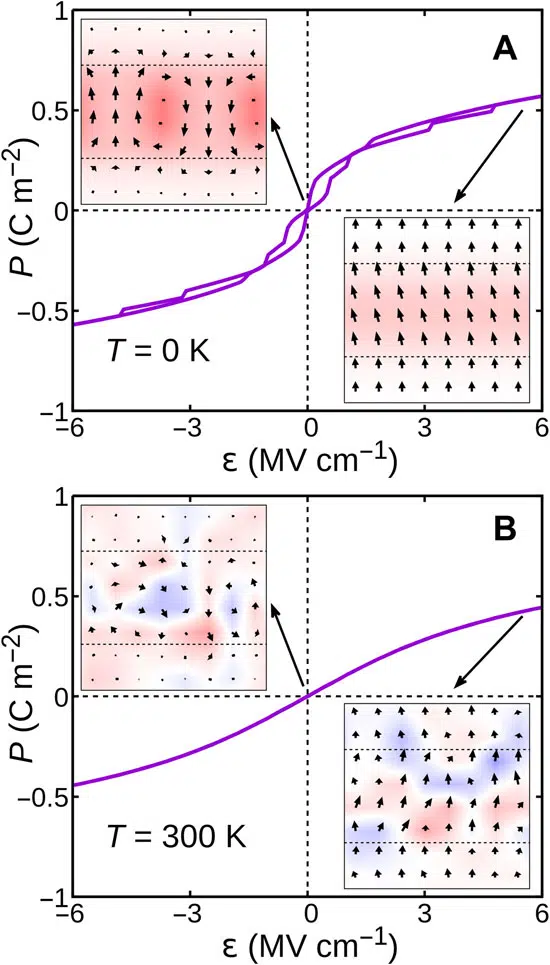
Fig. 3. Representative P-ε diagrams of PbTiO3/SrTiO3 superlattices at different temperatures.(A and B) Results at 0 K and room temperature, respectively. The insets in (A) show the polarization state at zero field and at saturation. The insets in (B) show representative snapshots of the system at zero field and at saturation. The color scale for the polarization component perpendicular to the paper is that of Fig. 2A.

In simulations, the scientists found their best superlattice could store more than 110 joules per cubic centimeter, given an electric field of 3.5 megavolts per centimeter. This was better than nearly all known antiferroelectric capacitors at that field strength. It was only surpassed by a complex perovskite solid solution that displayed 154 joules per cubic centimeter at 3.5 megavolts per centimeter, currently the record-highest energy density at that field strength.

“Conventional capacitors have energy storing densities that are more than 100 times smaller than the ones we predict for some of the artificial antiferroelectrics in the study,” Aramberri says. “This means that our superlattices could potentially be used to create capacitors with volumes 100 times smaller than the conventional ones.”

Aramberri notes there are factors other than energy density that one must consider when choosing a capacitor, such as its power density. “These deserve further investigation to assess the viability of our superlattices for commercial use,” he says.

He also cautions the lattices they examine contain lead, whose poisonous nature strongly limits its technological applications.

“Still, we believe our work provides a proof-of-concept that artificial antiferroelectrics can be tailor-made out of ferroelectrics and paraelectrics, and this idea is not intrinsically tied to the particular materials chosen for the building blocks,” Aramberri says.

All in all, these new findings suggest that “for many practical purposes, we may be able to use tailor-made artificial antiferroelectrics instead of intrinsic antiferroelectrics,” Aramberri says.

The next step “would be to test our simulations in real samples,” Aramberri says. “It would be interesting to measure other properties, like how much voltage they can withstand, their endurance in long-term use, and ultimately commercial viability. The latter relies partly on scalable and inexpensive fabrication techniques of high-quality oxide superlattices, which are not fully developed yet.”

The scientists detailed their findings in the journal Science Advances.
Related

Source: Luxemberg Institute of Science and Technology

Recent Posts

Würth Elektroniks Flexible EMI Shielding Sheets Provides Quick and Easy Schielding Solution

17.6.2026
10

Ultrahigh Energy Storage in Lead‑Free BiFeO₃‑Based Ceramic Capacitors via Local Polar Structure Design

16.6.2026
23

Imec Presents High-density MIMCAP RF interposer for III-V chiplets

15.6.2026
43

All‑Water Supercapacitor Based on 1‑nm Clay Channels and Nanoconfined Water Electrolyte

10.6.2026
42

Why Isolated DC/DC Power Supplies Fail Late, Würth Elektronik Podcast

8.6.2026
62

Designing 800 V DC EMC Filters: Calculation, Simulation and Measurement

4.6.2026
113

Passive Components Enable Safe and Reliable ADAS Architectures

28.5.2026
83

Current Sense Transformer Datasheet and Design‑in Guide

27.5.2026
110

Designing a USB Type‑C Flyback Planar Transformer with Frenetic’s Planar Tool

27.5.2026
47

Upcoming Events

Jul 14
16:00 - 17:00 CEST

EMC Design Essentials: Mastering Varistors and Common Mode Chokes

Jul 21
16:00 - 17:00 CEST

Safety by design: X and Y Interference suppression capacitors for power line filters

View Calendar

Popular Posts

  • Boost Converter Design and Calculation

    0 shares
    Share 0 Tweet 0
  • Buck Converter Design and Calculation

    0 shares
    Share 0 Tweet 0
  • LLC Resonant Converter Design and Calculation

    0 shares
    Share 0 Tweet 0
  • Flyback Converter Design and Calculation

    0 shares
    Share 0 Tweet 0
  • MLCC and Ceramic Capacitors

    0 shares
    Share 0 Tweet 0
  • Earthing Systems and IEC Classification Explained

    0 shares
    Share 0 Tweet 0
  • SEPIC Converter Design and Calculation

    0 shares
    Share 0 Tweet 0
  • Dual Active Bridge (DAB) Topology

    0 shares
    Share 0 Tweet 0
  • What Electronics Engineer Needs to Know About Passive Low Pass Filters

    0 shares
    Share 0 Tweet 0
  • MLCC Case Sizes Standards Explained

    0 shares
    Share 0 Tweet 0

Newsletter Subscription


Passive Components Blog

© EPCI - Leading Passive Components Educational and Information Site

  • Home
  • Privacy Policy
  • EPCI Membership & Advertisement
  • About

No Result
View All Result
  • Home
  • Knowledge Blog
  • Dossiers
  • PCNS

© EPCI - Leading Passive Components Educational and Information Site

This website uses cookies. By continuing to use this website you are giving consent to cookies being used. Visit our Privacy and Cookie Policy.
Go to mobile version