


Passive Components Blog
No Result
View All Result
  • Home
  • NewsFilter
    • All
    • Aerospace & Defence
    • Antenna
    • Applications
    • Automotive
    • Capacitors
    • Circuit Protection Devices
    • electro-mechanical news
    • Filters
    • Fuses
    • Inductors
    • Industrial
    • Integrated Passives
    • inter-connect news
    • Market & Supply Chain
    • Market Insights
    • Medical
    • Modelling and Simulation
    • New Materials & Supply
    • New Technologies
    • Non-linear Passives
    • Oscillators
    • Passive Sensors News
    • Resistors
    • RF & Microwave
    • Telecommunication
    • Weekly Digest

    KYOCERA AVX Introduces Traction‑Grade DC Link Film Capacitors

    When More Capacitance Hurts Reliability: The Role of the Metallic Skeleton in Tantalum Anodes

    Why Power Inductors Use a Ferrite Core With an Air Gap

    Wk 16 Electronics Supply Chain Digest

    YAGEO Introduces High‑Current Y2/X1 Film Capacitors for Wide-bandgap Power Systems

    Amphenol Explanded Liquid Cooling Connectors for AI, ESS and EV Systems

    Hirose Introduced BGA connector for PCIe Gen6 for AI and Edge Computing

    YAGEO Introduces High Rel MLCCs Beyond MIL-Spec Limits

    Würth Elektronik Expanded Capacity for Validation and Services in Asia

    Trending Tags

    • Ripple Current
    • RF
    • Leakage Current
    • Tantalum vs Ceramic
    • Snubber
    • Low ESR
    • Feedthrough
    • Derating
    • Dielectric Constant
    • New Products
    • Market Reports
  • VideoFilter
    • All
    • Antenna videos
    • Capacitor videos
    • Circuit Protection Video
    • Filter videos
    • Fuse videos
    • Inductor videos
    • Inter-Connect Video
    • Non-linear passives videos
    • Oscillator videos
    • Passive sensors videos
    • Resistor videos

    Why Power Inductors Use a Ferrite Core With an Air Gap

    Transformer-Based Power-Line Harvester Magnetic Design

    Thermal Modeling of Magnetics

    Standard vs Planar LLC transformers Comparison for Battery Chargers

    How Modern Tools Model Magnetic Components for Power Electronics

    Advanced Loss Modeling for Planar Magnetics in the Frenetic Planar Tool

    2026 Power Magnetics Design Trends: Flyback, DAB and Planar

    Enabling Software‑Defined Vehicle Architectures: Automotive Ethernet and Zonal Smart Power

    Calculating Resistance Value of a Flyback RC Snubber 

    Trending Tags

    • Capacitors explained
    • Inductors explained
    • Resistors explained
    • Filters explained
    • Application Video Guidelines
    • EMC
    • New Products
    • Ripple Current
    • Simulation
    • Tantalum vs Ceramic
  • Knowledge Blog
  • DossiersNew
  • Suppliers
    • Who is Who
  • PCNS
    • PCNS 2025
    • PCNS 2023
    • PCNS 2021
    • PCNS 2019
    • PCNS 2017
  • Events
  • Home
  • NewsFilter
    • All
    • Aerospace & Defence
    • Antenna
    • Applications
    • Automotive
    • Capacitors
    • Circuit Protection Devices
    • electro-mechanical news
    • Filters
    • Fuses
    • Inductors
    • Industrial
    • Integrated Passives
    • inter-connect news
    • Market & Supply Chain
    • Market Insights
    • Medical
    • Modelling and Simulation
    • New Materials & Supply
    • New Technologies
    • Non-linear Passives
    • Oscillators
    • Passive Sensors News
    • Resistors
    • RF & Microwave
    • Telecommunication
    • Weekly Digest

    KYOCERA AVX Introduces Traction‑Grade DC Link Film Capacitors

    When More Capacitance Hurts Reliability: The Role of the Metallic Skeleton in Tantalum Anodes

    Why Power Inductors Use a Ferrite Core With an Air Gap

    Wk 16 Electronics Supply Chain Digest

    YAGEO Introduces High‑Current Y2/X1 Film Capacitors for Wide-bandgap Power Systems

    Amphenol Explanded Liquid Cooling Connectors for AI, ESS and EV Systems

    Hirose Introduced BGA connector for PCIe Gen6 for AI and Edge Computing

    YAGEO Introduces High Rel MLCCs Beyond MIL-Spec Limits

    Würth Elektronik Expanded Capacity for Validation and Services in Asia

    Trending Tags

    • Ripple Current
    • RF
    • Leakage Current
    • Tantalum vs Ceramic
    • Snubber
    • Low ESR
    • Feedthrough
    • Derating
    • Dielectric Constant
    • New Products
    • Market Reports
  • VideoFilter
    • All
    • Antenna videos
    • Capacitor videos
    • Circuit Protection Video
    • Filter videos
    • Fuse videos
    • Inductor videos
    • Inter-Connect Video
    • Non-linear passives videos
    • Oscillator videos
    • Passive sensors videos
    • Resistor videos

    Why Power Inductors Use a Ferrite Core With an Air Gap

    Transformer-Based Power-Line Harvester Magnetic Design

    Thermal Modeling of Magnetics

    Standard vs Planar LLC transformers Comparison for Battery Chargers

    How Modern Tools Model Magnetic Components for Power Electronics

    Advanced Loss Modeling for Planar Magnetics in the Frenetic Planar Tool

    2026 Power Magnetics Design Trends: Flyback, DAB and Planar

    Enabling Software‑Defined Vehicle Architectures: Automotive Ethernet and Zonal Smart Power

    Calculating Resistance Value of a Flyback RC Snubber 

    Trending Tags

    • Capacitors explained
    • Inductors explained
    • Resistors explained
    • Filters explained
    • Application Video Guidelines
    • EMC
    • New Products
    • Ripple Current
    • Simulation
    • Tantalum vs Ceramic
  • Knowledge Blog
  • DossiersNew
  • Suppliers
    • Who is Who
  • PCNS
    • PCNS 2025
    • PCNS 2023
    • PCNS 2021
    • PCNS 2019
    • PCNS 2017
  • Events
No Result
View All Result
Passive Components Blog
No Result
View All Result

Samsung MLCCs Lineup for In-Vehicle Infotainment

4.9.2025
Reading Time: 5 mins read
A A

This article presents Samsung Electro-Mechanics’ lineup of compact, high-capacitance, low-ESL Multi-Layer Ceramic Capacitors (MLCCs) optimized for modern IVI architectures.

In-Vehicle Infotainment (IVI) systems are evolving beyond basic driving information displays to fully integrated entertainment and connectivity hubs. As high-resolution multi-display setups, V2X communication links, and advanced driver-and-passenger features become standard, processors demand rapid power-noise suppression and stable voltage rails under fast current transients.

RelatedPosts

Samsung Introduces Ultra-High-Voltage 1500 V MLCCs for xEV Powertrains

Samsung Presents MLCC Selection Guide for Humanoids and Robotic Applications

Samsung Introduces 35V MLCCs Flying Capacitors for USB PD Fast Charging

Advanced Driver Assistance Systems (ADAS) and autonomous driving technologies have redefined in-car electronics. IVI platforms now handle up to eight simultaneous high-resolution displays, Wi-Fi, Bluetooth, emergency call services, and vehicle-to-everything (V2X) communication. These complex tasks require System-on-Chips (SoCs) with high computing throughput and stringent power-integrity demands.

In-Vehicle Infotainment IVI Technology Trends

  • Expansion from single driving-status displays to multi-monitor entertainment and passenger interfaces
  • Integration of V2X, emergency call, Wi-Fi, and Bluetooth networks
  • Increasing reliance on real-time driver monitoring and voice-recognition engines
  • Greater graphics throughput and low-latency data processing

MLCC Requirements for IVI

As IVI processors scale performance:

  1. Miniaturization becomes critical to accommodate more decoupling capacitors in limited PCB real estate.
  2. High capacitance per footprint ensures stable supply during rapid load changes.
  3. Low equivalent series inductance (ESL) is essential for suppressing high-frequency noise on SoC power rails.
  4. Automotive-grade reliability (AEC-Q200) guarantees operation across temperature and vibration extremes.

Proposed MLCC Solutions

Miniaturized, High-Capacitance MLCCs for IVI Head-Units and Displays
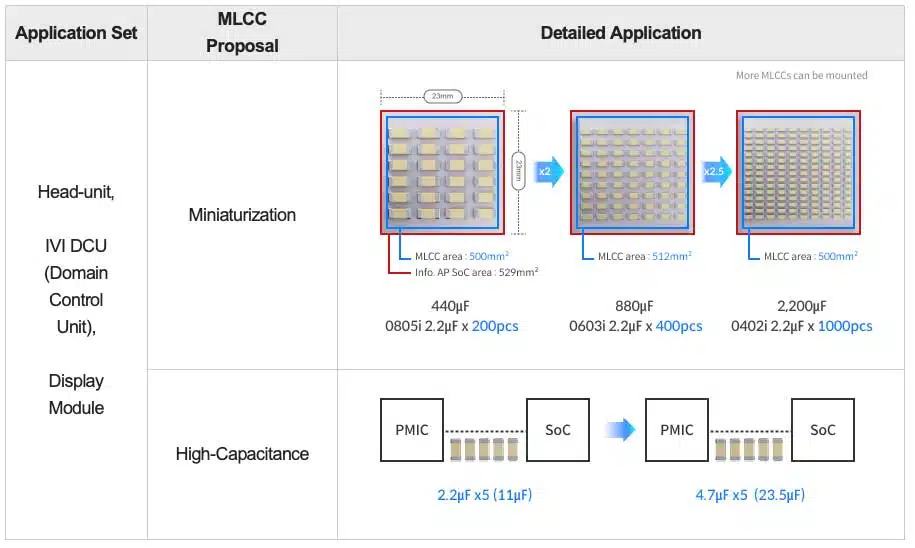
Samsung Electro-Mechanics offers three dielectric series tailored for IVI:

SeriesDielectricFootprintsCapacitance RangeVoltage RatingsProduction Status
X6SX6S (AEC-Q200)0201, 04021 nF – 100 µF10 Vdc – 25 VdcMass Production
X5RX5R (AEC-Q200)0201, 04021 nF – 100 µF6.3 Vdc – 35 VdcMass Production
C0GC0G (AEC-Q200)0201, 040210 pF – 33 nF50 Vdc – 100 VdcMass Production

These MLCCs enable tighter power-rail decoupling around CPU cores and GPUs, maintaining low impedance from DC to hundreds of megahertz.

Low-ESL MLCCs for High-Performance SoCs
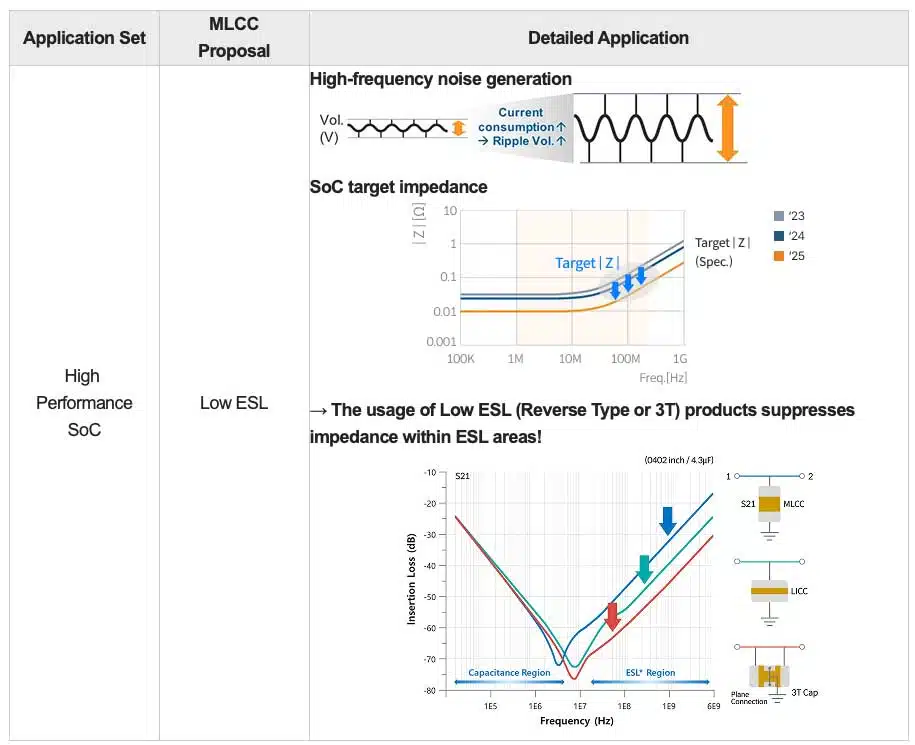
To address fast switching currents and high-frequency noise, Samsung Electro-Mechanics introduces two low-ESL designs:

TypeConstructionFootprintsCapacitanceVoltageStatus
Reverse Type2-Terminal0204 (0.22 mm), 0510 (0.30 mm), 0.53 mm47 nF, 1 µF, 2.2 µF2.5 V – 50 VMass Production & Under Development
3-Terminal3-Terminal (3T)0402 /1005 (0.50 mm), 0603 /1608 (0.70 mm), 1.35 mm4.3 µF, 10 µF, 4.7 µF2.5 V – 16 VMass Production & Under Development

These low-ESL MLCCs push the self-resonant frequency higher, sharply reducing impedance in the MHz-to-GHz region and ensuring SoC target-impedance requirements are met.

Technology Highlights

Samsung’s IVI-optimized MLCC portfolio leverages:

  • Proprietary fine-particle ceramic dielectrics for maximized volumetric efficiency
  • Advanced electrode materials to boost capacitance density
  • Ultra-precision wafer stacking to achieve sub-0.2 mm thickness and consistent ESL performance
  • Full AEC-Q200 qualification for automotive temperature and mechanical stress resilience

Detailed Product Lineup

Part NumberCategorySize (inch/mm)CapacitanceDielectricRated VoltageSamples & Data Sheet
CL03C220JB31IN#Infotainment0201 / 060322 pFC0G50 VdcAvailable
CL03A105MOR1IN#Infotainment0201 / 06031 µFX5R16 VdcAvailable
CL03X105MPR1IN#Infotainment0201 / 06031 µFX6S10 VdcAvailable
CL05C102JB51IN#Infotainment0402 / 10051 nFC0G50 VdcAvailable
CL05A475MPQ1IN#Infotainment0402 / 10054.7 µFX5R10 VdcAvailable
CL05X475MQQ1IN#Infotainment0402 / 10054.7 µFX6S6.3 VdcAvailable
CLL5Z225MS21PN#Low ESL (Reverse)0204 / 05102.2 µFX7T2.5 VdcAvailable
CLL5Z105MR41PN#Low ESL (Reverse)0204 / 05101 µFX7T4 VdcAvailable
CL05Z105MR41PT#Low ESL (3T)0402 / 10051 µFX7T4 VdcAvailable

Conclusion

Compact, high-capacitance, and low-ESL MLCCs are critical enablers for next-generation IVI systems. Samsung Electro-Mechanics’ proprietary materials and precision stacking technologies deliver automotive-grade components that support multi-display configurations, V2X communication, and high-frequency SoC decoupling.

For inquiries, documentation, or samples, please contact your Samsung Electro-Mechanics representative or submit requests through our product portal.

All listed MLCCs are AEC-Q200 qualified for automotive Infotainment applications.

Related

Source: Samsung Electro-Mechanics

Recent Posts

KYOCERA AVX Introduces Traction‑Grade DC Link Film Capacitors

21.4.2026
3

When More Capacitance Hurts Reliability: The Role of the Metallic Skeleton in Tantalum Anodes

20.4.2026
16

YAGEO Introduces High‑Current Y2/X1 Film Capacitors for Wide-bandgap Power Systems

17.4.2026
15

YAGEO Introduces High Rel MLCCs Beyond MIL-Spec Limits

16.4.2026
42

Samsung Introduces Ultra-High-Voltage 1500 V MLCCs for xEV Powertrains

16.4.2026
21

YAGEO Q1 2026 Results: AI Servers and Pricing Power Behind a Moderate Q2 Outlook

16.4.2026
61

YAGEO Releases Ferrite Shielded Power Inductors for High‑Density Designs

15.4.2026
14

Samsung Presents MLCC Selection Guide for Humanoids and Robotic Applications

15.4.2026
28

AI-Assisted Structural Diagnostics and Physics-Based Reliability Interpretation of Tantalum Capacitor Anodes

14.4.2026
31

Upcoming Events

Apr 21
16:00 - 17:00 CEST

Heatsink Solutions: Thermal Management in electronic devices

Apr 22
17:00 - 17:30 CEST

Magnetics in a high frequency GaN era

Apr 22
17:00 - 18:00 CEST

Derating Tantalum, Film, and Ceramic Capacitors

View Calendar

Popular Posts

  • Buck Converter Design and Calculation

    0 shares
    Share 0 Tweet 0
  • Boost Converter Design and Calculation

    0 shares
    Share 0 Tweet 0
  • Flyback Converter Design and Calculation

    0 shares
    Share 0 Tweet 0
  • LLC Resonant Converter Design and Calculation

    0 shares
    Share 0 Tweet 0
  • Dual Active Bridge (DAB) Topology

    0 shares
    Share 0 Tweet 0
  • MLCC and Ceramic Capacitors

    0 shares
    Share 0 Tweet 0
  • Capacitor Charging and Discharging

    0 shares
    Share 0 Tweet 0
  • Ripple Current and its Effects on the Performance of Capacitors

    3 shares
    Share 3 Tweet 0
  • MLCC Case Sizes Standards Explained

    0 shares
    Share 0 Tweet 0
  • Plastic Materials Dielectric Constant and DF

    4 shares
    Share 4 Tweet 0

Newsletter Subscription


Passive Components Blog

© EPCI - Leading Passive Components Educational and Information Site

  • Home
  • Privacy Policy
  • EPCI Membership & Advertisement
  • About

No Result
View All Result
  • Home
  • Knowledge Blog
  • PCNS

© EPCI - Leading Passive Components Educational and Information Site

This website uses cookies. By continuing to use this website you are giving consent to cookies being used. Visit our Privacy and Cookie Policy.
Go to mobile version