













Passive Components Blog
No Result
View All Result
  • Home
  • News
    • All
    • Aerospace & Defence
    • Antenna
    • Applications
    • Automotive
    • Capacitors
    • Circuit Protection Devices
    • electro-mechanical news
    • Filters
    • Fuses
    • Inductors
    • Industrial
    • Integrated Passives
    • inter-connect news
    • Market & Supply Chain
    • Market Insights
    • Medical
    • Modelling and Simulation
    • New Materials & Supply
    • New Technologies
    • Non-linear Passives
    • Oscillators
    • Passive Sensors News
    • Resistors
    • RF & Microwave
    • Telecommunication
    • Weekly Digest

    Samsung MLCC Revenue Seen Above KRW 8T by 2027, Murata EOL Actions Reshape Supply

    ROHM SDR01 high anti-surge thick-film chip resistor in 1005 metric 0402 package with 0.33 W rated power

    ROHM Introduces Anti-Surge 0402 Resistors Rated at 0.33 W

    ECIA Industry Pulse Q3 2026 chart showing passive components, semiconductors and electro-mechanical component market sentiment and lead-time pressure

    ECIA Industry Pulse Moderates as Passive Lead Times Tighten

    LG Innotek Demonstrates FC-BGA Substrates With Embedded Silicon Capacitors for AI Power Delivery

    On-Chip 3D-Printed Copper Microinductors: A New Route to Compact RF Electronics

    Emerging Capacitor Markets in Fusion Energy

    Murata DLW32SH_MF 1210 surface-mount common mode choke coil with metal terminals for automotive CAN FD signal-line noise suppression

    Murata Introduces Common Mode Chokes for Automotive CAN FD up to 150°C

    onsemi solid-state transformer concept for 800 V HVDC AI data center power conversion with SiC modules, DC-link capacitors and high-frequency magnetics

    Solid-State Transformers for 800 V AI Data Centers: Passive Component Design Considerations

    Littelfuse TX00AT314AMA omnipolar TMR magnetic switch sensor in a leaded TO-92-3 through-hole package

    Littelfuse Expands Omnipolar TMR Switch with Leaded TO-92 Package Option

    Trending Tags

    • Ripple Current
    • RF
    • Leakage Current
    • Tantalum vs Ceramic
    • Snubber
    • Low ESR
    • Feedthrough
    • Derating
    • Dielectric Constant
    • New Products
    • Market Reports
  • Knowledge Blog
  • Dossiers
    • AI Hardware Dossier
    • Automotive Dossier
    • Industrial Robotics Dossier
    • Power Converter Dossier
    • Capacitor Dossier
    • Resistor Dossier
    • Inductor Dossier
    • Circuit Protection Dossier
  • Suppliers
    • Who is Who
  • PCNS
    • PCNS 2025
    • PCNS 2023
    • PCNS 2021
    • PCNS 2019
    • PCNS 2017
  • Events
  • Home
  • News
    • All
    • Aerospace & Defence
    • Antenna
    • Applications
    • Automotive
    • Capacitors
    • Circuit Protection Devices
    • electro-mechanical news
    • Filters
    • Fuses
    • Inductors
    • Industrial
    • Integrated Passives
    • inter-connect news
    • Market & Supply Chain
    • Market Insights
    • Medical
    • Modelling and Simulation
    • New Materials & Supply
    • New Technologies
    • Non-linear Passives
    • Oscillators
    • Passive Sensors News
    • Resistors
    • RF & Microwave
    • Telecommunication
    • Weekly Digest

    Samsung MLCC Revenue Seen Above KRW 8T by 2027, Murata EOL Actions Reshape Supply

    ROHM SDR01 high anti-surge thick-film chip resistor in 1005 metric 0402 package with 0.33 W rated power

    ROHM Introduces Anti-Surge 0402 Resistors Rated at 0.33 W

    ECIA Industry Pulse Q3 2026 chart showing passive components, semiconductors and electro-mechanical component market sentiment and lead-time pressure

    ECIA Industry Pulse Moderates as Passive Lead Times Tighten

    LG Innotek Demonstrates FC-BGA Substrates With Embedded Silicon Capacitors for AI Power Delivery

    On-Chip 3D-Printed Copper Microinductors: A New Route to Compact RF Electronics

    Emerging Capacitor Markets in Fusion Energy

    Murata DLW32SH_MF 1210 surface-mount common mode choke coil with metal terminals for automotive CAN FD signal-line noise suppression

    Murata Introduces Common Mode Chokes for Automotive CAN FD up to 150°C

    onsemi solid-state transformer concept for 800 V HVDC AI data center power conversion with SiC modules, DC-link capacitors and high-frequency magnetics

    Solid-State Transformers for 800 V AI Data Centers: Passive Component Design Considerations

    Littelfuse TX00AT314AMA omnipolar TMR magnetic switch sensor in a leaded TO-92-3 through-hole package

    Littelfuse Expands Omnipolar TMR Switch with Leaded TO-92 Package Option

    Trending Tags

    • Ripple Current
    • RF
    • Leakage Current
    • Tantalum vs Ceramic
    • Snubber
    • Low ESR
    • Feedthrough
    • Derating
    • Dielectric Constant
    • New Products
    • Market Reports
  • Knowledge Blog
  • Dossiers
    • AI Hardware Dossier
    • Automotive Dossier
    • Industrial Robotics Dossier
    • Power Converter Dossier
    • Capacitor Dossier
    • Resistor Dossier
    • Inductor Dossier
    • Circuit Protection Dossier
  • Suppliers
    • Who is Who
  • PCNS
    • PCNS 2025
    • PCNS 2023
    • PCNS 2021
    • PCNS 2019
    • PCNS 2017
  • Events
No Result
View All Result
Passive Components Blog
No Result
View All Result

Stretchable Micro-Supercapacitors to Self-Power Wearable Devices

14.12.2020
Reading Time: 3 mins read
A A
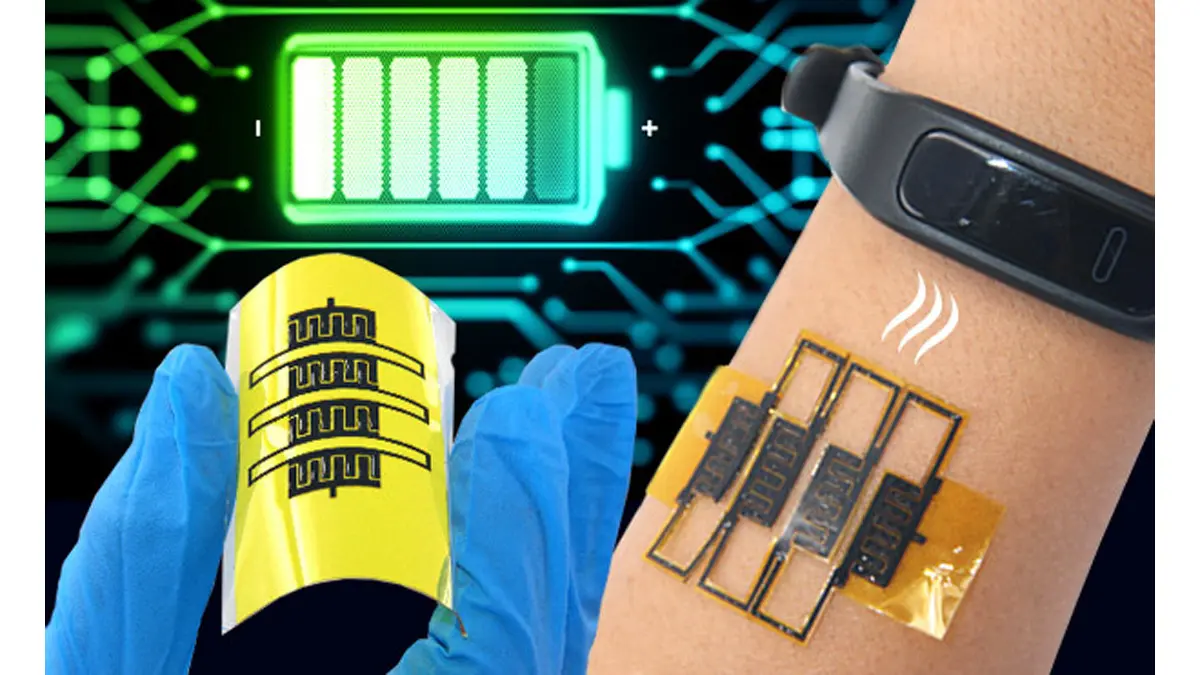
A team of international researchers, led by Huanyu “Larry” Cheng, Dorothy Quiggle Career Development Professor in Penn State's Department of Engineering Science and Mechanics, has developed a self-powered, stretchable system that will be used in wearable health-monitoring and diagnostic devices.
IMAGE: Penn State College of Engineering

A team of international researchers, led by Huanyu “Larry” Cheng, Dorothy Quiggle Career Development Professor in Penn State's Department of Engineering Science and Mechanics, has developed a self-powered, stretchable system that will be used in wearable health-monitoring and diagnostic devices. IMAGE: Penn State College of Engineering

A stretchable system that can harvest energy from human breathing and motion for use in wearable health-monitoring devices may be possible, according to an international team of researchers, led by Huanyu “Larry” Cheng, Dorothy Quiggle Career Development Professor in Penn State’s Department of Engineering Science and Mechanics.

The research team, with members from Penn State and Minjiang University and Nanjing University, both in China, recently published its results in Nano Energy. 

RelatedPosts

Samsung MLCC Revenue Seen Above KRW 8T by 2027, Murata EOL Actions Reshape Supply

ROHM Introduces Anti-Surge 0402 Resistors Rated at 0.33 W

ECIA Industry Pulse Moderates as Passive Lead Times Tighten

According to Cheng, current versions of batteries and supercapacitors powering wearable and stretchable health-monitoring and diagnostic devices have many shortcomings, including low energy density and limited stretchability. 

“This is something quite different than what we have worked on before, but it is a vital part of the equation,” Cheng said, noting that his research group and collaborators tend to focus on developing the sensors in wearable devices. “While working on gas sensors and other wearable devices, we always need to combine these devices with a battery for powering. Using micro-supercapacitors gives us the ability to self-power the sensor without the need for a battery.”

An alternative to batteries, micro-supercapacitors are energy storage devices that can complement or replace lithium-ion batteries in wearable devices. Micro-supercapacitors have a small footprint, high power density, and the ability to charge and discharge quickly. However, according to Cheng, when fabricated for wearable devices, conventional micro-supercapacitors have a “sandwich-like” stacked geometry that displays poor flexibility, long ion diffusion distances and a complex integration process when combined with wearable electronics.

This led Cheng and his team to explore alternative device architectures and integration processes to advance the use of micro-supercapacitors in wearable devices. They found that arranging micro-supercapacitor cells in a serpentine, island-bridge layout allows the configuration to stretch and bend at the bridges, while reducing deformation of the micro-supercapacitors — the islands. When combined, the structure becomes what the researchers refer to as “micro-supercapacitors arrays.”

“By using an island-bridge design when connecting cells, the micro-supercapacitor arrays displayed increased stretchability and allowed for adjustable voltage outputs,” Cheng said. “This allows the system to be reversibly stretched up to 100%.”

By using non-layered, ultrathin zinc-phosphorus nanosheets and 3D laser-induced graphene foam — a highly porous, self-heating nanomaterial — to construct the island-bridge design of the cells, Cheng and his team saw drastic improvements in electric conductivity and the number of absorbed charged ions. This proved that these micro-supercapacitor arrays can charge and discharge efficiently and store the energy needed to power a wearable device.

The researchers also integrated the system with a triboelectric nanogenerator, an emerging technology that converts mechanical movement to electrical energy. This combination created a self-powered system.

“When we have this wireless charging module that’s based on the triboelectric nanogenerator, we can harvest energy based on motion, such as bending your elbow or breathing and speaking,” Cheng said. “We are able to use these everyday human motions to charge the micro-supercapacitors.”

By combining this integrated system with a graphene-based strain sensor, the energy-storing micro-supercapacitor arrays — charged by the triboelectric nanogenerators — are able to power the sensor, Cheng said, showing the potential for this system to power wearable, stretchable devices. 

Other researchers on this project were Cheng Zeng, assistant professor; Zhixiang Peng, research assistant; Chao Xing, associate professor; Huaming Chen, associate professor; Chunlei Huang, assistant professor, and Jun Wang, professor, all at Minjiang University; Bingwen Zhang, assistant professor at the Fujian Provincial Key Laboratory of Functional Marine Sensing Materials at Minjiang University; and Shaolong Tang, professor of physics, Nanjing University. 

The National Natural Science Foundation of China; the Educational Commission of Fujian Province for Youths; the U.S. National Science Foundation; the National Heart, Lung, and Blood Institute of the U.S. National Institutes of Health supported this work.


Related

Source: PennState

Recent Posts

Samsung MLCC Revenue Seen Above KRW 8T by 2027, Murata EOL Actions Reshape Supply

11.9.2026
5

LG Innotek Demonstrates FC-BGA Substrates With Embedded Silicon Capacitors for AI Power Delivery

10.9.2026
22

On-Chip 3D-Printed Copper Microinductors: A New Route to Compact RF Electronics

10.9.2026
14

Emerging Capacitor Markets in Fusion Energy

10.9.2026
29
onsemi solid-state transformer concept for 800 V HVDC AI data center power conversion with SiC modules, DC-link capacitors and high-frequency magnetics

Solid-State Transformers for 800 V AI Data Centers: Passive Component Design Considerations

9.9.2026
60
TDK CN series 10 µF 100 V X7R soft-termination multilayer ceramic capacitor in 3225 EIA 1210 package

TDK Releases 100 V Soft-Termination X7R MLCCs 10 uF in 3225 Package

9.9.2026
14
Overview of fabricated ferroelectric capacitors improving hyperdimensional computing task learning accuracy. a The experimental work reported in this study comprises ferroelectric capacitor (FeCAP) device fabrication, structural and electrical characterization, analog state identification and their reliability study. b The computational part of the work explores the benefits of using characteristics from the fabricated devices in a hyperdimensional computing scheme; source: authors

High-Precision Hyperdimensional Computing with Multi-Level Ferroelectric HZO Capacitors

7.9.2026
20

August 2026 Interconnect, Passives and Electromechanical Components Market Insights

4.9.2026
48

Knowles Cornell Dubilier 105C Flatpack Aluminum Electrolytic Capacitors Target Low-Profile High-Density Power Designs

4.9.2026
42

Upcoming Events

Sep 16
17:00 - 18:00 CEST

Designing a 5 kW, 800 V-to-50 V PSFB Converter for Next-Generation Data Centers

Sep 29
16:00 - 17:00 CEST

Cybersecurity 2026

Nov 24
16:00 - 17:00 CET

Component selection with the WE REDEXPERT® DC-DC Converter Designer Tool

View Calendar

Popular Posts

  • Buck Converter Design and Calculation

    0 shares
    Share 0 Tweet 0
  • LLC Resonant Converter Design and Calculation

    0 shares
    Share 0 Tweet 0
  • Boost Converter Design and Calculation

    0 shares
    Share 0 Tweet 0
  • Flyback Converter Design and Calculation

    0 shares
    Share 0 Tweet 0
  • Earthing Systems and IEC Classification Explained

    0 shares
    Share 0 Tweet 0
  • MLCC and Ceramic Capacitors

    0 shares
    Share 0 Tweet 0
  • Resistor Symbols

    0 shares
    Share 0 Tweet 0
  • Capacitor Charging and Discharging

    0 shares
    Share 0 Tweet 0
  • Audio Capacitors: Choosing Capacitors for Crossover Circuits

    0 shares
    Share 0 Tweet 0
  • Thermistors Basics, NTC and PTC Thermistors

    0 shares
    Share 0 Tweet 0

Newsletter Subscription


Passive Components Blog

© 2015–2026
All rights reserved

  • Home
  • Privacy Policy
  • EPCI Membership & Advertisement
  • About

No Result
View All Result
  • Home
  • Knowledge Blog
  • Dossiers
  • PCNS

© 2015–2026
All rights reserved