




Passive Components Blog
No Result
View All Result
  • Home
  • News
    • All
    • Aerospace & Defence
    • Antenna
    • Applications
    • Automotive
    • Capacitors
    • Circuit Protection Devices
    • electro-mechanical news
    • Filters
    • Fuses
    • Inductors
    • Industrial
    • Integrated Passives
    • inter-connect news
    • Market & Supply Chain
    • Market Insights
    • Medical
    • Modelling and Simulation
    • New Materials & Supply
    • New Technologies
    • Non-linear Passives
    • Oscillators
    • Passive Sensors News
    • Resistors
    • RF & Microwave
    • Telecommunication
    • Weekly Digest

    August 2026 Interconnect, Passives and Electromechanical Components Market Insights

    AEM Introduced High-Power Fuses for Compact Automotive and Industrial Overcurrent Protection

    Knowles Cornell Dubilier 105C Flatpack Aluminum Electrolytic Capacitors Target Low-Profile High-Density Power Designs

    Vishay Thin Film Chip Resistors Combine up to 50 GHz Operation with High Power Density

    Samsung Electro-Mechanics Secures KRW 1.0722 Trillion AI Server MLCC Supply Contract

    KYOCERA AVX Adds 0201 C0G RF MLCCs to KGU Ultra-Low-ESR Capacitor Series

    Vishay Extends High-Current Common-Mode Chokes with 30 A EMI Filtering up to 150 °C

    Bourns Copper-Electrode MOV Series Targets High-Energy Line Surge Protection

    Bourns Expands 12 mm SMD Incremental Encoder with Shaft-Length Options for Compact HMI Controls

    Trending Tags

    • Ripple Current
    • RF
    • Leakage Current
    • Tantalum vs Ceramic
    • Snubber
    • Low ESR
    • Feedthrough
    • Derating
    • Dielectric Constant
    • New Products
    • Market Reports
  • Knowledge Blog
  • Dossiers
    • AI Hardware Dossier
    • Automotive Dossier
    • Industrial Robotics Dossier
    • Power Converter Dossier
    • Capacitor Dossier
    • Resistor Dossier
    • Inductor Dossier
    • Circuit Protection Dossier
  • Suppliers
    • Who is Who
  • PCNS
    • PCNS 2025
    • PCNS 2023
    • PCNS 2021
    • PCNS 2019
    • PCNS 2017
  • Events
  • Home
  • News
    • All
    • Aerospace & Defence
    • Antenna
    • Applications
    • Automotive
    • Capacitors
    • Circuit Protection Devices
    • electro-mechanical news
    • Filters
    • Fuses
    • Inductors
    • Industrial
    • Integrated Passives
    • inter-connect news
    • Market & Supply Chain
    • Market Insights
    • Medical
    • Modelling and Simulation
    • New Materials & Supply
    • New Technologies
    • Non-linear Passives
    • Oscillators
    • Passive Sensors News
    • Resistors
    • RF & Microwave
    • Telecommunication
    • Weekly Digest

    August 2026 Interconnect, Passives and Electromechanical Components Market Insights

    AEM Introduced High-Power Fuses for Compact Automotive and Industrial Overcurrent Protection

    Knowles Cornell Dubilier 105C Flatpack Aluminum Electrolytic Capacitors Target Low-Profile High-Density Power Designs

    Vishay Thin Film Chip Resistors Combine up to 50 GHz Operation with High Power Density

    Samsung Electro-Mechanics Secures KRW 1.0722 Trillion AI Server MLCC Supply Contract

    KYOCERA AVX Adds 0201 C0G RF MLCCs to KGU Ultra-Low-ESR Capacitor Series

    Vishay Extends High-Current Common-Mode Chokes with 30 A EMI Filtering up to 150 °C

    Bourns Copper-Electrode MOV Series Targets High-Energy Line Surge Protection

    Bourns Expands 12 mm SMD Incremental Encoder with Shaft-Length Options for Compact HMI Controls

    Trending Tags

    • Ripple Current
    • RF
    • Leakage Current
    • Tantalum vs Ceramic
    • Snubber
    • Low ESR
    • Feedthrough
    • Derating
    • Dielectric Constant
    • New Products
    • Market Reports
  • Knowledge Blog
  • Dossiers
    • AI Hardware Dossier
    • Automotive Dossier
    • Industrial Robotics Dossier
    • Power Converter Dossier
    • Capacitor Dossier
    • Resistor Dossier
    • Inductor Dossier
    • Circuit Protection Dossier
  • Suppliers
    • Who is Who
  • PCNS
    • PCNS 2025
    • PCNS 2023
    • PCNS 2021
    • PCNS 2019
    • PCNS 2017
  • Events
No Result
View All Result
Passive Components Blog
No Result
View All Result

Knowles Cornell Dubilier 105C Flatpack Aluminum Electrolytic Capacitors Target Low-Profile High-Density Power Designs

4.9.2026
Reading Time: 6 mins read
A A

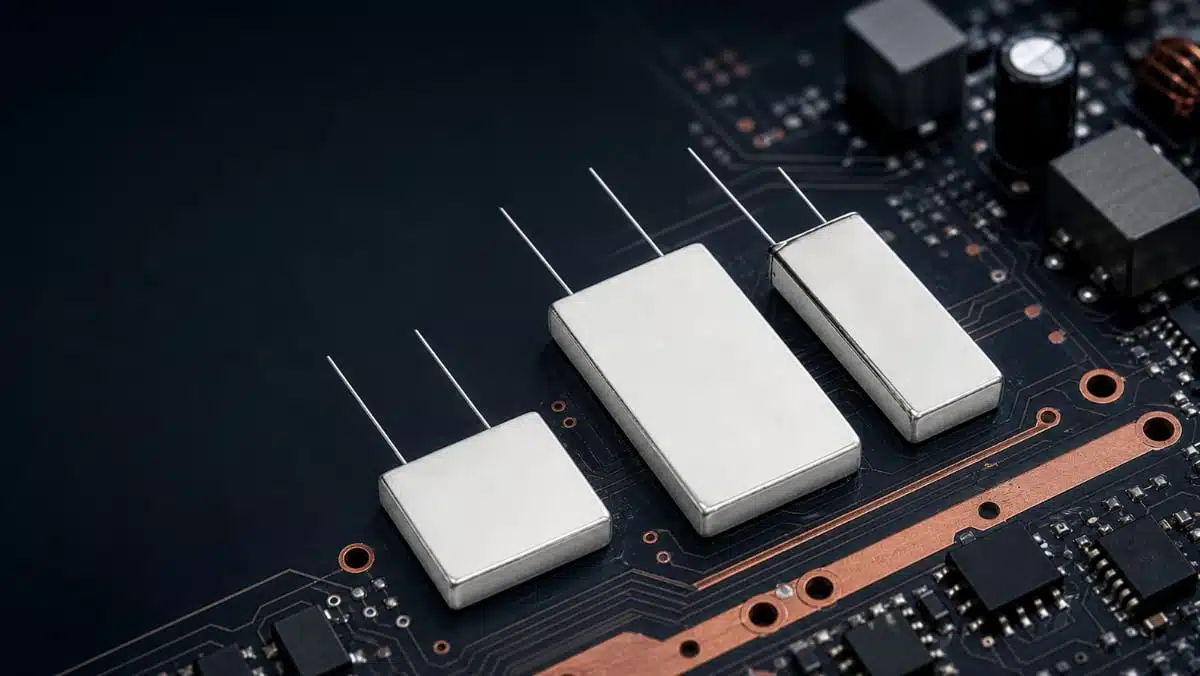
Knowles has expanded its Cornell Dubilier Flatpack™ portfolio with the Type CLS, a 105°C-rated family of prismatic aluminum electrolytic capacitors in stainless-steel cases.

The Knowles CLS series targets applications that need substantial bulk capacitance and ripple-current capability in a low-profile format, but do not require a 125°C temperature rating.

RelatedPosts

Filter Capacitors in Electric Vehicles: Knowles Safety MLCCs for BMS and Isolated DC/DC Converters

Knowles Introduces PP Film Capacitors for High‑Stress Power Electronics

Knowles Presents Pulse Power Capacitors for Demanding MedTech, Industrial and Defense Applications

Key features and benefits

  • 105°C temperature class: The CLS series is rated from -55°C to +105°C, providing a middle option between the existing 85°C MLPS and 125°C MLSG Flatpack™ ranges.
  • High bulk capacitance in a thin package: Rated capacitance spans 150 µF to 83,000 µF, enabling designers to consolidate energy-storage and filtering functions that might otherwise require several parallel capacitors.
  • Voltage ratings up to 300 Vdc: This range supports intermediate-voltage DC buses, bulk storage stages and power-supply filtering where low-profile mechanical integration is critical.
  • 10,000-hour load-life rating: Knowles specifies 10,000 hours at 105°C and rated ripple current. For electrolytic capacitors, this type of rating is especially relevant because operating temperature and ripple-current heating strongly influence useful service life.
  • Stainless-steel Flatpack™ enclosure: The manufacturer identifies the stainless-steel case as a means to improve thermal dissipation while providing a rugged, low-profile package.
  • Reduced interconnect count: A single prismatic capacitor can replace a parallel bank of smaller units, reducing PCB connection points and associated assembly or reliability concerns.
  • High-vibration suitability: The series brief specifies a 10 g standard vibration rating, with 30 g available using the HV design. Knowles also lists operation at altitudes up to 80,000 ft.

Technical highlights

ParameterType CLS specification
Capacitor technologyPrismatic aluminum electrolytic, stainless-steel Flatpack™ case
Rated voltage range10 Vdc to 300 Vdc
Capacitance range150 µF to 83,000 µF
Capacitance tolerance-20% / +20%
Operating temperature-55°C to +105°C
Load life10,000 hours at 105°C and rated ripple current
Ripple-current capabilityUp to 8.67 A at 20 kHz
Profile height12.7 mm
Case width options25.4 mm or 44.45 mm
Case length options25.4 mm to 76.2 mm
Vibration rating10 g standard; 30 g with HV design
Altitude capabilityUp to 80,000 ft

The available catalogue range uses a 12.7 mm height, with multiple case footprints and lead-spacing options. This makes the series relevant where a conventional cylindrical electrolytic capacitor is mechanically unsuitable because of enclosure height, board clearance or packaging constraints.

The CLS family is a polarized aluminum electrolytic capacitor. Its practical advantage is high capacitance density for bulk energy storage; designers must nevertheless respect polarity, voltage limits, ripple-current limits and temperature-dependent lifetime behaviour.

Typical applications

Knowles identifies the CLS series for demanding power-electronics and defence-related systems, including:

  • Military aircraft and airborne electronics
  • Military vessels
  • Ground-based radar equipment
  • Drones and unmanned platforms
  • Missile-defence systems
  • Aircraft radar systems
  • Low-profile, high-density commercial power supplies
  • Mission-critical power conversion and filtering equipment

Application fit

Design requirementWhy CLS may fit
Restricted enclosure heightThe 12.7 mm profile supports flat or densely stacked assemblies
Large bulk capacitance requirementValues up to 83,000 µF can reduce the number of parallel capacitor positions
High ripple-current loadingThe manufacturer specifies up to 8.67 A at 20 kHz; verify the rating for the selected part number and operating conditions
Harsh mechanical environmentStainless-steel packaging and specified vibration capability support mechanically demanding platforms
-55°C start-up environmentThe rated low-temperature limit is suited to systems exposed to severe ambient conditions
Long service expectationThe 10,000-hour 105°C load-life rating provides a defined baseline for lifetime assessment

For DC-bus and bulk-storage functions, the capacitor may act as an energy buffer between a rectified source and a switching load. A DC-link capacitor must be assessed as a circuit element, not only as a capacitance value: allowable ripple current, ESR, thermal path, bus inductance and transient requirements all affect the final design.

Design-in notes for engineers

  • Derive ripple current from the real waveform. The published maximum ripple-current value is a series-level headline figure. Confirm the RMS ripple current, frequency, ambient temperature and permitted temperature rise for the exact CLS part number. See how ripple current affects capacitor performance for the link between ripple current, ESR loss and self-heating.
  • Treat the 10,000-hour load-life figure as a rated-condition value. Lifetime modelling should account for the actual capacitor hot-spot temperature, ripple-current heating and mission profile rather than using the headline duration as a universal system-life value.
  • Check capacitance tolerance at the system minimum. With a -20% / +20% tolerance, hold-up, transient-energy and ripple-voltage calculations should be performed using the minimum specified capacitance.
  • Validate voltage margin and polarity. Use the selected part’s manufacturer documentation to establish appropriate voltage derating, surge behaviour, reverse-polarity protection and fault response for the specific converter topology.
  • Design the thermal interface deliberately. The flat metal enclosure can provide a useful heat-spreading surface, but only if the mechanical arrangement provides a repeatable thermal path to the chassis, airflow or other cooling structure.
  • Evaluate mechanical loading at the assembly level. Verify lead or terminal arrangement, mounting scheme, PCB flexure, vibration direction and any additional restraint required for the mass of the selected capacitor.
  • Qualify the specific ordering code. Catalogue options vary by capacitance, voltage, case dimensions and connection geometry. Final selection should use the current manufacturer datasheet and applicable environmental or system-level qualification plan.

Further reading

  • Aluminum Electrolytic Capacitors
  • DC-Link Capacitors – Design Tips
  • Ripple Current and its Effects on the Performance of Capacitors
  • Capacitor Ripple Current Testing: A Design Consideration

Source

This article is based on the Knowles press release and associated Cornell Dubilier Type CLS manufacturer documentation. Engineers should consult the current manufacturer datasheet and product documentation for final component qualification, application verification and design release.

  1. Knowles press release: New CLS 105°C Flatpack™ Capacitors Expand Knowles’ Cornell Dubilier Product Line
  2. Knowles Cornell Dubilier Type CLS 105°C Stainless Steel Flatpack™ series brief
  3. Knowles Cornell Dubilier prismatic aluminum electrolytic capacitor product finder

Related

Recent Posts

August 2026 Interconnect, Passives and Electromechanical Components Market Insights

4.9.2026
1

AEM Introduced High-Power Fuses for Compact Automotive and Industrial Overcurrent Protection

4.9.2026
2

Vishay Thin Film Chip Resistors Combine up to 50 GHz Operation with High Power Density

3.9.2026
5

Samsung Electro-Mechanics Secures KRW 1.0722 Trillion AI Server MLCC Supply Contract

3.9.2026
26

KYOCERA AVX Adds 0201 C0G RF MLCCs to KGU Ultra-Low-ESR Capacitor Series

3.9.2026
13

Vishay Extends High-Current Common-Mode Chokes with 30 A EMI Filtering up to 150 °C

3.9.2026
8

Bourns Copper-Electrode MOV Series Targets High-Energy Line Surge Protection

1.9.2026
7

Bourns Expands 12 mm SMD Incremental Encoder with Shaft-Length Options for Compact HMI Controls

1.9.2026
7

KEMET HRA X7R High-Reliability MLCCs Target Higher Capacitance in Defense and Aerospace Electronics

1.9.2026
27

Upcoming Events

Sep 10
11:00 - 12:00 CEST

Equipment models and model strategies for Space Missions

Sep 16
17:00 - 18:00 CEST

Designing a 5 kW, 800 V-to-50 V PSFB Converter for Next-Generation Data Centers

Sep 29
16:00 - 17:00 CEST

Cybersecurity 2026

View Calendar

Popular Posts

  • Buck Converter Design and Calculation

    0 shares
    Share 0 Tweet 0
  • LLC Resonant Converter Design and Calculation

    0 shares
    Share 0 Tweet 0
  • Boost Converter Design and Calculation

    0 shares
    Share 0 Tweet 0
  • Earthing Systems and IEC Classification Explained

    0 shares
    Share 0 Tweet 0
  • MLCC and Ceramic Capacitors

    0 shares
    Share 0 Tweet 0
  • Flyback Converter Design and Calculation

    0 shares
    Share 0 Tweet 0
  • Capacitor Charging and Discharging

    0 shares
    Share 0 Tweet 0
  • Audio Capacitors: Choosing Capacitors for Crossover Circuits

    0 shares
    Share 0 Tweet 0
  • Thermistors Basics, NTC and PTC Thermistors

    0 shares
    Share 0 Tweet 0
  • Resistor Symbols

    0 shares
    Share 0 Tweet 0

Newsletter Subscription


Passive Components Blog

© 2015–2026
All rights reserved

  • Home
  • Privacy Policy
  • EPCI Membership & Advertisement
  • About

No Result
View All Result
  • Home
  • Knowledge Blog
  • Dossiers
  • PCNS

© 2015–2026
All rights reserved