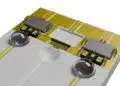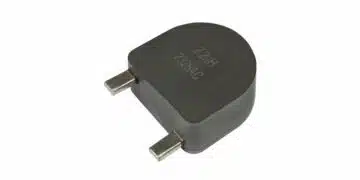




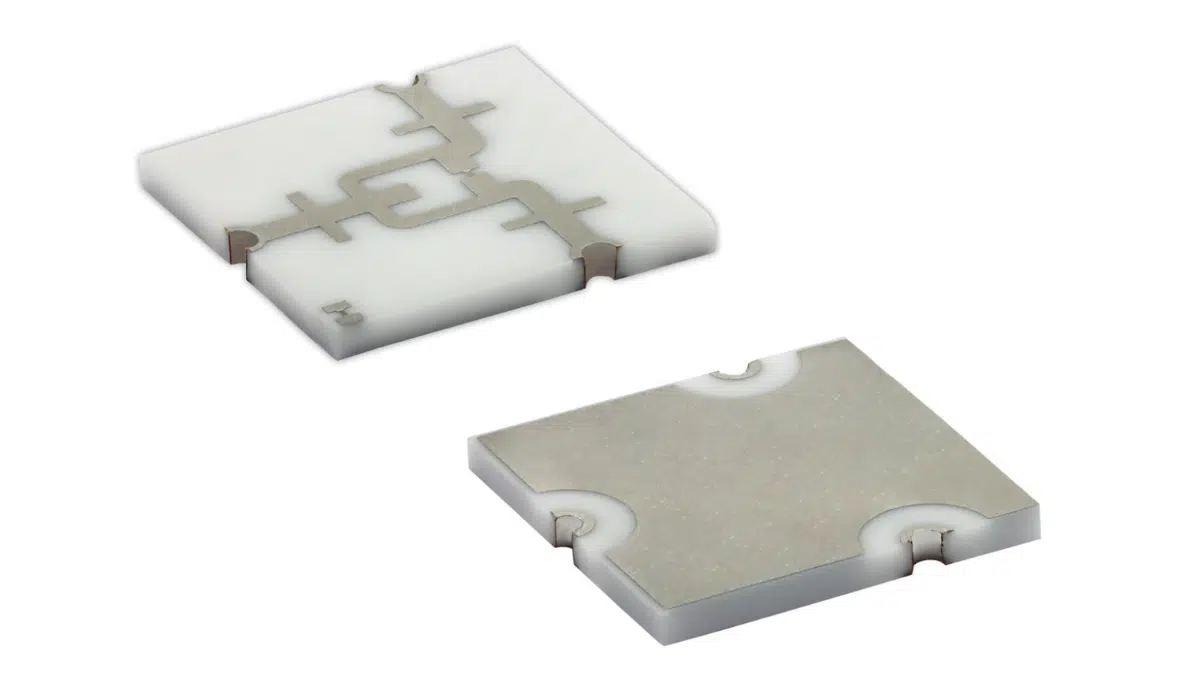
The Vishay Sfernice WLKN‑000 is a 2‑way Wilkinson power divider / combiner designed for 15 GHz to 20 GHz RF front ends in aerospace, defense, automotive, and high‑frequency connectivity applications.
Vishay WLKN Wilkinson power divider combines industry‑low insertion loss with a compact 1817 surface‑mount package, helping designers improve efficiency and save PCB space in demanding microwave systems.
Key features and benefits
Overview of main characteristics
| Parameter / Feature | WLKN‑000 Value / Description |
|---|---|
| Function | 2‑way Wilkinson power divider / combiner |
| Frequency range | 15 GHz to 20 GHz |
| Insertion loss | < 0.5 dB below 19 GHz |
| Return loss | 10 dB to 15 dB over operating band |
| Output‑to‑output isolation | < 20 dB at center frequency |
| Package size | 1817 surface‑mount package |
| Technology | Thin film |
| Temperature range | −55 °C to +155 °C |
| Compliance | RoHS‑compliant, halogen‑free, Vishay Green |
| Customization | Frequency band, return loss, insertion loss, case size, and more |
| Models | HFSS‑encrypted models available |
| Availability | Samples and production, 20‑week lead time |
Practical benefits
- Higher efficiency and better link budget
Low insertion loss (< 0.5 dB below 19 GHz) means less RF power is wasted as heat and more reaches the load or combined port, which is important in power‑constrained transmitters. - Space and BOM reduction
The integrated three‑port solution in an 1817 SMD package replaces discrete quarter‑wave lines and resistors, cutting layout complexity, external component count, and PCB area. - Improved channel isolation and stability
High output‑to‑output isolation (< 20 dB at the center frequency) reduces crosstalk, helps protect downstream amplifiers in combining mode, and stabilizes performance across parallel RF paths. - Robust operation in harsh environments
The −55 °C to +155 °C temperature range supports automotive under‑hood, defense, aerospace, and industrial systems with wide ambient and self‑heating conditions. - Simplified qualification
RoHS‑compliant, halogen‑free, Vishay Green status eases integration in environmentally regulated and high‑reliability projects.
Typical applications
| Market | Example Applications |
|---|---|
| Automotive | ADAS radar modules, high‑frequency automotive radio transceivers |
| Space / Satellite | LEO satellite payloads, satellite base station terminals |
| Telecom / Connectivity | 5G / 6G connectivity links, data link arrays |
| Defense / Aerospace | Drones, weapons guidance systems, payload systems, phased‑array radar systems |
In these systems, the WLKN‑000 is typically used as:
- A power divider, splitting one RF path into two parallel chains (for example two amplifiers or two antenna elements).
- A power combiner, summing two amplifier outputs into a single port, with isolation that helps prevent one amplifier from seeing the reflected power from the other branch.
The 15 GHz to 20 GHz band and high isolation make it especially relevant for phased‑array radar, MIMO front ends, and high‑frequency automotive radar where multi‑channel integrity is critical.
Technical highlights
Wilkinson topology and integration
The WLKN‑000 implements a Wilkinson 2‑way divider / combiner in a compact 1817 surface‑mount package. In this topology, quarter‑wave transmission lines and isolation resistors provide:
- Matched ports at all three connections when properly terminated.
- Low insertion loss when ports are matched.
- High isolation between output ports, improving channel separation.
Using thin film technology, Vishay can tightly control line impedances and resistor values, supporting broadband operation over 15 GHz to 20 GHz with consistent production behavior.
RF performance in practice
| RF Metric | What It Means in Practice |
|---|---|
| Insertion loss < 0.5 dB (below 19 GHz) | Minimal impact on transmitter EIRP or receiver noise figure. |
| Return loss 10–15 dB | Controlled mismatch; acceptable for many microwave front ends. |
| Output isolation < 20 dB (center) | Reduced crosstalk between channels, improved linearity and robustness. |
In practical RF chains, these parameters help designers:
- Maintain signal integrity in multi‑channel arrays.
- Limit undesired coupling between parallel amplifiers or antenna branches.
- Reduce the risk that mismatch on one branch destabilizes another when combining.
Environmental and customization aspects
- The −55 °C to +155 °C range makes the device suitable for harsh automotive, defense, aerospace, and industrial environments.
- The part is RoHS‑compliant, halogen‑free, Vishay Green, addressing environmental and regulatory requirements.
- Vishay can customize the device for specific frequency bands, target return loss and insertion loss, and case sizes, which is useful when a design needs an optimized solution for non‑standard bands.
- HFSS‑encrypted models support detailed electromagnetic simulation and co‑design with the PCB and surrounding RF structures.
Design‑in notes for engineers
When designing in the WLKN‑000, consider the following practical points.
Impedance environment and layout
- Keep all ports at the specified system impedance (typically 50 Ω) using controlled‑impedance microstrip or coplanar waveguide on RF‑grade laminates.
- Place the component as close as possible to the amplifier, mixer, or antenna feed to minimize interconnect loss at 15–20 GHz.
- Follow Vishay’s recommended land pattern and solder mask openings from the datasheet to avoid parasitics that can degrade isolation and return loss.
Thermal and power considerations
- Although insertion loss is low, at high RF power levels even small losses can result in non‑negligible dissipation. Verify junction and case temperatures against the −55 °C to +155 °C rating.
- Pay attention to the PCB’s thermal path (copper area, via stitching) beneath and around the 1817 package, especially in high‑duty‑cycle transmitters.
System‑level RF performance
- Use the HFSS‑encrypted models and S‑parameter data from Vishay to perform circuit and EM co‑simulation of the complete RF chain, including connectors, filters, and antennas.
- For phased‑array and multi‑channel systems, verify that the amplitude and phase balance of the divider / combiner meet beamforming requirements across the full 15–20 GHz band.
- Check isolation against system‑level specifications for channel‑to‑channel leakage, intermodulation, and spurious emissions.
Reliability and qualification
- The extended temperature range and Vishay’s reputation in defense and aerospace markets make the WLKN‑000 a candidate for long‑lifecycle platforms.
- For space or high‑reliability defense use, confirm screening options and any application‑specific qualification or derating practices via the manufacturer’s technical support channels.
Source
This article is based on information from Vishay Intertechnology’s official press release announcing the WLKN‑000 2‑way Wilkinson divider / combiner and related material available on the manufacturer’s website.