






Passive Components Blog
No Result
View All Result
  • Home
  • NewsFilter
    • All
    • Aerospace & Defence
    • Antenna
    • Applications
    • Automotive
    • Capacitors
    • Circuit Protection Devices
    • electro-mechanical news
    • Filters
    • Fuses
    • Inductors
    • Industrial
    • Integrated Passives
    • inter-connect news
    • Market & Supply Chain
    • Market Insights
    • Medical
    • Modelling and Simulation
    • New Materials & Supply
    • New Technologies
    • Non-linear Passives
    • Oscillators
    • Passive Sensors News
    • Resistors
    • RF & Microwave
    • Telecommunication
    • Weekly Digest

    Mechanical SSC Testing as a Structural Diagnostic Tool for Tantalum Capacitor Anodes

    Stackpole Introduces High‑Voltage Low VCR Chip Resistors

    GDT Gas Discharge Tubes: Surge Protection Fundamentals, Selection, and Design‑in Tips

    YMIN Introduces Vibration Resistant Compact Low ESR Aluminum Capacitors for Home Appliances

    Designing a Custom Core Transformer for 10 kW LLC Data Center Power Stages

    Magnetics Design in High‑Frequency GaN Converters

    ECIA Industry Pulse April 2026: Sentiment Cools but Stays Strong

    Industrial Passive Components Markets and Technologies 2026

    Automotive Passive Components Technology Dossier

    Trending Tags

    • Ripple Current
    • RF
    • Leakage Current
    • Tantalum vs Ceramic
    • Snubber
    • Low ESR
    • Feedthrough
    • Derating
    • Dielectric Constant
    • New Products
    • Market Reports
  • VideoFilter
    • All
    • Antenna videos
    • Capacitor videos
    • Circuit Protection Video
    • Filter videos
    • Fuse videos
    • Inductor videos
    • Inter-Connect Video
    • Non-linear passives videos
    • Oscillator videos
    • Passive sensors videos
    • Resistor videos

    Magnetics Design in High‑Frequency GaN Converters

    Qi2 Wireless Charging: Inductors, Capacitors and EMC Filters

    Two‑capacitor paradox explained for engineers

    Capacitances of Nonlinear MLCCs: What Datasheets Don’t Tell You

    Tapped Inductor Buck Converter Fundamentals

    Planar vs Conventional Transformer: When it Make Sense

    Modeling Fringing Field Losses in Inductors & Transformers

    Why Power Inductors Use a Ferrite Core With an Air Gap

    Transformer-Based Power-Line Harvester Magnetic Design

    Trending Tags

    • Capacitors explained
    • Inductors explained
    • Resistors explained
    • Filters explained
    • Application Video Guidelines
    • EMC
    • New Products
    • Ripple Current
    • Simulation
    • Tantalum vs Ceramic
  • Knowledge Blog
  • DossiersNew
  • Suppliers
    • Who is Who
  • PCNS
    • PCNS 2025
    • PCNS 2023
    • PCNS 2021
    • PCNS 2019
    • PCNS 2017
  • Events
  • Home
  • NewsFilter
    • All
    • Aerospace & Defence
    • Antenna
    • Applications
    • Automotive
    • Capacitors
    • Circuit Protection Devices
    • electro-mechanical news
    • Filters
    • Fuses
    • Inductors
    • Industrial
    • Integrated Passives
    • inter-connect news
    • Market & Supply Chain
    • Market Insights
    • Medical
    • Modelling and Simulation
    • New Materials & Supply
    • New Technologies
    • Non-linear Passives
    • Oscillators
    • Passive Sensors News
    • Resistors
    • RF & Microwave
    • Telecommunication
    • Weekly Digest

    Mechanical SSC Testing as a Structural Diagnostic Tool for Tantalum Capacitor Anodes

    Stackpole Introduces High‑Voltage Low VCR Chip Resistors

    GDT Gas Discharge Tubes: Surge Protection Fundamentals, Selection, and Design‑in Tips

    YMIN Introduces Vibration Resistant Compact Low ESR Aluminum Capacitors for Home Appliances

    Designing a Custom Core Transformer for 10 kW LLC Data Center Power Stages

    Magnetics Design in High‑Frequency GaN Converters

    ECIA Industry Pulse April 2026: Sentiment Cools but Stays Strong

    Industrial Passive Components Markets and Technologies 2026

    Automotive Passive Components Technology Dossier

    Trending Tags

    • Ripple Current
    • RF
    • Leakage Current
    • Tantalum vs Ceramic
    • Snubber
    • Low ESR
    • Feedthrough
    • Derating
    • Dielectric Constant
    • New Products
    • Market Reports
  • VideoFilter
    • All
    • Antenna videos
    • Capacitor videos
    • Circuit Protection Video
    • Filter videos
    • Fuse videos
    • Inductor videos
    • Inter-Connect Video
    • Non-linear passives videos
    • Oscillator videos
    • Passive sensors videos
    • Resistor videos

    Magnetics Design in High‑Frequency GaN Converters

    Qi2 Wireless Charging: Inductors, Capacitors and EMC Filters

    Two‑capacitor paradox explained for engineers

    Capacitances of Nonlinear MLCCs: What Datasheets Don’t Tell You

    Tapped Inductor Buck Converter Fundamentals

    Planar vs Conventional Transformer: When it Make Sense

    Modeling Fringing Field Losses in Inductors & Transformers

    Why Power Inductors Use a Ferrite Core With an Air Gap

    Transformer-Based Power-Line Harvester Magnetic Design

    Trending Tags

    • Capacitors explained
    • Inductors explained
    • Resistors explained
    • Filters explained
    • Application Video Guidelines
    • EMC
    • New Products
    • Ripple Current
    • Simulation
    • Tantalum vs Ceramic
  • Knowledge Blog
  • DossiersNew
  • Suppliers
    • Who is Who
  • PCNS
    • PCNS 2025
    • PCNS 2023
    • PCNS 2021
    • PCNS 2019
    • PCNS 2017
  • Events
No Result
View All Result
Passive Components Blog
No Result
View All Result

YAGEO Expands One Turn Inductors for AI and High-Efficiency Power Applications

27.6.2025
Reading Time: 3 mins read
A A

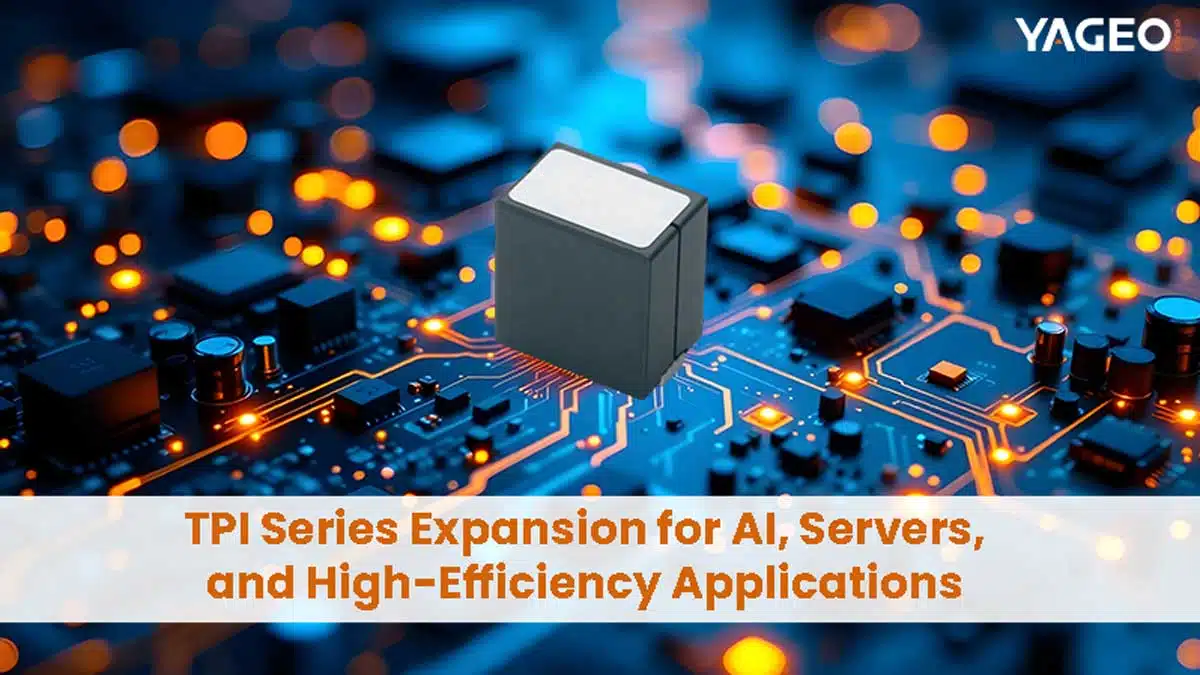
YAGEO Group Expands TPI Series SMD Ferrite Core Inductors to Meet Growing Power Demands of Next-Generation Computing Platforms.

YAGEO Group announces the expansion of its TPI Series Surface-Mount Device (SMD) ferrite core inductors, designed to address the escalating power requirements of next-generation computing platforms.

RelatedPosts

YAGEO Releases Compact RJ45 Connector for Multi‑Gigabit Ethernet

YAGEO Introduces C0G Flexible Termination Automotive MLCCs

YAGEO Introduces High‑Current Y2/X1 Film Capacitors for Wide-bandgap Power Systems

This latest development introduces new sizes, inductance values, and design profiles, offering optimized performance for both DC and AC high-efficiency topologies, including hard-switching and resonant converters.

Built for Power Density and Performance

As artificial intelligence (AI) acceleration, server workloads, and decentralized architectures continue to drive increased current demands and thermal challenges, YAGEO’s TPI Series rises to the occasion with:

  • Low DCR and Low Core Loss: Innovative one-turn Mn-Zn ferrite design minimizes heat generation and energy loss, supporting switching frequencies up to 3 MHz.
  • Stable Performance Under Extreme Conditions: Rated for operation from –40°C to +125°C, including self-temperature rise, ensuring consistent performance in dense, high-power environments.
  • Compact, Flexible Footprints: Available in sizes ranging from 7 × 6.7 mm to 12 × 8 mm, with vertical, horizontal, and low-height configurations—ideal for space-constrained board layouts near CPUs and GPUs.
  • High Current Capability: Supports currents up to 66 A with inductance values from 47 to 230 nH, perfectly suited for DC/DC converters and point-of-load regulation.

Optimized for Modern Power Topologies

  • DC Optimization: For hard-switching applications like multi-phase buck converters, the TPI Series features reduced DCR to minimize copper losses, enhancing system efficiency.
  • AC Optimization: In soft-switching architectures such as Switched Tank Converters (STC), the ferrite core and precisely engineered air gap structure significantly reduce AC losses caused by eddy currents and fringing flux.

Target Applications Include:

  • High-performance CPUs and GPUs
  • AI acceleration boards
  • Server and storage Voltage Regulator Modules (VRMs)
  • 48 V and 12 V power architectures
  • Decentralized DC power distribution systems

YAGEO Group’s expanded TPI Series represents a strategic advancement in power component technology, providing unparalleled efficiency, thermal management, and design flexibility for today’s most demanding computing environments.

Product Resources

  • 📄 TPI Series Datasheet
  • 🔗 TPI Series Resource Hub

Why Choose the TPI Series?

YAGEO Group’s TPI inductors are purpose-built for the future of power delivery. Whether optimizing ripple current, improving thermal margins, or shrinking PCB footprint, this expanded lineup helps engineers achieve higher performance and efficiency without design compromises.

Related

Source: YAGEO

Recent Posts

Stackpole Introduces High‑Voltage Low VCR Chip Resistors

25.5.2026
11

GDT Gas Discharge Tubes: Surge Protection Fundamentals, Selection, and Design‑in Tips

25.5.2026
15

Designing a Custom Core Transformer for 10 kW LLC Data Center Power Stages

22.5.2026
39

Magnetics Design in High‑Frequency GaN Converters

22.5.2026
35

Industrial Passive Components Markets and Technologies 2026

21.5.2026
93

Automotive Passive Components Technology Dossier

21.5.2026
63

Hirose Expands Compact High‑Voltage EV connectors

21.5.2026
18

Qi2 Wireless Charging: Inductors, Capacitors and EMC Filters

21.5.2026
26

Würth Elektronik Presents New Bidirectional Digital Isolators

20.5.2026
36

Upcoming Events

May 27
17:00 - 17:30 CEST

When requirements change: Live Planar redesign under time pressure

Jun 2
16:00 - 17:00 CEST

Calculation, Simulation and Measurement of 800V EMC Filters

Jun 16
16:00 - 17:00 CEST

EMC with EMC – EMC‑compliant design with electromechanical connectors

View Calendar

Popular Posts

  • Buck Converter Design and Calculation

    0 shares
    Share 0 Tweet 0
  • Boost Converter Design and Calculation

    0 shares
    Share 0 Tweet 0
  • Flyback Converter Design and Calculation

    0 shares
    Share 0 Tweet 0
  • LLC Resonant Converter Design and Calculation

    0 shares
    Share 0 Tweet 0
  • MLCC and Ceramic Capacitors

    0 shares
    Share 0 Tweet 0
  • Capacitor Charging and Discharging

    0 shares
    Share 0 Tweet 0
  • What Electronics Engineer Needs to Know About Passive Low Pass Filters

    0 shares
    Share 0 Tweet 0
  • Dual Active Bridge (DAB) Topology

    0 shares
    Share 0 Tweet 0
  • Ripple Current and its Effects on the Performance of Capacitors

    3 shares
    Share 3 Tweet 0
  • Samsung Electro-Mechanics Releases High-Capacitance MLCCs for AI Server Applications

    0 shares
    Share 0 Tweet 0

Newsletter Subscription


Passive Components Blog

© EPCI - Leading Passive Components Educational and Information Site

  • Home
  • Privacy Policy
  • EPCI Membership & Advertisement
  • About

No Result
View All Result
  • Home
  • Knowledge Blog
  • Dossiers
  • PCNS

© EPCI - Leading Passive Components Educational and Information Site

This website uses cookies. By continuing to use this website you are giving consent to cookies being used. Visit our Privacy and Cookie Policy.
Go to mobile version