









Passive Components Blog
No Result
View All Result
  • Home
  • NewsFilter
    • All
    • Aerospace & Defence
    • Antenna
    • Applications
    • Automotive
    • Capacitors
    • Circuit Protection Devices
    • electro-mechanical news
    • Filters
    • Fuses
    • Inductors
    • Industrial
    • Integrated Passives
    • inter-connect news
    • Market & Supply Chain
    • Market Insights
    • Medical
    • Modelling and Simulation
    • New Materials & Supply
    • New Technologies
    • Non-linear Passives
    • Oscillators
    • Passive Sensors News
    • Resistors
    • RF & Microwave
    • Telecommunication
    • Weekly Digest

    How Modern Tools Model Magnetic Components for Power Electronics

    Inductors and Ferrite Beads Price Hikes 

    TDK Extends Compact ThermoFuse Varistors up to 50 kA

    Samtec ANSI/VITA 90 Connectors: Rugged Small Form Factor Standard

    Resistor Technology Dossier

    Würth Elektronik IQD Awarded by EcoVadis Gold Sustainability Medal

    Advanced Loss Modeling for Planar Magnetics in the Frenetic Planar Tool

    AI Servers Demand is Driving Tantalum Capacitor Price Hikes

    DMASS Reports Europe Components Up 9.8% in Q4 2025

    Trending Tags

    • Ripple Current
    • RF
    • Leakage Current
    • Tantalum vs Ceramic
    • Snubber
    • Low ESR
    • Feedthrough
    • Derating
    • Dielectric Constant
    • New Products
    • Market Reports
  • VideoFilter
    • All
    • Antenna videos
    • Capacitor videos
    • Circuit Protection Video
    • Filter videos
    • Fuse videos
    • Inductor videos
    • Inter-Connect Video
    • Non-linear passives videos
    • Oscillator videos
    • Passive sensors videos
    • Resistor videos

    How Modern Tools Model Magnetic Components for Power Electronics

    Advanced Loss Modeling for Planar Magnetics in the Frenetic Planar Tool

    2026 Power Magnetics Design Trends: Flyback, DAB and Planar

    Enabling Software‑Defined Vehicle Architectures: Automotive Ethernet and Zonal Smart Power

    Calculating Resistance Value of a Flyback RC Snubber 

    One‑Pulse Characterization of Nonlinear Power Inductors

    Thermistor Linearization Challenges

    Coaxial Connectors and How to Connect with PCB

    PCB Manufacturing, Test Methods, Quality and Reliability

    Trending Tags

    • Capacitors explained
    • Inductors explained
    • Resistors explained
    • Filters explained
    • Application Video Guidelines
    • EMC
    • New Products
    • Ripple Current
    • Simulation
    • Tantalum vs Ceramic
  • Knowledge Blog
  • DossiersNew
  • Suppliers
    • Who is Who
  • PCNS
    • PCNS 2025
    • PCNS 2023
    • PCNS 2021
    • PCNS 2019
    • PCNS 2017
  • Events
  • Home
  • NewsFilter
    • All
    • Aerospace & Defence
    • Antenna
    • Applications
    • Automotive
    • Capacitors
    • Circuit Protection Devices
    • electro-mechanical news
    • Filters
    • Fuses
    • Inductors
    • Industrial
    • Integrated Passives
    • inter-connect news
    • Market & Supply Chain
    • Market Insights
    • Medical
    • Modelling and Simulation
    • New Materials & Supply
    • New Technologies
    • Non-linear Passives
    • Oscillators
    • Passive Sensors News
    • Resistors
    • RF & Microwave
    • Telecommunication
    • Weekly Digest

    How Modern Tools Model Magnetic Components for Power Electronics

    Inductors and Ferrite Beads Price Hikes 

    TDK Extends Compact ThermoFuse Varistors up to 50 kA

    Samtec ANSI/VITA 90 Connectors: Rugged Small Form Factor Standard

    Resistor Technology Dossier

    Würth Elektronik IQD Awarded by EcoVadis Gold Sustainability Medal

    Advanced Loss Modeling for Planar Magnetics in the Frenetic Planar Tool

    AI Servers Demand is Driving Tantalum Capacitor Price Hikes

    DMASS Reports Europe Components Up 9.8% in Q4 2025

    Trending Tags

    • Ripple Current
    • RF
    • Leakage Current
    • Tantalum vs Ceramic
    • Snubber
    • Low ESR
    • Feedthrough
    • Derating
    • Dielectric Constant
    • New Products
    • Market Reports
  • VideoFilter
    • All
    • Antenna videos
    • Capacitor videos
    • Circuit Protection Video
    • Filter videos
    • Fuse videos
    • Inductor videos
    • Inter-Connect Video
    • Non-linear passives videos
    • Oscillator videos
    • Passive sensors videos
    • Resistor videos

    How Modern Tools Model Magnetic Components for Power Electronics

    Advanced Loss Modeling for Planar Magnetics in the Frenetic Planar Tool

    2026 Power Magnetics Design Trends: Flyback, DAB and Planar

    Enabling Software‑Defined Vehicle Architectures: Automotive Ethernet and Zonal Smart Power

    Calculating Resistance Value of a Flyback RC Snubber 

    One‑Pulse Characterization of Nonlinear Power Inductors

    Thermistor Linearization Challenges

    Coaxial Connectors and How to Connect with PCB

    PCB Manufacturing, Test Methods, Quality and Reliability

    Trending Tags

    • Capacitors explained
    • Inductors explained
    • Resistors explained
    • Filters explained
    • Application Video Guidelines
    • EMC
    • New Products
    • Ripple Current
    • Simulation
    • Tantalum vs Ceramic
  • Knowledge Blog
  • DossiersNew
  • Suppliers
    • Who is Who
  • PCNS
    • PCNS 2025
    • PCNS 2023
    • PCNS 2021
    • PCNS 2019
    • PCNS 2017
  • Events
No Result
View All Result
Passive Components Blog
No Result
View All Result

Choosing the right blocking capacitors

11.2.2019
Reading Time: 2 mins read
A A

Source: Microwave and RF news, Knowles Precision Devices

Any engineer knows that capacitors are a fundamental building block in RF/microwave systems. Bypass networks are one example—they require capacitors to bypass ac signals to ground. For such cases, rules-of-thumb or approximate equations can be used to select the best capacitor for the job. However, those approaches may not always be valid. In the technical paper, “Choosing blocking capacitors – it’s more than just values,” Knowles Precision Devices discusses real-world capacitor performance and then presents measurement results of various capacitor bypass networks.

RelatedPosts

How Modern Tools Model Magnetic Components for Power Electronics

Inductors and Ferrite Beads Price Hikes 

TDK Extends Compact ThermoFuse Varistors up to 50 kA

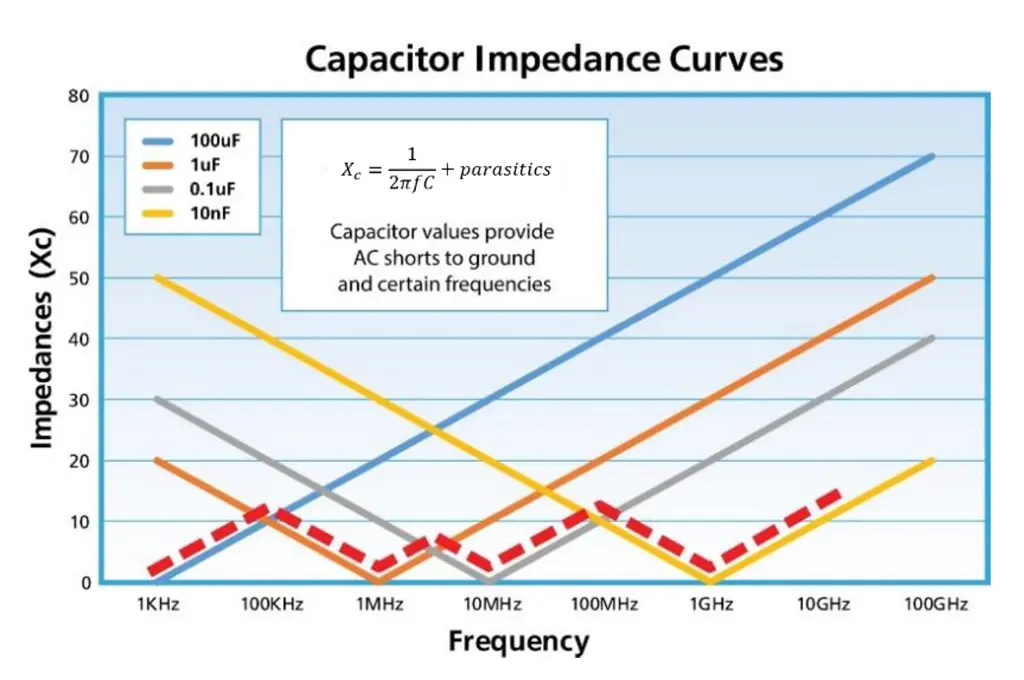
For bypass applications, the paper explains that capacitor values are chosen to provide a low-resistance ground path for unwanted noise signals. It then presents the familiar mathematical expression of capacitor reactance. This equation allows one to determine the theoretical capacitor values needed to provide a low-resistance path to ground for a signal at a given frequency.

In practice, actual capacitors are modeled as a combination of capacitors, inductors, and resistors. A low impedance is realized at a capacitor’s first self-resonant frequency. Above the resonant frequency, the impedance rises as the frequency increases. The paper illustrates this by presenting impedance plots of several capacitors with different values. Furthermore, a common approach to enable broadband RF isolation involves shunting three or four capacitors, each with different values, to ground. Oftentimes, designers employ this method by simply following the recommendations from a manufacturer’s datasheet.

The paper continues by breaking down the parasitic inductance that’s present in a capacitor. It’s noted that increasing a capacitor’s contact pad size can reduce the parasitic inductance. Mention is made of a new manufacturing process that allows for larger pad areas in capacitor footprints without compromising the voltage rating.

Real measurements are shown of the V-Series capacitors, demonstrating how one of them can offer broadband performance that’s typically achieved by bypass networks with multiple capacitors. Additional measurement results compare the performance of a traditional capacitor bypass network with a V-Series capacitor by itself, as well as with a UX-Series capacitor in combination with a V-Series capacitor.

Read more at the technical paper here.

Related

Recent Posts

How Modern Tools Model Magnetic Components for Power Electronics

5.3.2026
3

Advanced Loss Modeling for Planar Magnetics in the Frenetic Planar Tool

4.3.2026
11

AI Servers Demand is Driving Tantalum Capacitor Price Hikes

5.3.2026
51

DMASS Reports Europe Components Up 9.8% in Q4 2025

3.3.2026
14

Bourns Extends PPTC Resettable High‑Power, High‑Voltage Protection Fuses

2.3.2026
8

Mastering Galvanic Isolation in Power Electronics: Methods, Standards, and Implementation

2.3.2026
26

VINATech Targets AI Data Center Supercapacitor Boom

26.2.2026
41

Littelfuse NANO2 415 SMD Fuse Wins 2025 Product of the Year

26.2.2026
16

TDK Introduces 350V Safety Film Capacitors for Compact EMI Suppression

26.2.2026
35

Upcoming Events

Mar 19
13:00 - 14:00 CDT

Smart Consideration of Inductor Thermal Performance

Mar 21
All day

PSMA Capacitor Workshop 2026

Apr 21
16:00 - 17:00 CEST

Heatsink Solutions: Thermal Management in electronic devices

View Calendar

Popular Posts

  • Buck Converter Design and Calculation

    0 shares
    Share 0 Tweet 0
  • Boost Converter Design and Calculation

    0 shares
    Share 0 Tweet 0
  • Flyback Converter Design and Calculation

    0 shares
    Share 0 Tweet 0
  • LLC Resonant Converter Design and Calculation

    0 shares
    Share 0 Tweet 0
  • MLCC Manufacturers Consider Price Increase as AI Demand Outpaces Supply

    0 shares
    Share 0 Tweet 0
  • Dual Active Bridge (DAB) Topology

    0 shares
    Share 0 Tweet 0
  • Ripple Current and its Effects on the Performance of Capacitors

    3 shares
    Share 3 Tweet 0
  • MLCC and Ceramic Capacitors

    0 shares
    Share 0 Tweet 0
  • What is a Dielectric Constant and DF of Plastic Materials?

    4 shares
    Share 4 Tweet 0
  • MLCC Case Sizes Standards Explained

    0 shares
    Share 0 Tweet 0

Newsletter Subscription


Passive Components Blog

© EPCI - Leading Passive Components Educational and Information Site

  • Home
  • Privacy Policy
  • EPCI Membership & Advertisement
  • About

No Result
View All Result
  • Home
  • Knowledge Blog
  • PCNS

© EPCI - Leading Passive Components Educational and Information Site

This website uses cookies. By continuing to use this website you are giving consent to cookies being used. Visit our Privacy and Cookie Policy.
Go to mobile version