




Passive Components Blog
No Result
View All Result
  • Home
  • NewsFilter
    • All
    • Aerospace & Defence
    • Antenna
    • Applications
    • Automotive
    • Capacitors
    • Circuit Protection Devices
    • electro-mechanical news
    • Filters
    • Fuses
    • Inductors
    • Industrial
    • Integrated Passives
    • inter-connect news
    • Market & Supply Chain
    • Market Insights
    • Medical
    • Modelling and Simulation
    • New Materials & Supply
    • New Technologies
    • Non-linear Passives
    • Oscillators
    • Passive Sensors News
    • Resistors
    • RF & Microwave
    • Telecommunication
    • Weekly Digest

    Littelfuse Announced TVS Diodes for 48 V Automotive Systems

    Spectrum Controls Joins Modelithics Program to Offer High‑Fidelity RF Models for Resistors, Attenuators and Terminations

    RF Filters and Passive Components Enabling the 7 Missile RF Subsystems

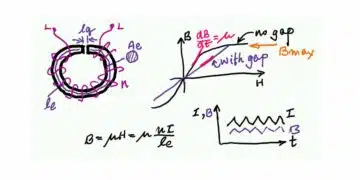
    Ferrite versus Nanocrystalline Power Inductor Cores: Turns, Gap and Size

    YAGEO Presents NANOMET Soft Magnetic Cores for High‑Density Power Conversion

    Coilcraft Releases High-Current Ferrite Beads for CISPR 25 EMC compliance

    From DCL to SSC: Bridging Electrical Symptoms and Structural Indicators in Tantalum Capacitors

    Vishay Unveils Multi-Turn Position Sensor for Harsh Industrial Environments

    YAGEO Introduces Automotive MOV Surge Protection Varistor

    Trending Tags

    • Ripple Current
    • RF
    • Leakage Current
    • Tantalum vs Ceramic
    • Snubber
    • Low ESR
    • Feedthrough
    • Derating
    • Dielectric Constant
    • New Products
    • Market Reports
  • VideoFilter
    • All
    • Antenna videos
    • Capacitor videos
    • Circuit Protection Video
    • Filter videos
    • Fuse videos
    • Inductor videos
    • Inter-Connect Video
    • Non-linear passives videos
    • Oscillator videos
    • Passive sensors videos
    • Resistor videos

    Ferrite versus Nanocrystalline Power Inductor Cores: Turns, Gap and Size

    KYOCERA AVX Presents Antenna Integrator Studio Tutorial for Antenna Placement and RF Design

    Power Design Simulation Tools for Faster Inductor Selection and Loss Optimization

    EMC‑Compliant PCB and Connector Design Guidelines

    Why Isolated DC/DC Power Supplies Fail Late, Würth Elektronik Podcast

    Designing 800 V DC EMC Filters: Calculation, Simulation and Measurement

    Current Sense Transformer Datasheet and Design‑in Guide

    Designing a USB Type‑C Flyback Planar Transformer with Frenetic’s Planar Tool

    Magnetics Design in High‑Frequency GaN Converters

    Trending Tags

    • Capacitors explained
    • Inductors explained
    • Resistors explained
    • Filters explained
    • Application Video Guidelines
    • EMC
    • New Products
    • Ripple Current
    • Simulation
    • Tantalum vs Ceramic
  • Knowledge Blog
  • Dossiers
    • AI Hardware Dossier
    • Power Converter Dossier
    • Automotive Dossier
    • Capacitor Dossier
    • Resistor Dossier
    • Inductor Dossier
    • Circuit Protection Dossier
  • Suppliers
    • Who is Who
  • PCNS
    • PCNS 2025
    • PCNS 2023
    • PCNS 2021
    • PCNS 2019
    • PCNS 2017
  • Events
  • Home
  • NewsFilter
    • All
    • Aerospace & Defence
    • Antenna
    • Applications
    • Automotive
    • Capacitors
    • Circuit Protection Devices
    • electro-mechanical news
    • Filters
    • Fuses
    • Inductors
    • Industrial
    • Integrated Passives
    • inter-connect news
    • Market & Supply Chain
    • Market Insights
    • Medical
    • Modelling and Simulation
    • New Materials & Supply
    • New Technologies
    • Non-linear Passives
    • Oscillators
    • Passive Sensors News
    • Resistors
    • RF & Microwave
    • Telecommunication
    • Weekly Digest

    Littelfuse Announced TVS Diodes for 48 V Automotive Systems

    Spectrum Controls Joins Modelithics Program to Offer High‑Fidelity RF Models for Resistors, Attenuators and Terminations

    RF Filters and Passive Components Enabling the 7 Missile RF Subsystems

    Ferrite versus Nanocrystalline Power Inductor Cores: Turns, Gap and Size

    YAGEO Presents NANOMET Soft Magnetic Cores for High‑Density Power Conversion

    Coilcraft Releases High-Current Ferrite Beads for CISPR 25 EMC compliance

    From DCL to SSC: Bridging Electrical Symptoms and Structural Indicators in Tantalum Capacitors

    Vishay Unveils Multi-Turn Position Sensor for Harsh Industrial Environments

    YAGEO Introduces Automotive MOV Surge Protection Varistor

    Trending Tags

    • Ripple Current
    • RF
    • Leakage Current
    • Tantalum vs Ceramic
    • Snubber
    • Low ESR
    • Feedthrough
    • Derating
    • Dielectric Constant
    • New Products
    • Market Reports
  • VideoFilter
    • All
    • Antenna videos
    • Capacitor videos
    • Circuit Protection Video
    • Filter videos
    • Fuse videos
    • Inductor videos
    • Inter-Connect Video
    • Non-linear passives videos
    • Oscillator videos
    • Passive sensors videos
    • Resistor videos

    Ferrite versus Nanocrystalline Power Inductor Cores: Turns, Gap and Size

    KYOCERA AVX Presents Antenna Integrator Studio Tutorial for Antenna Placement and RF Design

    Power Design Simulation Tools for Faster Inductor Selection and Loss Optimization

    EMC‑Compliant PCB and Connector Design Guidelines

    Why Isolated DC/DC Power Supplies Fail Late, Würth Elektronik Podcast

    Designing 800 V DC EMC Filters: Calculation, Simulation and Measurement

    Current Sense Transformer Datasheet and Design‑in Guide

    Designing a USB Type‑C Flyback Planar Transformer with Frenetic’s Planar Tool

    Magnetics Design in High‑Frequency GaN Converters

    Trending Tags

    • Capacitors explained
    • Inductors explained
    • Resistors explained
    • Filters explained
    • Application Video Guidelines
    • EMC
    • New Products
    • Ripple Current
    • Simulation
    • Tantalum vs Ceramic
  • Knowledge Blog
  • Dossiers
    • AI Hardware Dossier
    • Power Converter Dossier
    • Automotive Dossier
    • Capacitor Dossier
    • Resistor Dossier
    • Inductor Dossier
    • Circuit Protection Dossier
  • Suppliers
    • Who is Who
  • PCNS
    • PCNS 2025
    • PCNS 2023
    • PCNS 2021
    • PCNS 2019
    • PCNS 2017
  • Events
No Result
View All Result
Passive Components Blog
No Result
View All Result

COTS procurement for space missions

26.10.2020
Reading Time: 5 mins read
A A

Source: EPCI e-Symposium PCNS paper

by: Dr. Leo Farhat and Dr. Denis Lacombe; ESA ESTEC; The Netherlands

RelatedPosts

AVX Releases High-Temperature 150°C Glass-Encapsulated Multilayer Varistors

Most Reliable, Most Efficient and Price Effective Solid Tantalum Capacitors

Niobium and Niobium Oxide Capacitors Overview

presented by D.Lacombe at the 2nd PCNS 10-13th September 2019, Bucharest, Romania as paper 3.1.

ABSTRACT

More and more space missions are or are willing to use COTS EEE parts in their projects. Several working group in ESA and outside of ESA are trying to define a standardise way to procure such type of part for space applications. This presentation will try to present a status of the different working groups positions and the consequence for the procurement of passive EEE parts.


NEW SPACE AND COTS

COTS components are mainly used in these applications. COTS are, today, rarely used in other types of projects except Telecom.

New Space activities are active in:
• launchers
• constellations

Why COTS ?

There are three main reasons to use COTS components in space projects:

  1. better performances
  2. not existing in space QPL range
  3. COST, with 1/10 of the cost of equivalent space QPL parts

The first two – better performance and QPL list non-existence – are the main reasons for use in all space projects, the lower cost are the main driver for launchers and constellations applications.

Space standards

Today, we have two types of space standardization systems addressing EEE parts:

  • ESCC: European Procurement and qualification system (QPL and EPPL)
  • ECSS: Q60 series with guidelines for selection and procurement
    • Q30 and Q70 series for proper use of EEE parts
    • Several other E series

All these standards would be affected by the evolution of the New Space era.

Space standards for procurement of commercial parts:
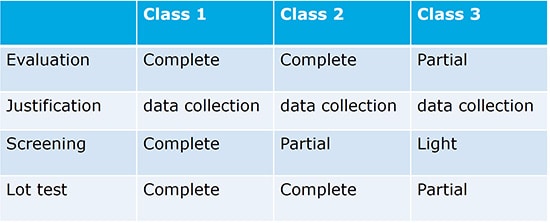
ECSS-Q-ST-60-13 (today) applicable for active EEE


Space standards for procurement of commercial parts: ECSS-Q-ST-60-13 update
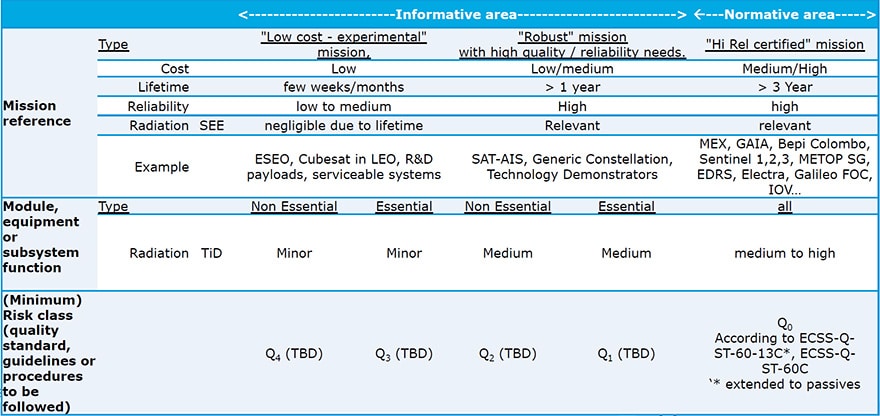
 

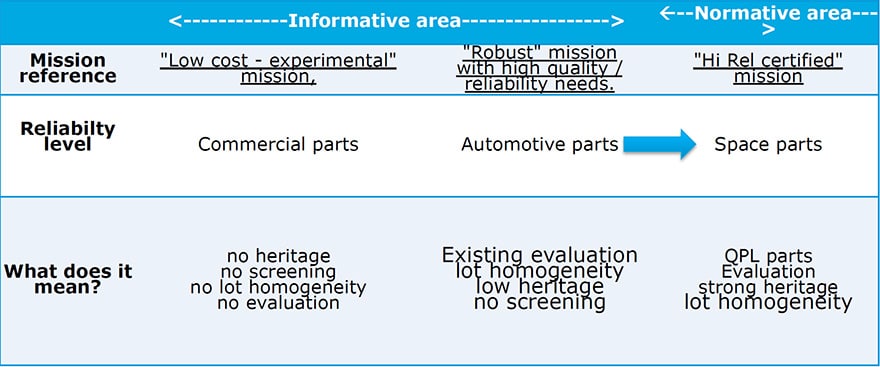
Which part for which level?

Can we use AEC-Q200 parts in High Rel. space?

There are several questions to be answered:

• What are the designs of the parts certified according to AEC-Q200 vs space QPL designs?
• What are the reliability data available to space customers and agencies?
• How the manufacturing processes and materials are monitored to ensure that the reliability of AEC-Q200 parts are the same that during certification (PPAP)?
• Can we accept parts without screening? if yes, for what applications?

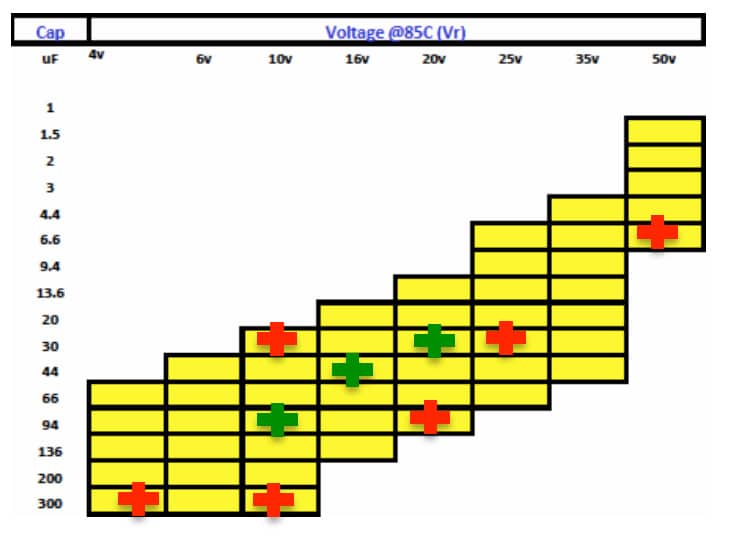
Is the design of AEC-Q200 parts compatible?
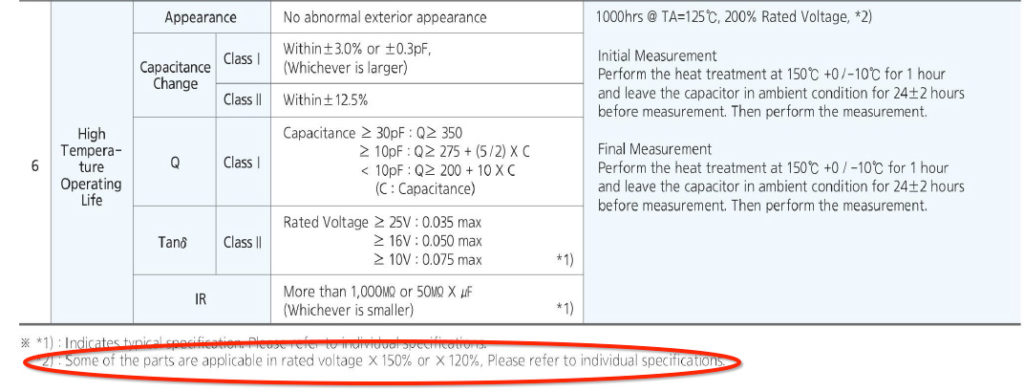
 

Samsung MLCC ceramic capacitor catalogue example

Available reliability data?

AEC-Q200 specifies clearly the tests to be performed and the methods to be used but:

• Reliability data package of AEC-Q200 are not freely available to space customers and agencies
• How the “four corners” defined in AEC-Q200 are chosen with regards to the range of certified products?

Is PPAP assuring a stable reliability level?

For space QPL parts, we have equivalent document that is called PID (Process Identification Document). It defines the design rules, the materials, the processes, tests and equipment used during manufacturing. BUT in addition to this, we request screening tests and a two years maintenance of qualification tests.

PPAP is generally not available for space actors. We expect that in addition to the information contained in space PID we will find some Statistical Process Control that would allow to discard regular reliability tests.
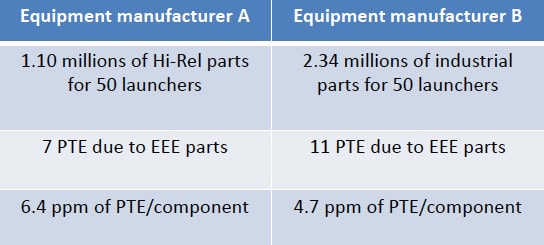
 

Ariane 5 field return

Can we accept parts without screening?

What is the usual screening?

• specific tests like surge current
• short accelerated life test and Is it relevant to remove early failure?
• early failure are not always the same types of failure that long term failure
• What are the types of rejects observed with usual screening?

Can we accept AEC-Q200 parts for space projects?

It depends on two main aspects:

1] what are the needs and requirements?

  • mission duration
  • criticality
  • constellation or not
  • cost

2] how can we trust our suppliers?

  • PPAP
  • reliability testing
  • audit
  • etc?

What can we learn space QPL parts?

Space QPL parts are reliable. Is it too much reliable? For example, ceramic capacitors lifetime 2000 hours life test at 2 times rated voltage at 125C is equivalent to more than 100 years of operational conditions. What does it bring for a “3 years” mission? Do we still need a derating?

Screening is part of space heritage and is mandatory for flights models. It may be now the time to analyse the types of rejects during screening. Is it still relevant as it is defined?


more 2nd PCNS symposium technical papers can be viewed and downloaded in pdf from EPCI Academy e-Proceedings:
Related

Recent Posts

Spectrum Controls Joins Modelithics Program to Offer High‑Fidelity RF Models for Resistors, Attenuators and Terminations

10.7.2026
2

RF Filters and Passive Components Enabling the 7 Missile RF Subsystems

9.7.2026
22

Ferrite versus Nanocrystalline Power Inductor Cores: Turns, Gap and Size

9.7.2026
31

YAGEO Presents NANOMET Soft Magnetic Cores for High‑Density Power Conversion

8.7.2026
52

Coilcraft Releases High-Current Ferrite Beads for CISPR 25 EMC compliance

8.7.2026
33

From DCL to SSC: Bridging Electrical Symptoms and Structural Indicators in Tantalum Capacitors

7.7.2026
43

Vishay Unveils Multi-Turn Position Sensor for Harsh Industrial Environments

7.7.2026
25

TDK Releases Compact SMD Gate Drive Transformers for xEV

7.7.2026
27

High-Q RF & Microwave MLCCs: A Cross-Vendor Benchmark

2.7.2026
76

Upcoming Events

Jul 14
16:00 - 17:00 CEST

EMC Design Essentials: Mastering Varistors and Common Mode Chokes

Jul 21
16:00 - 17:00 CEST

Safety by design: X and Y Interference suppression capacitors for power line filters

Jul 28
8:00 - 11:00 CEST

Post Procurement Testing of EEE Components for LEO Space Applications

View Calendar

Popular Posts

  • Boost Converter Design and Calculation

    0 shares
    Share 0 Tweet 0
  • Buck Converter Design and Calculation

    0 shares
    Share 0 Tweet 0
  • Flyback Converter Design and Calculation

    0 shares
    Share 0 Tweet 0
  • LLC Resonant Converter Design and Calculation

    0 shares
    Share 0 Tweet 0
  • MLCC and Ceramic Capacitors

    0 shares
    Share 0 Tweet 0
  • YAGEO Announces July 2026 Capacitor Price Increase

    0 shares
    Share 0 Tweet 0
  • Earthing Systems and IEC Classification Explained

    0 shares
    Share 0 Tweet 0
  • Nvidia Vera Rubin: Why One AI Rack Needs So Many More MLCC Capacitors

    0 shares
    Share 0 Tweet 0
  • Dual Active Bridge (DAB) Topology

    0 shares
    Share 0 Tweet 0
  • MLCC Case Sizes Standards Explained

    0 shares
    Share 0 Tweet 0

Newsletter Subscription


Passive Components Blog

© EPCI - Leading Passive Components Educational and Information Site

  • Home
  • Privacy Policy
  • EPCI Membership & Advertisement
  • About

No Result
View All Result
  • Home
  • Knowledge Blog
  • Dossiers
  • PCNS

© EPCI - Leading Passive Components Educational and Information Site

This website uses cookies. By continuing to use this website you are giving consent to cookies being used. Visit our Privacy and Cookie Policy.
Go to mobile version