





Passive Components Blog
No Result
View All Result
  • Home
  • NewsFilter
    • All
    • Aerospace & Defence
    • Antenna
    • Applications
    • Automotive
    • Capacitors
    • Circuit Protection Devices
    • electro-mechanical news
    • Filters
    • Fuses
    • Inductors
    • Industrial
    • Integrated Passives
    • inter-connect news
    • Market & Supply Chain
    • Market Insights
    • Medical
    • Modelling and Simulation
    • New Materials & Supply
    • New Technologies
    • Non-linear Passives
    • Oscillators
    • Passive Sensors News
    • Resistors
    • RF & Microwave
    • Telecommunication
    • Weekly Digest

    Littelfuse Announced TVS Diodes for 48 V Automotive Systems

    Spectrum Controls Joins Modelithics Program to Offer High‑Fidelity RF Models for Resistors, Attenuators and Terminations

    RF Filters and Passive Components Enabling the 7 Missile RF Subsystems

    Ferrite versus Nanocrystalline Power Inductor Cores: Turns, Gap and Size

    YAGEO Presents NANOMET Soft Magnetic Cores for High‑Density Power Conversion

    Coilcraft Releases High-Current Ferrite Beads for CISPR 25 EMC compliance

    From DCL to SSC: Bridging Electrical Symptoms and Structural Indicators in Tantalum Capacitors

    Vishay Unveils Multi-Turn Position Sensor for Harsh Industrial Environments

    YAGEO Introduces Automotive MOV Surge Protection Varistor

    Trending Tags

    • Ripple Current
    • RF
    • Leakage Current
    • Tantalum vs Ceramic
    • Snubber
    • Low ESR
    • Feedthrough
    • Derating
    • Dielectric Constant
    • New Products
    • Market Reports
  • VideoFilter
    • All
    • Antenna videos
    • Capacitor videos
    • Circuit Protection Video
    • Filter videos
    • Fuse videos
    • Inductor videos
    • Inter-Connect Video
    • Non-linear passives videos
    • Oscillator videos
    • Passive sensors videos
    • Resistor videos

    Ferrite versus Nanocrystalline Power Inductor Cores: Turns, Gap and Size

    KYOCERA AVX Presents Antenna Integrator Studio Tutorial for Antenna Placement and RF Design

    Power Design Simulation Tools for Faster Inductor Selection and Loss Optimization

    EMC‑Compliant PCB and Connector Design Guidelines

    Why Isolated DC/DC Power Supplies Fail Late, Würth Elektronik Podcast

    Designing 800 V DC EMC Filters: Calculation, Simulation and Measurement

    Current Sense Transformer Datasheet and Design‑in Guide

    Designing a USB Type‑C Flyback Planar Transformer with Frenetic’s Planar Tool

    Magnetics Design in High‑Frequency GaN Converters

    Trending Tags

    • Capacitors explained
    • Inductors explained
    • Resistors explained
    • Filters explained
    • Application Video Guidelines
    • EMC
    • New Products
    • Ripple Current
    • Simulation
    • Tantalum vs Ceramic
  • Knowledge Blog
  • Dossiers
    • AI Hardware Dossier
    • Power Converter Dossier
    • Automotive Dossier
    • Capacitor Dossier
    • Resistor Dossier
    • Inductor Dossier
    • Circuit Protection Dossier
  • Suppliers
    • Who is Who
  • PCNS
    • PCNS 2025
    • PCNS 2023
    • PCNS 2021
    • PCNS 2019
    • PCNS 2017
  • Events
  • Home
  • NewsFilter
    • All
    • Aerospace & Defence
    • Antenna
    • Applications
    • Automotive
    • Capacitors
    • Circuit Protection Devices
    • electro-mechanical news
    • Filters
    • Fuses
    • Inductors
    • Industrial
    • Integrated Passives
    • inter-connect news
    • Market & Supply Chain
    • Market Insights
    • Medical
    • Modelling and Simulation
    • New Materials & Supply
    • New Technologies
    • Non-linear Passives
    • Oscillators
    • Passive Sensors News
    • Resistors
    • RF & Microwave
    • Telecommunication
    • Weekly Digest

    Littelfuse Announced TVS Diodes for 48 V Automotive Systems

    Spectrum Controls Joins Modelithics Program to Offer High‑Fidelity RF Models for Resistors, Attenuators and Terminations

    RF Filters and Passive Components Enabling the 7 Missile RF Subsystems

    Ferrite versus Nanocrystalline Power Inductor Cores: Turns, Gap and Size

    YAGEO Presents NANOMET Soft Magnetic Cores for High‑Density Power Conversion

    Coilcraft Releases High-Current Ferrite Beads for CISPR 25 EMC compliance

    From DCL to SSC: Bridging Electrical Symptoms and Structural Indicators in Tantalum Capacitors

    Vishay Unveils Multi-Turn Position Sensor for Harsh Industrial Environments

    YAGEO Introduces Automotive MOV Surge Protection Varistor

    Trending Tags

    • Ripple Current
    • RF
    • Leakage Current
    • Tantalum vs Ceramic
    • Snubber
    • Low ESR
    • Feedthrough
    • Derating
    • Dielectric Constant
    • New Products
    • Market Reports
  • VideoFilter
    • All
    • Antenna videos
    • Capacitor videos
    • Circuit Protection Video
    • Filter videos
    • Fuse videos
    • Inductor videos
    • Inter-Connect Video
    • Non-linear passives videos
    • Oscillator videos
    • Passive sensors videos
    • Resistor videos

    Ferrite versus Nanocrystalline Power Inductor Cores: Turns, Gap and Size

    KYOCERA AVX Presents Antenna Integrator Studio Tutorial for Antenna Placement and RF Design

    Power Design Simulation Tools for Faster Inductor Selection and Loss Optimization

    EMC‑Compliant PCB and Connector Design Guidelines

    Why Isolated DC/DC Power Supplies Fail Late, Würth Elektronik Podcast

    Designing 800 V DC EMC Filters: Calculation, Simulation and Measurement

    Current Sense Transformer Datasheet and Design‑in Guide

    Designing a USB Type‑C Flyback Planar Transformer with Frenetic’s Planar Tool

    Magnetics Design in High‑Frequency GaN Converters

    Trending Tags

    • Capacitors explained
    • Inductors explained
    • Resistors explained
    • Filters explained
    • Application Video Guidelines
    • EMC
    • New Products
    • Ripple Current
    • Simulation
    • Tantalum vs Ceramic
  • Knowledge Blog
  • Dossiers
    • AI Hardware Dossier
    • Power Converter Dossier
    • Automotive Dossier
    • Capacitor Dossier
    • Resistor Dossier
    • Inductor Dossier
    • Circuit Protection Dossier
  • Suppliers
    • Who is Who
  • PCNS
    • PCNS 2025
    • PCNS 2023
    • PCNS 2021
    • PCNS 2019
    • PCNS 2017
  • Events
No Result
View All Result
Passive Components Blog
No Result
View All Result

Littelfuse Announced TVS Diodes for 48 V Automotive Systems

10.7.2026
Reading Time: 6 mins read
A A

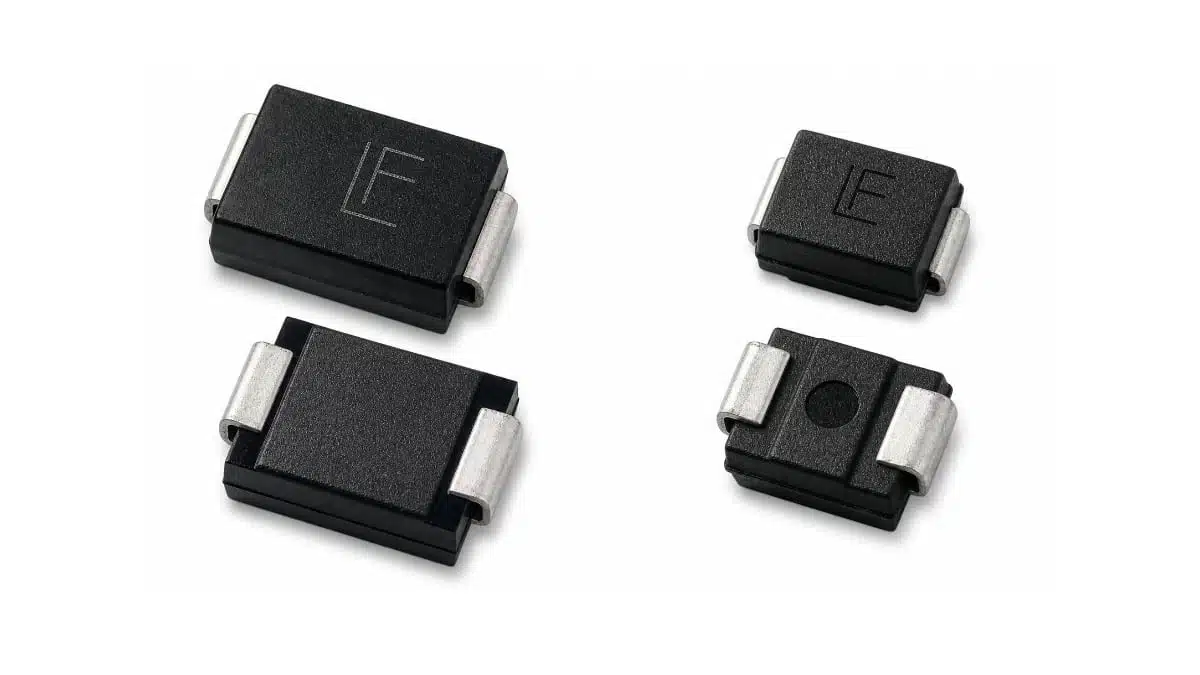
Littelfuse has introduced FlatSuppressX TP5.0SMD-FL and TP1KSMB-FL TVS diodes specifically tailored for 48 V automotive power architectures that must meet ISO 21780 requirements.

These Littelfuse TVS diode devices target the circuit protection of increasingly sensitive dc/dc converters, gate drivers, and power ICs against transient overvoltage events while keeping clamping voltage ultra‑low and stable.

RelatedPosts

Littelfuse Unveils High‑Current 48V SMD Fuse for AI Data Center Protection

Littelfuse Expands High-Voltage TVS Diodes

Littelfuse Presents Ultra-Miniature Half-Pitch SMT DIP Switches

Key features and benefits

  • FlatSuppressX clamping behavior – Proprietary foldback/snapback I‑V characteristic maintains a near‑constant, low clamping voltage during fast transients and high‑energy surge events, improving protection accuracy versus conventional TVS diodes whose clamping voltage typically rises with current. In practice, this helps keep the voltage seen by MOSFETs and controllers below their absolute maximum ratings during load dump, inductive kickback, or wiring fault transients.
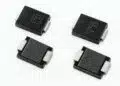
  • High surge capability options – TP5.0SMD-FL is rated up to 5000 W peak pulse power in a DO‑214AB (SMC) package, while TP1KSMB-FL offers up to 1000 W in a DO‑214AA (SMB) package. This gives designers a scalable choice depending on the expected surge energy at different points of the 48 V bus.
  • Designed for 48 V automotive systems – Both series are aligned with ISO 21780 for 48 V architectures and optimized for protection of power buses, I/O interfaces, and other vulnerable nodes in automotive electronics. This is relevant for systems such as electric power steering and zone control units where 48 V rails are becoming standard.
  • System cost and efficiency benefits – Lower and well‑controlled clamping allows the use of downstream components with lower voltage ratings, which can reduce BOM cost and enable higher efficiency power stages. The flatter clamping characteristic also simplifies worst‑case stress calculations for safety and reliability assessments.
  • Automotive‑grade reliability – Both TP5.0SMD-FL and TP1KSMB-FL are AEC‑Q101 qualified, supporting high‑reliability operation over wide temperature ranges and harsh transient environments common in automotive applications.
  • Fast response and compact footprint – Typical response time is specified as less than 1 ps for rapid transient suppression, and the low‑profile, surface‑mount DO‑214 packages help conserve PCB area in space‑constrained ECUs.

Typical applications

Littelfuse positions these FlatSuppressX devices as general protection elements for 48 V automotive electronics, especially where compliance with ISO 21780 and robust transient immunity are required. They are intended for use in both centralized and zonal architectures.

Typical application areas include:

  • Battery Disconnect Units (BDUs) – Protection of contactor driver circuits, sensing interfaces, and auxiliary electronics exposed to switching transients on the 48 V line.
  • Zone Control Units (ZCUs) – Surge suppression on zone power feeds, local dc/dc modules, and communication interfaces in distributed architectures.
  • Electric Power Steering (EPS) – Protection of 48 V supply rails feeding power modules and control electronics where transient robustness is critical for functional safety.
  • dc/dc converters and power distribution networks – Input and output protection for converters stepping between 12 V and 48 V, as well as protection of downstream power buses and loads.
  • General 48 V automotive systems – Any subsystem defined under ISO 21780 where load dump, inductive load switching, or harness faults can generate surge events that must be clamped safely.

In all these use cases, the low and stable clamping characteristic is intended to allow closer alignment between the TVS device behavior and the absolute maximum ratings of sensitive ICs.

Technical highlights

The two FlatSuppressX families share the same functional concept but differ in surge capability and package size. The table below summarizes the most important high‑level parameters as presented in the press release; detailed electrical ratings remain according to the manufacturer datasheet.

ParameterTP5.0SMD-FLTP1KSMB-FL
Peak pulse power capability5000 W (5 kW)1000 W (1 kW)
PackageDO‑214AB (SMC)DO‑214AA (SMB)
TechnologyFlatSuppressX TVS architectureFlatSuppressX TVS architecture
Target system voltage48 V automotive systems, ISO 2178048 V automotive systems, ISO 21780
QualificationAEC‑Q101 automotive‑gradeAEC‑Q101 automotive‑grade

The FlatSuppressX architecture is characterized by an advanced foldback/snapback I‑V curve designed to keep clamping voltage nearly flat over a range of surge currents without entering latch‑up. By comparison, conventional TVS diodes often show increasing clamping voltage with current, which can push the transient voltage closer to or beyond the limits of sensitive ICs in high‑energy events.

According to the press information, both device families exhibit very fast response times, helping them react quickly to fast edges on the 48 V bus. The surface‑mount DO‑214 packages are widely used in automotive electronics, simplifying PCB library integration and assembly with standard reflow profiles.

Design-in notes for engineers

For hardware engineers and component specifiers working on 48 V automotive platforms, a few practical design‑in considerations can help leverage the FlatSuppressX behavior effectively.

  • Select surge capability according to system position – Use TP5.0SMD-FL where surge energy can be high (for example, near BDUs or main power distribution nodes), and TP1KSMB-FL at downstream modules where transient energy has already been limited. Matching the 5 kW versus 1 kW capability to the worst‑case surge profile reduces over‑design and cost.
  • Align clamping behavior with IC absolute maximum ratings – Since FlatSuppressX devices offer lower, flatter clamping voltages compared to conventional TVS solutions, it becomes easier to select MOSFETs and drivers with lower voltage ratings while maintaining a safe margin. During design reviews, it is advisable to verify that the specified clamping levels under surge test conditions remain comfortably below the IC ratings according to the manufacturer datasheet.
  • Consider ISO 21780 test scenarios – Protection design should account for standard 48 V automotive test pulses, load dump conditions, and harness fault cases as defined by ISO 21780 and OEM requirements. The use of FlatSuppressX devices may simplify meeting these tests by constraining peak voltage while still tolerating the required surge energy.
  • Check thermal and layout aspects of DO‑214 packages – The DO‑214AB and DO‑214AA outlines are well known but still require careful pad layout, copper area, and thermal path design to handle repeated surge events. For higher energy protection points, the larger SMC footprint of TP5.0SMD-FL can offer better thermal spreading compared with SMB.
  • Use as part of a coordinated protection scheme – In many 48 V automotive systems, TVS diodes work together with fuses, current‑limiting elements, and filter networks. FlatSuppressX devices can be placed at key nodes to clamp voltage, while other components shape current and energy to keep stresses within safe limits.

From a purchasing perspective, the existence of two surge classes in standardized packages at automotive qualification level can simplify second‑source strategies and long‑term availability planning, provided that detailed parameter alignment is confirmed against the datasheet and OEM qualification criteria.

Source

This article is based on information provided in the official Littelfuse press release announcing the TP5.0SMD-FL and TP1KSMB-FL Series FlatSuppressX TVS diodes for 48 V automotive systems, complemented by data from the corresponding product pages as referenced below.
References

  1. Littelfuse press release – FlatSuppressX TP5.0SMD-FL and TP1KSMB-FL TVS diodes for 48 V automotive systems
  2. Littelfuse TP5.0SMD-FL Series product page
  3. Littelfuse TP1KSMB-FL Series product page

Related

Recent Posts

Coilcraft Releases High-Current Ferrite Beads for CISPR 25 EMC compliance

8.7.2026
33

Vishay Unveils Multi-Turn Position Sensor for Harsh Industrial Environments

7.7.2026
25

YAGEO Introduces Automotive MOV Surge Protection Varistor

7.7.2026
18

TDK Releases Compact SMD Gate Drive Transformers for xEV

7.7.2026
27

Molex Unveils Automotive Ethernet Connectors for Next‑Gen SDV Architectures

2.7.2026
40

TAIYO YUDEN Introduced Hybrid Aluminum Capacitors for 48V Automotive Power Supplies

2.7.2026
66

YAGEO Announces July 2026 Capacitor Price Increase

1.7.2026
623

YAGEO Presents Single-Phase Common Mode Chokes for Industrial EMI Suppression

1.7.2026
29

Enabling the 800 V AI Server Era: How C0G High-Voltage MLCC Supports Next-Generation Power Architectures

1.7.2026
151

Upcoming Events

Jul 14
16:00 - 17:00 CEST

EMC Design Essentials: Mastering Varistors and Common Mode Chokes

Jul 21
16:00 - 17:00 CEST

Safety by design: X and Y Interference suppression capacitors for power line filters

Jul 28
8:00 - 11:00 CEST

Post Procurement Testing of EEE Components for LEO Space Applications

View Calendar

Popular Posts

  • Boost Converter Design and Calculation

    0 shares
    Share 0 Tweet 0
  • Buck Converter Design and Calculation

    0 shares
    Share 0 Tweet 0
  • Flyback Converter Design and Calculation

    0 shares
    Share 0 Tweet 0
  • LLC Resonant Converter Design and Calculation

    0 shares
    Share 0 Tweet 0
  • MLCC and Ceramic Capacitors

    0 shares
    Share 0 Tweet 0
  • YAGEO Announces July 2026 Capacitor Price Increase

    0 shares
    Share 0 Tweet 0
  • Earthing Systems and IEC Classification Explained

    0 shares
    Share 0 Tweet 0
  • Nvidia Vera Rubin: Why One AI Rack Needs So Many More MLCC Capacitors

    0 shares
    Share 0 Tweet 0
  • Dual Active Bridge (DAB) Topology

    0 shares
    Share 0 Tweet 0
  • MLCC Case Sizes Standards Explained

    0 shares
    Share 0 Tweet 0

Newsletter Subscription


Passive Components Blog

© EPCI - Leading Passive Components Educational and Information Site

  • Home
  • Privacy Policy
  • EPCI Membership & Advertisement
  • About

No Result
View All Result
  • Home
  • Knowledge Blog
  • Dossiers
  • PCNS

© EPCI - Leading Passive Components Educational and Information Site

This website uses cookies. By continuing to use this website you are giving consent to cookies being used. Visit our Privacy and Cookie Policy.
Go to mobile version