






Passive Components Blog
No Result
View All Result
  • Home
  • NewsFilter
    • All
    • Aerospace & Defence
    • Antenna
    • Applications
    • Automotive
    • Capacitors
    • Circuit Protection Devices
    • electro-mechanical news
    • Filters
    • Fuses
    • Inductors
    • Industrial
    • Integrated Passives
    • inter-connect news
    • Market & Supply Chain
    • Market Insights
    • Medical
    • Modelling and Simulation
    • New Materials & Supply
    • New Technologies
    • Non-linear Passives
    • Oscillators
    • Passive Sensors News
    • Resistors
    • RF & Microwave
    • Telecommunication
    • Weekly Digest

    DigiKey Releases Season Two of Sustainable Futures Series

    Using a Virtual Anode Thermal Model to Evaluate Miniaturization Risk in Tantalum Capacitors

    Bourns Introduced High-Current Coupled Inductor for 48 V Hybrid and IBC Converters

    Würth Elektronik Expands Nanocrystalline Cable Cores for Broadband EMI Suppression

    High‑Speed Supercapacitor Balancing for AI Data Center Power Systems

    Bourns Introduced Automotive TVS Diodes for Compact ESD Protection

    EMC‑Compliant PCB and Connector Design Guidelines

    Practical Value of Structural Diagnostics for Tantalum Capacitor Anodes

    Hall-Effect Sensing for Harsh Environments: TT Electronics Selected in NASA’s Dragonfly Fan

    Trending Tags

    • Ripple Current
    • RF
    • Leakage Current
    • Tantalum vs Ceramic
    • Snubber
    • Low ESR
    • Feedthrough
    • Derating
    • Dielectric Constant
    • New Products
    • Market Reports
  • VideoFilter
    • All
    • Antenna videos
    • Capacitor videos
    • Circuit Protection Video
    • Filter videos
    • Fuse videos
    • Inductor videos
    • Inter-Connect Video
    • Non-linear passives videos
    • Oscillator videos
    • Passive sensors videos
    • Resistor videos

    EMC‑Compliant PCB and Connector Design Guidelines

    Why Isolated DC/DC Power Supplies Fail Late, Würth Elektronik Podcast

    Designing 800 V DC EMC Filters: Calculation, Simulation and Measurement

    Current Sense Transformer Datasheet and Design‑in Guide

    Designing a USB Type‑C Flyback Planar Transformer with Frenetic’s Planar Tool

    Magnetics Design in High‑Frequency GaN Converters

    Qi2 Wireless Charging: Inductors, Capacitors and EMC Filters

    Two‑capacitor paradox explained for engineers

    Capacitances of Nonlinear MLCCs: What Datasheets Don’t Tell You

    Trending Tags

    • Capacitors explained
    • Inductors explained
    • Resistors explained
    • Filters explained
    • Application Video Guidelines
    • EMC
    • New Products
    • Ripple Current
    • Simulation
    • Tantalum vs Ceramic
  • Knowledge Blog
  • DossiersNew
  • Suppliers
    • Who is Who
  • PCNS
    • PCNS 2025
    • PCNS 2023
    • PCNS 2021
    • PCNS 2019
    • PCNS 2017
  • Events
  • Home
  • NewsFilter
    • All
    • Aerospace & Defence
    • Antenna
    • Applications
    • Automotive
    • Capacitors
    • Circuit Protection Devices
    • electro-mechanical news
    • Filters
    • Fuses
    • Inductors
    • Industrial
    • Integrated Passives
    • inter-connect news
    • Market & Supply Chain
    • Market Insights
    • Medical
    • Modelling and Simulation
    • New Materials & Supply
    • New Technologies
    • Non-linear Passives
    • Oscillators
    • Passive Sensors News
    • Resistors
    • RF & Microwave
    • Telecommunication
    • Weekly Digest

    DigiKey Releases Season Two of Sustainable Futures Series

    Using a Virtual Anode Thermal Model to Evaluate Miniaturization Risk in Tantalum Capacitors

    Bourns Introduced High-Current Coupled Inductor for 48 V Hybrid and IBC Converters

    Würth Elektronik Expands Nanocrystalline Cable Cores for Broadband EMI Suppression

    High‑Speed Supercapacitor Balancing for AI Data Center Power Systems

    Bourns Introduced Automotive TVS Diodes for Compact ESD Protection

    EMC‑Compliant PCB and Connector Design Guidelines

    Practical Value of Structural Diagnostics for Tantalum Capacitor Anodes

    Hall-Effect Sensing for Harsh Environments: TT Electronics Selected in NASA’s Dragonfly Fan

    Trending Tags

    • Ripple Current
    • RF
    • Leakage Current
    • Tantalum vs Ceramic
    • Snubber
    • Low ESR
    • Feedthrough
    • Derating
    • Dielectric Constant
    • New Products
    • Market Reports
  • VideoFilter
    • All
    • Antenna videos
    • Capacitor videos
    • Circuit Protection Video
    • Filter videos
    • Fuse videos
    • Inductor videos
    • Inter-Connect Video
    • Non-linear passives videos
    • Oscillator videos
    • Passive sensors videos
    • Resistor videos

    EMC‑Compliant PCB and Connector Design Guidelines

    Why Isolated DC/DC Power Supplies Fail Late, Würth Elektronik Podcast

    Designing 800 V DC EMC Filters: Calculation, Simulation and Measurement

    Current Sense Transformer Datasheet and Design‑in Guide

    Designing a USB Type‑C Flyback Planar Transformer with Frenetic’s Planar Tool

    Magnetics Design in High‑Frequency GaN Converters

    Qi2 Wireless Charging: Inductors, Capacitors and EMC Filters

    Two‑capacitor paradox explained for engineers

    Capacitances of Nonlinear MLCCs: What Datasheets Don’t Tell You

    Trending Tags

    • Capacitors explained
    • Inductors explained
    • Resistors explained
    • Filters explained
    • Application Video Guidelines
    • EMC
    • New Products
    • Ripple Current
    • Simulation
    • Tantalum vs Ceramic
  • Knowledge Blog
  • DossiersNew
  • Suppliers
    • Who is Who
  • PCNS
    • PCNS 2025
    • PCNS 2023
    • PCNS 2021
    • PCNS 2019
    • PCNS 2017
  • Events
No Result
View All Result
Passive Components Blog
No Result
View All Result

Elohim and Daeduck Electronics Achieve Milestone in Embedded Silicon Capacitor Integration

23.1.2024
Reading Time: 4 mins read
A A
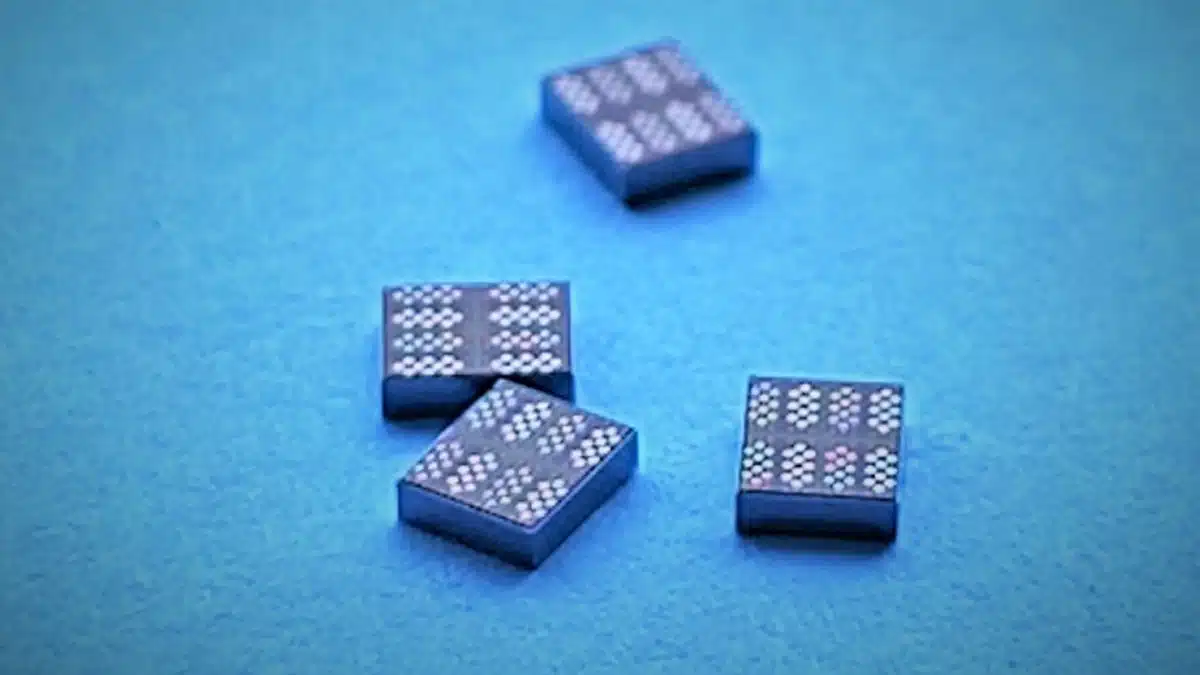
Elohim Silicon Capacitor for Embedded Application

Elohim Silicon Capacitor for Embedded Application

Elohim Inc., a leading innovator in embedded silicon capacitor technology, proudly announces a transformative collaboration with Daeduck Electronics, an esteemed player in the semiconductor packaging industry.

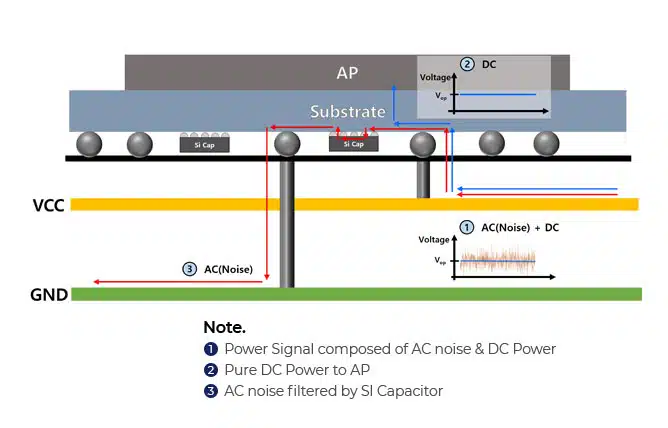
The latest development sees Elohim’s silicon capacitors embedded within Daeduck’s cutting-edge FCBGA substrate product, setting the stage for groundbreaking applications and future advancements.

RelatedPosts

DigiKey Releases Season Two of Sustainable Futures Series

Using a Virtual Anode Thermal Model to Evaluate Miniaturization Risk in Tantalum Capacitors

Bourns Introduced High-Current Coupled Inductor for 48 V Hybrid and IBC Converters

Daeduck Electronics conducted thorough reliability verification of Elohim’s silicon capacitors integrated into their component embedded substrate. Remarkably, the capacitance characteristics exhibited no significant change before and after reliability tests under thermal and highly accelerated stress tests. This reinforces the stability and resilience of Elohim’s silicon capacitor technology under varied environmental conditions.

Building on this successful integration, Elohim Inc. and Daeduck Electronics are set to enter the commercialization phase, with a focus on advancing semiconductor packaging solutions. The strategic collaboration aims to refine the integration of Elohim’s silicon capacitors into the FCBGA substrate, providing the semiconductor industry with a state-of-the-art packaging solution that meets the evolving demands of electronic devices.

The successful integration and evaluation open new doors for applications of Elohim’s silicon capacitors within the semiconductor industry. The Si-capacitor embedded FCBGA substrate, now validated for reliability, is expected to play a pivotal role in applications ranging from data centers to mobile application processors, GPU and CPU packages, and beyond. Elohim Inc. and Daeduck Electronics foresee a transformative impact on power optimization, reliability, and performance in electronic devices.

In a strategic move towards commercialization, Elohim Inc. and Daeduck Electronics are actively advancing their joint development with the aim of introducing a target product to the market. The companies are committed to refining the integration process, ensuring the seamless incorporation of silicon capacitors into the RDL interposer for widespread application in various electronic devices. The collaborative effort is poised to achieve commercialization by the end of 2024 or early 2025, setting ambitious targets for the semiconductor packaging industry.
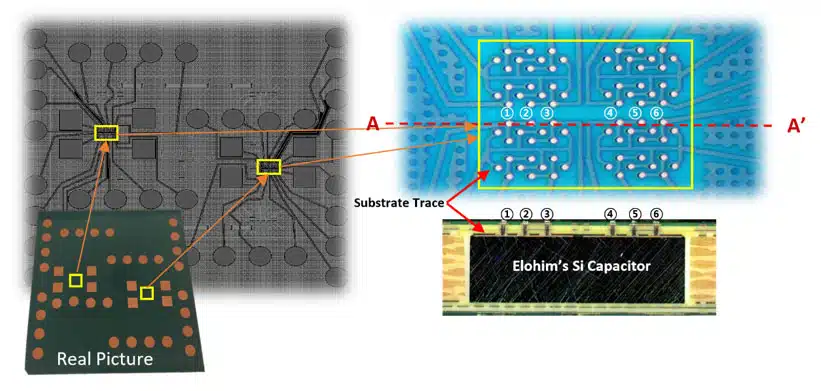
Embedded substrate of Elohim embedded silicon capacitor made by Daeduck Electronics

The collaboration between Elohim Inc. and Daeduck Electronics signifies a strategic partnership dedicated to achieving technological excellence in the semiconductor packaging sector. By surpassing reliability tests and setting ambitious commercialization goals, the companies reinforce their commitment to pushing the boundaries of innovation in electronic components.

About Elohim Silicon Capacitors

ELOHIM ultra-high-density silicon capacitors have been developed with high-k dielectrics and low-resistivity electrodes using semiconductor processes, employing a deep trench 3D structure to achieve a smaller size and higher capacitance. ELOHIM’s technology offers a range of form factors, providing high capacitance levels up to 1,000 nF/mm² (with 2,000 nF/mm² under development).

Currently, products with a silicon thickness of 70 μm are in the production stage (50 μm available on request). Reliable dielectric and electrode performance, as well as capacitance and electrical characteristics, are optimized through silicon processes. Customizable multi-terminals contribute to the high performance (low ESR and low ESL) of the silicon capacitor in various designs. ELOHIM silicon capacitors feature stability in the face of temperature and voltage changes, ensuring reliability over a 10-year lifespan (TDDB).

Features of Elohim 1st Generation Si Capacitor (Deep Trench)

  • >1,000 nF/mm² capacitance Density
  • >5 V Breakdown Voltage for Mobile and HPC
  • -65°C ~ 150°C Operation Temperature range
  • Size: 0.6×1.0mm, 1.2×1.0mm, 1.8×1.6mm, 2.6×2.1mm in thickness 70-635um
  • Capacitance Range: 250nF – 4600nF
  • Use for power delivery
ItemsTargetAchieved
Equivalent Series Resistance (ESR)< 30 mΩ2 mΩ
Equivalent Series Inductance (ESL)< 30 pH0.56 pH
Voltage Coefficient of Capacitance (VCC)< 1.0 %/V0.6 %/V
Temperature Coefficient of Capacitance (TCC)< 1.0 %/°C0.032 %/°C
Breakdown Voltage> 5 V5.3 V

Related

Source: Elohim

Recent Posts

Using a Virtual Anode Thermal Model to Evaluate Miniaturization Risk in Tantalum Capacitors

24.6.2026
14

High‑Speed Supercapacitor Balancing for AI Data Center Power Systems

23.6.2026
41

Practical Value of Structural Diagnostics for Tantalum Capacitor Anodes

22.6.2026
23

Knowles Expands High‑Q Ceramic Core Inductors for RF designs

19.6.2026
23

TrendForce: CSP in‑house AI ASIC Boom Reshapes Capacitor Demand

18.6.2026
110

Samsung Introduces Automotive 1206 100uF X7T MLCC for Power Rails in ADAS and SoCs

17.6.2026
32

YMIN Hybrid Aluminum Capacitors for Automotive LiDAR Power Rails

17.6.2026
30

Samsung Presents Ultra‑Thin Silicon Capacitors for AI and Server PDN

17.6.2026
71

YAGEO Introduces 310VAC SMD Y2 Safety MP Capacitors for Compact EMI Filtering

16.6.2026
36

Upcoming Events

Jun 30
17:00 - 18:00 CEST

PSMA Capacitor Committee Webinar: High Voltage Pulse Capacitors

Jul 14
16:00 - 17:00 CEST

EMC Design Essentials: Mastering Varistors and Common Mode Chokes

Jul 21
16:00 - 17:00 CEST

Safety by design: X and Y Interference suppression capacitors for power line filters

View Calendar

Popular Posts

  • Boost Converter Design and Calculation

    0 shares
    Share 0 Tweet 0
  • Buck Converter Design and Calculation

    0 shares
    Share 0 Tweet 0
  • LLC Resonant Converter Design and Calculation

    0 shares
    Share 0 Tweet 0
  • Flyback Converter Design and Calculation

    0 shares
    Share 0 Tweet 0
  • MLCC and Ceramic Capacitors

    0 shares
    Share 0 Tweet 0
  • Earthing Systems and IEC Classification Explained

    0 shares
    Share 0 Tweet 0
  • Nvidia Vera Rubin: Why One AI Rack Needs So Many More MLCC Capacitors

    0 shares
    Share 0 Tweet 0
  • Dual Active Bridge (DAB) Topology

    0 shares
    Share 0 Tweet 0
  • SEPIC Converter Design and Calculation

    0 shares
    Share 0 Tweet 0
  • MLCC Case Sizes Standards Explained

    0 shares
    Share 0 Tweet 0

Newsletter Subscription


Passive Components Blog

© EPCI - Leading Passive Components Educational and Information Site

  • Home
  • Privacy Policy
  • EPCI Membership & Advertisement
  • About

No Result
View All Result
  • Home
  • Knowledge Blog
  • Dossiers
  • PCNS

© EPCI - Leading Passive Components Educational and Information Site

This website uses cookies. By continuing to use this website you are giving consent to cookies being used. Visit our Privacy and Cookie Policy.
Go to mobile version