












Passive Components Blog
No Result
View All Result
  • Home
  • NewsFilter
    • All
    • Aerospace & Defence
    • Antenna
    • Applications
    • Automotive
    • Capacitors
    • Circuit Protection Devices
    • electro-mechanical news
    • Filters
    • Fuses
    • Inductors
    • Industrial
    • Integrated Passives
    • inter-connect news
    • Market & Supply Chain
    • Market Insights
    • Medical
    • Modelling and Simulation
    • New Materials & Supply
    • New Technologies
    • Non-linear Passives
    • Oscillators
    • Passive Sensors News
    • Resistors
    • RF & Microwave
    • Telecommunication
    • Weekly Digest

    YAGEO Presents NANOMET Soft Magnetic Cores for High‑Density Power Conversion

    Coilcraft Releases High-Current Ferrite Beads for CISPR 25 EMC compliance

    From DCL to SSC: Bridging Electrical Symptoms and Structural Indicators in Tantalum Capacitors

    Vishay Unveils Multi-Turn Position Sensor for Harsh Industrial Environments

    YAGEO Introduces Automotive MOV Surge Protection Varistor

    TDK Releases Compact SMD Gate Drive Transformers for xEV

    Wk 26 Electronics Supply Chain Digest

    High-Q RF & Microwave MLCCs: A Cross-Vendor Benchmark

    Molex Unveils Automotive Ethernet Connectors for Next‑Gen SDV Architectures

    Trending Tags

    • Ripple Current
    • RF
    • Leakage Current
    • Tantalum vs Ceramic
    • Snubber
    • Low ESR
    • Feedthrough
    • Derating
    • Dielectric Constant
    • New Products
    • Market Reports
  • VideoFilter
    • All
    • Antenna videos
    • Capacitor videos
    • Circuit Protection Video
    • Filter videos
    • Fuse videos
    • Inductor videos
    • Inter-Connect Video
    • Non-linear passives videos
    • Oscillator videos
    • Passive sensors videos
    • Resistor videos

    KYOCERA AVX Presents Antenna Integrator Studio Tutorial for Antenna Placement and RF Design

    Power Design Simulation Tools for Faster Inductor Selection and Loss Optimization

    EMC‑Compliant PCB and Connector Design Guidelines

    Why Isolated DC/DC Power Supplies Fail Late, Würth Elektronik Podcast

    Designing 800 V DC EMC Filters: Calculation, Simulation and Measurement

    Current Sense Transformer Datasheet and Design‑in Guide

    Designing a USB Type‑C Flyback Planar Transformer with Frenetic’s Planar Tool

    Magnetics Design in High‑Frequency GaN Converters

    Qi2 Wireless Charging: Inductors, Capacitors and EMC Filters

    Trending Tags

    • Capacitors explained
    • Inductors explained
    • Resistors explained
    • Filters explained
    • Application Video Guidelines
    • EMC
    • New Products
    • Ripple Current
    • Simulation
    • Tantalum vs Ceramic
  • Knowledge Blog
  • DossiersNew
  • Suppliers
    • Who is Who
  • PCNS
    • PCNS 2025
    • PCNS 2023
    • PCNS 2021
    • PCNS 2019
    • PCNS 2017
  • Events
  • Home
  • NewsFilter
    • All
    • Aerospace & Defence
    • Antenna
    • Applications
    • Automotive
    • Capacitors
    • Circuit Protection Devices
    • electro-mechanical news
    • Filters
    • Fuses
    • Inductors
    • Industrial
    • Integrated Passives
    • inter-connect news
    • Market & Supply Chain
    • Market Insights
    • Medical
    • Modelling and Simulation
    • New Materials & Supply
    • New Technologies
    • Non-linear Passives
    • Oscillators
    • Passive Sensors News
    • Resistors
    • RF & Microwave
    • Telecommunication
    • Weekly Digest

    YAGEO Presents NANOMET Soft Magnetic Cores for High‑Density Power Conversion

    Coilcraft Releases High-Current Ferrite Beads for CISPR 25 EMC compliance

    From DCL to SSC: Bridging Electrical Symptoms and Structural Indicators in Tantalum Capacitors

    Vishay Unveils Multi-Turn Position Sensor for Harsh Industrial Environments

    YAGEO Introduces Automotive MOV Surge Protection Varistor

    TDK Releases Compact SMD Gate Drive Transformers for xEV

    Wk 26 Electronics Supply Chain Digest

    High-Q RF & Microwave MLCCs: A Cross-Vendor Benchmark

    Molex Unveils Automotive Ethernet Connectors for Next‑Gen SDV Architectures

    Trending Tags

    • Ripple Current
    • RF
    • Leakage Current
    • Tantalum vs Ceramic
    • Snubber
    • Low ESR
    • Feedthrough
    • Derating
    • Dielectric Constant
    • New Products
    • Market Reports
  • VideoFilter
    • All
    • Antenna videos
    • Capacitor videos
    • Circuit Protection Video
    • Filter videos
    • Fuse videos
    • Inductor videos
    • Inter-Connect Video
    • Non-linear passives videos
    • Oscillator videos
    • Passive sensors videos
    • Resistor videos

    KYOCERA AVX Presents Antenna Integrator Studio Tutorial for Antenna Placement and RF Design

    Power Design Simulation Tools for Faster Inductor Selection and Loss Optimization

    EMC‑Compliant PCB and Connector Design Guidelines

    Why Isolated DC/DC Power Supplies Fail Late, Würth Elektronik Podcast

    Designing 800 V DC EMC Filters: Calculation, Simulation and Measurement

    Current Sense Transformer Datasheet and Design‑in Guide

    Designing a USB Type‑C Flyback Planar Transformer with Frenetic’s Planar Tool

    Magnetics Design in High‑Frequency GaN Converters

    Qi2 Wireless Charging: Inductors, Capacitors and EMC Filters

    Trending Tags

    • Capacitors explained
    • Inductors explained
    • Resistors explained
    • Filters explained
    • Application Video Guidelines
    • EMC
    • New Products
    • Ripple Current
    • Simulation
    • Tantalum vs Ceramic
  • Knowledge Blog
  • DossiersNew
  • Suppliers
    • Who is Who
  • PCNS
    • PCNS 2025
    • PCNS 2023
    • PCNS 2021
    • PCNS 2019
    • PCNS 2017
  • Events
No Result
View All Result
Passive Components Blog
No Result
View All Result

Filter Bandwidth Explained

4.1.2023
Reading Time: 5 mins read
A A

This blog article from Knowles Precision Devices perform a deep dive on what bandwidth is and why we need to consider bandwidth when selecting a filter. 

In previous article, we provided a brief overview of five key filter specifications to understand, one of which was bandwidth. In this post, we will dive deeper into bandwidth by looking at the history of bandwidth, how bandwidth dictates data rate, and why the type of filter required will vary depending on an application’s bandwidth requirements.

RelatedPosts

Knowles Expands High‑Q Ceramic Core Inductors for RF designs

Knowles Releases 3825 X1/Y2 Safety MLCCs for High‑Voltage Applications

Knowles Expands High Q Ceramic Core Inductors

First, let’s look at why bandwidth is important. In general, bandwidth is defined as the width of the passband of the bandpass filter and expressed as the frequency difference between the lower and upper 3 dB points. Bandwidth will dictate the data rate, or how quickly we can send information through a channel such as an optical fiber or a section of the radio spectrum.

A Historical Review of How to Calculate Bandwidth

To better understand bandwidth, let’s look back at some of the historical work that laid the foundation for how to consider this specification. In the 1920s, when Harry Nyquist was working on the telegraph at AT&T’s Department of Development and Research, the notion of the Nyquist Rate emerged from his work. In short, this is the theoretical minimum system bandwidth needed to detect Rs symbols per second is Rs/2 hertz.

A way to look at this more simply is to think about how signals behave in time when they are band limited. A signal such as a series of pulses that is band limited in the frequency domain gets distorted and smeared out in time. To stop these smeared-out pulses from overlapping and becoming indistinguishable at a detector, there needs to be enough bandwidth to contain all, or at least the majority, of the frequency components that make up that signal pulse. It turns out, the amount of bandwidth we need gives us the Nyquist Rate, which says that for things to make sense at the other end of a transmission, we can send pulses as fast as twice the channel bandwidth, but no faster.

Similarly, to understand why bandwidth follows when we need to increase data rate, let’s look at the Shannon-Hartley theorem that was developed in 1948 by Claude Shannon and Ralph Hartley, both researchers at Bell Labs. This theorem tells us that the maximum amount of error-free digital data that can be transmitted over a channel of a given bandwidth in the presence of noise, which is calculated using the following equation:
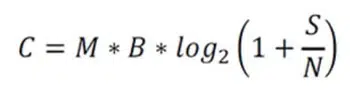
where:

  • C = Channel capacity in bits/second
  • M = Number of channels (e.g. the MIMO order)
  • B = Bandwidth in hertz
  • S = transmit power, in watts
  • N = noise on channel, in watts
  • S/N = signal to noise ratio

To increase channel capacity (data rates) we can increase bandwidth, the number of channels, or transmit power (S) or decrease the noise on the channel (N). Since this post is focused on bandwidth, we won’t get into too much detail about this, but it is worth noting that you can reduce N and increase channel capacity with filtering. For example, by including a filter with very low insertion loss, you could improve the overall noise figure, or you could address any aliasing effects that would bring out of band noise in the band of interest using a really good filter. 

How Does an Application’s Bandwidth Requirements Impact Filter Selection?

Bandwidth requirements vary widely by application as shown in Figure 1.
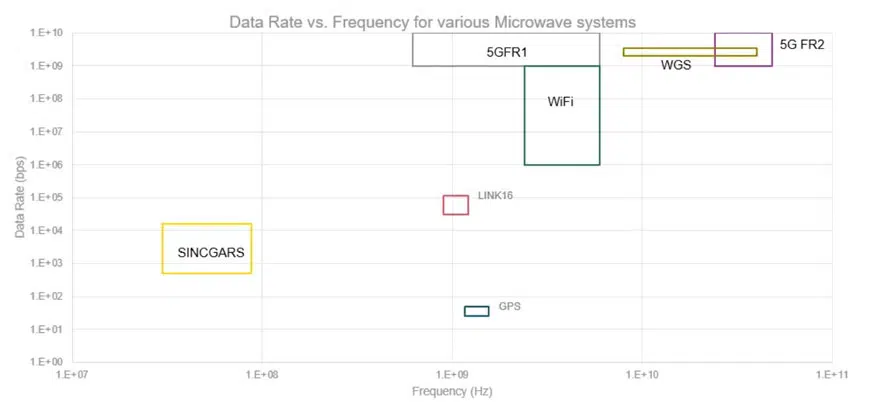
Figure 1. The relationship between bandwidth and frequency for a variety of common microwave systems adapted From: Demmin, Booz Allen Hamilton 68th IEEE Electronic Components and Technology Conference.

Since different applications require different data rates to successfully transmit signals without introducing noise, different types of filters are necessary as bandwidth and frequency increase. In short, the type of filter you need depends on where you are on the frequency versus bandwidth plot. More specifically, if you look back to Five Key Filter Specifications again, we also noted that we can look at the relative, or fractional, bandwidth of the filter. This is the ratio of a filter’s bandwidth to its center frequency. As shown in Figure 2, different filter technologies are capable of different fractional bandwidths.
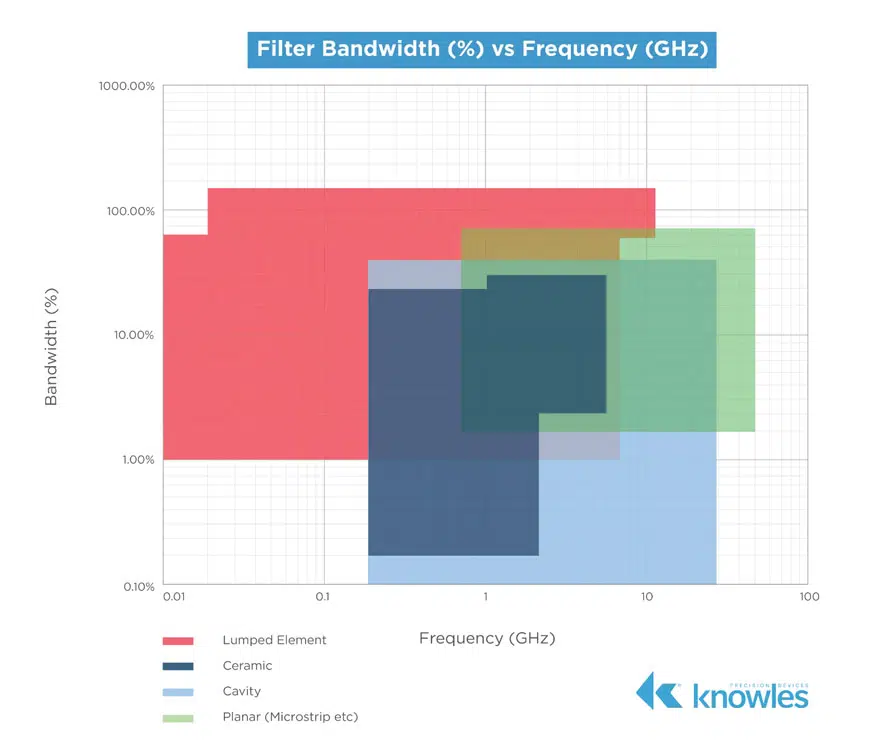
Figure 2. Fractional bandwidths across frequencies for a variety of filter types.

Throughout this post, we looked at several different aspects of bandwidth, including how bandwidth is driven by the required channel capacity, or data rate; how different systems have different data rates, and hence, different bandwidths; and how different filter technologies are used to meet these varying bandwidth needs. In the next post in this series, we will spend more time exploring poles and zeros and how these are tools a filter designer can manipulate to improve a filter’s response.

Related

Recent Posts

From DCL to SSC: Bridging Electrical Symptoms and Structural Indicators in Tantalum Capacitors

7.7.2026
31

Enabling the 800 V AI Server Era: How C0G High-Voltage MLCC Supports Next-Generation Power Architectures

1.7.2026
138

Power Design Simulation Tools for Faster Inductor Selection and Loss Optimization

29.6.2026
34

Using a Virtual Anode Thermal Model to Evaluate Miniaturization Risk in Tantalum Capacitors

24.6.2026
48

EMC‑Compliant PCB and Connector Design Guidelines

22.6.2026
83

Practical Value of Structural Diagnostics for Tantalum Capacitor Anodes

22.6.2026
43

Würth Elektroniks Flexible EMI Shielding Sheets Provides Quick and Easy Schielding Solution

17.6.2026
79

Ultrahigh Energy Storage in Lead‑Free BiFeO₃‑Based Ceramic Capacitors via Local Polar Structure Design

16.6.2026
40

All‑Water Supercapacitor Based on 1‑nm Clay Channels and Nanoconfined Water Electrolyte

10.6.2026
70

Upcoming Events

Jul 14
16:00 - 17:00 CEST

EMC Design Essentials: Mastering Varistors and Common Mode Chokes

Jul 21
16:00 - 17:00 CEST

Safety by design: X and Y Interference suppression capacitors for power line filters

Jul 28
8:00 - 11:00 CEST

Post Procurement Testing of EEE Components for LEO Space Applications

View Calendar

Popular Posts

  • Boost Converter Design and Calculation

    0 shares
    Share 0 Tweet 0
  • Buck Converter Design and Calculation

    0 shares
    Share 0 Tweet 0
  • Flyback Converter Design and Calculation

    0 shares
    Share 0 Tweet 0
  • LLC Resonant Converter Design and Calculation

    0 shares
    Share 0 Tweet 0
  • MLCC and Ceramic Capacitors

    0 shares
    Share 0 Tweet 0
  • Earthing Systems and IEC Classification Explained

    0 shares
    Share 0 Tweet 0
  • Nvidia Vera Rubin: Why One AI Rack Needs So Many More MLCC Capacitors

    0 shares
    Share 0 Tweet 0
  • YAGEO Announces July 2026 Capacitor Price Increase

    0 shares
    Share 0 Tweet 0
  • MLCC Case Sizes Standards Explained

    0 shares
    Share 0 Tweet 0
  • Dual Active Bridge (DAB) Topology

    0 shares
    Share 0 Tweet 0

Newsletter Subscription


Passive Components Blog

© EPCI - Leading Passive Components Educational and Information Site

  • Home
  • Privacy Policy
  • EPCI Membership & Advertisement
  • About

No Result
View All Result
  • Home
  • Knowledge Blog
  • Dossiers
  • PCNS

© EPCI - Leading Passive Components Educational and Information Site

This website uses cookies. By continuing to use this website you are giving consent to cookies being used. Visit our Privacy and Cookie Policy.
Go to mobile version