





Passive Components Blog
No Result
View All Result
  • Home
  • News
    • All
    • Aerospace & Defence
    • Antenna
    • Applications
    • Automotive
    • Capacitors
    • Circuit Protection Devices
    • electro-mechanical news
    • Filters
    • Fuses
    • Inductors
    • Industrial
    • Integrated Passives
    • inter-connect news
    • Market & Supply Chain
    • Market Insights
    • Medical
    • Modelling and Simulation
    • New Materials & Supply
    • New Technologies
    • Non-linear Passives
    • Optoelectronics and Isolation
    • Oscillators
    • Passive Sensors News
    • Resistors
    • RF & Microwave
    • Telecommunication
    • Weekly Digest
    TDK HVC28 and HVC29 high-voltage DC contactors with black housings and main power terminals

    TDK Introduces Gas-Filled High-Voltage DC Contactors up to 600 A

    Murata SWL RF coaxial switch connector measurement diagram and SWL-to-SWJ board-area comparison.

    Murata RF Switch Connectors Cut PCB Test-Point Area

    Elektra Awards 2026: Passive Components and Interconnect Finalists Showcase Advances in Power Integrity, Precision and Reliability

    Mathematical state-space illustration of a series-connected memcapacitor oscillator with two constrained memory coordinates

    Memcapacitor chaos in a six-state series-connected model

    Exxelia capacitor and magnetics innovations for Electronica 2026, including CM-HVLP and CF-PP140 capacitors

    Exxelia Brings High-Temperature Passives to Electronica 2026

    IP&E Market Outlook: AI Demand Tightens Supply and Supports Higher Pricing into 2027

    Samsung Electro-Mechanics CL05Z106MS66PN automotive MLCC illustration with a rectangular ceramic body and metal end terminations

    Samsung Adds 0402 10 µF X7T MLCC for ADAS Power Rails

    Bourns PTVS03-450E-H power TVS diode in a surface-mount DFN package

    Bourns Releases 450 V Power TVS for DC Bus Clamping

    MLCC construction image

    Samsung Electro-Mechanics Patent Targets to Reduce Moisture and Cracks in High-Capacity MLCCs

    Trending Tags

    • Ripple Current
    • RF
    • Leakage Current
    • Tantalum vs Ceramic
    • Snubber
    • Low ESR
    • Feedthrough
    • Derating
    • Dielectric Constant
    • New Products
    • Market Reports
  • Knowledge Blog
  • Dossiers
    • Aerospace and Defense Passive Components Dossier
    • AI Hardware Dossier
    • Automotive Dossier
    • Industrial Robotics Dossier
    • Power Converter Dossier
    • Capacitor Dossier
    • Circuit Protection Dossier
    • Inductor Dossier
    • Resistor Dossier
    • Silicon Capacitors and Integrated Passives Dossier
  • Suppliers
    • Who is Who
  • PCNS
    • PCNS 2025
    • PCNS 2023
    • PCNS 2021
    • PCNS 2019
    • PCNS 2017
  • Events
No Result
View All Result
Passive Components Blog
No Result
View All Result

Impact of Channel Length of the Pores to Supercapacitor Performance 

24.3.2025
Reading Time: 5 mins read
A A

Researchers from KIT, Germany published their study on supercapacitor performance: “Impact of the Channel Length in Nanoporous Electric Double-Layer Capacitors on the Charge Transport Explored by Metal–Organic Framework Films” in ACS Physical Chemistry Journal.

This study explores the impact of channel length in nanoporous electric double-layer supercapacitors (EDLCs) using metal-organic framework (MOF) films.

RelatedPosts

TDK Introduces Gas-Filled High-Voltage DC Contactors up to 600 A

Murata RF Switch Connectors Cut PCB Test-Point Area

Elektra Awards 2026: Passive Components and Interconnect Finalists Showcase Advances in Power Integrity, Precision and Reliability

Cu3(HHTP)2 films of varying thicknesses were deposited on substrates and used as working electrodes in EDLCs with aqueous KCl and pure ionic liquid electrolytes.

The study found that the scan-rate-dependent capacitance is proportional to the MOF film thickness, indicating accessible pore space.

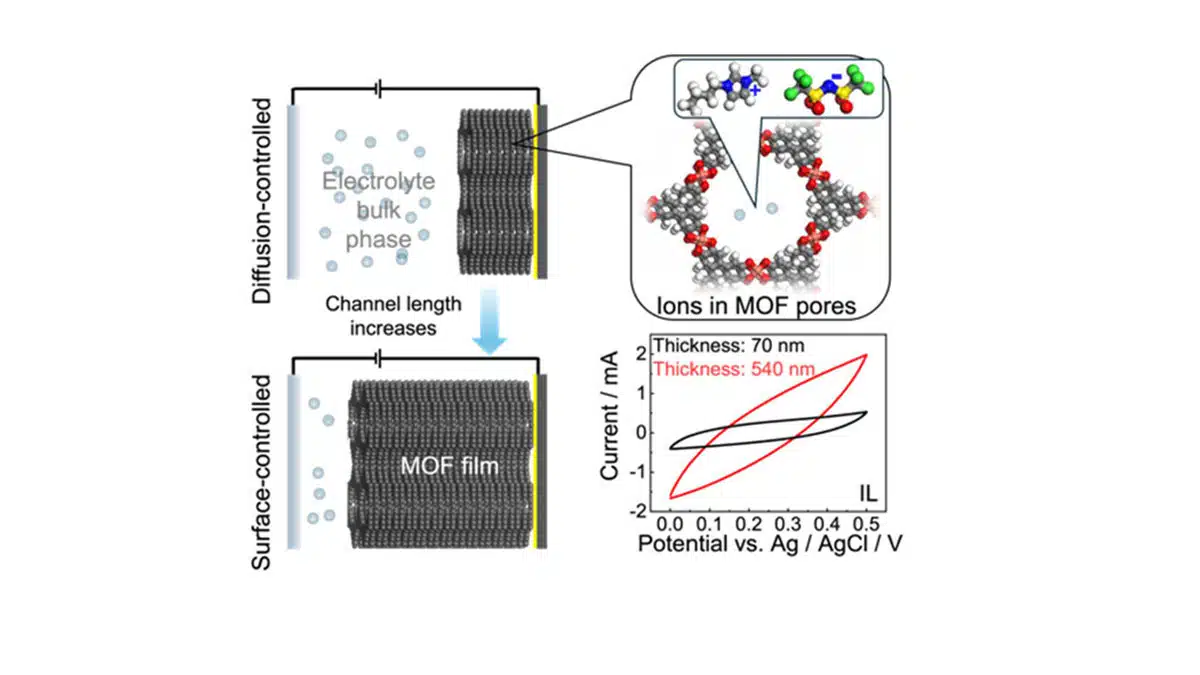
Cu3(HHTP)2 SURMOF films were synthesized using a layer-by-layer dipping method on gold-coated silicon wafers. The films exhibited a dense, continuous morphology with a linear growth rate, with thickness increasing with the number of synthesis cycles. Electrochemical analysis showed nearly rectangular CV curves in KCl electrolyte, indicating excellent capacitive performance, while IL electrolyte exhibited spindle-shaped curves, reflecting a deviation from ideal double-layer capacitance.

The capacitance of MOF electrodes in KCl and IL electrolytes is proportional to film thickness, indicating homogeneous material. Analysis of scan rate-dependent capacitance reveals that the entire pore space is accessible to KCl ions, while IL ions are partially blocked. The capacitance per MOF surface area is constant for KCl but decreases for IL due to larger ionic sizes and kinetic effects.

The study synthesized 2D-cMOF Cu3(HHTP)2 films with varying thicknesses and evaluated their performance as working electrodes in EDLCs. The b-values, determined from the Randles–Sevcik equation, increased with film thickness, indicating a transition from diffusion-controlled to surface-controlled current behavior. The analysis of total capacitance showed that film thickness impacts capacitance, depending on the electrolyte, with highly mobile electrolytes like KCl benefiting from thicker films while less mobile electrolytes like IL require shorter channel lengths for optimal performance.

A review of supercapacitors with graphene/graphyne electrodes and various ionic liquids is presented. The study compares the performance of these supercapacitors using molecular dynamics simulations. The findings highlight the potential of graphene/graphyne electrodes in enhancing supercapacitor performance.

Key Points

Here are the key points extracted from the article:

  • Objective:
  • The study explores the impact of pore channel length (i.e., film thickness) in nanoporous electrodes on the performance of electric double-layer capacitors (EDLCs).
  • Materials Used:
  • Two-dimensional conductive metal–organic frameworks (MOFs), specifically Cu₃(HHTP)₂, were synthesized with precisely controlled thickness.
  • Electrolytes Studied:
  • Aqueous potassium chloride (KCl) solution.
  • Pure ionic liquid (IL), [BMIM]⁺[TFSI]⁻.
  • Key Findings:
  • For KCl: Ion transport is primarily surface-controlled, even for thick films, leading to efficient charge kinetics. Capacitance per surface area remains constant irrespective of film thickness.
  • For IL: Ion transport is diffusion-limited, and thicker films significantly decrease capacitance due to higher transport resistance.
  • Channel length influences capacitance differently based on the electrolyte’s mobility.
  • Methodologies:
  • Cyclic voltammetry (CV) experiments were conducted to analyze ion transport and charge kinetics.
  • Techniques such as Trasatti and Dunn’s methods were applied for capacitance evaluation.
  • Applications:
  • Insights aid in designing high-performance energy storage devices by balancing film thickness and electrolyte properties.

Conclusions

In summary, we synthesized 2D-cMOF Cu3(HHTP)2 films with varying thicknesses and evaluated their performance as working electrodes in EDLCs. By using two types of electrolytes, aqueous KCl and pure IL [BMIM]+[TFSI]−, we systematically investigated the impact of the channel length of the pores on the EDLC capacitance and the ion transport kinetics within the MOF electrodes. The CV data are analyzed by various methods, including those introduced by Trasatti and Dunn.

The determined b-value from the Randles–Sevcik equation increases with film thickness, indicating a transition from diffusion-controlled to surface-controlled current behavior, highlighting the growing influence of surface processes in thicker films. The analysis of the total capacitance shows that, while the entire pore space seems to be accessible by the ions of the electrolyte, the film thickness (i.e., the channel length) can have a dramatic impact on the capacitance, depending on the electrolyte.

For highly mobile aqueous KCl solution, the capacitance per specific MOF surface area is not affected by the film thickness; thus, thicker films result in larger capacitances normalized to the substrate area. On the other hand, using IL as the electrolyte shows a strong diffusion transport limitation, which results in decreasing performance with increasing channel length. This study provides valuable insights into the design and optimization of electrodes made of 2D c-MOF and also other materials for energy storage applications.

In future studies, the effect of the pore structure and functionality along with electrolyte optimization needs to be explored in combination with the effect of the channel length. This will allow us to develop the ideal material for high-performance supercapacitors and other energy storage technologies.

Read the full article here: https://pubs.acs.org/doi/10.1021/acsphyschemau.4c00104

Related

Source: ACS Publications

Recent Posts

Elektra Awards 2026: Passive Components and Interconnect Finalists Showcase Advances in Power Integrity, Precision and Reliability

28.10.2026
10
Mathematical state-space illustration of a series-connected memcapacitor oscillator with two constrained memory coordinates

Memcapacitor chaos in a six-state series-connected model

28.10.2026
4
Exxelia capacitor and magnetics innovations for Electronica 2026, including CM-HVLP and CF-PP140 capacitors

Exxelia Brings High-Temperature Passives to Electronica 2026

29.10.2026
13
Samsung Electro-Mechanics CL05Z106MS66PN automotive MLCC illustration with a rectangular ceramic body and metal end terminations

Samsung Adds 0402 10 µF X7T MLCC for ADAS Power Rails

27.10.2026
12
MLCC construction image

Samsung Electro-Mechanics Patent Targets to Reduce Moisture and Cracks in High-Capacity MLCCs

26.10.2026
35
Samsung Electro-Mechanics MFC molded frame ceramic capacitor with epoxy encapsulation and external metal frame

Samsung 100V Molded Frame MLCC Targets 48V AI Server PSUs

26.10.2026
21
TDK B3201 series Y1 film safety capacitors with rectangular cases and parallel wire leads

TDK Introduces Y1 Film Safety Capacitors for 500 V AC EMI Filtering

21.10.2026
31
Modelithics COMPLETE+3D v26.4 library for RF passive-component and 3D electromagnetic simulation in Keysight ADS/RFPro

Modelithics COMPLETE+3D v26.4 Expands RF Models and 3D Workflows

19.10.2026
12
Siemens executives Markus Grabmeier and Barry Powell with Skeleton Technologies CEO Taavi Madiberk at the investment announcement

Siemens Backs Skeleton’s US AI Power Manufacturing Expansion

15.10.2026
69

Upcoming Events

Nov 24
16:00 - 17:00 CET

Select the Correct Components for Your DC/DC Converter

Dec 1
16:00 - 17:00 CET

Developing low-noise mixed-signal systems

Dec 8
16:00 - 17:00 CET

WE-CCMF: Design Principles, Layout Guidelines and Measurement Results for High-Speed EMI Filtering

View Calendar

Popular Posts

  • Buck Converter Design and Calculation

    0 shares
    Share 0 Tweet 0
  • Boost Converter Design and Calculation

    0 shares
    Share 0 Tweet 0
  • September 2026 Interconnect, Passives and Electromechanical Components Market Insights

    0 shares
    Share 0 Tweet 0
  • LLC Resonant Converter Design and Calculation

    0 shares
    Share 0 Tweet 0
  • Capacitor Charging and Discharging

    0 shares
    Share 0 Tweet 0
  • Flyback Converter Design and Calculation

    0 shares
    Share 0 Tweet 0
  • MLCC and Ceramic Capacitors

    0 shares
    Share 0 Tweet 0
  • RF Connector Types: How To Choose the Right One

    0 shares
    Share 0 Tweet 0
  • Passive Low Pass Filters: Fundamentals and EMI Design

    0 shares
    Share 0 Tweet 0
  • Audio Capacitors: Choosing Capacitors for Crossover Circuits

    0 shares
    Share 0 Tweet 0

Newsletter Subscription


Passive Components Blog

© 2015–2026
All rights reserved

  • Home
  • Privacy Policy
  • EPCI Membership & Advertisement
  • About

No Result
View All Result
  • Home
  • Knowledge Blog
  • Dossiers
  • PCNS

© 2015–2026
All rights reserved