




Silicon capacitors for AI processors, precision thick-film resistors and automotive polymer capacitors are among the finalists for the Elektra Awards 2026.
Silicon capacitors for AI processors, precision thick-film resistors and automotive polymer capacitors feature among the finalists for the Elektra Awards 2026.
The Passive/Interconnection/Electromechanical Product of the Year shortlist brings together 11 entries covering passive components, RF connectivity, high-voltage switching, power distribution, optical cabling and ultrasonic sensing.
For passive-component engineers, the selection highlights several important development priorities: bringing decoupling closer to the processor, combining resistor precision with higher power density, improving automotive capacitor robustness and extending passive RF performance into millimetre-wave frequencies.
The winners are scheduled to be announced on 8 December 2026 at the Hilton Bankside in London.
Passive Component Finalists at a Glance
Five shortlisted entries are particularly relevant to passive-component design: three capacitor technologies, a precision resistor series and an RF attenuator family.
| Manufacturer | Finalist product | Main technical focus |
|---|---|---|
| Empower Semiconductor | EC2005P, EC2025P and EC2006P ECAP silicon capacitors | High-density, low-inductance package-level decoupling |
| Panasonic Industry Europe | ERJPC high-precision thick-film resistors | Precision, temperature stability and increased power density |
| Panasonic Industry Europe | SP-Cap AX polymer aluminium capacitors | Low-ESR, low-profile capacitance for automotive electronics |
| Smiths Interconnect | TSX wire-bondable fixed chip attenuators | Broadband passive RF attenuation for space and defence |
| Vishay Intertechnology | SMDY1 Automotive Series | Surface-mount Y1 safety capacitors for automotive EMI suppression |
Empower ECAP Silicon Capacitors: Bringing Decoupling Inside the Processor Package
Empower Semiconductor’s EC2005P, EC2025P and EC2006P silicon capacitors address a central challenge in AI and high-performance computing: maintaining a stable processor supply voltage during rapid load changes.
Rather than relying exclusively on PCB-mounted decoupling, the ECAP approach places high-density capacitance within the processor package or substrate. This shortens the electrical connection between the capacitor and the load, reducing the parasitic inductance that can limit high-frequency decoupling performance.
The devices use deep-trench silicon capacitor structures and integrate multiple capacitive elements into a single component. Their significance lies in combining capacitance density with very low parasitic inductance and resistance.
Product highlights:
- Footprint classes of approximately 2 × 2 mm, 4 × 2 mm and 4 × 4 mm.
- Approximate total capacitance classes of 9 µF, 19 µF and 36 µF, respectively.
- Maximum operating voltage of 1.2 V for the listed models.
- Equivalent series inductance below 5 pH.
- Support for substrate embedding, die-side mounting and land-side mounting.
- Silicon capacitor technology designed to avoid the bias-dependent capacitance reduction associated with high-capacitance Class II ceramic dielectrics.
The engineering distinction is placement as much as capacitor technology. Package-integrated capacitors add a decoupling layer between on-die capacitance and board-level components, allowing engineers to distribute capacitance more effectively throughout the power-delivery network.
For related technology background, see Empower E-CAP Silicon Capacitors vs MLCC. The wider relationship between processor power delivery and passive-component selection is covered in the AI Hardware Dossier.
Panasonic ERJPC: Precision Thick-Film Resistors Challenge Thin-Film Territory
Panasonic’s ERJPC series combines resistance tolerance down to ±0.1% with a temperature coefficient of resistance as low as ±25 ppm/K. These specifications bring thick-film resistors into applications traditionally associated with thin-film devices.
The series targets precision circuits in battery-management systems, electronic control units, industrial equipment and data-server applications. Its development focuses on balancing initial accuracy, temperature stability, environmental robustness and power dissipation within compact chip packages.
Product highlights:
- Resistance tolerance options down to ±0.1%.
- TCR down to ±25 ppm/K.
- Rated power of 0.2 W in 0603 and 0.25 W in 0805 packages.
- Up to twice the power rating of the thin-film solutions used in Panasonic’s comparison.
- AEC-Q200 compliance.
- Construction designed to improve resistance stability and withstand environmental and electrical stresses.
For designers, the important development is a broader choice of technology for precision applications. ERJPC creates opportunities to balance accuracy, thermal performance, footprint and cost without automatically selecting thin-film construction.
Technology selection still requires more than comparing initial tolerance. Temperature coefficient, long-term drift, electrical noise, working voltage and pulse loading all contribute to the application’s total error and reliability requirements. The blog’s Resistor Technology Selection and Benchmark Guidelines provides a broader selection framework, while Thick-Film Chip Resistors: Construction and Properties explains the underlying technology.
Panasonic SP-Cap AX: Low-ESR Polymer Aluminium Capacitors for Automotive Electronics
The SP-Cap AX series extends Panasonic’s rectangular conductive-polymer aluminium electrolytic capacitor platform into automotive applications.
The listed AX devices combine 470 µF capacitance with a 2.5 V rating and ESR options from 3 mΩ to 6 mΩ. Their 1.9 mm height supports designs where board area and available enclosure height are constrained.
Product highlights:
- Nominal capacitance of 470 µF.
- Rated voltage of 2.5 V.
- Maximum ESR options of 3 mΩ, 4.5 mΩ and 6 mΩ.
- Package dimensions of 7.3 × 4.3 × 1.9 mm.
- Operating-temperature range of −55°C to +125°C.
- Endurance specification of 2,000 hours at +125°C.
The AX series is a low-voltage capacitor solution, not a component for direct connection to a vehicle’s high-voltage battery bus. Its combination of high capacitance, low ESR and low profile makes it relevant to compact automotive power-supply stages.
Low ESR can reduce ripple-related dissipation, but capacitor selection must also account for ripple-current rating, operating temperature and lifetime requirements. These relationships are explained in Understanding the Influence of ESR and Ripple Current for Capacitor Selection.
Smiths Interconnect TSX: Broadband Passive Attenuation for Space and Defence
Smiths Interconnect’s TSX wire-bondable fixed chip attenuators demonstrate that passive-component innovation extends beyond low-frequency capacitors and resistors.
The TSX WB2 series provides broadband attenuation up to 50 GHz in a compact 0404 wire-bondable package, with qualification to MIL-PRF-55342 for demanding space and defence applications.
The devices target chip-and-wire RF assemblies used in transmit/receive modules, amplifier circuits, radar and satellite communications.
Product highlights:
- Broadband performance from DC to 50 GHz.
- Compact 0404 wire-bondable construction.
- Attenuation values of 1–10 dB, plus 15 dB, 20 dB and 30 dB.
- Low voltage standing-wave ratio and tight attenuation tolerance.
- Qualification and testing options supporting high-reliability programmes.
The combination of bandwidth, small size and a defined qualification route is central to the product’s appeal. At these frequencies, the component’s geometry and interconnection become part of its electrical performance, making package and assembly choices particularly important.
For a wider comparison of resistive technologies and their application characteristics, see Thin Film and Metal Film Resistors.
Vishay SMDY1 Automotive: Y1 Safety Capacitors Move to Surface Mount
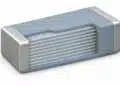
Vishay’s SMDY1 Automotive Series combines automotive qualification with a surface-mount ceramic-disc safety capacitor format.
The devices provide a Y1 rating of 500 VAC and 1,500 VDC, with capacitance values from 470 pF to 4.7 nF. Target applications include on-board chargers, traction inverters, battery-management systems, e-compressors and AC/DC converters.
Product highlights:
- AEC-Q200 qualification, with PPAP documentation available.
- Y1 rating of 500 VAC and 1,500 VDC.
- X1 rating of 760 VAC.
- Capacitance range of 470 pF to 4.7 nF, with ±20% tolerance.
- Class IIB humidity performance under IEC 60384-14 Annex I.
- Creepage distances of 10 mm and 14.5 mm across the two case sizes.
- Reflow-compatible surface-mount construction.
The assembly format is a significant part of the development. Surface mounting can eliminate a separate through-hole assembly step, while the flat package supports low-profile enclosures and alternative PCB placement.
Safety capacitors must be selected according to their approved function, insulation requirements and operating conditions—not capacitance and voltage alone. The article Safety Class X and Y Capacitors in EVs explains their different roles in automotive EMI suppression.
Further Finalists: Interconnection, Switching and System Monitoring
The remaining six shortlisted entries extend the category into RF connectivity, high-current power distribution, high-voltage switching, optical infrastructure and cooling-system monitoring.
Smiths Interconnect EZiCoax: Solderless RF Board-to-Board Connections
EZiCoax is a single-piece, spring-loaded coaxial interconnect for signals between parallel PCBs. Its double-ended compression-contact design removes the need for soldering and separate mating connectors.
Highlights include operation up to 40 GHz, a 3.0 mm pitch and connection height down to 3.30 mm. The compliant construction supports compact RF modules where assembly, mechanical tolerance and serviceability matter.
Molex Multi-Channel Liquid-Cooled Busbars: Cooling the Power-Distribution Layer
Molex incorporates up to seven coolant channels within its busbar architecture to extract heat more uniformly and reduce local hot spots.
The configurable design allows changes to busbar dimensions and coolant inlet/outlet positions. Molex reports up to 20% higher cooling efficiency than a single-channel design in its simulations; the result is configuration-dependent rather than a universal installation-level improvement.
This entry illustrates how thermal management increasingly extends beyond processors to the conductors supplying them. The AI Hardware Dossier places these developments within the broader evolution of high-power computing infrastructure.
OMRON G9KD: PCB Power Relays for High-Voltage DC Systems
The G9KD PCB power relay targets energy storage, EV charging and bidirectional vehicle-power applications. The family supports switching voltages up to 1,500 VDC and uses an air-switching design rather than hydrogen-gas filling.
The operating limits require careful interpretation: the specified 150 A breaking capability applies up to 1,000 VDC, not at the full 1,500 VDC switching-voltage limit. Other highlights include 12 kV dielectric withstand between coil and contacts.
Pickering Series 600: Configurable High-Voltage Reed Relays
Pickering’s Series 600 uses a modular architecture offering more than 2,500 combinations of ratings and connection options.
Across the range, capabilities include switching voltages from 3.5 kV to 12.5 kV, stand-off voltages from 5 kV to 20 kV and switch-to-coil isolation up to 25 kV. These represent range capabilities, not simultaneous ratings for every configuration.
Applications include dielectric-withstand testing, cable testing, EV battery-system testing and solar-inverter insulation testing.
TiniFiber Direct Burial Micro Armor: Protected Optical Links
TiniFiber’s Direct Burial Micro Armor Fiber combines a water-blocked core with stainless-steel protection and reinforced Kevlar construction for outdoor and underground optical links.
The design targets mechanical protection in a compact cable format. One example, the 12-fibre TF12-OS2-DB, has a nominal 7.5 mm outer diameter, an HDPE jacket and an operating-temperature range of −40°C to +75°C.
Sensata Ultrasonic Sensing: Beyond Flow Measurement
Sensata’s shortlisted entry focuses on ultrasonic sensing for real-time diagnostics, extending the category into system monitoring.
The company’s FL Series illustrates this approach through non-intrusive coolant-flow measurement, no moving parts and low pressure drop. The technology targets liquid-cooled data centres and industrial equipment, where flow monitoring supports thermal management and identification of operating problems.
Source and Further Links
Edited and extended from the Electronics Weekly finalist announcement, with additional product information from manufacturer publications and technical documentation.
- Electronics Weekly — Elektra Awards 2026 finalist announcement.electronicsweekly
- Empower Semiconductor — EC2005P, EC2025P and EC2006P technical award submission.edgeawards.secure-platform
- Panasonic Industry — ERJPC high-precision thick-film resistors.industry.panasonic
- Panasonic Industry — SP-Cap product lineup and AX series.industrial.panasonic
- Smiths Interconnect — TSX wire-bondable fixed chip attenuators.smithsinterconnect
- Vishay — SMDY1 Automotive Series announcement.vishay
- Smiths Interconnect — EZiCoax.smithsinterconnect
- Molex — Multi-channel liquid-cooled busbar technology.molex
- OMRON — G9KD datasheet, hosted by Mouser.mouser
- Pickering Series 600 — Product introduction and technical overview.wnie
- TiniFiber — Direct Burial Micro Armor.tinifiber
- Sensata — Ultrasonic flow sensors for data-centre cooling.investors.sensata
Read More
- Safety Class X and Y Capacitors in EVs — Learn how safety capacitors support EMI suppression in electric vehicles.
- AI Hardware Dossier: Passive Components from Processor to Power Infrastructure — Explore the changing requirements for capacitors, resistors and other passives in AI systems.
- Empower E-CAP Silicon Capacitors vs MLCC — Background on silicon capacitor technology and its positioning alongside ceramic capacitors.
- Losses in Capacitors — ESR, DF and Q Factor — Understand the relationships between capacitor losses, impedance and frequency.
- Understanding the Influence of ESR and Ripple Current for Capacitor Selection — Practical selection considerations for power-electronics applications.
- Resistor Technology Selection and Benchmark Guidelines — Compare resistor technologies against precision, power and reliability requirements.
- Thick-Film Chip Resistors: Construction and Properties — Review the construction and operating characteristics of thick-film devices.