





Passive Components Blog
No Result
View All Result
  • Home
  • News
    • All
    • Aerospace & Defence
    • Antenna
    • Applications
    • Automotive
    • Capacitors
    • Circuit Protection Devices
    • electro-mechanical news
    • Filters
    • Fuses
    • Inductors
    • Industrial
    • Integrated Passives
    • inter-connect news
    • Market & Supply Chain
    • Market Insights
    • Medical
    • Modelling and Simulation
    • New Materials & Supply
    • New Technologies
    • Non-linear Passives
    • Optoelectronics and Isolation
    • Oscillators
    • Passive Sensors News
    • Resistors
    • RF & Microwave
    • Telecommunication
    • Weekly Digest
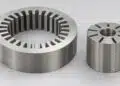
    VACUUMSCHMELZE VACODUR Max cobalt-iron lamination material illustrated as thin metallic rotor and stator stacks.

    VACUUMSCHMELZE Introduced VACODUR Max Cobalt-Iron Alloy for Motor Laminations

    Stackpole RPCQ thick-film chip resistors in rectangular surface-mount packages with end terminations

    Stackpole Releases Pulse-Withstanding Chip Resistors up to 4 W

    Bourns CRT-G thin film chip resistor illustration with a rectangular body and metallic end terminations

    Bourns Introduces Precision Thin Film Resistors for Measurement

    Würth Elektronik ABC of Thermal Management textbook

    Würth Elektronik Launches ABC of Thermal Management Guide

    Schematic of six-arm nitrene crosslinker joining PEI polymer chains in a free-standing dielectric film.

    Crosslinked PEI Film Capacitor Dielectrics Reach 6 J/cm³ at 200°C

    Conceptual illustration of Peak Nano NanoPlex HDC capacitor dielectric film rolls beside a cast-film production line

    Peak Nano Scales NanoPlex HDC Capacitor Film Production 20-Fold

    Bourns Releases 450 V DC Bus TVS Diode

    YAGEO Nexensos M422 Pb-free platinum RTD graphic showing the operating temperature range, nominal resistance options and joining methods.

    YAGEO Introduces Pb-Free Platinum RTD Temperature Sensor

    Reference tantalum capacitor anode characterization, tantalum anode modeling, process selection and life-test verification.

    Tantalum Anode Design Combines Structural Benchmarks and Modeling

    Trending Tags

    • Ripple Current
    • RF
    • Leakage Current
    • Tantalum vs Ceramic
    • Snubber
    • Low ESR
    • Feedthrough
    • Derating
    • Dielectric Constant
    • New Products
    • Market Reports
  • Knowledge Blog
  • Dossiers
    • Aerospace and Defense Passive Components Dossier
    • AI Hardware Dossier
    • Automotive Dossier
    • Industrial Robotics Dossier
    • Power Converter Dossier
    • Capacitor Dossier
    • Circuit Protection Dossier
    • Inductor Dossier
    • Resistor Dossier
    • Silicon Capacitors and Integrated Passives Dossier
  • Suppliers
    • Who is Who
  • PCNS
    • PCNS 2025
    • PCNS 2023
    • PCNS 2021
    • PCNS 2019
    • PCNS 2017
  • Events
No Result
View All Result
Passive Components Blog
No Result
View All Result

Samsung 100V Molded Frame MLCC Targets 48V AI Server PSUs

26.10.2026
Reading Time: 6 mins read
A A
Samsung Electro-Mechanics MFC molded frame ceramic capacitor with epoxy encapsulation and external metal frame

Samsung Electro-Mechanics has introduced a 10 µF, 100 V X7T molded frame capacitor for the output stage of 48 V AI server power supply units.

The CL32Z106KCFMNW# combines a ceramic capacitor with a metal frame and epoxy molding, addressing board-bending stress and environmental exposure in output-filter capacitor banks.

RelatedPosts

Samsung Adds 0402 10 µF X7T MLCC for ADAS Power Rails

Samsung Electro-Mechanics Patent Targets to Reduce Moisture and Cracks in High-Capacity MLCCs

Samsung Low-Profile and Embedded MLCCs for Compact Devices

Key features and benefits

  • 10 µF nominal capacitance and 100 V DC rated voltage for output-stage filtering in 48 V AI server PSUs.
  • 1210 inch / 3225 metric size designation.
  • X7T dielectric, with a temperature-characteristic range of −55 °C to +125 °C.
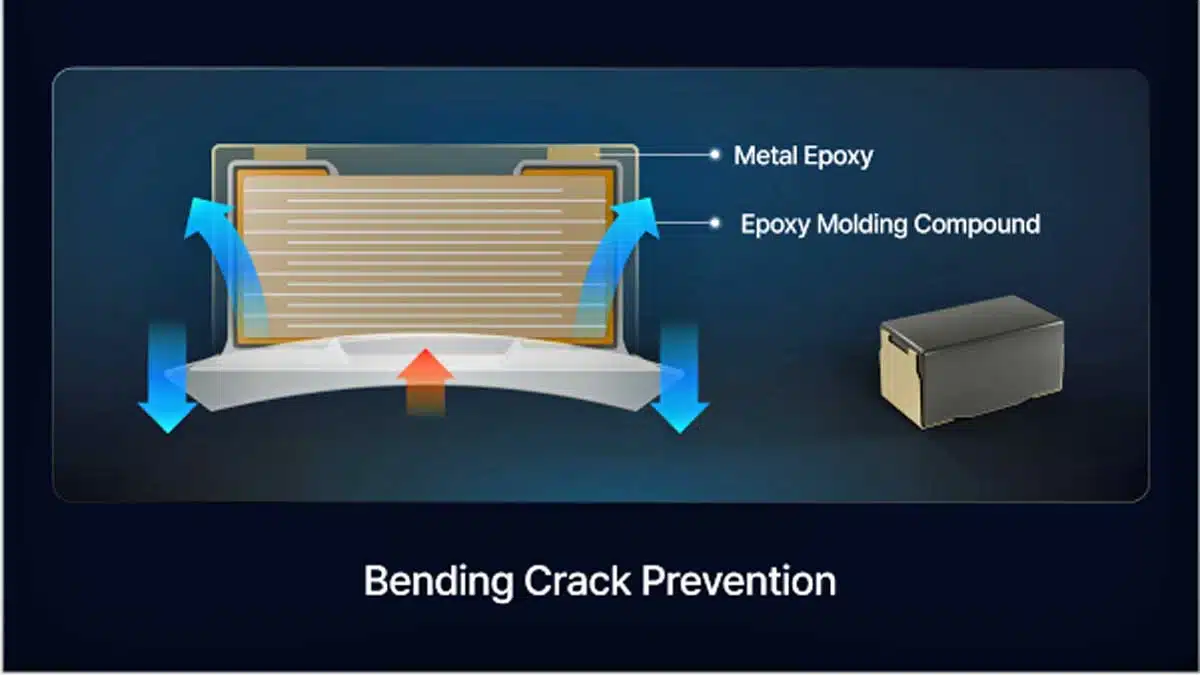
  • Metal frame that absorbs PCB deformation stress and reduces its transmission to the ceramic chip.
  • Epoxy molding around the chip to provide a barrier against humidity, dust and physical contact.

The MFC construction addresses the mechanical connection between the PCB and the ceramic capacitor. Rather than relying on the ceramic body to accommodate board deformation, the external frame provides a stress-absorbing structure.

Technical highlights

ParameterValue
Product designationCL32Z106KCFMNW#
Component technologyMolded frame MLCC
Nominal capacitance10 µF
Capacitance tolerance±10%
Rated voltage100 V DC
Size designation1210 / 3225
DielectricX7T
Temperature-characteristic range−55 °C to +125 °C
Temperature-related capacitance change−33% to +22%

The X7T temperature characteristic allows capacitance to change by −33% to +22% relative to its reference value over the temperature range, without DC bias. This temperature characteristic and the ±10% initial capacitance tolerance are separate selection parameters.

For output-filter design, nominal capacitance is therefore a starting point rather than a complete description of circuit behaviour. The capacitor bank should be assessed at its operating voltage and temperature, with the required output-ripple performance as the design criterion.

Metal frame and epoxy molding

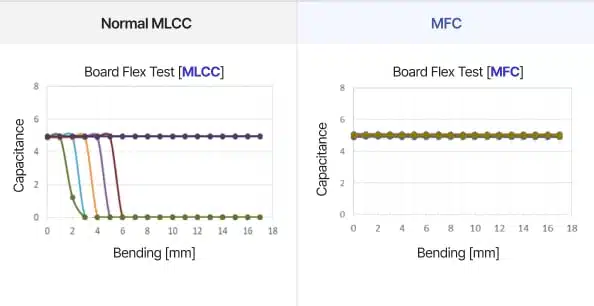
PCB bending during manufacture and assembly can initiate microcracks in ceramic dielectric layers. These cracks can develop into short-circuit paths under electrical stress. The metal frame absorbs deformation stress before it reaches the ceramic chip, addressing the mechanism behind MLCC flex cracking and capacitor failure.

The epoxy molding surrounds the chip and separates it from external humidity, dust and physical impact. The frame and molding serve different functions: the frame manages mechanical stress transfer, while the encapsulation provides an environmental and physical barrier.
Typical applications

The primary application is ripple suppression at the output of 48 V AI server PSUs. In this circuit position, ceramic MLCCs operate alongside aluminium capacitors as part of the output-filter network.

The 100 V DC rating supports selection for this 48 V output application, while the 10 µF nominal capacitance contributes to the ceramic portion of the filter bank. The molded frame construction is relevant where large PSU boards experience bending during manufacturing and assembly.

The wider MFC family also targets power circuits and DC-DC converters where PCB bending stress is an important design consideration.

Application fit

Selection involves both electrical filtering requirements and the mechanical conditions of the assembled power supply. The capacitance and voltage rating govern the electrical starting point; the frame and epoxy molding address stress and exposure around the ceramic chip.

The X7T capacitance-temperature characteristic deserves particular attention when establishing the minimum capacitance required by the output filter. Initial tolerance and temperature-related variation should be treated separately rather than using the nominal 10 µF value throughout the design.

The 1210 / 3225 designation is a size code. PCB layout should use the molded-frame package outline and land pattern, rather than a footprint selected from the size code alone.

Design-in notes for engineers

  • Assess operating voltage, ripple and transient excursions against the 100 V DC rating.
  • Establish the capacitance required at the operating voltage and temperature before fixing the capacitor-bank population.
  • Include the ±10% initial tolerance and the X7T temperature characteristic in the capacitance budget.
  • Use the package-specific outline, land pattern and assembly requirements when preparing the PCB footprint.
  • Address PCB bending during manufacturing and assembly as part of the mechanical design.
  • Validate the final selection under actual operating conditions before production release.

Further reading

  • MLCC Class II DC BIAS Explained, Samsung Video
  • MLCC DC BIAS and AGEING Capacitance Loss Explained
  • Temperature, Bias and Ageing Impact to MLCC Ceramic Capacitors

Source

This article is based on the Samsung Electro-Mechanics product announcement and official product documentation. Engineers should refer to the current manufacturer datasheet for final design and qualification.

References

  1. Introducing the 1210 X7T 10uF 100V MFC (Molded Frame Capacitor): A Key Solution for the 48V Output Voltage of AI Server PSUs, Samsung Electro-Mechanics, 21 October 2026.
  2. Multilayer Ceramic Capacitors — Part I: Commercial/Industrial, Samsung Electro-Mechanics.
  3. MLCC Product Search and Part Numbering Guide, Samsung Electro-Mechanics.
  4. MFC — MLCC with a High Tolerance to Cracking, Samsung Electro-Mechanics.
Related

Recent Posts

VACUUMSCHMELZE VACODUR Max cobalt-iron lamination material illustrated as thin metallic rotor and stator stacks.

VACUUMSCHMELZE Introduced VACODUR Max Cobalt-Iron Alloy for Motor Laminations

12.11.2026
65
Stackpole RPCQ thick-film chip resistors in rectangular surface-mount packages with end terminations

Stackpole Releases Pulse-Withstanding Chip Resistors up to 4 W

12.11.2026
11
Bourns CRT-G thin film chip resistor illustration with a rectangular body and metallic end terminations

Bourns Introduces Precision Thin Film Resistors for Measurement

12.11.2026
11
Würth Elektronik ABC of Thermal Management textbook

Würth Elektronik Launches ABC of Thermal Management Guide

11.11.2026
26
Schematic of six-arm nitrene crosslinker joining PEI polymer chains in a free-standing dielectric film.

Crosslinked PEI Film Capacitor Dielectrics Reach 6 J/cm³ at 200°C

11.11.2026
24
Conceptual illustration of Peak Nano NanoPlex HDC capacitor dielectric film rolls beside a cast-film production line

Peak Nano Scales NanoPlex HDC Capacitor Film Production 20-Fold

10.11.2026
28

Bourns Releases 450 V DC Bus TVS Diode

10.11.2026
3
YAGEO Nexensos M422 Pb-free platinum RTD graphic showing the operating temperature range, nominal resistance options and joining methods.

YAGEO Introduces Pb-Free Platinum RTD Temperature Sensor

9.11.2026
9
Reference tantalum capacitor anode characterization, tantalum anode modeling, process selection and life-test verification.

Tantalum Anode Design Combines Structural Benchmarks and Modeling

9.11.2026
24

Upcoming Events

Nov 24
16:00 - 17:00 CET

Select the Correct Components for Your DC/DC Converter

Dec 1
16:00 - 17:00 CET

Developing low-noise mixed-signal systems

Dec 8
16:00 - 17:00 CET

WE-CCMF: Design Principles, Layout Guidelines and Measurement Results for High-Speed EMI Filtering

View Calendar

Popular Posts

  • Buck Converter Design and Calculation

    0 shares
    Share 0 Tweet 0
  • September 2026 Interconnect, Passives and Electromechanical Components Market Insights

    0 shares
    Share 0 Tweet 0
  • Boost Converter Design and Calculation

    0 shares
    Share 0 Tweet 0
  • Capacitor Charging and Discharging

    0 shares
    Share 0 Tweet 0
  • LLC Resonant Converter Design and Calculation

    0 shares
    Share 0 Tweet 0
  • RF Connector Types: How To Choose the Right One

    0 shares
    Share 0 Tweet 0
  • Passive Low Pass Filters: Fundamentals and EMI Design

    0 shares
    Share 0 Tweet 0
  • Flyback Converter Design and Calculation

    0 shares
    Share 0 Tweet 0
  • MLCC and Ceramic Capacitors

    0 shares
    Share 0 Tweet 0
  • Thermistor Basics: NTC and PTC Selection Guide

    0 shares
    Share 0 Tweet 0

Newsletter Subscription


Passive Components Blog

© 2015–2026
All rights reserved

  • Home
  • Privacy Policy
  • EPCI Membership & Advertisement
  • About

No Result
View All Result
  • Home
  • Knowledge Blog
  • Dossiers
  • PCNS

© 2015–2026
All rights reserved