








Passive Components Blog
No Result
View All Result
  • Home
  • NewsFilter
    • All
    • Aerospace & Defence
    • Antenna
    • Applications
    • Automotive
    • Capacitors
    • Circuit Protection Devices
    • electro-mechanical news
    • Filters
    • Fuses
    • Inductors
    • Industrial
    • Integrated Passives
    • inter-connect news
    • Market & Supply Chain
    • Market Insights
    • Medical
    • Modelling and Simulation
    • New Materials & Supply
    • New Technologies
    • Non-linear Passives
    • Oscillators
    • Passive Sensors News
    • Resistors
    • RF & Microwave
    • Telecommunication
    • Weekly Digest

    Knowles Expands High‑Q Ceramic Core Inductors for RF designs

    Vishay Unveils 1.5 kV IHDV High Voltage Power Inductors for EV and Industrial Converters

    SCHURTER Introduces PPTC Resettable Overcurrent Protection for Compact Electronics

    TrendForce: CSP in‑house AI ASIC Boom Reshapes Capacitor Demand

    Würth Elektroniks Flexible EMI Shielding Sheets Provides Quick and Easy Schielding Solution

    Samsung Introduces Automotive 1206 100uF X7T MLCC for Power Rails in ADAS and SoCs

    Hirose Releases Ultra‑low Profile FPC‑to‑board Connector

    YMIN Hybrid Aluminum Capacitors for Automotive LiDAR Power Rails

    Samsung Presents Ultra‑Thin Silicon Capacitors for AI and Server PDN

    Trending Tags

    • Ripple Current
    • RF
    • Leakage Current
    • Tantalum vs Ceramic
    • Snubber
    • Low ESR
    • Feedthrough
    • Derating
    • Dielectric Constant
    • New Products
    • Market Reports
  • VideoFilter
    • All
    • Antenna videos
    • Capacitor videos
    • Circuit Protection Video
    • Filter videos
    • Fuse videos
    • Inductor videos
    • Inter-Connect Video
    • Non-linear passives videos
    • Oscillator videos
    • Passive sensors videos
    • Resistor videos

    Why Isolated DC/DC Power Supplies Fail Late, Würth Elektronik Podcast

    Designing 800 V DC EMC Filters: Calculation, Simulation and Measurement

    Current Sense Transformer Datasheet and Design‑in Guide

    Designing a USB Type‑C Flyback Planar Transformer with Frenetic’s Planar Tool

    Magnetics Design in High‑Frequency GaN Converters

    Qi2 Wireless Charging: Inductors, Capacitors and EMC Filters

    Two‑capacitor paradox explained for engineers

    Capacitances of Nonlinear MLCCs: What Datasheets Don’t Tell You

    Tapped Inductor Buck Converter Fundamentals

    Trending Tags

    • Capacitors explained
    • Inductors explained
    • Resistors explained
    • Filters explained
    • Application Video Guidelines
    • EMC
    • New Products
    • Ripple Current
    • Simulation
    • Tantalum vs Ceramic
  • Knowledge Blog
  • DossiersNew
  • Suppliers
    • Who is Who
  • PCNS
    • PCNS 2025
    • PCNS 2023
    • PCNS 2021
    • PCNS 2019
    • PCNS 2017
  • Events
  • Home
  • NewsFilter
    • All
    • Aerospace & Defence
    • Antenna
    • Applications
    • Automotive
    • Capacitors
    • Circuit Protection Devices
    • electro-mechanical news
    • Filters
    • Fuses
    • Inductors
    • Industrial
    • Integrated Passives
    • inter-connect news
    • Market & Supply Chain
    • Market Insights
    • Medical
    • Modelling and Simulation
    • New Materials & Supply
    • New Technologies
    • Non-linear Passives
    • Oscillators
    • Passive Sensors News
    • Resistors
    • RF & Microwave
    • Telecommunication
    • Weekly Digest

    Knowles Expands High‑Q Ceramic Core Inductors for RF designs

    Vishay Unveils 1.5 kV IHDV High Voltage Power Inductors for EV and Industrial Converters

    SCHURTER Introduces PPTC Resettable Overcurrent Protection for Compact Electronics

    TrendForce: CSP in‑house AI ASIC Boom Reshapes Capacitor Demand

    Würth Elektroniks Flexible EMI Shielding Sheets Provides Quick and Easy Schielding Solution

    Samsung Introduces Automotive 1206 100uF X7T MLCC for Power Rails in ADAS and SoCs

    Hirose Releases Ultra‑low Profile FPC‑to‑board Connector

    YMIN Hybrid Aluminum Capacitors for Automotive LiDAR Power Rails

    Samsung Presents Ultra‑Thin Silicon Capacitors for AI and Server PDN

    Trending Tags

    • Ripple Current
    • RF
    • Leakage Current
    • Tantalum vs Ceramic
    • Snubber
    • Low ESR
    • Feedthrough
    • Derating
    • Dielectric Constant
    • New Products
    • Market Reports
  • VideoFilter
    • All
    • Antenna videos
    • Capacitor videos
    • Circuit Protection Video
    • Filter videos
    • Fuse videos
    • Inductor videos
    • Inter-Connect Video
    • Non-linear passives videos
    • Oscillator videos
    • Passive sensors videos
    • Resistor videos

    Why Isolated DC/DC Power Supplies Fail Late, Würth Elektronik Podcast

    Designing 800 V DC EMC Filters: Calculation, Simulation and Measurement

    Current Sense Transformer Datasheet and Design‑in Guide

    Designing a USB Type‑C Flyback Planar Transformer with Frenetic’s Planar Tool

    Magnetics Design in High‑Frequency GaN Converters

    Qi2 Wireless Charging: Inductors, Capacitors and EMC Filters

    Two‑capacitor paradox explained for engineers

    Capacitances of Nonlinear MLCCs: What Datasheets Don’t Tell You

    Tapped Inductor Buck Converter Fundamentals

    Trending Tags

    • Capacitors explained
    • Inductors explained
    • Resistors explained
    • Filters explained
    • Application Video Guidelines
    • EMC
    • New Products
    • Ripple Current
    • Simulation
    • Tantalum vs Ceramic
  • Knowledge Blog
  • DossiersNew
  • Suppliers
    • Who is Who
  • PCNS
    • PCNS 2025
    • PCNS 2023
    • PCNS 2021
    • PCNS 2019
    • PCNS 2017
  • Events
No Result
View All Result
Passive Components Blog
No Result
View All Result

Is GaN Replacing Silicon? The Applications and Limitations of Gallium Nitride in 2019

25.1.2019
Reading Time: 3 mins read
A A

Source: All About Circuits article

by Robin Mitchell. GaN transistors are, in general terms, faster and more efficient than classic silicon devices. But if that’s the case, what limitations are keeping it from unseating silicon from its throne? Silicon technology is approaching its limits. Meanwhile, there’s a continuing need for faster, more efficient circuits. One of the paths forward from this point is for researchers and companies alike to look towards different materials to produce the devices of tomorrow.

RelatedPosts

Knowles Expands High‑Q Ceramic Core Inductors for RF designs

Vishay Unveils 1.5 kV IHDV High Voltage Power Inductors for EV and Industrial Converters

SCHURTER Introduces PPTC Resettable Overcurrent Protection for Compact Electronics

One material in particular that has caught the attention of the industry is gallium nitride or GaN, which is already gaining increasing use in optoelectronics.

Here’s a look at the current state of GaN.

GaN vs. Silicon
When looking at the physical characteristics of GaN, it is easy to see why it is a very promising semiconductor. GaN is a binary III/V direct bandgap semiconductor whose bandgap is 3.4eV—several times greater than that of silicon whose band gap is only 1.1eV.

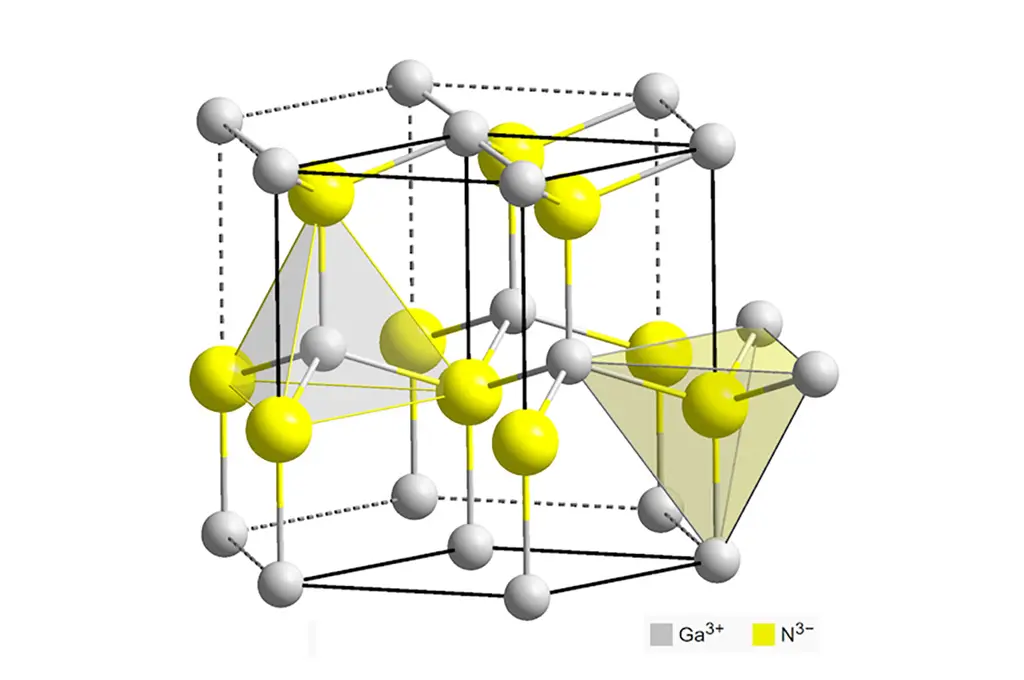
Featured Image: A GaN Wurtzite polyhedron. Image used courtesy of Solid_State [CC BY-SA 4.0]

This wider bandgap makes GaN highly suitable for optoelectronics and is key to producing devices such as UV LEDs where frequency doubling is impractical. Not only do GaN semiconductors have 1000 times the electron mobility than silicon they are also able to operate at higher temperatures while still maintaining their characteristics (up to 400 degrees Celsius). These combined characteristics would make GaN highly desirable in high frequency (THz), high temperature, and high power environments.

The Problem with GaN

While GaN devices are widely used in the optoelectronics industry (such as LEDs), they are not commonly used in transistors for several reasons. One of the biggest hurdles in GaN transistors is that GaN devices are typically depletion type devices which are ON when the gate-source voltage is zero and this is a problem as power circuitry and logic rely on both normally on and normally off transistors.

Image used courtesy of Panasonic

Currently, there are several proposals to create GaN devices that are OFF when the gate-source voltage is zero including the addition of fluoride ions, an MIS-type gate stack, a combined GaN and Si device, and the use of a P-type material on-top of the  AlGaN/GaN heterojunction.

Current GaN Applications

While the number of devices incorporating GaN transistors is small several companies are making attempts to increase the interest in GaN-based products. For example, Panasonic have used their patented X-GaN technology to produce GaN-based transistors in a number of applications including power converters (with an efficiency of up to 99%) and replacements for transistors in motor configurations. Their X-GaN transistors can also be used to replace MOSFET and freewheel diodes completely which allows for energy to be conserved as well as reducing the physical size of the circuit.


Image courtesy military areospace

GaN transistors are also finding their way into radio applications due to their superior frequency characteristics with Comtech PST Corp. producing their model BPMC928109-1000 which is a GaN amplifier for use in speed cameras, air traffic control, and even military applications requiring frequencies between 9.2-10GHz at 10kW of power.

Will GaN Replace Silicon?

GaN has many serious advantages over silicon, being more power efficient, faster, and even better recovery characteristics. However, while GaN may seem like a superior choice it won’t be replacing silicon in all applications for a while.

The first hurdle that needs to be overcome is the depleted nature of GaN transistors; effective power and logic circuits require transistors of both normally-on and normally-off types. While normally-off GaN transistors can be produced, they either rely on a typical silicon MOSFET or they require special additional layers that make them hard to shrink. The inability to produce GaN transistors at the same scale as current silicon transistors also means they are impractical for use in CPUs and other microcontrollers.

The second issue with GaN transistors is that the only alternative known method for producing an enhanced GaN transistor (at the time of writing) is with the use of the patented Panasonic method of using the additional AlGaN layer. This means that any innovation involving that transistor type will rely on Panasonic until other methods can be researched.

Work on GaN devices has been around since early 2000s, but GaN transistors are still in their infancy. While there is no doubt that they will replace silicon transistors in power applications within the next decade, they are still far from being used in data processing applications.

However, if GaN devices can be miniaturized (smaller than 100nm features) then not only can they be used to replace silicon for better power efficiency but they could also operate at far greater speeds and allow the power of processors to continue to increase.


Related

Recent Posts

Ultrahigh Energy Storage in Lead‑Free BiFeO₃‑Based Ceramic Capacitors via Local Polar Structure Design

16.6.2026
27

Imec Presents High-density MIMCAP RF interposer for III-V chiplets

15.6.2026
44

All‑Water Supercapacitor Based on 1‑nm Clay Channels and Nanoconfined Water Electrolyte

10.6.2026
43

Molecular Memristor Shows Record 145 kH Emergent Inductance

12.5.2026
63

Researchers Propose Next‑Gen Compact Memory Using Ultra-thin Ferroelectric Capacitors

11.5.2026
99

Electrocaloric Multilayer Capacitors: Towards Quiet, Solid‑State Cooling Around Room Temperature

7.5.2026
300

High-Crystallinity Nanocrystalline Composites for MHz Chip Inductors

7.5.2026
114

Kyocera Developed Multilayer Ceramic Core Substrate for AI Packages

30.4.2026
138

Nanocrystalline Cores for Low‑Loss MHz Chip Inductors

25.3.2026
104

Upcoming Events

Jul 14
16:00 - 17:00 CEST

EMC Design Essentials: Mastering Varistors and Common Mode Chokes

Jul 21
16:00 - 17:00 CEST

Safety by design: X and Y Interference suppression capacitors for power line filters

View Calendar

Popular Posts

  • Boost Converter Design and Calculation

    0 shares
    Share 0 Tweet 0
  • Buck Converter Design and Calculation

    0 shares
    Share 0 Tweet 0
  • LLC Resonant Converter Design and Calculation

    0 shares
    Share 0 Tweet 0
  • Flyback Converter Design and Calculation

    0 shares
    Share 0 Tweet 0
  • MLCC and Ceramic Capacitors

    0 shares
    Share 0 Tweet 0
  • Earthing Systems and IEC Classification Explained

    0 shares
    Share 0 Tweet 0
  • Dual Active Bridge (DAB) Topology

    0 shares
    Share 0 Tweet 0
  • SEPIC Converter Design and Calculation

    0 shares
    Share 0 Tweet 0
  • MLCC Case Sizes Standards Explained

    0 shares
    Share 0 Tweet 0
  • What Electronics Engineer Needs to Know About Passive Low Pass Filters

    0 shares
    Share 0 Tweet 0

Newsletter Subscription


Passive Components Blog

© EPCI - Leading Passive Components Educational and Information Site

  • Home
  • Privacy Policy
  • EPCI Membership & Advertisement
  • About

No Result
View All Result
  • Home
  • Knowledge Blog
  • Dossiers
  • PCNS

© EPCI - Leading Passive Components Educational and Information Site

This website uses cookies. By continuing to use this website you are giving consent to cookies being used. Visit our Privacy and Cookie Policy.
Go to mobile version