


Passive Components Blog
No Result
View All Result
  • Home
  • News
    • All
    • Aerospace & Defence
    • Antenna
    • Applications
    • Automotive
    • Capacitors
    • Circuit Protection Devices
    • electro-mechanical news
    • Filters
    • Fuses
    • Inductors
    • Industrial
    • Integrated Passives
    • inter-connect news
    • Market & Supply Chain
    • Market Insights
    • Medical
    • Modelling and Simulation
    • New Materials & Supply
    • New Technologies
    • Non-linear Passives
    • Oscillators
    • Passive Sensors News
    • Resistors
    • RF & Microwave
    • Telecommunication
    • Weekly Digest
    TDK CN series 10 µF 100 V X7R soft-termination multilayer ceramic capacitor in 3225 EIA 1210 package

    TDK Releases 100 V Soft-Termination X7R MLCCs 10 uF in 3225 Package

    Compact inductive rotary position encoder sensor near a motor shaft, representing the Vishay RAIK045I MP encoder category

    Vishay Introduces 16-Bit Inductive Encoder for Motor-Adjacent Position Sensing

    Hirose FH51 automotive FPC/FFC connector with low-profile receptacle construction and top-and-bottom contact arrangement

    Hirose Automotive FPC/FFC Connector Adds One-Action Mating up to 125°C

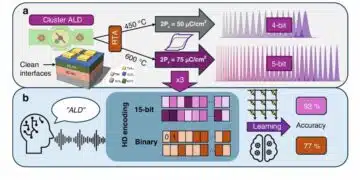
    Overview of fabricated ferroelectric capacitors improving hyperdimensional computing task learning accuracy. a The experimental work reported in this study comprises ferroelectric capacitor (FeCAP) device fabrication, structural and electrical characterization, analog state identification and their reliability study. b The computational part of the work explores the benefits of using characteristics from the fabricated devices in a hyperdimensional computing scheme; source: authors

    High-Precision Hyperdimensional Computing with Multi-Level Ferroelectric HZO Capacitors

    Coilcraft Introduces Automotive Common Mode Chokes Target CISPR 25 Class 5 EMC Compliance

    Murata Expands Automotive Metal Power Inductor Range

    Modelithics Qorvo GaN Library v26.5.11 Adds 200 W RF Transistor Model

    Bourns Releases Low-Profile Incremental Ring Encoder Targets Compact Industrial HMIs

    Wk 34 Electronics Supply Chain Digest

    Trending Tags

    • Ripple Current
    • RF
    • Leakage Current
    • Tantalum vs Ceramic
    • Snubber
    • Low ESR
    • Feedthrough
    • Derating
    • Dielectric Constant
    • New Products
    • Market Reports
  • Knowledge Blog
  • Dossiers
    • AI Hardware Dossier
    • Automotive Dossier
    • Industrial Robotics Dossier
    • Power Converter Dossier
    • Capacitor Dossier
    • Resistor Dossier
    • Inductor Dossier
    • Circuit Protection Dossier
  • Suppliers
    • Who is Who
  • PCNS
    • PCNS 2025
    • PCNS 2023
    • PCNS 2021
    • PCNS 2019
    • PCNS 2017
  • Events
  • Home
  • News
    • All
    • Aerospace & Defence
    • Antenna
    • Applications
    • Automotive
    • Capacitors
    • Circuit Protection Devices
    • electro-mechanical news
    • Filters
    • Fuses
    • Inductors
    • Industrial
    • Integrated Passives
    • inter-connect news
    • Market & Supply Chain
    • Market Insights
    • Medical
    • Modelling and Simulation
    • New Materials & Supply
    • New Technologies
    • Non-linear Passives
    • Oscillators
    • Passive Sensors News
    • Resistors
    • RF & Microwave
    • Telecommunication
    • Weekly Digest
    TDK CN series 10 µF 100 V X7R soft-termination multilayer ceramic capacitor in 3225 EIA 1210 package

    TDK Releases 100 V Soft-Termination X7R MLCCs 10 uF in 3225 Package

    Compact inductive rotary position encoder sensor near a motor shaft, representing the Vishay RAIK045I MP encoder category

    Vishay Introduces 16-Bit Inductive Encoder for Motor-Adjacent Position Sensing

    Hirose FH51 automotive FPC/FFC connector with low-profile receptacle construction and top-and-bottom contact arrangement

    Hirose Automotive FPC/FFC Connector Adds One-Action Mating up to 125°C

    Overview of fabricated ferroelectric capacitors improving hyperdimensional computing task learning accuracy. a The experimental work reported in this study comprises ferroelectric capacitor (FeCAP) device fabrication, structural and electrical characterization, analog state identification and their reliability study. b The computational part of the work explores the benefits of using characteristics from the fabricated devices in a hyperdimensional computing scheme; source: authors

    High-Precision Hyperdimensional Computing with Multi-Level Ferroelectric HZO Capacitors

    Coilcraft Introduces Automotive Common Mode Chokes Target CISPR 25 Class 5 EMC Compliance

    Murata Expands Automotive Metal Power Inductor Range

    Modelithics Qorvo GaN Library v26.5.11 Adds 200 W RF Transistor Model

    Bourns Releases Low-Profile Incremental Ring Encoder Targets Compact Industrial HMIs

    Wk 34 Electronics Supply Chain Digest

    Trending Tags

    • Ripple Current
    • RF
    • Leakage Current
    • Tantalum vs Ceramic
    • Snubber
    • Low ESR
    • Feedthrough
    • Derating
    • Dielectric Constant
    • New Products
    • Market Reports
  • Knowledge Blog
  • Dossiers
    • AI Hardware Dossier
    • Automotive Dossier
    • Industrial Robotics Dossier
    • Power Converter Dossier
    • Capacitor Dossier
    • Resistor Dossier
    • Inductor Dossier
    • Circuit Protection Dossier
  • Suppliers
    • Who is Who
  • PCNS
    • PCNS 2025
    • PCNS 2023
    • PCNS 2021
    • PCNS 2019
    • PCNS 2017
  • Events
No Result
View All Result
Passive Components Blog
No Result
View All Result

Lobachevsky University Scientists Create A Prototype Neural Network Based On Memristors

14.11.2017
Reading Time: 3 mins read
A A

source: ECN news

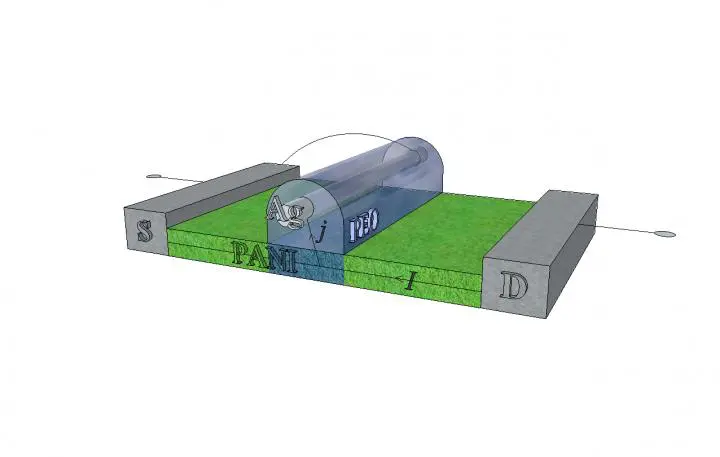
Mon, 11/13/2017 – by Lobachevsky University. Lobachevsky University scientists under the supervision of Alexey Mikhailov, Head of the UNN PTRI Laboratory of Thin Film Physics and Technology, are working to develop an adaptive neural interface that combines, on the one hand, a living culture, and on the other, a neural network based on memristors. This project is one if the first attempts to combine living biological culture with a bio-like neural network based on memristors. Memristor neural networks will be linked to a multi-electrode system for recording and stimulating the bioelectrical activity of a neuron culture that performs the function of analyzing and classifying the network dynamics of living cells.

RelatedPosts

TDK Releases 100 V Soft-Termination X7R MLCCs 10 uF in 3225 Package

Vishay Introduces 16-Bit Inductive Encoder for Motor-Adjacent Position Sensing

Hirose Automotive FPC/FFC Connector Adds One-Action Mating up to 125°C

Compared with some international competitors who set the task of “connecting the living world and artificial architectures” (for example, the RAMP project), the advantage of the UNN project is that highly skilled experts in various fields (including physics and technology of memristive nanostructures, neural network modeling, electronic circuit design, neurodynamics and neurobiology) are concentrated both in terms of their location and organization within the same university.

According to Alexey Mikhailov, UNN scientists are now working to create a neural network prototype based on memristors, which is similar to a biological nervous system with regard to its internal structure and functionality.

“Due to the locality of the memristive effect (such phenomena occur at the nanoscale) and the use of modern standard microelectronic technologies, it will be possible to obtain a large number of neurons and synapses on a single chip. These are our long-time prospects for the future. It means, in fact, that one can “grow” the human brain on a chip. At present, we are doing something on a simpler scale: we are trying to create hybrid electronic circuits where some functions are implemented on the basis of traditional electronics (transistors), and some new functions that are difficult to implement in hardware are realized on the basis of memristors”, said Alexey Mikhailov.

Currently, researchers are exploring the possibility of constructing a feedback whereby the output signal from the memristor network will be used to stimulate the biological network. Actually, it means that for the first time the process of learning will be realized for a living cell culture. The living culture used by the scientists is an artificially grown neuronal culture of brain cells. In principle, however, one can also use a slice of living tissue.

The aim of the project is to create compact electronic devices based on memristors that reproduce the property of synaptic plasticity and function as part of bio-like neural networks in conjunction with living biological cultures.

The use of hybrid neural networks based on memristors opens up amazing prospects. First, with the help of memristors it will be possible to implement the computing power of modern supercomputers on a single chip. Secondly, it will be possible to create robots that manage an artificially grown neuronal culture. Thirdly, such “brain-like” electronic systems can be used to replace parts of the living nervous system in the event of their damage or disease.

The project’s tasks of creating electronic models of artificial neural networks (ANN), as well as the integration of memristive architectures into the systems for recording and processing the activity of living biological neural network structures are fully in line with the current world trends and priorities in the development of neuromorphic systems.

The balance in the combination of different approaches is the key to successful development and sustainability of the project. The first (and the main) of these approaches is to demonstrate the potential of the “traditional” ANN in the form of a two-layer perceptron based on programmable memristive elements. The key advantages of the artificial neural network being developed include, first of all, its multilayer structure, and hence the ability to solve nonlinear classification problems (based on the shape of the input signal), which is very important when dealing with complex bioelectric activity, and secondly, the hardware implementation of all artificial network elements on one board, including the memristive synaptic chip, control electronics and neuron circuits. In the future, this arrangement will allow us to implement the adaptive neural interface “living neural network – memristive ANN” in the form of a compact autonomous device.

The second approach that the researchers are pursuing in parallel is to find some alternative solutions for creating non-traditional neural network architectures where the stochastic nature and the “live” dynamics of memristive devices play a key role. These features of memristors make it possible to use them for direct processing and analysis of nerve cell activity, as well as for developing plausible physical models of spiking neural networks with self-organization of memristive connections between neurons. These results make an important contribution to the achievement of the project goal and lay a groundwork for the transition to a qualitatively new level in the field of bio-like memrisive systems.
Related

Recent Posts

Compact inductive rotary position encoder sensor near a motor shaft, representing the Vishay RAIK045I MP encoder category

Vishay Introduces 16-Bit Inductive Encoder for Motor-Adjacent Position Sensing

9.9.2026
1
Overview of fabricated ferroelectric capacitors improving hyperdimensional computing task learning accuracy. a The experimental work reported in this study comprises ferroelectric capacitor (FeCAP) device fabrication, structural and electrical characterization, analog state identification and their reliability study. b The computational part of the work explores the benefits of using characteristics from the fabricated devices in a hyperdimensional computing scheme; source: authors

High-Precision Hyperdimensional Computing with Multi-Level Ferroelectric HZO Capacitors

7.9.2026
15

Bourns Releases Low-Profile Incremental Ring Encoder Targets Compact Industrial HMIs

7.9.2026
2

August 2026 Interconnect, Passives and Electromechanical Components Market Insights

4.9.2026
35

Vishay Thin Film Chip Resistors Combine up to 50 GHz Operation with High Power Density

3.9.2026
15

Bourns Expands 12 mm SMD Incremental Encoder with Shaft-Length Options for Compact HMI Controls

1.9.2026
11

Bourns UT-A Wirewound Power Resistors Target High-Temperature and Pulse-Load Applications

31.8.2026
23

Modelithics COMPLETE v26.4 Expands RF Passive Models for Keysight ADS

28.8.2026
14

Vishay IFBT SMT Flyback Transformers Target PoE and Isolated DC/DC Designs up to 30 W

28.8.2026
23

Upcoming Events

Sep 10
11:00 - 12:00 CEST

Equipment models and model strategies for Space Missions

Sep 16
17:00 - 18:00 CEST

Designing a 5 kW, 800 V-to-50 V PSFB Converter for Next-Generation Data Centers

Sep 29
16:00 - 17:00 CEST

Cybersecurity 2026

View Calendar

Popular Posts

  • Buck Converter Design and Calculation

    0 shares
    Share 0 Tweet 0
  • LLC Resonant Converter Design and Calculation

    0 shares
    Share 0 Tweet 0
  • Boost Converter Design and Calculation

    0 shares
    Share 0 Tweet 0
  • Flyback Converter Design and Calculation

    0 shares
    Share 0 Tweet 0
  • Earthing Systems and IEC Classification Explained

    0 shares
    Share 0 Tweet 0
  • MLCC and Ceramic Capacitors

    0 shares
    Share 0 Tweet 0
  • Capacitor Charging and Discharging

    0 shares
    Share 0 Tweet 0
  • Resistor Symbols

    0 shares
    Share 0 Tweet 0
  • Audio Capacitors: Choosing Capacitors for Crossover Circuits

    0 shares
    Share 0 Tweet 0
  • Thermistors Basics, NTC and PTC Thermistors

    0 shares
    Share 0 Tweet 0

Newsletter Subscription


Passive Components Blog

© 2015–2026
All rights reserved

  • Home
  • Privacy Policy
  • EPCI Membership & Advertisement
  • About

No Result
View All Result
  • Home
  • Knowledge Blog
  • Dossiers
  • PCNS

© 2015–2026
All rights reserved