





NAWA Technologies unviels hybrid battery powered electrica motorbike concept destined for CES 2020 exhibition.
Potential of revolutionary new electric power train unleashed by company’s next-generation ultracapacitors system can be applied to all forms of electric vehicle
- Pioneering ultra-fast energy storage experts, NAWA Technologies, reveal a vision for a future electric power train, debuted in a stunning electric motor bike concept
- NAWA Racer is inspired by 1960s café racers but is powered by a world-first ‘hybrid’ battery system, which combines the company’s next-gen ultracapacitors with lithium-ion
- Offering ten times more power and five times more energy than existing ultracapacitors, they unleash the potential of a hybrid battery, bringing huge efficiency improvements
- Revolutionary system allows NAWA Racer to re-use 80 percent of the energy otherwise lost in braking, gives a 300km urban range and brings weight savings of 25 percent
- Marking the first time an electric motorbike has used ultracapacitors, NAWA Technologies’ hybrid battery system is fully scale-able and can be applied to any EV, including cars
- See the NAWA Racer concept at CES a Eureka Park, Stand G, Booth 50463
December 19th, 2019-NAWA Technologies, maker of next-generation ultra-fast energy storage systems, reveals NAWA Racer a stunning zero emission motorbike concept which features a world-first in electric power trains: a ‘hybrid’ battery. Appearing at the Consumer Electronics Show (CES) in Las Vegas on 7thJanuary 2020, NAWA Racer combines NAWA Technologies’ revolutionary ultracapacitors–which offer ten times more power and five times more energy than existing tech –with conventional lithium-ion cells.
Marking the first time an electric motorbike has used ultracapacitors, the hybrid system offers the best of both worlds: ultra-fast charging, incredible energy recovery and high power output thanks to the ultracapacitors, and a long continuous range thanks to better lithium-ion management. Inspired by the original café racers of London in the 1960s, which were lightweight, powerful bikes used for short, quick rides between cafés, NAWA Racer builds on these themes, boasting a raft of efficiency benefits that make it perfect for the city, with features other e-motorbikes cannot offer.
Next-gen ultracapacitors: the key to unlocking a hybrid battery
The basis of NAWA Racer’sadvantage is the company’scarbon-based ultracapacitors,which charge and discharge in seconds, capable of picking up energy from regenerative braking and supplying it back to an electric motor very quickly. They can do this millions of times over without degradation, offering very fast energy transfer, unlike lithium-ion. But although they have five times more energy storage than existing technology, lithium-ion does still offer greater overall capacity.
By integrating these ultracapacitors into a lithium-ion system, the result is a battery that has much more efficient overall performance, greatly reducing the charge and discharge cycles the lithium-ion battery performs, extending the life of the entire system. Regardless of electric vehicle, from motorbike to car, the efficiency improvements made by a hybrid ultracapacitor battery system can reduce the size of the lithium-ion battery by up t ohalf, or extend the range by up to double –or a combination in between depending on use. This is especially the case where there is a lot of braking and accelerating, such as in an urban area.
Energy efficient and light weight
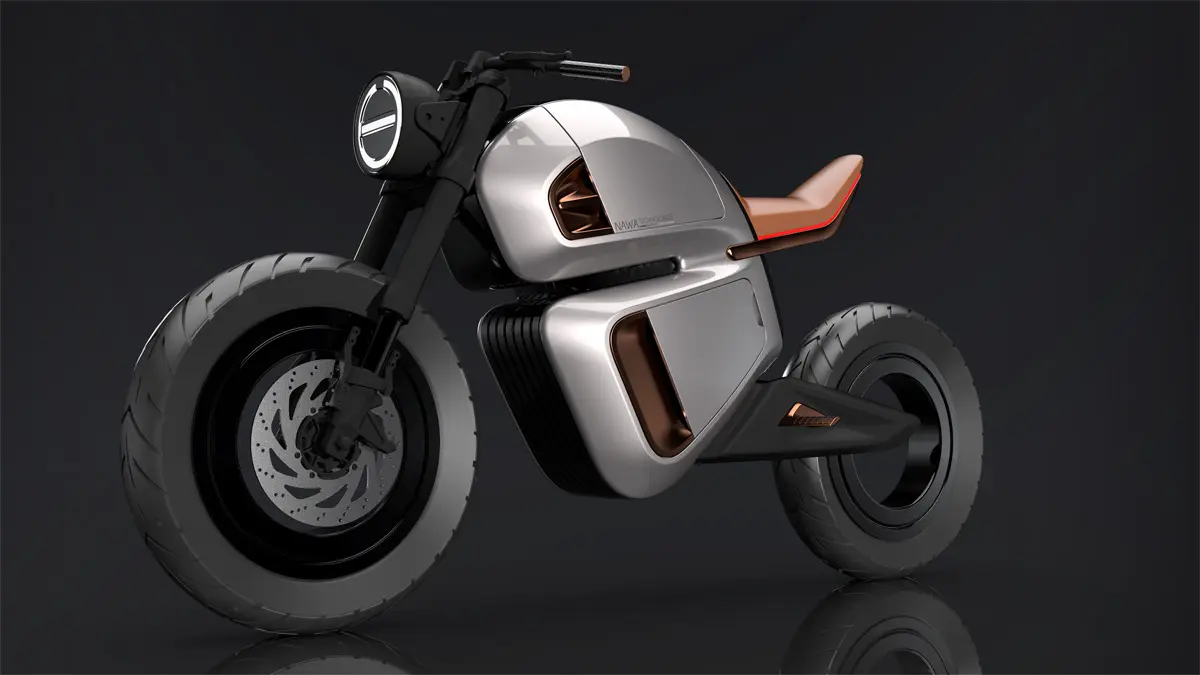
Located in the bike’s top tank area is an arrangement of NAWA Technologies’ own ultracapacitors, known as NAWACap and offering 0.1 kWh, which boost a lithium-ion battery mounted low in the chassis, where the internal combustion engine would otherwise be. Re-using more than 80 percent of the energy captured from regenerative braking –lithium-ion can only re-use 30 percent –NAWACap brings major leaps in efficiency, allowing NAWA Racer to use a much smaller lithium-ion battery than would otherwise be possible:just 9 kWh, around half the size of a conventional electric sports bike’s battery.
The NAWACap pack itself is light weight too, weighing as little as 10 kg, and combined with the bike’s carbon fibre frame and composite body panels, NAWA Racer tips the scales at just 150kg, a weight saving of 25 percent over conventional electric sports bikes. This lightweight, compact hybrid battery system results in exceptional range. Thanks to its lithium-ion battery, NAWA Racer can cover 150km on a mixed cycle, including highways. But the city is where it really shines. By capturing so much energy from stop-start riding, releasing it again as acceleration, NAWA Racer can double its range in an urban area, covering 300kmbetween charges. The NAWACap pack recharges in just two minutes and the entire battery can be charged to 80 percent in one hour from a home supply.
Exhilarating performance – at all times
As standard, the hub-less rim motor produces 100PS, rocketing NAWA Racer from rest to 100km/h in comfortably under three seconds, onto a top speed in excess of 160km/h. And no matter the charge level of the lithium-ion battery, this acceleration will always be available because of the ultracapacitor’s high power characteristics, which continually maintain response and performance. Unlike with a regular fixed battery, NAWA Racer’s NAWACap pack can also be removed and swapped for different levels of performance, allowing riders to tune their bike’s characteristics.
NAWA Racer also features a ‘Race’ mode, which gives a boost of ultracapacitor power. This is inspired by the original days of the café racer, when riders would go ‘record racing’–short, fast rides to an agreed point and back, before a record had finished on the café’s juke box –and ‘Race’ mode is designed to give the rider the edge on the return journey (or to over take slower traffic in every day riding). It also features an ‘Eco’ mode, where energy recovery is further maximised.
Minimalistic design Intended to turn heads as well as offer a ground-breaking electric power train, NAWA Racer brings a modern twist to its retro looks with simple, smooth lightweight composite panels, painted aluminium and copper, based on a strong, stiff but light carbon fibre frame. Details such as LED lighting for the headlight and taillight, anodised matteblack suspension forks, nubuck leather saddle in vintage camel and a hub-less rim motor complete the striking look. For the project, NAWA Technologies has been supported by expert design and engineering services provider Envisage Group(https://www.envisagegroupltd.com), who has worked with NAWA Technologies to develop the design of NAWA Racer and realise a dynamic demonstrator for CES.
Envisage focuses on creating bespoke, perfectly-engineered vehicles and products, with a global reputation for craftmanship, working with the world’s largest and most prestigious OEMs and product manufacturers. Although simply a vision of an electric motorbike of the future for now, NAWA Racer’s hybrid battery system can be applied to all forms of electric vehicle and the technology could go into production in the very near future.
Pascal Boulanger, Founder, Chairman of the board, CTOand COO of NAWA Technologies, said: “Electric vehicles are still limited by the energy their batteries can store and the time it takes to recharge them. A promising solution is to combine lithium-ion with ultracapacitors –but until now they have not had enough energy, been too expensive and lacked the power capabilities to easily integrate them within a hybrid battery system.
NAWA Technologies’ ultracapacitors offer the complete solution, the lowest internal resistance–allowing DC/DC converter-less integration –and lower cost. Taking performance, range, efficiency, weight and charging time to new heights, this system is also more environmentally-friendly. Our ultracapacitors are based on carbon, which is naturally occurring and abundant, so our hybrid packs also reduce the need for lithium mining.”
Ulrik Grape, CEO of NAWA Technologies, said: “The NAWA Racer is our vision for the electric motorbike of tomorrow – a retro-inspired machine, but one that is thoroughly modern. It is lightweight, fast and fun, perfect for an emission-free city commute that will put a smile on your face. But it also lays down a blueprint for the future. NAWA Technologies’ next-gen ultracapacitors have unleashed the potential of the hybrid battery system –and this design of power train is fully scale-able. There is no reason why this cannot be applied to a larger motorbike, or car or other electric vehicle. And what is more, this technology could go into production in the very near future.”
NAWA Technologies’ core market is the production of its next-generation ultracapacitor cells. With development completed, and 10 M€ funding already raised from historical and new investors, NAWATechnologies begins the mass production phase over the coming year. A first of its kind cell production line will be installed at its Aix-en-Provence facility and, at full production, NAWA expects to achieve a capacity of in excess of 300,000 cells per month. These will be first used globally in a wide range of electrical systems including power tools, automated guided vehicles and sensor based IoT markets. With the global market for ultracapacitors estimated to grow to €2-3bn in 2023, NAWA Technologies is ideally positioned to take advantage of increased demand.