


MLCC and tantalum capacitor prices rose repeatedly through 2025 and 2026, and designers are asking where film capacitors can take over part of the load.
HYDRA compares the price events with the technical limits of each capacitor technology. The result is a functional view: film capacitors cover some positions in the power stage and on the mains side, and they do not replace MLCC where density and low voltage decide.
Price Events in 2025 and 2026
A single AI rack cabinet needs up to 440,000 high-end MLCCs, 8 to 10 times the count of a standard server (TrendForce). Demand of this size has moved the price lists of several suppliers.
| Date | Technology | Event |
|---|---|---|
| 2025 | Tantalum | Price adjustments of 20 to 30 % for certain voltage and capacitance ratings |
| 1 Apr 2026 | Tantalum | Third tantalum capacitor price increase in under 12 months, lead times 16 to 18 weeks |
| Apr 2026 | MLCC | Taiyo Yuden: high-capacitance automotive +10 to 30 %, consumer grades +6 to 13 % |
| 1 Jul 2026 | MLCC | YAGEO: increase of about 50 % reported by industry sources; Walsin: consumer MLCC +5 to 15 % |
| 1 Aug 2026 | MLCC | Samsung Electro-Mechanics: all MLCC categories +30 % |
| 1 Sep 2026 | MLCC | Taiyo Yuden: further price adjustment |
Related coverage on this blog includes the tantalum price increases driven by AI servers and the YAGEO July 2026 price increase. Samsung Electro-Mechanics has long-term agreements with more than 10 AI customers, and two AI server agreements run through 2027, which keeps part of the capacity committed.
Why Film Is Not a Drop-In Replacement
A film capacitor and an MLCC differ in dielectric, size and behaviour under voltage. A swap on the bill of materials is therefore a redesign, not a part substitution.
- Permittivity: polypropylene has a relative permittivity of about 2.2, so the capacitance per volume is far below that of class II ceramics.
- DC bias: the capacitance of class II MLCC falls with applied DC voltage, while PP film stays stable.
- Microphonics and cracking: class II MLCC can generate acoustic noise and can crack under board flexure. Film is not piezoelectric and is not brittle in the same way.
- Self-healing: metallised PP film clears local dielectric faults, which suits high-voltage AC and pulse duty.
The DC-bias effect has a direct size consequence. If a class II MLCC keeps a fraction k of its nominal capacitance at the operating voltage, the nominal value needed for a required capacitance is:
With k = 0.2, that is 20 % of the nominal value retained (up to 80% of capacitance loss!), the nominal capacitance must be 5 times the required value. Part of the apparent MLCC advantage in density disappears at high bias. Class 2 behaviour is covered in DC bias voltage dependence of class 2 MLCC.
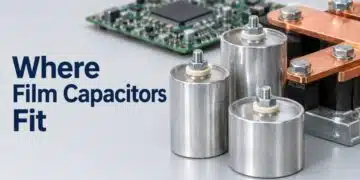
Where Film Capacitors Fit
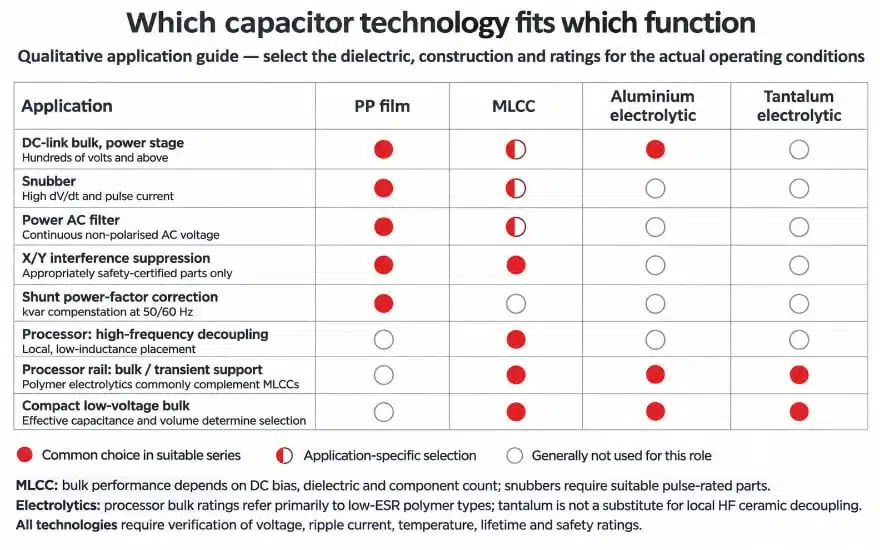
Suited to film
- DC-link: positions above about 500 V in power stages, where film competes with aluminium electrolytic and not with tantalum.
- Snubbers: high dv/dt and pulse current.
- AC filters and PFC: non-polarised AC voltage and mains-frequency power factor correction.
- X and Y interference suppression: safety-rated capacitors under IEC 60384-14.
Not suited to film
- Processor decoupling: low voltage and density come first, which favours MLCC and tantalum.
- Compact low-voltage bulk: tens of microfarads below 100 V remain with aluminium, tantalum and MLCC.
Film therefore relieves the supply of MLCC and tantalum only indirectly, when a design moves a power-stage function to film and frees ceramic capacity. High-voltage ceramics for the same domain are discussed in 800 VDC AI data centers and capacitor demand.
HYDRA film series
| Function | Series | Voltage range |
|---|---|---|
| DC link | EGB DCL, EBB DCL | 700 to 1500 V DC |
| AC filter | EAB MKP, EBB MKP, ERB DPM, ECB DPM | 420 to 1400 V AC |
| Power factor correction | PAB DPM, PMB DPM, PRB DPMg, PRB DPM | 230 to 690 V AC |
| Motor run | MKP (S0), MKP-Si (S2) | 400 to 500 V AC |
Supply Resilience Checklist
Price increases and 16 to 18 week lead times make supply a design input. Six questions can be applied to every bill of materials before the next allocation.
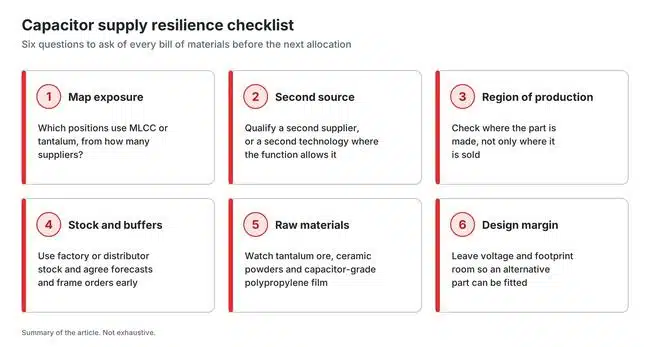
- Map exposure: which positions use MLCC or tantalum, and from how many suppliers.
- Second source: qualify a second supplier, or a second technology where the function allows it.
- Region of production: check where the part is made, not only where it is sold.
- Stock and buffers: use factory or distributor stock and agree forecasts and frame orders early.
- Raw materials: watch tantalum ore, ceramic powders and capacitor-grade polypropylene film.
- Design margin: leave voltage and footprint room so an alternative part can be fitted.
Conclusion
The price events of 2025 and 2026 affect MLCC and tantalum first. Film capacitors address a different part of the circuit, mainly DC-link, snubber, AC filter, PFC and suppression positions. A review of each capacitor position by function shows which parts can change technology and which need dual sourcing and earlier orders.
Further Reading
- Film and Foil Organic Dielectric Capacitors
- Film Capacitor Technologies and Applications 2024
- AI Data Centers Push Aluminium Capacitor Prices Higher
- KEMET Design it Day: DC Link Capacitor Selection Guide
Source
This article is based on the HYDRA technical article and the cited market reports. Engineers should refer to the current manufacturer datasheet for final design and qualification.
References
- The 2026 Capacitor Price Shock: MLCC and Tantalum Shortages and Where Film Capacitors Fit, HYDRA a.s., 6 October 2026.
- Across the Board 30% Price Hike: MLCC Price Surge Intensifies, TrendForce, 4 August 2026.
- Wang and Blaabjerg, Reliability of Capacitors for DC-Link Applications in Power Electronic Converters, IEEE Transactions on Industry Applications, 2014.
- NASA NEPP guidance on multilayer ceramic capacitors
- IEC 60384-14, Fixed capacitors for use in electronic equipment, Part 14: suppression capacitors and connections to the supply mains
- Helix: Rethinking DC-Link Capacitors for Silicon Carbide EV Inverters, Electronic Design.
- HYDRA – EPCI premium supplier page, Passive Components Blog.