









Passive Components Blog
No Result
View All Result
  • Home
  • NewsFilter
    • All
    • Aerospace & Defence
    • Antenna
    • Applications
    • Automotive
    • Capacitors
    • Circuit Protection Devices
    • electro-mechanical news
    • Filters
    • Fuses
    • Inductors
    • Industrial
    • Integrated Passives
    • inter-connect news
    • Market & Supply Chain
    • Market Insights
    • Medical
    • Modelling and Simulation
    • New Materials & Supply
    • New Technologies
    • Non-linear Passives
    • Oscillators
    • Passive Sensors News
    • Resistors
    • RF & Microwave
    • Telecommunication
    • Weekly Digest

    Samsung Introduced Low ESL 3-Terminal Reverse-Geometry MLCCs for High-Performance ADAS

    Würth Elektronik Presents New Bidirectional Digital Isolators

    Using Stress–Strain Curves to Diagnose Tantalum Powders for Capacitors

    Coilcraft Introduces SMT Current Sense Transformers for High‑Performance Power Electronics

    Samsung Launches Ultra-Compact 008004 High Q MLCC for Next-Generation RF Applications

    Nichicon Extends Rechargeable Batteries Temperature to Rival Supercapacitors

    Two‑capacitor paradox explained for engineers

    YAGEO Releases Compact RJ45 Connector for Multi‑Gigabit Ethernet

    Circuit Protection Technology Annual Dossier

    Trending Tags

    • Ripple Current
    • RF
    • Leakage Current
    • Tantalum vs Ceramic
    • Snubber
    • Low ESR
    • Feedthrough
    • Derating
    • Dielectric Constant
    • New Products
    • Market Reports
  • VideoFilter
    • All
    • Antenna videos
    • Capacitor videos
    • Circuit Protection Video
    • Filter videos
    • Fuse videos
    • Inductor videos
    • Inter-Connect Video
    • Non-linear passives videos
    • Oscillator videos
    • Passive sensors videos
    • Resistor videos

    Two‑capacitor paradox explained for engineers

    Capacitances of Nonlinear MLCCs: What Datasheets Don’t Tell You

    Tapped Inductor Buck Converter Fundamentals

    Planar vs Conventional Transformer: When it Make Sense

    Modeling Fringing Field Losses in Inductors & Transformers

    Why Power Inductors Use a Ferrite Core With an Air Gap

    Transformer-Based Power-Line Harvester Magnetic Design

    Thermal Modeling of Magnetics

    Standard vs Planar LLC transformers Comparison for Battery Chargers

    Trending Tags

    • Capacitors explained
    • Inductors explained
    • Resistors explained
    • Filters explained
    • Application Video Guidelines
    • EMC
    • New Products
    • Ripple Current
    • Simulation
    • Tantalum vs Ceramic
  • Knowledge Blog
  • DossiersNew
  • Suppliers
    • Who is Who
  • PCNS
    • PCNS 2025
    • PCNS 2023
    • PCNS 2021
    • PCNS 2019
    • PCNS 2017
  • Events
  • Home
  • NewsFilter
    • All
    • Aerospace & Defence
    • Antenna
    • Applications
    • Automotive
    • Capacitors
    • Circuit Protection Devices
    • electro-mechanical news
    • Filters
    • Fuses
    • Inductors
    • Industrial
    • Integrated Passives
    • inter-connect news
    • Market & Supply Chain
    • Market Insights
    • Medical
    • Modelling and Simulation
    • New Materials & Supply
    • New Technologies
    • Non-linear Passives
    • Oscillators
    • Passive Sensors News
    • Resistors
    • RF & Microwave
    • Telecommunication
    • Weekly Digest

    Samsung Introduced Low ESL 3-Terminal Reverse-Geometry MLCCs for High-Performance ADAS

    Würth Elektronik Presents New Bidirectional Digital Isolators

    Using Stress–Strain Curves to Diagnose Tantalum Powders for Capacitors

    Coilcraft Introduces SMT Current Sense Transformers for High‑Performance Power Electronics

    Samsung Launches Ultra-Compact 008004 High Q MLCC for Next-Generation RF Applications

    Nichicon Extends Rechargeable Batteries Temperature to Rival Supercapacitors

    Two‑capacitor paradox explained for engineers

    YAGEO Releases Compact RJ45 Connector for Multi‑Gigabit Ethernet

    Circuit Protection Technology Annual Dossier

    Trending Tags

    • Ripple Current
    • RF
    • Leakage Current
    • Tantalum vs Ceramic
    • Snubber
    • Low ESR
    • Feedthrough
    • Derating
    • Dielectric Constant
    • New Products
    • Market Reports
  • VideoFilter
    • All
    • Antenna videos
    • Capacitor videos
    • Circuit Protection Video
    • Filter videos
    • Fuse videos
    • Inductor videos
    • Inter-Connect Video
    • Non-linear passives videos
    • Oscillator videos
    • Passive sensors videos
    • Resistor videos

    Two‑capacitor paradox explained for engineers

    Capacitances of Nonlinear MLCCs: What Datasheets Don’t Tell You

    Tapped Inductor Buck Converter Fundamentals

    Planar vs Conventional Transformer: When it Make Sense

    Modeling Fringing Field Losses in Inductors & Transformers

    Why Power Inductors Use a Ferrite Core With an Air Gap

    Transformer-Based Power-Line Harvester Magnetic Design

    Thermal Modeling of Magnetics

    Standard vs Planar LLC transformers Comparison for Battery Chargers

    Trending Tags

    • Capacitors explained
    • Inductors explained
    • Resistors explained
    • Filters explained
    • Application Video Guidelines
    • EMC
    • New Products
    • Ripple Current
    • Simulation
    • Tantalum vs Ceramic
  • Knowledge Blog
  • DossiersNew
  • Suppliers
    • Who is Who
  • PCNS
    • PCNS 2025
    • PCNS 2023
    • PCNS 2021
    • PCNS 2019
    • PCNS 2017
  • Events
No Result
View All Result
Passive Components Blog
No Result
View All Result

Replacing Aluminum Electrolytic Capacitors with Tantalum or Ceramic Capacitors

7.6.2022
Reading Time: 6 mins read
A A

This article written by Teddy Won, KYOCERA-AVX Components Corporation, discusses shortcomings and replacing of aluminum electrolytic capacitors with tantalum capacitors or ceramic MLCC capacitors.

Introduction to Electrolytic Capacitors

Like all capacitors, electrolytic capacitors (shortly electrolytics or e-caps) are based on the principle of storing energy in an electric field using a voltage applied across a dielectric.

RelatedPosts

KYOCERA 10 µF 0201 MLCC Brings High‑Capacitance into Mobile Designs

KYOCERA AVX Extends MLV Varistors for 48V Automotive Protection

Kyocera Developed Multilayer Ceramic Core Substrate for AI Packages

The basic structure of this arrangement is shown in figure 1, where two metallic plates are used to contact the dielectric.

Electrolytic capacitors are unique in that the dielectric is formed by growing an oxide on the surface of a metallic (typically aluminum or tantalum) foil.

This oxide acts as a unidirectional insulator and gives the electrolytic capacitor its polarized characteristic. An electrolyte (typically liquid) is employed to interface with the irregular and rough oxide surface to make electrical contact with the other side of the oxide layer.
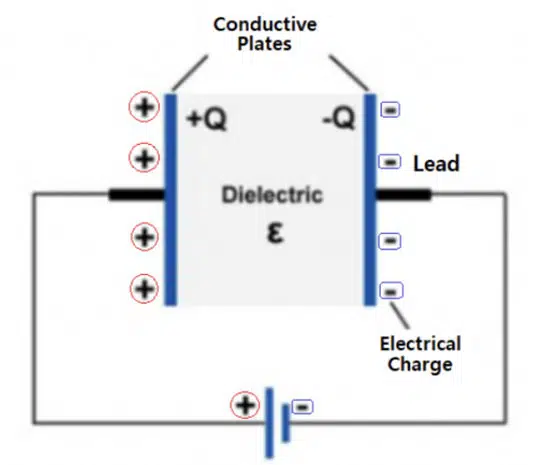
Figure 1 – Basic capacitor structure

Figure 2 shows that the foil-oxide-electrolyte foil structure is crimped into two wire leads and rolled to form the internal capacitor structure. It is worth noting that the electrolyte is often impregnated within a paper substrate for manufacturing purposes.

The impedance ratio describes the linearized temperature sensitivity of the impedance. Aluminum electrolytic capacitors often exhibit poor temperature sensitivity making them difficult to design into harsh environments. The rated ripple current is a limiting value that restricts an output ripple current below a certain level to prevent damage from self-heating.
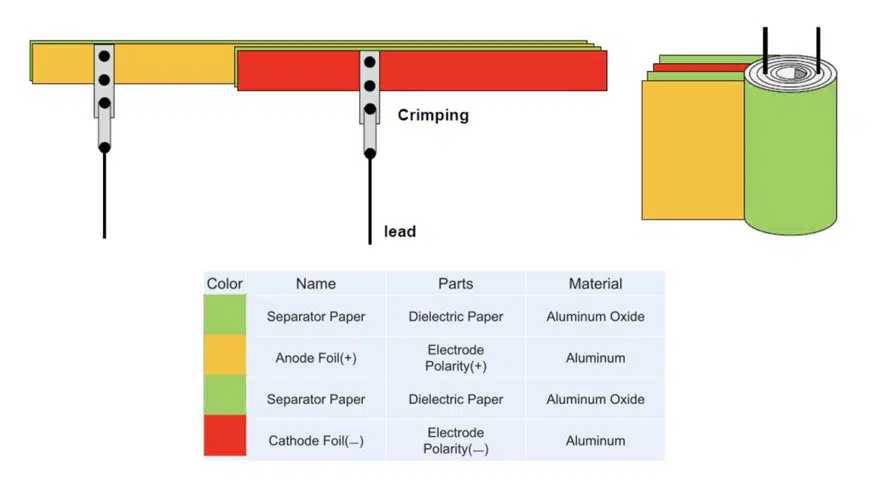
Figure 2 – Aluminum electrolytic capacitor core

This is intimately coupled to ESR since the internal resistance is the source of self-heating. Finally, the frequency coefficient for rated ripple details the acceptable ripple currents across different frequency ranges. In switching converter applications, knowledge of the frequency dependence is critical for selecting output capacitors. Table 1. provides overview of the most common capacitor electrical parameters such as DCL Leakage Current, DF Dissipation Factor (= tangent of loss angle tgd), Impedance and Ripple Current.
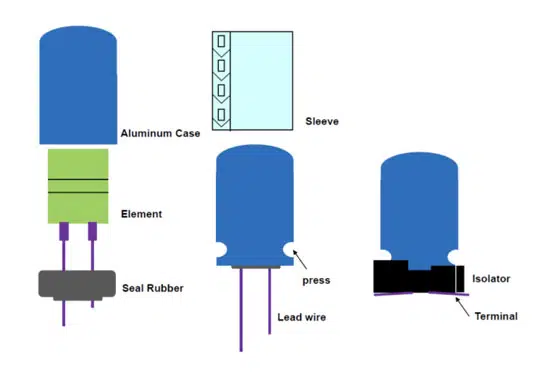
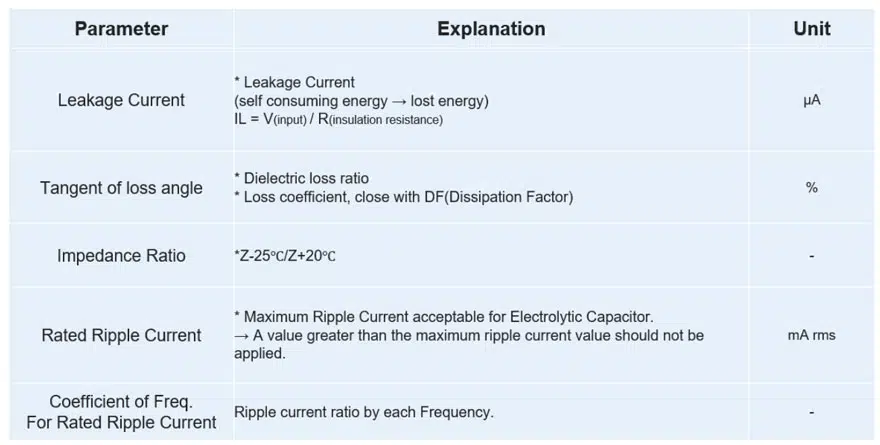
Figure 3 – Electrolytic capacitor case
Table 1 – Common electrolytic capacitor parameters

The Shortcomings of Aluminum Electrolytic Capacitors

Just like any other capacitor technology, aluminum electrolytics exhibit sensitivities that are undesirable in certain applications and must be accounted for during component selection. While their voltage ratings can be extremely high, they are generally sensitive to heat. In addition, due to a relatively high internal resistance, aluminum electrolytics require charge and discharge rates to be controlled concerning self-heating.

Finally, aluminum electrolytics can be sensitive to corrosion and have a relatively limited lifetime compared to other capacitor structures. These qualities are summarized in table 2. In high-reliability applications, such as automotive, Aluminum electrolytics can pose additional challenges. Their physical structure makes them sensitive to vibration induced failure modes. Special lead and case designs must be employed in these environments.

In addition, commonly used liquid electrolytes can introduce additional failure modes when external temperatures induce vaporization. When combined with the large physical size of aluminum electrolytics, and their relatively high variation specifications, they generally become unattractive for high-reliability applications.
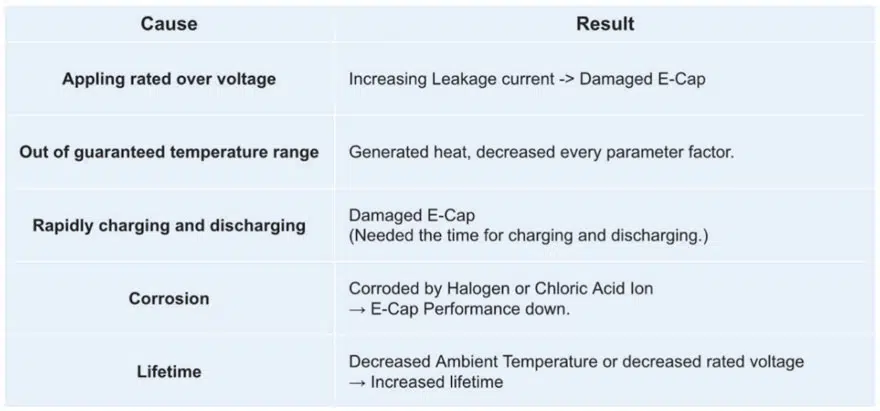
Table 2 – Aluminum electrolytic capacitors failure modes

Replacing Aluminum Electrolytic Capacitors
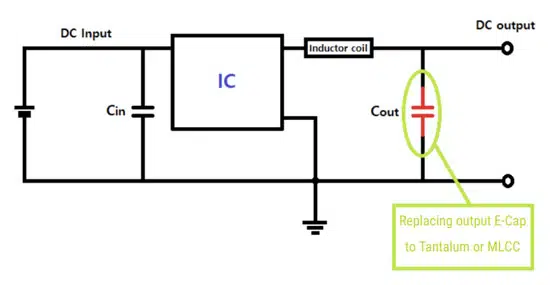
Figure 4 – Output capacitor choice in a DC/DC converter design

Designs are often required to meet certain regulatory standards that specify performance around reliability, environment, and performance. These must be reconciled with traditional concerns of size and cost. As a simple example, consider the output smoothing capacitor shown in the DC/DC converter design in figure 4.

The configuration of the output capacitor in figure 4 has a fixed and known polarity. That allows aluminum electrolytics, tantalum or multilayer MLCCs to be possible candidates for use. If the application demands long life, extreme temperature tolerance, or small physical size, then traditional aluminum electrolytics may not be optimal. As shown in figure 5, if a large bulk capacitance and low voltage are required, then the tantalum option may be preferable. If the voltage is particularly high or ripple performance is critical, then several low ESR MLCCs in parallel may be suitable.

Figure 5 – Comparison of voltage rating and lifetime for MLCCs and electrolytics

Conclusion

Given cost requirements and any other specific performance demands, there exist a wide variety of capacitor options that could readily replace the aluminum electrolytic capacitor.

Table 3 presents a high-level comparison between MLCC, aluminum electrolytic, and tantalum capacitors. Whenever lifetime reliability, temperature stability, or size are of paramount importance, one should consider replacing aluminum electrolytic capacitors in a design with MLCC’s or tantalum devices. Multiple MLCC’s may be necessary to achieve the required capacitance, and the bill of material costs might require adjustments for tantalum devices, but the resulting performance will justify the change.


Table 3 – An overall comparison of ceramic, aluminum electrolytic, and tantalum capacitors

Related

Source: KYOCERA AVX

Recent Posts

Samsung Introduced Low ESL 3-Terminal Reverse-Geometry MLCCs for High-Performance ADAS

20.5.2026
10

Würth Elektronik Presents New Bidirectional Digital Isolators

20.5.2026
8

Using Stress–Strain Curves to Diagnose Tantalum Powders for Capacitors

20.5.2026
11

Samsung Launches Ultra-Compact 008004 High Q MLCC for Next-Generation RF Applications

20.5.2026
7

Nichicon Extends Rechargeable Batteries Temperature to Rival Supercapacitors

19.5.2026
22

Two‑capacitor paradox explained for engineers

18.5.2026
46

ESA SPCD 26 Registration Open

15.5.2026
24

Capacitances of Nonlinear MLCCs: What Datasheets Don’t Tell You

14.5.2026
87

How a Digital Structural Twin Can Predict Tantalum Capacitor Reliability

14.5.2026
64

Upcoming Events

Jun 2
16:00 - 17:00 CEST

Calculation, Simulation and Measurement of 800V EMC Filters

Jun 16
16:00 - 17:00 CEST

EMC with EMC – EMC‑compliant design with electromechanical connectors

View Calendar

Popular Posts

  • Buck Converter Design and Calculation

    0 shares
    Share 0 Tweet 0
  • Boost Converter Design and Calculation

    0 shares
    Share 0 Tweet 0
  • Flyback Converter Design and Calculation

    0 shares
    Share 0 Tweet 0
  • LLC Resonant Converter Design and Calculation

    0 shares
    Share 0 Tweet 0
  • MLCC and Ceramic Capacitors

    0 shares
    Share 0 Tweet 0
  • Capacitor Charging and Discharging

    0 shares
    Share 0 Tweet 0
  • What Electronics Engineer Needs to Know About Passive Low Pass Filters

    0 shares
    Share 0 Tweet 0
  • Dual Active Bridge (DAB) Topology

    0 shares
    Share 0 Tweet 0
  • Ripple Current and its Effects on the Performance of Capacitors

    3 shares
    Share 3 Tweet 0
  • Samsung Electro-Mechanics Releases High-Capacitance MLCCs for AI Server Applications

    0 shares
    Share 0 Tweet 0

Newsletter Subscription


Passive Components Blog

© EPCI - Leading Passive Components Educational and Information Site

  • Home
  • Privacy Policy
  • EPCI Membership & Advertisement
  • About

No Result
View All Result
  • Home
  • Knowledge Blog
  • PCNS

© EPCI - Leading Passive Components Educational and Information Site

This website uses cookies. By continuing to use this website you are giving consent to cookies being used. Visit our Privacy and Cookie Policy.
Go to mobile version