







Passive Components Blog
No Result
View All Result
  • Home
  • NewsFilter
    • All
    • Aerospace & Defence
    • Antenna
    • Applications
    • Automotive
    • Capacitors
    • Circuit Protection Devices
    • electro-mechanical news
    • Filters
    • Fuses
    • Inductors
    • Industrial
    • Integrated Passives
    • inter-connect news
    • Market & Supply Chain
    • Market Insights
    • Medical
    • Modelling and Simulation
    • New Materials & Supply
    • New Technologies
    • Non-linear Passives
    • Oscillators
    • Passive Sensors News
    • Resistors
    • RF & Microwave
    • Telecommunication
    • Weekly Digest

    TU Wien Sets New Benchmark in Superconducting Vacuum Gap nanoCapacitors

    2026 Power Magnetics Design Trends: Flyback, DAB and Planar

    Vishay Releases Sulfur‑Resistant Chip Resistors

    Würth Elektronik Introduces Lead-Free SMT Spacers

    Schurter Releases EKO HV Fuses up to 1000 VDC, 1100 A

    Empower Releases High-Density Embedded Silicon Capacitors

    TDK Unveils 125C Compact DC Link Film Capacitors

    SCHURTER Releases Coin Cell Supercapacitors for Backup Power

    Skeleton Technologies Expands in U.S. to Power AI Data Centers

    Trending Tags

    • Ripple Current
    • RF
    • Leakage Current
    • Tantalum vs Ceramic
    • Snubber
    • Low ESR
    • Feedthrough
    • Derating
    • Dielectric Constant
    • New Products
    • Market Reports
  • VideoFilter
    • All
    • Antenna videos
    • Capacitor videos
    • Circuit Protection Video
    • Filter videos
    • Fuse videos
    • Inductor videos
    • Inter-Connect Video
    • Non-linear passives videos
    • Oscillator videos
    • Passive sensors videos
    • Resistor videos

    2026 Power Magnetics Design Trends: Flyback, DAB and Planar

    Enabling Software‑Defined Vehicle Architectures: Automotive Ethernet and Zonal Smart Power

    Calculating Resistance Value of a Flyback RC Snubber 

    One‑Pulse Characterization of Nonlinear Power Inductors

    Thermistor Linearization Challenges

    Coaxial Connectors and How to Connect with PCB

    PCB Manufacturing, Test Methods, Quality and Reliability

    Transformer Behavior – Current Transfer and Hidden Feedback

    Choosing the Right Capacitor: The Importance of Accurate Measurements

    Trending Tags

    • Capacitors explained
    • Inductors explained
    • Resistors explained
    • Filters explained
    • Application Video Guidelines
    • EMC
    • New Products
    • Ripple Current
    • Simulation
    • Tantalum vs Ceramic
  • Knowledge Blog
  • DossiersNew
  • Suppliers
    • Who is Who
  • PCNS
    • PCNS 2025
    • PCNS 2023
    • PCNS 2021
    • PCNS 2019
    • PCNS 2017
  • Events
  • Home
  • NewsFilter
    • All
    • Aerospace & Defence
    • Antenna
    • Applications
    • Automotive
    • Capacitors
    • Circuit Protection Devices
    • electro-mechanical news
    • Filters
    • Fuses
    • Inductors
    • Industrial
    • Integrated Passives
    • inter-connect news
    • Market & Supply Chain
    • Market Insights
    • Medical
    • Modelling and Simulation
    • New Materials & Supply
    • New Technologies
    • Non-linear Passives
    • Oscillators
    • Passive Sensors News
    • Resistors
    • RF & Microwave
    • Telecommunication
    • Weekly Digest

    TU Wien Sets New Benchmark in Superconducting Vacuum Gap nanoCapacitors

    2026 Power Magnetics Design Trends: Flyback, DAB and Planar

    Vishay Releases Sulfur‑Resistant Chip Resistors

    Würth Elektronik Introduces Lead-Free SMT Spacers

    Schurter Releases EKO HV Fuses up to 1000 VDC, 1100 A

    Empower Releases High-Density Embedded Silicon Capacitors

    TDK Unveils 125C Compact DC Link Film Capacitors

    SCHURTER Releases Coin Cell Supercapacitors for Backup Power

    Skeleton Technologies Expands in U.S. to Power AI Data Centers

    Trending Tags

    • Ripple Current
    • RF
    • Leakage Current
    • Tantalum vs Ceramic
    • Snubber
    • Low ESR
    • Feedthrough
    • Derating
    • Dielectric Constant
    • New Products
    • Market Reports
  • VideoFilter
    • All
    • Antenna videos
    • Capacitor videos
    • Circuit Protection Video
    • Filter videos
    • Fuse videos
    • Inductor videos
    • Inter-Connect Video
    • Non-linear passives videos
    • Oscillator videos
    • Passive sensors videos
    • Resistor videos

    2026 Power Magnetics Design Trends: Flyback, DAB and Planar

    Enabling Software‑Defined Vehicle Architectures: Automotive Ethernet and Zonal Smart Power

    Calculating Resistance Value of a Flyback RC Snubber 

    One‑Pulse Characterization of Nonlinear Power Inductors

    Thermistor Linearization Challenges

    Coaxial Connectors and How to Connect with PCB

    PCB Manufacturing, Test Methods, Quality and Reliability

    Transformer Behavior – Current Transfer and Hidden Feedback

    Choosing the Right Capacitor: The Importance of Accurate Measurements

    Trending Tags

    • Capacitors explained
    • Inductors explained
    • Resistors explained
    • Filters explained
    • Application Video Guidelines
    • EMC
    • New Products
    • Ripple Current
    • Simulation
    • Tantalum vs Ceramic
  • Knowledge Blog
  • DossiersNew
  • Suppliers
    • Who is Who
  • PCNS
    • PCNS 2025
    • PCNS 2023
    • PCNS 2021
    • PCNS 2019
    • PCNS 2017
  • Events
No Result
View All Result
Passive Components Blog
No Result
View All Result

Researchers Demonstrated Zinc-Ion Based Photo-Supercapacitor

28.7.2025
Reading Time: 4 mins read
A A

Researchers from Iran published article titled: FeCo2O4@Bi2S3 S-scheme heterojunction for photo-rechargeable Zn-ion capacitors in the Chemical Engineering Journal.

Abstract

RelatedPosts

TU Wien Sets New Benchmark in Superconducting Vacuum Gap nanoCapacitors

2026 Power Magnetics Design Trends: Flyback, DAB and Planar

Vishay Releases Sulfur‑Resistant Chip Resistors

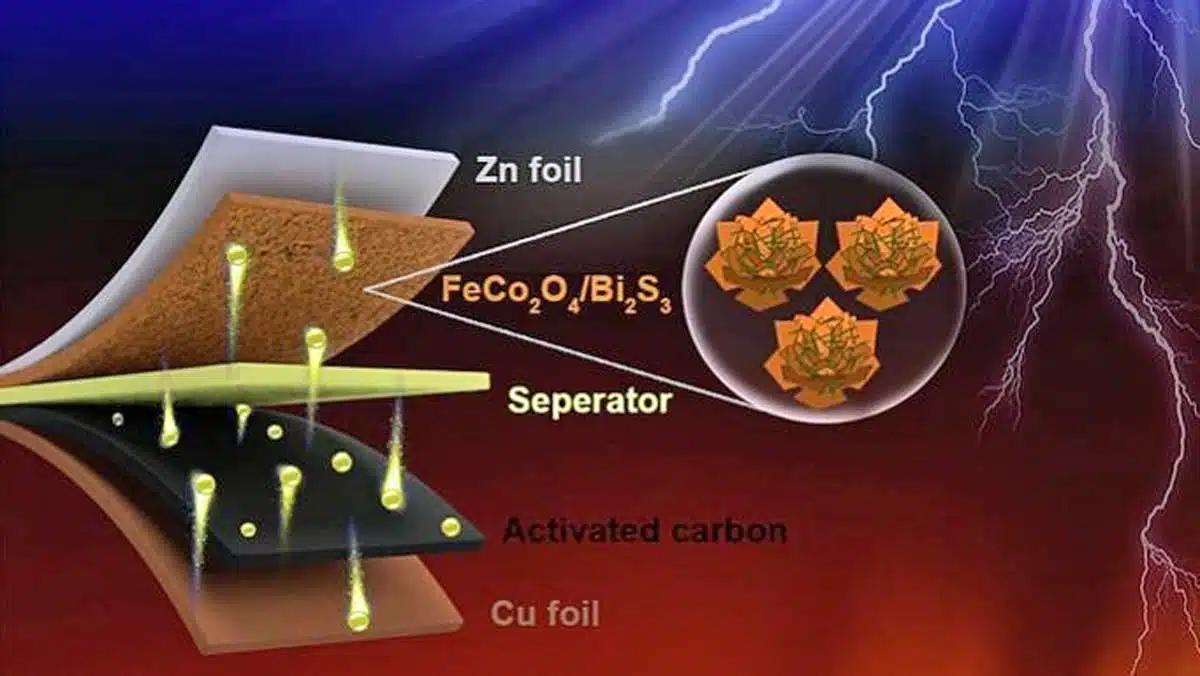
Solar energy harvesting and storage systems are being developed to address current energy challenges. In this study, we propose novel FeCo2O4 nanoflowers/Bi2S3 nanorods (FCO-NF/BS-NR) heterostructures as photoelectrodes for energy-efficient composite photo-rechargeable zinc-ion supercapacitors (PR-ZICs).

This work evaluates the performance of zinc ion photo-capacitors with FCO/BS composites at varying weight percentages of BS. The optimal photoelectrode (FCO/BS-0.1) exhibited a specific capacitance of 123.25 mF cm−2 under light illumination. The PR-ZIC with FCO/BS-0.1 exhibited superior performance under light, with a specific capacitance of 744 mF cm−2, energy density of 413.33 mWh cm−2, and power density of 882.67 mW cm−2, compared to dark conditions. Additionally, it retained 97.59 % of its capacitance after 10,000 cycles. Thus, the FCO/BS-0.1 photo-enhanced zinc-ion capacitor’s capacitance offers a practical and effective approach to developing a low-cost, highly efficient photo-supercapacitor system.


Keywords: Bi2S3 nanorods; FeCo2O4 nanoflowers; Photoelectrode; Energy storage; Photo-rechargeable; Zn-ion capacitors

Introduction

The global push toward sustainable energy has intensified efforts to develop integrated systems that both harvest and store solar energy efficiently. Photo-rechargeable (PR) energy storage devices, which combine light absorption and electrochemical storage into a single unit, promise to overcome the intermittent nature of solar power. This study introduces a novel S-scheme heterojunction composed of FeCo₂O₄ nanoflowers and Bi₂S₃ nanorods (FCO-NF/BS-NR) as a photoelectrode for zinc-ion capacitors (PR-ZICs), aiming to enhance photocarrier separation and achieve high-performance, long-life photo-supercapacitors.

Key Points

  • FeCo₂O₄/Bi₂S₃ S-scheme heterojunctions synthesized for the first time
  • Photocarrier recombination effectively suppressed, confirmed by photoelectrochemical analysis
  • Photo-rechargeable zinc-ion capacitor (PR-ZIC) successfully constructed using FCO/BS composite
  • Exceptional cycling stability: 97.59% capacitance retention over 10,000 cycles
  • Specific capacitance boosted to 744 mF cm⁻² under light irradiation

Extended Summary

The FCO-NF/BS-NR heterostructures were fabricated via a single-step hydrothermal process followed by annealing. Initially, hierarchical BS nanorods form when bismuth nitrate and thiourea undergo hydrolysis, creating a porous, lamellar Bi₂S₃ framework. FeCo₂O₄ nanoflowers then grow atop these rods, establishing intimate interfacial contact. Structural and morphological analyses confirmed the formation of the S-scheme heterojunction, which is critical for directional charge transfer and reduced recombination.

Photoelectrochemical measurements revealed that the FCO/BS-0.1 composition—where BS accounts for 10 wt% of the composite—achieved the highest photocurrent density among tested ratios. Under visible light, this electrode delivered a specific capacitance of 123.25 mF cm⁻², more than double its dark performance. These results demonstrate the heterojunction’s ability to harness solar photons and convert them into stored charge with minimal losses.

The PR-ZIC device was assembled using symmetric electrodes of FCO/BS-0.1 on zinc foil. Under illumination, the capacitor’s performance surged to a specific capacitance of 744 mF cm⁻², an energy density of 413.33 mWh cm⁻², and a power density of 882.67 mW cm⁻². Compared to dark conditions, these metrics represent a dramatic enhancement in both energy and power handling, showcasing the practical viability of the photo-enhanced system for on-demand energy delivery.

Long-term cycling tests under light exposure demonstrated outstanding stability: the PR-ZIC retained 97.59% of its initial capacitance after 10,000 cycles. This robustness arises from the S-scheme heterojunction, which not only accelerates charge separation but also mitigates structural degradation by uniformly distributing redox reactions across the electrode surface.

Mechanistically, the FCO/BS heterojunction leverages band alignment between FeCo₂O₄ and Bi₂S₃ to drive photogenerated electrons toward the conduction band of FeCo₂O₄ while holes migrate into Bi₂S₃. This S-scheme charge-transfer pathway reduces electron–hole recombination and maximizes light utilization. Additionally, the high surface area and abundant active sites of the nanoflower–nanorod architecture facilitate rapid ion diffusion and electron transport, further boosting capacitive performance.

Conclusion

This work pioneers the integration of FeCo₂O₄ nanoflowers and Bi₂S₃ nanorods into an S-scheme heterojunction for photo-rechargeable zinc-ion capacitors. The optimized FCO/BS-0.1 electrode exhibits superior photoelectrochemical properties, translating into a PR-ZIC with high specific capacitance, exceptional energy and power densities, and remarkable cycling stability. By employing earth-abundant, low-cost materials and a scalable synthesis route, this study lays the groundwork for developing practical, efficient, and durable photo-supercapacitors that could power the next generation of portable electronics and off-grid energy systems.

Read the full scientific article:

Sara Ramandi, Mohammad H. Entezari,
FeCo2O4@Bi2S3 S-scheme heterojunction for photo-rechargeable Zn-ion capacitors,
Chemical Engineering Journal,
Volume 520,
2025,
166373,
ISSN 1385-8947,
https://doi.org/10.1016/j.cej.2025.166373.
(https://www.sciencedirect.com/science/article/pii/S1385894725072110)


Related

Source: Chemical Engineering Journal

Recent Posts

TU Wien Sets New Benchmark in Superconducting Vacuum Gap nanoCapacitors

16.2.2026
7

Empower Releases High-Density Embedded Silicon Capacitors

11.2.2026
41

TDK Unveils 125C Compact DC Link Film Capacitors

11.2.2026
25

SCHURTER Releases Coin Cell Supercapacitors for Backup Power

10.2.2026
21

Skeleton Technologies Expands in U.S. to Power AI Data Centers

9.2.2026
27

Smoltek CNF-MIM Capacitors Hit 1,000x Lower Leakage

6.2.2026
22

Murata Opens New Ceramic Capacitor Manufacturing and R&D Center in Japan

5.2.2026
87

Murata Publishes Power Delivery Guide for AI Servers

4.2.2026
118

Mechanical Drift Indicator of Tantalum Capacitor Anodes Degradation under Reverse Bias

3.2.2026
45

Upcoming Events

Feb 24
16:00 - 17:00 CET

Mastering Galvanic Isolation: Ensuring Safety in Power Electronics

Mar 3
16:00 - 17:00 CET

Cybersecurity at the Eleventh Hour – from RED to CRA – Information and Discussion

Mar 21
All day

PSMA Capacitor Workshop 2026

View Calendar

Popular Posts

  • Buck Converter Design and Calculation

    0 shares
    Share 0 Tweet 0
  • Boost Converter Design and Calculation

    0 shares
    Share 0 Tweet 0
  • LLC Resonant Converter Design and Calculation

    0 shares
    Share 0 Tweet 0
  • Flyback Converter Design and Calculation

    0 shares
    Share 0 Tweet 0
  • Ripple Current and its Effects on the Performance of Capacitors

    3 shares
    Share 3 Tweet 0
  • Dual Active Bridge (DAB) Topology

    0 shares
    Share 0 Tweet 0
  • MLCC and Ceramic Capacitors

    0 shares
    Share 0 Tweet 0
  • What is a Dielectric Constant and DF of Plastic Materials?

    4 shares
    Share 4 Tweet 0
  • MLCC Case Sizes Standards Explained

    0 shares
    Share 0 Tweet 0
  • 3-Phase EMI Filter Design, Simulation, Calculation and Test

    0 shares
    Share 0 Tweet 0

Newsletter Subscription


Passive Components Blog

© EPCI - Leading Passive Components Educational and Information Site

  • Home
  • Privacy Policy
  • EPCI Membership & Advertisement
  • About

No Result
View All Result
  • Home
  • Knowledge Blog
  • PCNS

© EPCI - Leading Passive Components Educational and Information Site

This website uses cookies. By continuing to use this website you are giving consent to cookies being used. Visit our Privacy and Cookie Policy.
Go to mobile version