






Passive Components Blog
No Result
View All Result
  • Home
  • NewsFilter
    • All
    • Aerospace & Defence
    • Antenna
    • Applications
    • Automotive
    • Capacitors
    • Circuit Protection Devices
    • electro-mechanical news
    • Filters
    • Fuses
    • Inductors
    • Industrial
    • Integrated Passives
    • inter-connect news
    • Market & Supply Chain
    • Market Insights
    • Medical
    • Modelling and Simulation
    • New Materials & Supply
    • New Technologies
    • Non-linear Passives
    • Oscillators
    • Passive Sensors News
    • Resistors
    • RF & Microwave
    • Telecommunication
    • Weekly Digest

    Molecular Memristor Shows Record 145 kH Emergent Inductance

    Planar vs Conventional Transformer: When it Make Sense

    Researchers Propose Next‑Gen Compact Memory Using Ultra-thin Ferroelectric Capacitors

    Nichicon ADN Automotive Hybrid Aluminum Capacitors Now Available in EMEA

    Wk 19 Electronics Supply Chain Digest

    Electrocaloric Multilayer Capacitors: Towards Quiet, Solid‑State Cooling Around Room Temperature

    High-Crystallinity Nanocrystalline Composites for MHz Chip Inductors

    European Components Distribution Shows Strong Q1 2026 Growth Amid Geopolitical Uncertainty

    Stackpole Expanded its AlN Thick Film Chip Resistors

    Trending Tags

    • Ripple Current
    • RF
    • Leakage Current
    • Tantalum vs Ceramic
    • Snubber
    • Low ESR
    • Feedthrough
    • Derating
    • Dielectric Constant
    • New Products
    • Market Reports
  • VideoFilter
    • All
    • Antenna videos
    • Capacitor videos
    • Circuit Protection Video
    • Filter videos
    • Fuse videos
    • Inductor videos
    • Inter-Connect Video
    • Non-linear passives videos
    • Oscillator videos
    • Passive sensors videos
    • Resistor videos

    Planar vs Conventional Transformer: When it Make Sense

    Modeling Fringing Field Losses in Inductors & Transformers

    Why Power Inductors Use a Ferrite Core With an Air Gap

    Transformer-Based Power-Line Harvester Magnetic Design

    Thermal Modeling of Magnetics

    Standard vs Planar LLC transformers Comparison for Battery Chargers

    How Modern Tools Model Magnetic Components for Power Electronics

    Advanced Loss Modeling for Planar Magnetics in the Frenetic Planar Tool

    2026 Power Magnetics Design Trends: Flyback, DAB and Planar

    Trending Tags

    • Capacitors explained
    • Inductors explained
    • Resistors explained
    • Filters explained
    • Application Video Guidelines
    • EMC
    • New Products
    • Ripple Current
    • Simulation
    • Tantalum vs Ceramic
  • Knowledge Blog
  • DossiersNew
  • Suppliers
    • Who is Who
  • PCNS
    • PCNS 2025
    • PCNS 2023
    • PCNS 2021
    • PCNS 2019
    • PCNS 2017
  • Events
  • Home
  • NewsFilter
    • All
    • Aerospace & Defence
    • Antenna
    • Applications
    • Automotive
    • Capacitors
    • Circuit Protection Devices
    • electro-mechanical news
    • Filters
    • Fuses
    • Inductors
    • Industrial
    • Integrated Passives
    • inter-connect news
    • Market & Supply Chain
    • Market Insights
    • Medical
    • Modelling and Simulation
    • New Materials & Supply
    • New Technologies
    • Non-linear Passives
    • Oscillators
    • Passive Sensors News
    • Resistors
    • RF & Microwave
    • Telecommunication
    • Weekly Digest

    Molecular Memristor Shows Record 145 kH Emergent Inductance

    Planar vs Conventional Transformer: When it Make Sense

    Researchers Propose Next‑Gen Compact Memory Using Ultra-thin Ferroelectric Capacitors

    Nichicon ADN Automotive Hybrid Aluminum Capacitors Now Available in EMEA

    Wk 19 Electronics Supply Chain Digest

    Electrocaloric Multilayer Capacitors: Towards Quiet, Solid‑State Cooling Around Room Temperature

    High-Crystallinity Nanocrystalline Composites for MHz Chip Inductors

    European Components Distribution Shows Strong Q1 2026 Growth Amid Geopolitical Uncertainty

    Stackpole Expanded its AlN Thick Film Chip Resistors

    Trending Tags

    • Ripple Current
    • RF
    • Leakage Current
    • Tantalum vs Ceramic
    • Snubber
    • Low ESR
    • Feedthrough
    • Derating
    • Dielectric Constant
    • New Products
    • Market Reports
  • VideoFilter
    • All
    • Antenna videos
    • Capacitor videos
    • Circuit Protection Video
    • Filter videos
    • Fuse videos
    • Inductor videos
    • Inter-Connect Video
    • Non-linear passives videos
    • Oscillator videos
    • Passive sensors videos
    • Resistor videos

    Planar vs Conventional Transformer: When it Make Sense

    Modeling Fringing Field Losses in Inductors & Transformers

    Why Power Inductors Use a Ferrite Core With an Air Gap

    Transformer-Based Power-Line Harvester Magnetic Design

    Thermal Modeling of Magnetics

    Standard vs Planar LLC transformers Comparison for Battery Chargers

    How Modern Tools Model Magnetic Components for Power Electronics

    Advanced Loss Modeling for Planar Magnetics in the Frenetic Planar Tool

    2026 Power Magnetics Design Trends: Flyback, DAB and Planar

    Trending Tags

    • Capacitors explained
    • Inductors explained
    • Resistors explained
    • Filters explained
    • Application Video Guidelines
    • EMC
    • New Products
    • Ripple Current
    • Simulation
    • Tantalum vs Ceramic
  • Knowledge Blog
  • DossiersNew
  • Suppliers
    • Who is Who
  • PCNS
    • PCNS 2025
    • PCNS 2023
    • PCNS 2021
    • PCNS 2019
    • PCNS 2017
  • Events
No Result
View All Result
Passive Components Blog
No Result
View All Result

Researchers Propose Novel MLCC Dielectric Design to Increase Energy Storage Capacity

24.7.2025
Reading Time: 3 mins read
A A
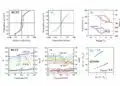
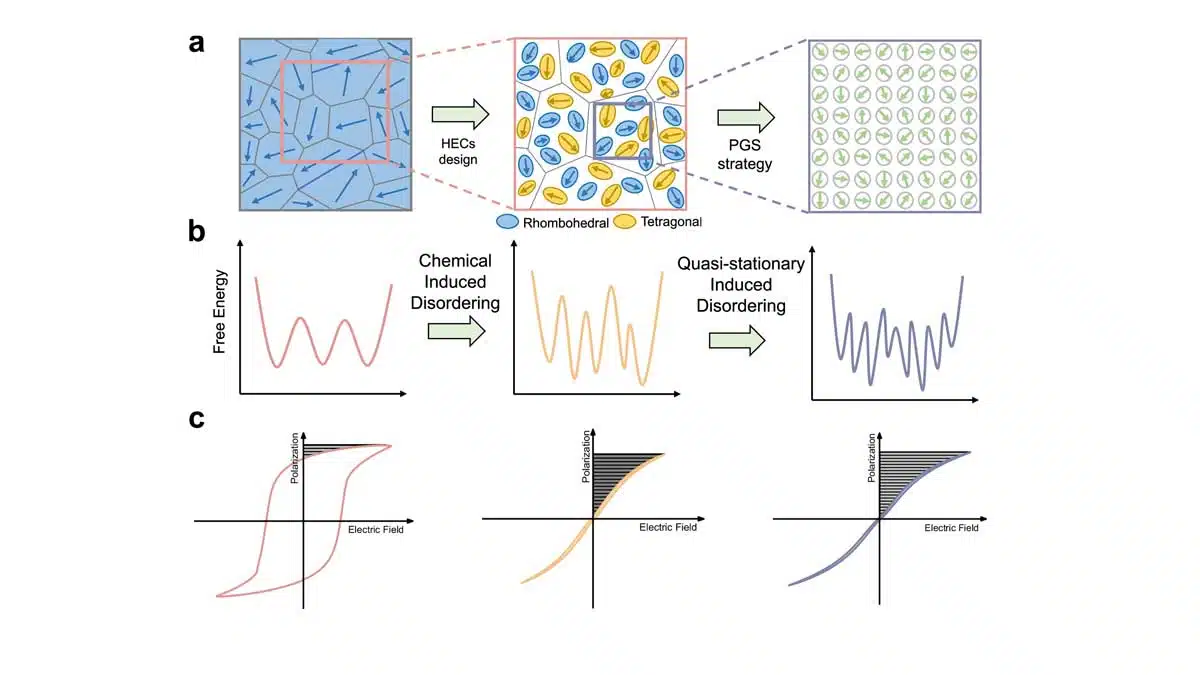
Comparative display of a grain size and domain structure; b free energy; c P-E loops after high-entropy ceramics (HECs) and PGS design. source: Nature Communications  ISSN 2041-1723

Comparative display of a grain size and domain structure; b free energy; c P-E loops after high-entropy ceramics (HECs) and PGS design. source: Nature Communications ISSN 2041-1723

Researchers from Dianzi University, Hangzhou, Zhejiang, China published their study in nature communications journal on novel polar glass state strategy to enhance energy storage performance of MLCC ceramic capacitors.

Introduction

RelatedPosts

Molecular Memristor Shows Record 145 kH Emergent Inductance

Planar vs Conventional Transformer: When it Make Sense

Researchers Propose Next‑Gen Compact Memory Using Ultra-thin Ferroelectric Capacitors

Multilayer ceramic capacitors (MLCCs) are key components in modern electronics, prized for their compact size, high power density, and fast charge–discharge rates.

Despite significant progress, achieving both high recoverable energy density and efficiency across a wide temperature range remains challenging. This study introduces a novel “polar glass state” (PGS) strategy to overcome these limitations in Bi₀.₅Na₀.₅TiO₃-based MLCCs, enabling ultrahigh energy storage performance with exceptional thermal and cycling stability.

Key Points

  • A polar glass state (PGS) strategy disrupts nanoscale ferroelectric order and minimizes hysteresis loss.
  • Bi₀.₅Na₀.₅TiO₃–based MLCCs reach 22.92 J cm⁻³ recoverable energy density and 97.1% efficiency at 1200 kV cm⁻¹.
  • High breakdown strength (1200 kV cm⁻¹) is achieved via hierarchical grain refinement.
  • Stable performance up to 150 °C with less than 2% efficiency fluctuation.
  • Excellent cycling reliability demonstrated over 10⁵ charge–discharge cycles.

Extended Summary

The escalating demand for efficient and miniaturized energy storage devices, driven by electric vehicles and pulsed power systems, calls for dielectric capacitors that deliver both high energy density and efficiency. Traditional MLCCs often suffer from significant hysteresis losses and decline in performance at elevated temperatures, limiting their broader application.

To address these challenges, the authors propose the polar glass state, a non-equilibrium structural design that “freezes” the material in a state where atomic-scale polarizations are randomly distributed. By introducing controlled chemical heterogeneity and carefully tuning sintering dynamics, long-range ferroelectric regions are disrupted, reducing remnant polarization and lowering energy barriers for polarization switching.

Using a base matrix of 0.82Bi₀.₅Na₀.₅TiO₃–0.18Bi₀.₅K₀.₅TiO₃ modified with Sr(Sc₀.₅Ta₀.₅)O₃, the team fabricated tape-cast multilayer capacitors (1.88 R-MLCCs) with six dielectric layers and platinum electrodes. These capacitors exhibit ultralow hysteresis loops at room temperature, with a maximum polarization (Pₘ) of 58.5 μC cm⁻² and a remnant polarization (Pᵣ) near zero.

Energy storage testing under a field of 1200 kV cm⁻¹ reveals a recoverable energy density of 22.92 J cm⁻³ and efficiency of 97.1%. Weibull analysis shows an increase in breakdown strength from 425 kV cm⁻¹ in bulk ceramics to 1200 kV cm⁻¹ in MLCCs, thanks to grain size reduction to roughly 0.5 μm. Performance remains robust up to 150 °C, delivering over 14 J cm⁻³ with under 2% efficiency drop.

Reliability tests highlight impressive cycling stability, with less than 1% degradation after 10⁵ cycles at 800 kV cm⁻¹. Fast discharge experiments demonstrate over 16 J cm⁻³ released within 2.8 μs, confirming suitability for high-power pulsed applications.

Comprehensive structural analyses across multiple scales—atomistic via AC-STEM, short-range by total scattering, long-range by XRD, and micro-range by PFM—validate the persistence of the PGS from 25 °C to 150 °C. The randomized polarization distribution and stable R/T phase coexistence underpin both the high energy storage capabilities and thermal resilience.

Conclusion

This work establishes the polar glass state as a transformative design paradigm for MLCCs, achieving record-high energy density and efficiency alongside unmatched thermal and cycling reliability. By engineering disorder at multiple length scales, the study paves the way for next-generation dielectric capacitors in demanding applications, from compact on-chip energy storage to advanced pulsed power systems.

Read the full original scientific paper here:

Zhao, W., Liu, Z., Xu, D. et al. Advanced stability and energy storage capacity in hierarchically engineered Bi0.5Na0.5TiO3-based multilayer capacitors. Nat Commun 16, 6549 (2025). https://doi.org/10.1038/s41467-025-61936-2

Related

Source: Nat Communication

Recent Posts

Molecular Memristor Shows Record 145 kH Emergent Inductance

12.5.2026
8

Planar vs Conventional Transformer: When it Make Sense

11.5.2026
30

Researchers Propose Next‑Gen Compact Memory Using Ultra-thin Ferroelectric Capacitors

11.5.2026
24

Nichicon ADN Automotive Hybrid Aluminum Capacitors Now Available in EMEA

11.5.2026
21

Electrocaloric Multilayer Capacitors: Towards Quiet, Solid‑State Cooling Around Room Temperature

7.5.2026
182

High-Crystallinity Nanocrystalline Composites for MHz Chip Inductors

7.5.2026
63

KYOCERA 10 µF 0201 MLCC Brings High‑Capacitance into Mobile Designs

6.5.2026
50

Energy Localization in Tantalum Anode Formation: A Structural Perspective

4.5.2026
46

YAGEO Introduces C0G Flexible Termination Automotive MLCCs

30.4.2026
41

Upcoming Events

May 13
17:00 - 17:30 CEST

Winding Loss Modeling for Toroidal Magnetics – Including Gapped Cores

May 19
16:00 - 17:00 CEST

Designing Qi2 Wireless Power Systems: Practical Development and EMC Optimization

Jun 2
16:00 - 17:00 CEST

Calculation, Simulation and Measurement of 800V EMC Filters

View Calendar

Popular Posts

  • Buck Converter Design and Calculation

    0 shares
    Share 0 Tweet 0
  • Boost Converter Design and Calculation

    0 shares
    Share 0 Tweet 0
  • Flyback Converter Design and Calculation

    0 shares
    Share 0 Tweet 0
  • LLC Resonant Converter Design and Calculation

    0 shares
    Share 0 Tweet 0
  • MLCC and Ceramic Capacitors

    0 shares
    Share 0 Tweet 0
  • Dual Active Bridge (DAB) Topology

    0 shares
    Share 0 Tweet 0
  • What Electronics Engineer Needs to Know About Passive Low Pass Filters

    0 shares
    Share 0 Tweet 0
  • Capacitor Charging and Discharging

    0 shares
    Share 0 Tweet 0
  • Ripple Current and its Effects on the Performance of Capacitors

    3 shares
    Share 3 Tweet 0
  • MLCC Case Sizes Standards Explained

    0 shares
    Share 0 Tweet 0

Newsletter Subscription


Passive Components Blog

© EPCI - Leading Passive Components Educational and Information Site

  • Home
  • Privacy Policy
  • EPCI Membership & Advertisement
  • About

No Result
View All Result
  • Home
  • Knowledge Blog
  • PCNS

© EPCI - Leading Passive Components Educational and Information Site

This website uses cookies. By continuing to use this website you are giving consent to cookies being used. Visit our Privacy and Cookie Policy.
Go to mobile version