










Passive Components Blog
No Result
View All Result
  • Home
  • NewsFilter
    • All
    • Aerospace & Defence
    • Antenna
    • Applications
    • Automotive
    • Capacitors
    • Circuit Protection Devices
    • electro-mechanical news
    • Filters
    • Fuses
    • Inductors
    • Industrial
    • Integrated Passives
    • inter-connect news
    • Market & Supply Chain
    • Market Insights
    • Medical
    • Modelling and Simulation
    • New Materials & Supply
    • New Technologies
    • Non-linear Passives
    • Oscillators
    • Passive Sensors News
    • Resistors
    • RF & Microwave
    • Telecommunication
    • Weekly Digest

    Littelfuse Expands High-Voltage TVS Diodes

    DigiKey Adds 31k New In‑Stock Parts in Q1 2026

    Miniaturization of Tantalum Capacitors: Structural Limit Under Constant Rating

    Heatsink Design and Thermal Interface Materials for Reliable Electronics

    Murata New MLCC Bulk Case Packaging Cuts Packaging Material by 99%

    Wk 17 Electronics Supply Chain Digest

    Exxelia Introduces SMD High‑Voltage Mica Capacitors

    Modelithics Releases COMPLETE v26.1 for Keysight ADS

    April 2026 Interconnect, Passives and Electromechanical Components Market Insights

    Trending Tags

    • Ripple Current
    • RF
    • Leakage Current
    • Tantalum vs Ceramic
    • Snubber
    • Low ESR
    • Feedthrough
    • Derating
    • Dielectric Constant
    • New Products
    • Market Reports
  • VideoFilter
    • All
    • Antenna videos
    • Capacitor videos
    • Circuit Protection Video
    • Filter videos
    • Fuse videos
    • Inductor videos
    • Inter-Connect Video
    • Non-linear passives videos
    • Oscillator videos
    • Passive sensors videos
    • Resistor videos

    Why Power Inductors Use a Ferrite Core With an Air Gap

    Transformer-Based Power-Line Harvester Magnetic Design

    Thermal Modeling of Magnetics

    Standard vs Planar LLC transformers Comparison for Battery Chargers

    How Modern Tools Model Magnetic Components for Power Electronics

    Advanced Loss Modeling for Planar Magnetics in the Frenetic Planar Tool

    2026 Power Magnetics Design Trends: Flyback, DAB and Planar

    Enabling Software‑Defined Vehicle Architectures: Automotive Ethernet and Zonal Smart Power

    Calculating Resistance Value of a Flyback RC Snubber 

    Trending Tags

    • Capacitors explained
    • Inductors explained
    • Resistors explained
    • Filters explained
    • Application Video Guidelines
    • EMC
    • New Products
    • Ripple Current
    • Simulation
    • Tantalum vs Ceramic
  • Knowledge Blog
  • DossiersNew
  • Suppliers
    • Who is Who
  • PCNS
    • PCNS 2025
    • PCNS 2023
    • PCNS 2021
    • PCNS 2019
    • PCNS 2017
  • Events
  • Home
  • NewsFilter
    • All
    • Aerospace & Defence
    • Antenna
    • Applications
    • Automotive
    • Capacitors
    • Circuit Protection Devices
    • electro-mechanical news
    • Filters
    • Fuses
    • Inductors
    • Industrial
    • Integrated Passives
    • inter-connect news
    • Market & Supply Chain
    • Market Insights
    • Medical
    • Modelling and Simulation
    • New Materials & Supply
    • New Technologies
    • Non-linear Passives
    • Oscillators
    • Passive Sensors News
    • Resistors
    • RF & Microwave
    • Telecommunication
    • Weekly Digest

    Littelfuse Expands High-Voltage TVS Diodes

    DigiKey Adds 31k New In‑Stock Parts in Q1 2026

    Miniaturization of Tantalum Capacitors: Structural Limit Under Constant Rating

    Heatsink Design and Thermal Interface Materials for Reliable Electronics

    Murata New MLCC Bulk Case Packaging Cuts Packaging Material by 99%

    Wk 17 Electronics Supply Chain Digest

    Exxelia Introduces SMD High‑Voltage Mica Capacitors

    Modelithics Releases COMPLETE v26.1 for Keysight ADS

    April 2026 Interconnect, Passives and Electromechanical Components Market Insights

    Trending Tags

    • Ripple Current
    • RF
    • Leakage Current
    • Tantalum vs Ceramic
    • Snubber
    • Low ESR
    • Feedthrough
    • Derating
    • Dielectric Constant
    • New Products
    • Market Reports
  • VideoFilter
    • All
    • Antenna videos
    • Capacitor videos
    • Circuit Protection Video
    • Filter videos
    • Fuse videos
    • Inductor videos
    • Inter-Connect Video
    • Non-linear passives videos
    • Oscillator videos
    • Passive sensors videos
    • Resistor videos

    Why Power Inductors Use a Ferrite Core With an Air Gap

    Transformer-Based Power-Line Harvester Magnetic Design

    Thermal Modeling of Magnetics

    Standard vs Planar LLC transformers Comparison for Battery Chargers

    How Modern Tools Model Magnetic Components for Power Electronics

    Advanced Loss Modeling for Planar Magnetics in the Frenetic Planar Tool

    2026 Power Magnetics Design Trends: Flyback, DAB and Planar

    Enabling Software‑Defined Vehicle Architectures: Automotive Ethernet and Zonal Smart Power

    Calculating Resistance Value of a Flyback RC Snubber 

    Trending Tags

    • Capacitors explained
    • Inductors explained
    • Resistors explained
    • Filters explained
    • Application Video Guidelines
    • EMC
    • New Products
    • Ripple Current
    • Simulation
    • Tantalum vs Ceramic
  • Knowledge Blog
  • DossiersNew
  • Suppliers
    • Who is Who
  • PCNS
    • PCNS 2025
    • PCNS 2023
    • PCNS 2021
    • PCNS 2019
    • PCNS 2017
  • Events
No Result
View All Result
Passive Components Blog
No Result
View All Result

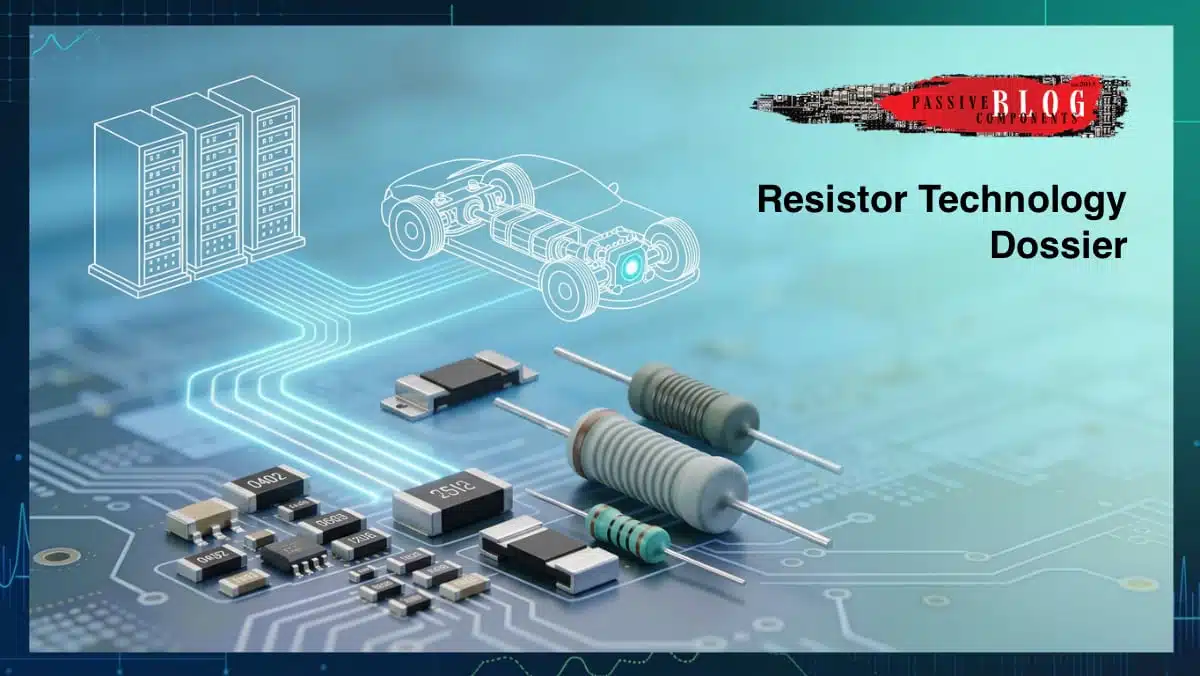
Resistor Technology Dossier

4.3.2026
Reading Time: 4 mins read
A A

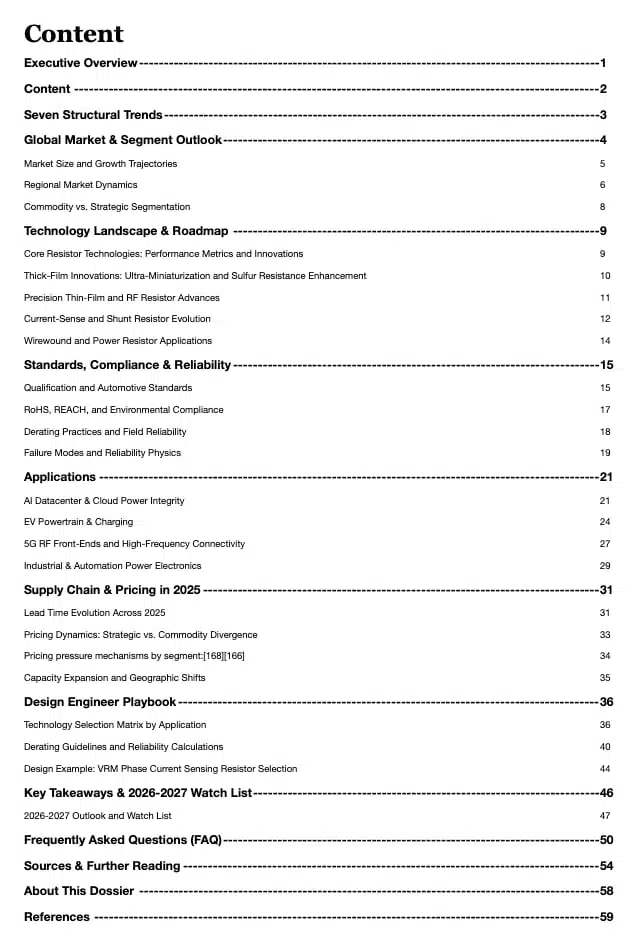
Passive Components Blog has released the 2026 Annual Resistor Dossier, a 69‑page deep dive into how resistors moved from low‑margin commodity parts to strategic enablers of AI, EV and 5G infrastructure in 2025–2026.

Executive Overview

The resistor industry experienced a pivotal transformation in 2025, evolving from a predominantly commodity-driven sector into a strategic technology landscape where high-precision, current-sensing, and high-reliability resistors became critical enablers of AI infrastructure, electric vehicle powertrains, and 5G connectivity. This shift was driven by three converging forces: the exponential current-sensing demands of artificial intelligence accelerators and datacenter power distribution, the voltage architecture revolution in electric vehicles requiring precision shunt resistors for battery management and traction control, and the frequency stability requirements of 5G-Advanced RF front-ends. Collectively, these applications created a bifurcated market where application-specific, high-accuracy resistors commanded premium pricing and extended lead times, while general-purpose thick-film segments faced margin pressure from Asian oversupply.

RelatedPosts

Inductor Technology Dossier

Capacitor Technology Dossier

The global resistor market reached USD 10.82 billion in 2025, representing a 4.2% compound annual growth rate that lagged broader passive component growth but masked dramatic segment divergence. This growth was highly non-uniform—strategic segments including current-sense/shunt resistors, precision thin-film, and automotive-qualified thick-film resistors grew at 8-14% CAGR, while commodity general-purpose chip resistors stagnated or declined in value despite volume growth. The divergence reflects a critical industry inflection point: resistors are no longer passive price-driven commodities but active determinants of system accuracy, power efficiency, and functional safety in mission-critical applications.
What the dossier covers

  • Seven structural trends shaping 2025
    From AI datacenter current‑sensing dominance and the 800 V EV tipping point to 5G‑Advanced RF front‑ends, regional supply chain reconfiguration, miniaturization limits, intensifying AEC‑Q200 regimes and sulfur‑resistance requirements.
  • Hard numbers behind the shift
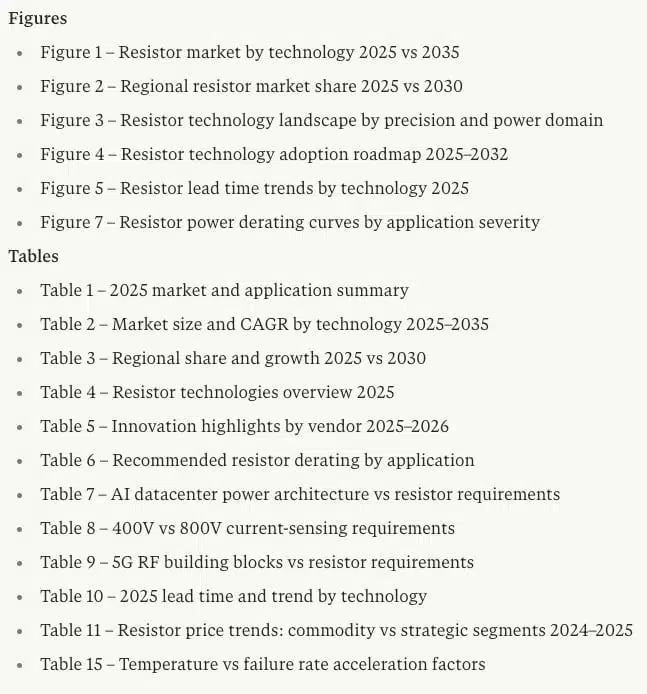
    Detailed tables quantify 2025 market size and 2035 projections by technology, including general thick‑film, current‑sense/shunt, precision thin‑film, automotive‑qualified thick‑film, wirewound/power and networks/arrays, highlighting the value shift toward strategic segments.
  • AI, EV and other application chapters
    Application‑focused sections dissect resistor roles in AI server PDNs, 800 V EV traction inverters and BMS/OBC, 5G RF front‑ends, industrial drives, solar inverters and DC fast‑charging, with concrete current‑sensing and derating examples.
  • Technology landscape & roadmap
    A full technology map compares thick‑film, thin‑film, current‑sense shunts, wirewound and legacy metal‑film across resistance range, power rating, TCR, temperature and volumetric efficiency, plus a roadmap of adoption for currentsense, thin‑film RF, automotive thick‑film and other key platforms through 2032.
  • Qualification, compliance and reliability
    The dossier summarizes AEC‑Q200 Rev. E implications for resistors, extended temperature and overload stress regimes, RoHS/REACH and sulfur‑resistance requirements, and provides practical derating tables and failure‑mode analysis for long‑life automotive, industrial and datacenter designs.

Who should read it

  • Component manufacturers and distributors
    Planning 2026–2030 roadmaps for thick‑film, thin‑film, current‑sense shunts and wirewound/power resistors.
  • OEM and Tier‑1 engineering teams
    Designing AI servers, EV powertrains and charging, industrial automation, renewables and 5G RF systems who need a consolidated view of resistor options, limits and trade‑offs.
  • Sourcing, category and product managers
    Managing lead‑time, qualification and single‑source risk in strategic resistor categories across automotive, datacenter and industrial programs.

Why it stands apart

Unlike generic resistor reports that stop at high‑level market sizing, the 2026 Annual Resistor Dossier combines:

  • Quantitative market and CAGR data across all major resistor technologies.
  • Detailed technology benchmarking (tolerance, TCR, power, temperature, volumetric efficiency).
  • Application engineering guidance for AI, EV, 5G, industrial and grid‑tied systems, including real current‑sense design, derating and reliability examples.

The result is a compact, high‑density reference that can be read in an afternoon and used all year for strategy, design and sourcing decisions.

Availability

The Annual Resistor Technology Dossier – is available now at 699EUR exclusively from passive-components.eu as a paid download.

To learn more and purchase your copy, visit the Technology Dossiers page on the passive-components.eu blog.


Technology Dossiers

Related

Recent Posts

DigiKey Adds 31k New In‑Stock Parts in Q1 2026

29.4.2026
2

Exxelia Introduces SMD High‑Voltage Mica Capacitors

28.4.2026
17

Modelithics Releases COMPLETE v26.1 for Keysight ADS

23.4.2026
13

April 2026 Interconnect, Passives and Electromechanical Components Market Insights

22.4.2026
61

KYOCERA AVX Introduces Traction‑Grade DC Link Film Capacitors

21.4.2026
44

YAGEO Introduces High‑Current Y2/X1 Film Capacitors for Wide-bandgap Power Systems

17.4.2026
39

Amphenol Explanded Liquid Cooling Connectors for AI, ESS and EV Systems

17.4.2026
21

Hirose Introduced BGA connector for PCIe Gen6 for AI and Edge Computing

17.4.2026
12

Würth Elektronik Expanded Capacity for Validation and Services in Asia

16.4.2026
17

Upcoming Events

Apr 30
10:00 - 11:00 CDT

Programming Embedded Systems

May 5
16:00 - 17:00 CEST

Understanding and Selecting Capacitors – Fundamentals, Technologies and Latest Trends

May 12
8:00 - 15:00 CEST

ESCC Space Splice connectors

View Calendar

Popular Posts

  • Buck Converter Design and Calculation

    0 shares
    Share 0 Tweet 0
  • Boost Converter Design and Calculation

    0 shares
    Share 0 Tweet 0
  • Flyback Converter Design and Calculation

    0 shares
    Share 0 Tweet 0
  • LLC Resonant Converter Design and Calculation

    0 shares
    Share 0 Tweet 0
  • Dual Active Bridge (DAB) Topology

    0 shares
    Share 0 Tweet 0
  • MLCC and Ceramic Capacitors

    0 shares
    Share 0 Tweet 0
  • What Electronics Engineer Needs to Know About Passive Low Pass Filters

    0 shares
    Share 0 Tweet 0
  • Capacitor Charging and Discharging

    0 shares
    Share 0 Tweet 0
  • Ripple Current and its Effects on the Performance of Capacitors

    3 shares
    Share 3 Tweet 0
  • MLCC Case Sizes Standards Explained

    0 shares
    Share 0 Tweet 0

Newsletter Subscription


Passive Components Blog

© EPCI - Leading Passive Components Educational and Information Site

  • Home
  • Privacy Policy
  • EPCI Membership & Advertisement
  • About

No Result
View All Result
  • Home
  • Knowledge Blog
  • PCNS

© EPCI - Leading Passive Components Educational and Information Site

This website uses cookies. By continuing to use this website you are giving consent to cookies being used. Visit our Privacy and Cookie Policy.
Go to mobile version