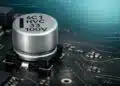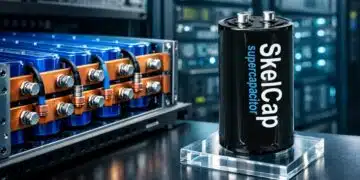



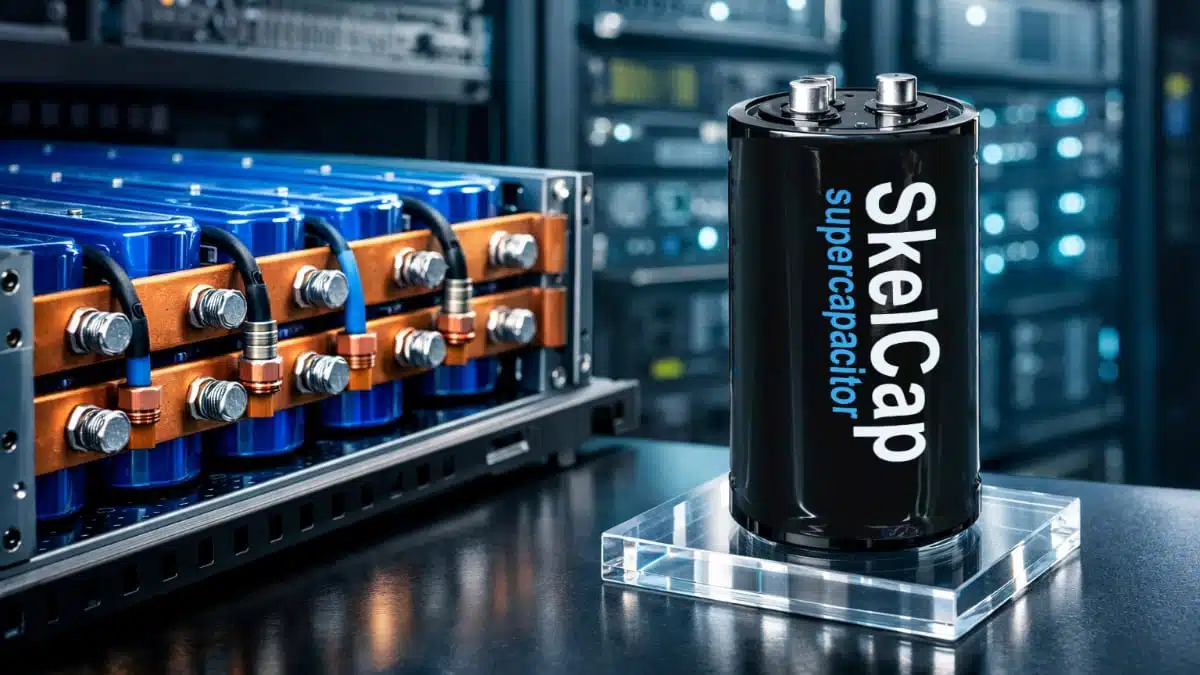
Skeleton Technologies has announced a new supercapacitor that achieves a UL 810A‑certified peak current of 3,500 A in a volume of only 0.39 L, roughly the size of a standard beverage can.
This combination of very high peak current capability and compact form factor targets rapidly growing power demands in AI data centers and other high‑power electronics where short‑duration, high‑current pulses and safety are critical.
Key features and benefits
- Record UL‑certified peak current
The new Skeleton supercapacitor reaches a peak current rating of 3,500 A, with safety verified under UL 810A testing. In practice, this enables much higher instantaneous current than typical battery‑based solutions of similar volume, which is particularly important for AI server racks with steep power transients. - High power density in compact volume
With a volume of 0.39 L, approximately equivalent to a “Coca‑Cola can” mechanical envelope, the device offers very high power density for cabinet and rack‑level designs where vertical space and airflow paths are tightly constrained. - UL 810A safety certification
The device has completed UL 810A safety certification, a standard that specifically addresses electrochemical capacitors. For design engineers, this simplifies safety compliance, eases approval with certification bodies, and can shorten time‑to‑market for systems requiring third‑party safety validation. - Robust failure behavior
Skeleton emphasizes that the technology remains safe even under extreme abuse such as direct flame or mechanical penetration (for example, a projectile through the cell), without resulting in explosion. For data center and industrial environments, this points to a lower risk of catastrophic failures compared to many high‑energy battery chemistries. - Designed for AI power systems
The supercapacitor is part of Skeleton’s broader AI power systems portfolio, including GrapheneGPU and AI data center solutions, and is optimized for instantaneous power delivery, rapid response, and very high cycling endurance under modern AI workloads.
Typical applications
While the press release focuses on AI data centers, a UL 810A‑certified supercapacitor with 3,500 A peak current in a 0.39 L volume is relevant across multiple high‑power use cases where short‑duration high current is needed and safety is critical.
AI and data center infrastructure
- Rack‑level or cabinet‑level power smoothing for GPU clusters
- Peak shaving at the AI server row or pod level to limit grid connection size and reduce upstream infrastructure costs
- Short‑duration backup or ride‑through for double‑conversion UPS systems to bridge transfer events or absorb transient overloads
- Support for solid‑state transformer front ends and electronic STATCOMs (E‑STATCOMs) used in large data centers
Grid and industrial power electronics
- Grid‑connected power quality systems (STATCOMs, E‑STATCOMs, and other reactive power / voltage support solutions)
- High‑power industrial drives with frequent torque transients, where supercapacitors offload peak current from the mains
- DC link buffer stages in power converters subject to repetitive high‑current pulses
Transportation and heavy industry
- Applications already served by Skeleton’s existing modules and systems (such as heavy transportation, mining, marine, and rail) where short bursts of high power and long cycle life are required, and where UL 810A‑certified components may help with safety approvals
- Hybrid solutions where supercapacitors handle the high‑current pulse demand and batteries or other energy storage cover longer‑duration energy needs
In all these cases, the new device is intended to sit inside a wider system (modules, racks, or turnkey power solutions) where Skeleton’s AI power systems provide the integration, control, and thermal design.
Technical highlights
Key parameters
| Parameter | Value / description |
|---|---|
| Peak current rating | 3,500 A (UL 810A‑certified) |
| Device volume | 0.39 L, approximately standard beverage can size |
| Safety standard | UL 810A (electrochemical capacitors) |
| Technology type | Supercapacitor (ultracapacitor) |
| Application focus | AI data centers, AI power systems, grid support |
In practical circuit terms:
- A 3,500 A peak current capability allows the supercapacitor to supply or absorb very large current pulses over short durations, enabling functions such as rapid load‑step compensation, fault current limiting, or fast bus voltage support.
- The compact volume helps achieve high power density at the cabinet or system level, allowing designers to place energy storage close to the point of load, which improves transient response and reduces bus inductance.
For precise values such as nominal capacitance, equivalent series resistance (ESR), maximum voltage, temperature range, and life expectancy under specific cycling conditions, engineers should refer to the corresponding Skeleton supercapacitor datasheet, where all ratings and test conditions are defined according to manufacturer documentation.
Role within Skeleton AI power systems
Skeleton positions this supercapacitor as part of a complete AI power systems offering that spans from the grid connection to the GPU boards.
Interaction with GrapheneGPU and related solutions
- GrapheneGPU for AI data centers
Skeleton’s GrapheneGPU solution is designed to eliminate rapid power fluctuations in data centers, reducing grid connection requirements and overall energy consumption by up to 44 percent. It can respond in less than 10 microseconds to match GPU reaction times and withstand degradation from the constant charge and discharge cycles associated with AI workloads.
The new supercapacitor, with its UL 810A‑certified 3,500 A peak current, acts as a core building block enabling this ultra‑fast response and high cycling capability. - Integration with UPS and grid‑support systems
Skeleton’s AI power systems are presented as capable of covering all AI infrastructure power needs: from GPUs to the power grid, including the “white‑space” of the data center, double‑conversion UPS systems, solid‑state transformers, and E‑STATCOMs.
Supercapacitors with very high peak current and robust safety behavior provide the short‑duration power buffering and fault‑tolerant performance required in these systems.
For design engineers, this means that the component is not only a standalone supercapacitor, but also a qualified element within a larger architecture that has already been validated in AI data center deployments across the United States.
Design‑in notes for engineers
To make best use of a UL 810A‑certified supercapacitor with 3,500 A peak current capability, design engineers should consider both device‑level and system‑level aspects.
Electrical and thermal design
- Observe manufacturer ratings
Always design within the voltage, temperature, and current limits specified in the official Skeleton datasheet, including derating recommendations for continuous operation, ambient temperature, and life expectations. Where exact figures are required, rely on the datasheet and not on press release information. - Consider peak versus RMS current
The 3,500 A figure refers to peak current under UL test conditions. For real applications, evaluate both peak and RMS current in your duty cycle, ensuring that I²R losses and internal heating remain within acceptable limits for the supercapacitor and surrounding circuitry. - Low‑inductance connections
At kiloampere‑level currents, stray inductance in busbars, connectors, and PCB traces can cause significant voltage overshoot and ringing. Use short, wide conductors, laminated busbars, or low‑inductance connection schemes to maintain stability and minimize EMI. - Thermal management
Even though supercapacitors typically have lower internal resistance than many batteries, continuous or repetitive high‑current pulses can still generate substantial heat. Provide adequate cooling paths, airflow, or heat sinks as indicated in Skeleton’s application notes and thermal guidelines.
Safety, compliance, and system integration
- Leverage UL 810A certification
Using a UL 810A‑certified device simplifies system safety approvals. However, the overall system still needs appropriate protection, including fusing, fault detection, isolation, and controlled discharge paths. - Abuse tolerance
The robust behavior described by Skeleton (for example, safe response under flame or mechanical penetration) reduces the risk of thermal runaway or explosion. Nevertheless, system designers should still consider worst‑case scenarios and design enclosures, venting, and protective measures according to relevant safety standards. - Coordination with UPS and grid interfaces
When used together with double‑conversion UPS systems, solid‑state transformers, or E‑STATCOMs, ensure that control algorithms and protection logic properly coordinate supercapacitor charging and discharging. This avoids unnecessary cycling, maximizes lifetime, and ensures that the supercapacitor is available for genuine peak events.
Use‑case optimization
- AI data center racks
For AI racks with rapidly changing loads, place the supercapacitor or associated module as close as practical to the power distribution point feeding the GPUs. This reduces bus impedance and improves response to sub‑millisecond load steps. - Hybrid battery–supercapacitor systems
In applications where both long‑duration backup and high‑current pulses are required, consider architectures in which the supercapacitor handles transient events while batteries cover longer outages. This can reduce stress on the batteries, prolonging their life and reducing total cost of ownership. - Lifecycle considerations
Supercapacitors typically offer very high cycle life, especially compared to many battery chemistries. When dimensioning the system, account for the expected number of cycles and the allowable capacity or ESR drift over time as specified by Skeleton, and plan maintenance or monitoring accordingly.
Source
This article is based on a Skeleton Technologies press release describing the UL 810A‑certified supercapacitor with 3,500 A peak current, complemented by contextual information from the manufacturer’s public product and solution pages to help engineers and purchasers understand the design‑in implications.
References
- Skeleton Technologies press release: Supercapacitor Sets Record for Highest Peak Current Certified by UL at 3,500 Amperes
- Skeleton Technologies AI data center solutions – GrapheneGPU
- Skeleton Technologies AI power systems for data centers and grid
- Skeleton Technologies supercapacitors product overview