



Passive Components Blog
No Result
View All Result
  • Home
  • NewsFilter
    • All
    • Aerospace & Defence
    • Antenna
    • Applications
    • Automotive
    • Capacitors
    • Circuit Protection Devices
    • electro-mechanical news
    • Filters
    • Fuses
    • Inductors
    • Industrial
    • Integrated Passives
    • inter-connect news
    • Market & Supply Chain
    • Market Insights
    • Medical
    • Modelling and Simulation
    • New Materials & Supply
    • New Technologies
    • Non-linear Passives
    • Oscillators
    • Passive Sensors News
    • Resistors
    • RF & Microwave
    • Telecommunication
    • Weekly Digest

    Selecting Current Sense Transformers with Würth Elektronik REDEXPERT

    Mechanical Drift Indicator of Tantalum Capacitor Anodes Degradation under Reverse Bias

    Enabling Software‑Defined Vehicle Architectures: Automotive Ethernet and Zonal Smart Power

    Calculating Resistance Value of a Flyback RC Snubber 

    Wk 5 Electronics Supply Chain Digest

    Top 10 Connector Vendors by Product Type

    Bourns Releases High‑Q Air Coil Inductors for RF Aplications

    CMSE 2026 Announces Call for Presentations on High-Reliability Military and Space Electronics

    ESA Call for Papers 6th Space Passive Component Days – SPCD 2026

    Trending Tags

    • Ripple Current
    • RF
    • Leakage Current
    • Tantalum vs Ceramic
    • Snubber
    • Low ESR
    • Feedthrough
    • Derating
    • Dielectric Constant
    • New Products
    • Market Reports
  • VideoFilter
    • All
    • Antenna videos
    • Capacitor videos
    • Circuit Protection Video
    • Filter videos
    • Fuse videos
    • Inductor videos
    • Inter-Connect Video
    • Non-linear passives videos
    • Oscillator videos
    • Passive sensors videos
    • Resistor videos

    Enabling Software‑Defined Vehicle Architectures: Automotive Ethernet and Zonal Smart Power

    Calculating Resistance Value of a Flyback RC Snubber 

    One‑Pulse Characterization of Nonlinear Power Inductors

    Thermistor Linearization Challenges

    Coaxial Connectors and How to Connect with PCB

    PCB Manufacturing, Test Methods, Quality and Reliability

    Transformer Behavior – Current Transfer and Hidden Feedback

    Choosing the Right Capacitor: The Importance of Accurate Measurements

    RF Inductors: Selection and Design Challenges for High-Frequency Circuits

    Trending Tags

    • Capacitors explained
    • Inductors explained
    • Resistors explained
    • Filters explained
    • Application Video Guidelines
    • EMC
    • New Products
    • Ripple Current
    • Simulation
    • Tantalum vs Ceramic
  • Knowledge Blog
  • DossiersNew
  • Suppliers
    • Who is Who
  • PCNS
    • PCNS 2025
    • PCNS 2023
    • PCNS 2021
    • PCNS 2019
    • PCNS 2017
  • Events
  • Home
  • NewsFilter
    • All
    • Aerospace & Defence
    • Antenna
    • Applications
    • Automotive
    • Capacitors
    • Circuit Protection Devices
    • electro-mechanical news
    • Filters
    • Fuses
    • Inductors
    • Industrial
    • Integrated Passives
    • inter-connect news
    • Market & Supply Chain
    • Market Insights
    • Medical
    • Modelling and Simulation
    • New Materials & Supply
    • New Technologies
    • Non-linear Passives
    • Oscillators
    • Passive Sensors News
    • Resistors
    • RF & Microwave
    • Telecommunication
    • Weekly Digest

    Selecting Current Sense Transformers with Würth Elektronik REDEXPERT

    Mechanical Drift Indicator of Tantalum Capacitor Anodes Degradation under Reverse Bias

    Enabling Software‑Defined Vehicle Architectures: Automotive Ethernet and Zonal Smart Power

    Calculating Resistance Value of a Flyback RC Snubber 

    Wk 5 Electronics Supply Chain Digest

    Top 10 Connector Vendors by Product Type

    Bourns Releases High‑Q Air Coil Inductors for RF Aplications

    CMSE 2026 Announces Call for Presentations on High-Reliability Military and Space Electronics

    ESA Call for Papers 6th Space Passive Component Days – SPCD 2026

    Trending Tags

    • Ripple Current
    • RF
    • Leakage Current
    • Tantalum vs Ceramic
    • Snubber
    • Low ESR
    • Feedthrough
    • Derating
    • Dielectric Constant
    • New Products
    • Market Reports
  • VideoFilter
    • All
    • Antenna videos
    • Capacitor videos
    • Circuit Protection Video
    • Filter videos
    • Fuse videos
    • Inductor videos
    • Inter-Connect Video
    • Non-linear passives videos
    • Oscillator videos
    • Passive sensors videos
    • Resistor videos

    Enabling Software‑Defined Vehicle Architectures: Automotive Ethernet and Zonal Smart Power

    Calculating Resistance Value of a Flyback RC Snubber 

    One‑Pulse Characterization of Nonlinear Power Inductors

    Thermistor Linearization Challenges

    Coaxial Connectors and How to Connect with PCB

    PCB Manufacturing, Test Methods, Quality and Reliability

    Transformer Behavior – Current Transfer and Hidden Feedback

    Choosing the Right Capacitor: The Importance of Accurate Measurements

    RF Inductors: Selection and Design Challenges for High-Frequency Circuits

    Trending Tags

    • Capacitors explained
    • Inductors explained
    • Resistors explained
    • Filters explained
    • Application Video Guidelines
    • EMC
    • New Products
    • Ripple Current
    • Simulation
    • Tantalum vs Ceramic
  • Knowledge Blog
  • DossiersNew
  • Suppliers
    • Who is Who
  • PCNS
    • PCNS 2025
    • PCNS 2023
    • PCNS 2021
    • PCNS 2019
    • PCNS 2017
  • Events
No Result
View All Result
Passive Components Blog
No Result
View All Result

Skeleton to support Formula Student Team Tallinn for the upcoming 2021 season

13.10.2020
Reading Time: 2 mins read
A A

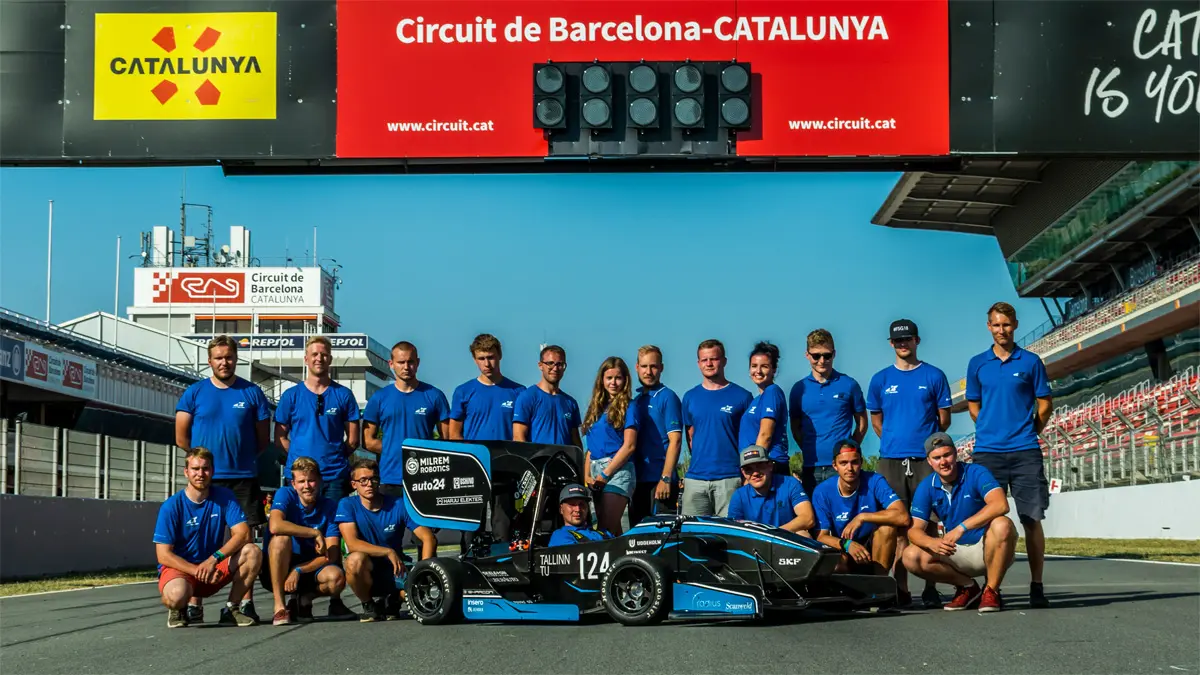
Skeleton Technologies is happy to announce that it will support Formula Student Team Tallinn for the upcoming 2021 season.

The Formula Student is an international product development competition for engineering and automotive technology students. The idea was born in the United States, where university teams have been competing for nearly three decades in the Formula SAE series.

RelatedPosts

Selecting Current Sense Transformers with Würth Elektronik REDEXPERT

Mechanical Drift Indicator of Tantalum Capacitor Anodes Degradation under Reverse Bias

Enabling Software‑Defined Vehicle Architectures: Automotive Ethernet and Zonal Smart Power

The main objective of the Formula Student competition is to design, build, and present a single-seat formula car prototype for an amateur weekend racer. Therefore, participating in Formula Student project offers students the multifarious product development and economic analysis experience.

Formula Student Team Tallinn is composed of students from Tallinn University of Technology & Tallinn University of Applied Sciences. It has been active since 2006 and the team has had a very close relation with Skeleton Technologies since 2016. Over the years, 11 members of FST Tallinn have been recruited by the company. In addition, FS Team Tallinn and Skeleton exchange engineering knowledge.

Skeleton has renewed its partnership with Formula Student Team Tallinn and will be a sponsor for the upcoming 2021 season. Like last year, the team will be competing in 6 competitions with two cars, an electric one, FEST21, and a driverless one, FEST21-DV. Formula Student Team Tallinn builds entirely new formula cars each year.

Georg Kõivumägi, Formula Student Team Captain, says: “Our team really appreciates our partnership with Skeleton Technologies. We are proud to wear the logo of such a high-tech company in our formula car. Furthermore, the knowledge exchange with Skeleton Technologies allows us to build the fastest formula car possible.”

The tradition of formula race in Estonia dates back from 1959. The very first Estonia-named formula vehicle had its first ride on the Nevski racing track in Leningrad. The project was led by Ants Seiler who was the first person to build racing cars in Tallinn’s car repair factory called “Nr. 1”.

Related

Source: Skeleton Technologies

Recent Posts

Enabling Software‑Defined Vehicle Architectures: Automotive Ethernet and Zonal Smart Power

2.2.2026
11

Samsung Q4 2025 Results: MLCC focus for AI, Server and Automotive

26.1.2026
93

Capacitor Technology Dossier

26.1.2026
127

ROHM Extends 2012 Shunt Resistors Power Rating up to 1.25 W

23.1.2026
27

0603 Automotive Chip Varistors as TVS Diode Replacements, TDK Tech Note

21.1.2026
37

Conductive Polymer Capacitor Market and Design‑In Guide to 2035

20.1.2026
169

YAGEO Offers Automotive MOVs for EV and AI power

19.1.2026
38

Littelfuse Unveils Ultra-Low-Power TMR Magnetic Switches

13.1.2026
40

Rubycon PMLCAP DC‑Link Film Capacitors in Mass Production

9.1.2026
121

Upcoming Events

Feb 24
16:00 - 17:00 CET

Designing Qi2 Wireless Power Systems: Practical Development and EMC Optimization

Mar 3
16:00 - 17:00 CET

Cybersecurity at the Eleventh Hour – from RED to CRA – Information and Discussion

Mar 21
All day

PSMA Capacitor Workshop 2026

View Calendar

Popular Posts

  • Buck Converter Design and Calculation

    0 shares
    Share 0 Tweet 0
  • Boost Converter Design and Calculation

    0 shares
    Share 0 Tweet 0
  • LLC Resonant Converter Design and Calculation

    0 shares
    Share 0 Tweet 0
  • Flyback Converter Design and Calculation

    0 shares
    Share 0 Tweet 0
  • Ripple Current and its Effects on the Performance of Capacitors

    3 shares
    Share 3 Tweet 0
  • How Metal Prices Are Driving Passive Component Price Hikes

    0 shares
    Share 0 Tweet 0
  • MLCC and Ceramic Capacitors

    0 shares
    Share 0 Tweet 0
  • Dual Active Bridge (DAB) Topology

    0 shares
    Share 0 Tweet 0
  • What is a Dielectric Constant and DF of Plastic Materials?

    4 shares
    Share 4 Tweet 0
  • Degradation of Capacitors and its Failure Mechanisms

    0 shares
    Share 0 Tweet 0

Newsletter Subscription


Passive Components Blog

© EPCI - Leading Passive Components Educational and Information Site

  • Home
  • Privacy Policy
  • EPCI Membership & Advertisement
  • About

No Result
View All Result
  • Home
  • Knowledge Blog
  • PCNS

© EPCI - Leading Passive Components Educational and Information Site

This website uses cookies. By continuing to use this website you are giving consent to cookies being used. Visit our Privacy and Cookie Policy.
Go to mobile version