






Passive Components Blog
No Result
View All Result
  • Home
  • NewsFilter
    • All
    • Aerospace & Defence
    • Antenna
    • Applications
    • Automotive
    • Capacitors
    • Circuit Protection Devices
    • electro-mechanical news
    • Filters
    • Fuses
    • Inductors
    • Industrial
    • Integrated Passives
    • inter-connect news
    • Market & Supply Chain
    • Market Insights
    • Medical
    • Modelling and Simulation
    • New Materials & Supply
    • New Technologies
    • Non-linear Passives
    • Oscillators
    • Passive Sensors News
    • Resistors
    • RF & Microwave
    • Telecommunication
    • Weekly Digest

    DC/DC Push‑Pull Converter vs PSFB Design Guide

    Wk 2 Electronics Supply Chain Digest

    Rubycon PMLCAP DC‑Link Film Capacitors in Mass Production

    Bourns SSD‑1000A AEC‑Q Digital Current Sensors

    YAGEO High‑Capacitance X7R Automotive MLCC Extensions

    How Metal Prices Are Driving Passive Component Price Hikes

    Modelithics COMPLETE Library v25.8 for Keysight ADS

    Taiyo Yuden Releases 165C Automotive Multilayer Metal Power Inductor in 1608 Size

    Energy-Controlled Structural Evolution of Amorphous Ta₂O₅ in Tantalum Anodes

    Trending Tags

    • Ripple Current
    • RF
    • Leakage Current
    • Tantalum vs Ceramic
    • Snubber
    • Low ESR
    • Feedthrough
    • Derating
    • Dielectric Constant
    • New Products
    • Market Reports
  • VideoFilter
    • All
    • Antenna videos
    • Capacitor videos
    • Circuit Protection Video
    • Filter videos
    • Fuse videos
    • Inductor videos
    • Inter-Connect Video
    • Non-linear passives videos
    • Oscillator videos
    • Passive sensors videos
    • Resistor videos

    One‑Pulse Characterization of Nonlinear Power Inductors

    Thermistor Linearization Challenges

    Coaxial Connectors and How to Connect with PCB

    PCB Manufacturing, Test Methods, Quality and Reliability

    Transformer Behavior – Current Transfer and Hidden Feedback

    Choosing the Right Capacitor: The Importance of Accurate Measurements

    RF Inductors: Selection and Design Challenges for High-Frequency Circuits

    Transformer Safety IEC 61558 Standard

    3-Phase EMI Filter Design, Simulation, Calculation and Test

    Trending Tags

    • Capacitors explained
    • Inductors explained
    • Resistors explained
    • Filters explained
    • Application Video Guidelines
    • EMC
    • New Products
    • Ripple Current
    • Simulation
    • Tantalum vs Ceramic
  • Knowledge Blog
  • Suppliers
    • Who is Who
  • PCNS
    • PCNS 2025
    • PCNS 2023
    • PCNS 2021
    • PCNS 2019
    • PCNS 2017
  • Events
  • Home
  • NewsFilter
    • All
    • Aerospace & Defence
    • Antenna
    • Applications
    • Automotive
    • Capacitors
    • Circuit Protection Devices
    • electro-mechanical news
    • Filters
    • Fuses
    • Inductors
    • Industrial
    • Integrated Passives
    • inter-connect news
    • Market & Supply Chain
    • Market Insights
    • Medical
    • Modelling and Simulation
    • New Materials & Supply
    • New Technologies
    • Non-linear Passives
    • Oscillators
    • Passive Sensors News
    • Resistors
    • RF & Microwave
    • Telecommunication
    • Weekly Digest

    DC/DC Push‑Pull Converter vs PSFB Design Guide

    Wk 2 Electronics Supply Chain Digest

    Rubycon PMLCAP DC‑Link Film Capacitors in Mass Production

    Bourns SSD‑1000A AEC‑Q Digital Current Sensors

    YAGEO High‑Capacitance X7R Automotive MLCC Extensions

    How Metal Prices Are Driving Passive Component Price Hikes

    Modelithics COMPLETE Library v25.8 for Keysight ADS

    Taiyo Yuden Releases 165C Automotive Multilayer Metal Power Inductor in 1608 Size

    Energy-Controlled Structural Evolution of Amorphous Ta₂O₅ in Tantalum Anodes

    Trending Tags

    • Ripple Current
    • RF
    • Leakage Current
    • Tantalum vs Ceramic
    • Snubber
    • Low ESR
    • Feedthrough
    • Derating
    • Dielectric Constant
    • New Products
    • Market Reports
  • VideoFilter
    • All
    • Antenna videos
    • Capacitor videos
    • Circuit Protection Video
    • Filter videos
    • Fuse videos
    • Inductor videos
    • Inter-Connect Video
    • Non-linear passives videos
    • Oscillator videos
    • Passive sensors videos
    • Resistor videos

    One‑Pulse Characterization of Nonlinear Power Inductors

    Thermistor Linearization Challenges

    Coaxial Connectors and How to Connect with PCB

    PCB Manufacturing, Test Methods, Quality and Reliability

    Transformer Behavior – Current Transfer and Hidden Feedback

    Choosing the Right Capacitor: The Importance of Accurate Measurements

    RF Inductors: Selection and Design Challenges for High-Frequency Circuits

    Transformer Safety IEC 61558 Standard

    3-Phase EMI Filter Design, Simulation, Calculation and Test

    Trending Tags

    • Capacitors explained
    • Inductors explained
    • Resistors explained
    • Filters explained
    • Application Video Guidelines
    • EMC
    • New Products
    • Ripple Current
    • Simulation
    • Tantalum vs Ceramic
  • Knowledge Blog
  • Suppliers
    • Who is Who
  • PCNS
    • PCNS 2025
    • PCNS 2023
    • PCNS 2021
    • PCNS 2019
    • PCNS 2017
  • Events
No Result
View All Result
Passive Components Blog
No Result
View All Result

Switch Filter Banks for Agile RF Receiver Design in Radar

1.3.2024
Reading Time: 3 mins read
A A

This article based on Knowles Precision Devices blog explains role and function of switch filter banks in radar applications.

In the article RF Components for Radar Application, we provided an overview of the key functional units in radar, including duplexing, filtering, power amplification, waveform generation, low-noise amplification (LNA), receiving and analog-to-digital conversion (ADC). Here, we’ll focus on a particular form of filtering technology: switch filter banks. 

RelatedPosts

Knowles Doubles Capacitance of its Class I Ceramic C0G Capacitors

Knowles Releases High Q Non-Magnetic X7R MLCCs for Medical Imaging

Knowles Unveils High-Performance Safety-Certified MLCC Capacitors

Designing Agile Radio Frequency (RF) Receivers with Nimble RF Components  

Today, modern radar systems are expected to serve in a multi-mission capacity. For example, the F-35 Joint Strike Fighter uses a multi-function array, where the radar active electronically scanned array (AESA) in the aircraft nose cone is shared between the electronic warfare (EW) and communications systems. 

Tunable bandwidth is becoming more and more desirable. Designers need to be able to balance radar range and resolution and optimize performance across missions. Further, these systems need to operate reliably in a congested spectrum where there are many blockers. 

In RF communications systems, unwanted input signals, otherwise known as blockers, directly or indirectly degrade the gain and signal-to-noise ratio (SNR) of the signal of interest. Blockers take the form of intentional and unintentional interference. Other RF communications systems operating in the adjacent frequency spectrum can cause unintentional interference, but so can malicious EW systems. 

Agile RF receivers can be optimized moment-to-moment to adjust to evolving parameters. This level of control is accomplished using fully digital receivers with analog filter protection to evade blockers and prevent receiver damage. Nimble analog RF components, like switch filter banks, are critical to accomplish this level of optimization.  

Switch filter banks are traditionally associated with larger footprints, but Knowles Precision Devices is leveraging materials science innovations to shrink the size of each individual filter. We use high-precision lithographic processes to pattern microstrip filters on our custom ceramics, and we develop low-loss, temperature-stable dielectrics that allow us to significantly reduce filter form factors (Figure 1). 
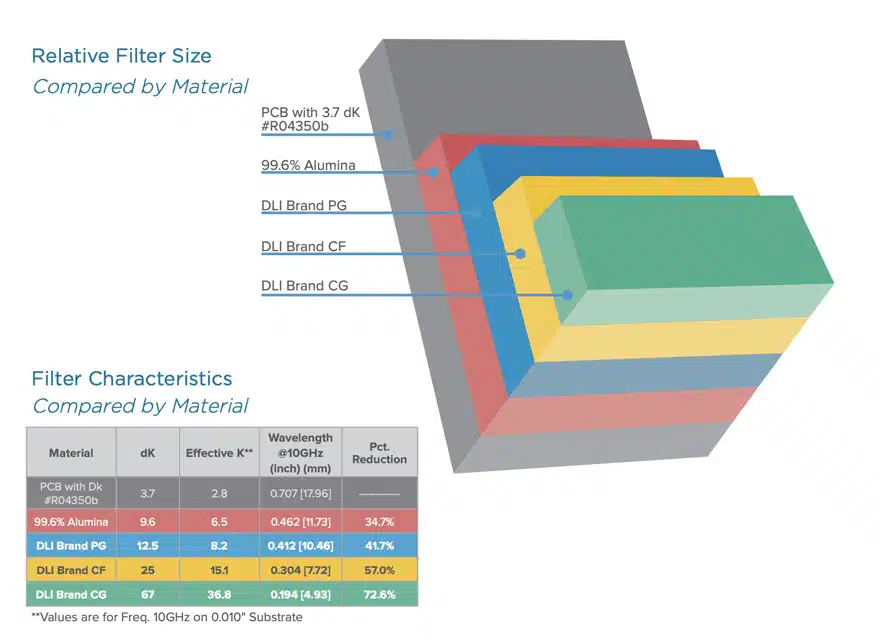
Figure 1: Relative DLI brand filter size with materials breakdown.  

From there, our custom engineering team uses these miniature filters to create state-of-the-art multi-band filter structures that enable tiny switch filter banks.  

Beyond miniaturizing filter components, there’s an opportunity to innovate around packaging. In partnership with Criteria Labs, we’ve established a small but reliable packaging concept for switch filter banks (Figure 2). With consideration for input size and how narrow the output needs to be, a designer has room for more channels.  
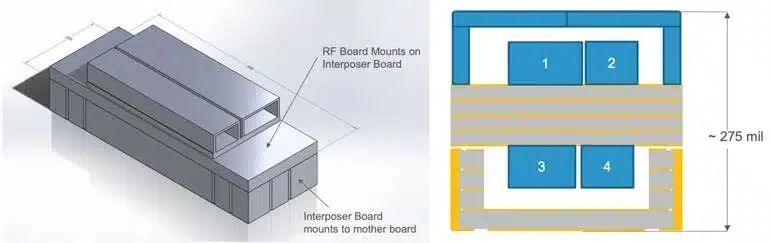
Figure 2. Knowles Precision Devices and Criteria Labs collaborated on a design to shrink a four-channel switch filter bank. 

The design, based on a four-channel filter bank, features a 3D-stacked structure with alternating filters and interposer boards mounted directly to the printed circuit board (PCB). The result is a reduction in internal spacing that ultimately reduces the size of the filter bank. 

Related

Source: Knowles Precision Devices

Recent Posts

Modelithics COMPLETE Library v25.8 for Keysight ADS

7.1.2026
27

Transient Suppression Guide

19.11.2025
123

Overvoltage and Transient Protection for DC/DC Power Modules

13.11.2025
127

3-Phase EMI Filter Design, Simulation, Calculation and Test

6.11.2025
453

Common Mode Chokes Selection for RF Circuits in Next-Generation Communication Systems

30.10.2025
41

Kyocera Launches New SAW Filter for GNSS 1.6GHz Satellite Communications

30.9.2025
47

Space Evaluation Testing on SAW Filter Based on Piezo-On-Insulator Technology

29.9.2025
41

EMI Noise Mitigation in Automotive 48V Power Supply Systems

24.9.2025
113

High-Frequency Ceramic Capacitor Performance of Novel Embedded Electrode Design

23.9.2025
97

Upcoming Events

Jan 27
16:00 - 17:00 CET

Simplifying Vehicle Development with Automotive Ethernet and Zonal Smart Switch Technologies

Feb 24
16:00 - 17:00 CET

Designing Qi2 Wireless Power Systems: Practical Development and EMC Optimization

View Calendar

Popular Posts

  • Buck Converter Design and Calculation

    0 shares
    Share 0 Tweet 0
  • Boost Converter Design and Calculation

    0 shares
    Share 0 Tweet 0
  • LLC Resonant Converter Design and Calculation

    0 shares
    Share 0 Tweet 0
  • Flyback Converter Design and Calculation

    0 shares
    Share 0 Tweet 0
  • Ripple Current and its Effects on the Performance of Capacitors

    3 shares
    Share 3 Tweet 0
  • MLCC and Ceramic Capacitors

    0 shares
    Share 0 Tweet 0
  • What Electronics Engineer Needs to Know About Passive Low Pass Filters

    0 shares
    Share 0 Tweet 0
  • Dual Active Bridge (DAB) Topology

    0 shares
    Share 0 Tweet 0
  • SEPIC Converter Design and Calculation

    0 shares
    Share 0 Tweet 0
  • What is a Dielectric Constant and DF of Plastic Materials?

    4 shares
    Share 4 Tweet 0

Newsletter Subscription


Passive Components Blog

© EPCI - Leading Passive Components Educational and Information Site

  • Home
  • Privacy Policy
  • EPCI Membership & Advertisement
  • About

No Result
View All Result
  • Home
  • Knowledge Blog
  • PCNS

© EPCI - Leading Passive Components Educational and Information Site

This website uses cookies. By continuing to use this website you are giving consent to cookies being used. Visit our Privacy and Cookie Policy.
Go to mobile version