





Passive Components Blog
No Result
View All Result
  • Home
  • NewsFilter
    • All
    • Aerospace & Defence
    • Antenna
    • Applications
    • Automotive
    • Capacitors
    • Circuit Protection Devices
    • electro-mechanical news
    • Filters
    • Fuses
    • Inductors
    • Industrial
    • Integrated Passives
    • inter-connect news
    • Market & Supply Chain
    • Market Insights
    • Medical
    • Modelling and Simulation
    • New Materials & Supply
    • New Technologies
    • Non-linear Passives
    • Oscillators
    • Passive Sensors News
    • Resistors
    • RF & Microwave
    • Telecommunication
    • Weekly Digest

    Power Converter Dossier: Passive Components Design and Selection Guide 2026

    Evans Group Unifies Four High-Rel Capacitor Leaders

    Skeleton Releases Graphene‑Based UPS for AI Data Centers

    Designing 800 V DC EMC Filters: Calculation, Simulation and Measurement

    TDK Releases DC-link Film Capacitors with Ultra-low Inductance for SiC Power Converters

    Murata Introduces World First 2.2uF 100V Soft‑Term MLCC in 0805 Size for Automotive

    Murata and Xona Partner on LEO Satellite Navigation for Industrial Applications

    Bourns Offers Custom Magnetics for 3‑Phase Flying Capacitor Inverters

    YAGEO Releases Cost Efficient Pt‑RTD Sensors with Ni wires

    Trending Tags

    • Ripple Current
    • RF
    • Leakage Current
    • Tantalum vs Ceramic
    • Snubber
    • Low ESR
    • Feedthrough
    • Derating
    • Dielectric Constant
    • New Products
    • Market Reports
  • VideoFilter
    • All
    • Antenna videos
    • Capacitor videos
    • Circuit Protection Video
    • Filter videos
    • Fuse videos
    • Inductor videos
    • Inter-Connect Video
    • Non-linear passives videos
    • Oscillator videos
    • Passive sensors videos
    • Resistor videos

    Designing 800 V DC EMC Filters: Calculation, Simulation and Measurement

    Current Sense Transformer Datasheet and Design‑in Guide

    Designing a USB Type‑C Flyback Planar Transformer with Frenetic’s Planar Tool

    Magnetics Design in High‑Frequency GaN Converters

    Qi2 Wireless Charging: Inductors, Capacitors and EMC Filters

    Two‑capacitor paradox explained for engineers

    Capacitances of Nonlinear MLCCs: What Datasheets Don’t Tell You

    Tapped Inductor Buck Converter Fundamentals

    Planar vs Conventional Transformer: When it Make Sense

    Trending Tags

    • Capacitors explained
    • Inductors explained
    • Resistors explained
    • Filters explained
    • Application Video Guidelines
    • EMC
    • New Products
    • Ripple Current
    • Simulation
    • Tantalum vs Ceramic
  • Knowledge Blog
  • DossiersNew
  • Suppliers
    • Who is Who
  • PCNS
    • PCNS 2025
    • PCNS 2023
    • PCNS 2021
    • PCNS 2019
    • PCNS 2017
  • Events
  • Home
  • NewsFilter
    • All
    • Aerospace & Defence
    • Antenna
    • Applications
    • Automotive
    • Capacitors
    • Circuit Protection Devices
    • electro-mechanical news
    • Filters
    • Fuses
    • Inductors
    • Industrial
    • Integrated Passives
    • inter-connect news
    • Market & Supply Chain
    • Market Insights
    • Medical
    • Modelling and Simulation
    • New Materials & Supply
    • New Technologies
    • Non-linear Passives
    • Oscillators
    • Passive Sensors News
    • Resistors
    • RF & Microwave
    • Telecommunication
    • Weekly Digest

    Power Converter Dossier: Passive Components Design and Selection Guide 2026

    Evans Group Unifies Four High-Rel Capacitor Leaders

    Skeleton Releases Graphene‑Based UPS for AI Data Centers

    Designing 800 V DC EMC Filters: Calculation, Simulation and Measurement

    TDK Releases DC-link Film Capacitors with Ultra-low Inductance for SiC Power Converters

    Murata Introduces World First 2.2uF 100V Soft‑Term MLCC in 0805 Size for Automotive

    Murata and Xona Partner on LEO Satellite Navigation for Industrial Applications

    Bourns Offers Custom Magnetics for 3‑Phase Flying Capacitor Inverters

    YAGEO Releases Cost Efficient Pt‑RTD Sensors with Ni wires

    Trending Tags

    • Ripple Current
    • RF
    • Leakage Current
    • Tantalum vs Ceramic
    • Snubber
    • Low ESR
    • Feedthrough
    • Derating
    • Dielectric Constant
    • New Products
    • Market Reports
  • VideoFilter
    • All
    • Antenna videos
    • Capacitor videos
    • Circuit Protection Video
    • Filter videos
    • Fuse videos
    • Inductor videos
    • Inter-Connect Video
    • Non-linear passives videos
    • Oscillator videos
    • Passive sensors videos
    • Resistor videos

    Designing 800 V DC EMC Filters: Calculation, Simulation and Measurement

    Current Sense Transformer Datasheet and Design‑in Guide

    Designing a USB Type‑C Flyback Planar Transformer with Frenetic’s Planar Tool

    Magnetics Design in High‑Frequency GaN Converters

    Qi2 Wireless Charging: Inductors, Capacitors and EMC Filters

    Two‑capacitor paradox explained for engineers

    Capacitances of Nonlinear MLCCs: What Datasheets Don’t Tell You

    Tapped Inductor Buck Converter Fundamentals

    Planar vs Conventional Transformer: When it Make Sense

    Trending Tags

    • Capacitors explained
    • Inductors explained
    • Resistors explained
    • Filters explained
    • Application Video Guidelines
    • EMC
    • New Products
    • Ripple Current
    • Simulation
    • Tantalum vs Ceramic
  • Knowledge Blog
  • DossiersNew
  • Suppliers
    • Who is Who
  • PCNS
    • PCNS 2025
    • PCNS 2023
    • PCNS 2021
    • PCNS 2019
    • PCNS 2017
  • Events
No Result
View All Result
Passive Components Blog
No Result
View All Result

Test Explanations: Corrosion

14.9.2021
Reading Time: 3 mins read
A A

As noted previously, the environmental exposures for non-noble (tin) and noble (gold) plated contacts are different. The dominant degradation mechanism for tin connectors is fretting corrosion, a build-up of oxide debris at the contact interface due to small scale motions (tens of microns). The oxidation of tin is a given and the degradation process is dominated by the mechanical stability of the contact interface with respect to inhibiting fretting motions. Tin corrosion exposures are predominantly temperature-humidity related and there is no generally accepted correlation between such exposures and field performance.

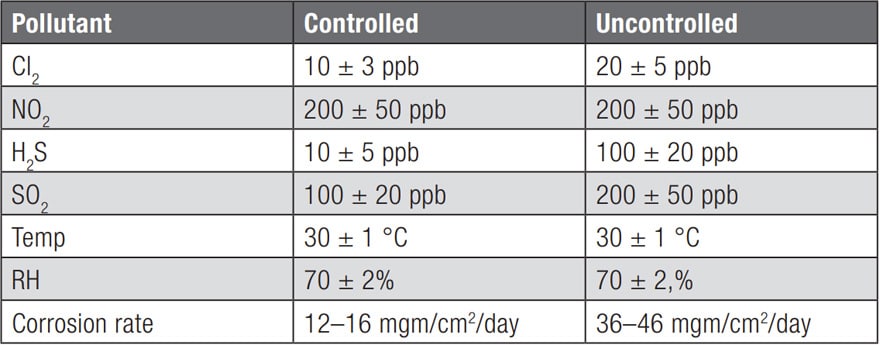
The situation with noble metal finishes, in particular gold over nickel, is very different. There were a number of investigations into the environmental stability of gold contact finishes in the ‘70s and a significant amount of data relating test environments to field performance was developed. The details of these studies are outside the scope, but suffice it to say that there are two test environments that are generally accepted as indicative of field performance. As shown in Table 2.9, taken from EIA 364 TP 65 they are:
RelatedPosts

Polymer Materials and Processing

What is RF Connector

Connector Materials and Processes

Tab. 2.9: Mixed flowing gas exposure parameters

While other test environments are specified, they have in common the important pollutants, Cl2, NO2, H2S and SO2, and the low level of pollutant concentrations, parts per billion and the temperature and humidity levels.

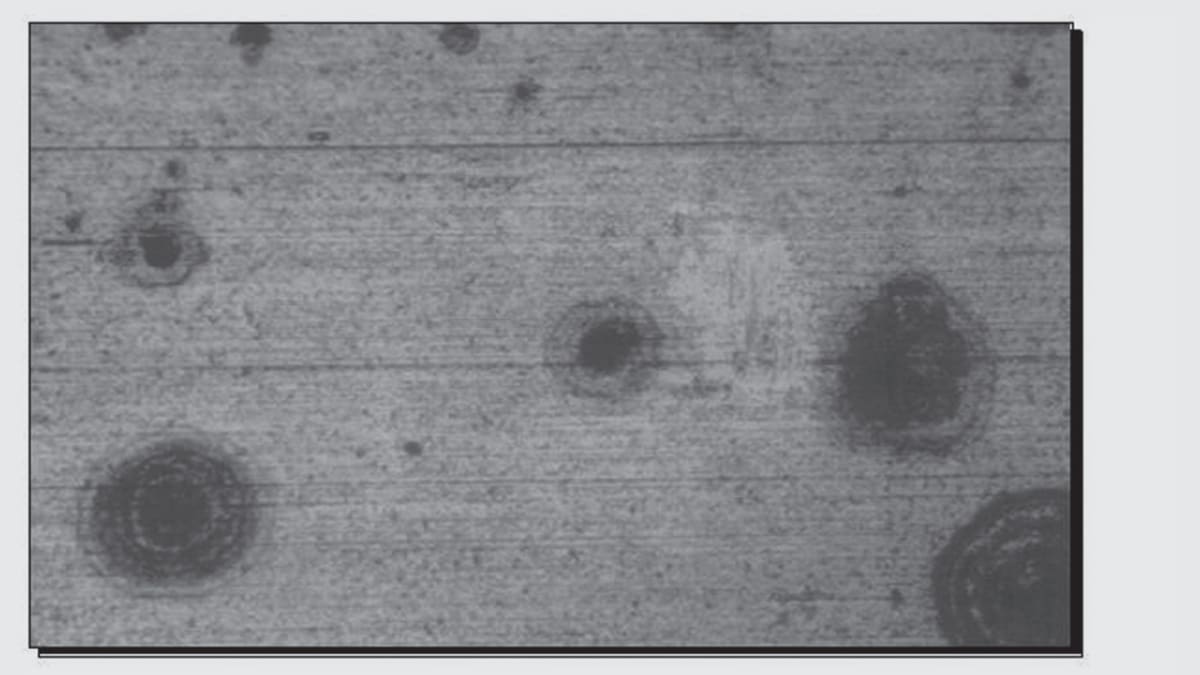
Some of the major findings about noble metal corrosion in mixed flowing gas environments are suggested in Figure 2.120 and 2.121.
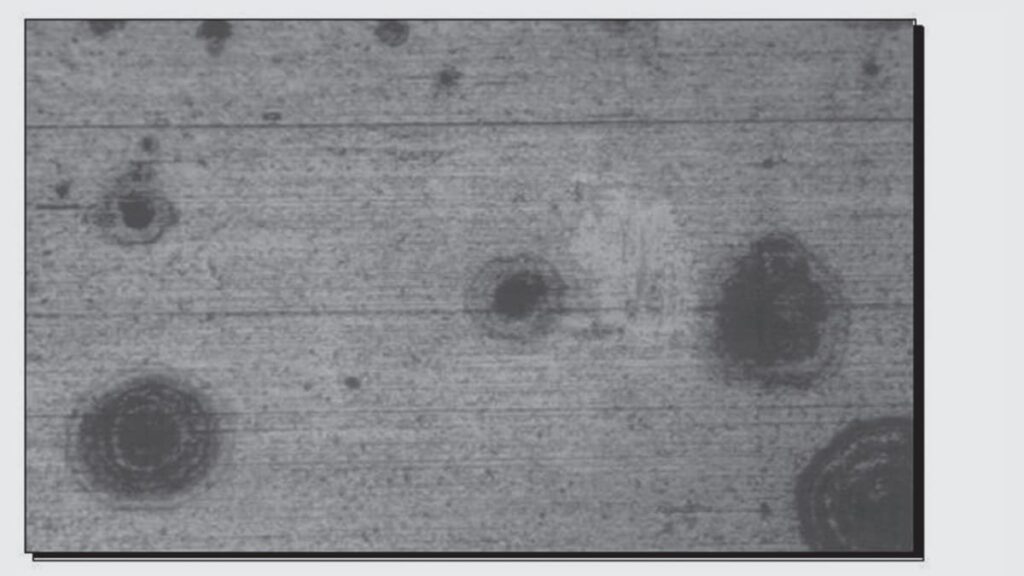
Fig. 2.120: Pore corrosion and corrosion migration from pore sites

First, Figure 2.120 illustrates pore corrosion and the migration of corrosion products from the pore sites over the contact surface, the rings around the pore sites. The corrosion source, in all cases, is the copper alloy of the contact spring. The corrosion products that are migrating are identified in Figure 2.121. The X-ray maps shown in Figure 2.121 show that the
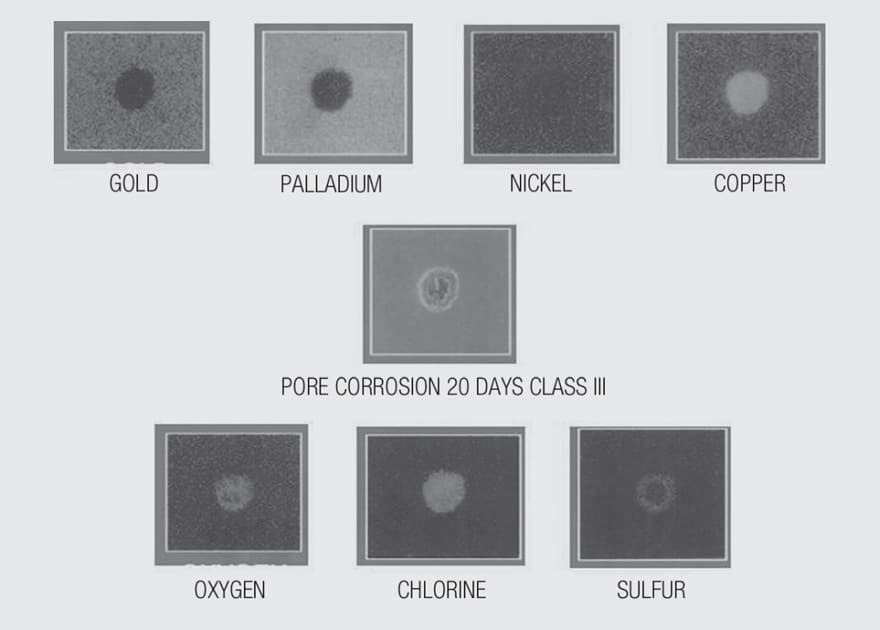
Fig. 2.121: X-ray maps identifying corrosion product migration from pore sites

contact finish under test was a gold flash over nickel over copper alloy. The pore site in this case originated at the copper alloy as indicated by the intensity of the copper signal at the upper right in the figure. The corrosion products, the lower row of X-ray maps consisted of copper, oxygen, chlorine and sulfur. The corrosion synergy between chlorine and sulfur distinguishes mild from harsh environments. Note the difference in corrosion rates between the controlled and uncontrolled environments and the chlorine and sulfur concentrations in Table 2.9. The corrosion rates are, in fact, used to validate the exposure by measuring the sample weight gain. There are acceleration factors for these two environments with a two day exposure to the test environment being equivalent to a year of exposure in the field environment.


Related

Source: Wurth elektronik

Recent Posts

Circular Connectors Coding

26.11.2025
137

Connector PCB Design Challenges

3.10.2025
91

Non-Magnetic Interconnects

23.4.2025
43

10 Tips for Ensuring Reliability of Discrete Wire Assemblies

20.2.2025
82

Polymer Materials and Processing

11.8.2025
194

Basic PCB Technology Overview

1.7.2025
38

What is RF Connector

17.12.2024
42

Creepage and Clearance of Connector

25.7.2025
72

RF Connector Types: How To Choose the Right One

24.4.2026
82

Upcoming Events

Jun 16
16:00 - 17:00 CEST

EMC with EMC – EMC‑compliant design with electromechanical connectors

View Calendar

Popular Posts

  • Buck Converter Design and Calculation

    0 shares
    Share 0 Tweet 0
  • Boost Converter Design and Calculation

    0 shares
    Share 0 Tweet 0
  • MLCC and Ceramic Capacitors

    0 shares
    Share 0 Tweet 0
  • Flyback Converter Design and Calculation

    0 shares
    Share 0 Tweet 0
  • LLC Resonant Converter Design and Calculation

    0 shares
    Share 0 Tweet 0
  • Dual Active Bridge (DAB) Topology

    0 shares
    Share 0 Tweet 0
  • What Electronics Engineer Needs to Know About Passive Low Pass Filters

    0 shares
    Share 0 Tweet 0
  • Capacitor Charging and Discharging

    0 shares
    Share 0 Tweet 0
  • SEPIC Converter Design and Calculation

    0 shares
    Share 0 Tweet 0
  • Earthing Systems and IEC Classification Explained

    0 shares
    Share 0 Tweet 0

Newsletter Subscription


Passive Components Blog

© EPCI - Leading Passive Components Educational and Information Site

  • Home
  • Privacy Policy
  • EPCI Membership & Advertisement
  • About

No Result
View All Result
  • Home
  • Knowledge Blog
  • Dossiers
  • PCNS

© EPCI - Leading Passive Components Educational and Information Site

This website uses cookies. By continuing to use this website you are giving consent to cookies being used. Visit our Privacy and Cookie Policy.
Go to mobile version