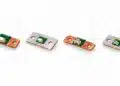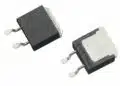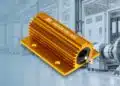


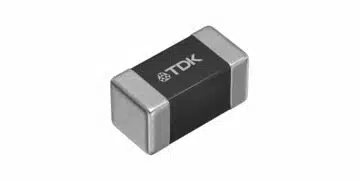




Thick-film chip resistors are the mainstream general-purpose resistor technology for surface-mount electronics. They combine low cost, broad resistance ranges, compact standard packages, and robust assembly performance, making them suitable for biasing, pull-up and pull-down functions, current limiting, damping, voltage dividers, and many power-electronics support functions.
A thick-film resistor is not, however, a universal solution. Its granular cermet resistive element generally has higher excess noise, voltage dependence, resistance drift, and temperature coefficient than precision thin-film or metal-foil technologies. Successful selection therefore starts with thick film as a practical baseline, then moves to a specialised resistor technology only when the circuit requirements justify it.
Key takeaways
- Thick-film chip resistors are the default choice for many cost-sensitive and medium-precision SMT designs.
- They use a fired cermet resistive paste on a ceramic substrate and are normally laser trimmed to the final resistance value.
- Standard series are available in a wide range of chip sizes, resistance values, tolerances, TCR options, voltage ratings, and power ratings.
- High-power, pulse-proof, anti-surge, high-voltage, long-side-termination, and sulfur-resistant variants must be selected by their specific datasheet ratings rather than by standard chip-resistor assumptions.
- Thin film, metal foil, or dedicated current-sense technologies are preferable when low noise, low TCR, tight ratio tracking, low voltage coefficient, or exceptional long-term stability is required.
Thick-film resistors as workhorse technology
Thick-film, also called metal-glaze, resistors use a resistive paste containing conductive oxide particles and glass frit. After screen printing and firing, the resulting cermet film forms a stable resistive path on a ceramic substrate. The technology supports high sheet resistance and therefore enables high resistance values in compact chip packages.
- Typical standard tolerances are ±1%, ±2%, and ±5%.
- Typical TCR options are approximately ±50 ppm/°C to ±200 ppm/°C, although the available range depends on the series, resistance value, and supplier.
- Standard chip-resistor series are widely used in consumer, industrial, communications, and automotive electronics.
- Performance limits are strongly application dependent: resistance value, package size, trimming geometry, voltage stress, pulse waveform, PCB thermal design, and environmental conditions all matter.
Use thick film as the baseline choice when its tolerance, TCR, noise, stability, voltage, power, and pulse limits satisfy the design requirement with margin. Do not select a resistor solely by nominal resistance, package size, and steady-state power rating.
Thick Film Chip Resistor Construction and Process
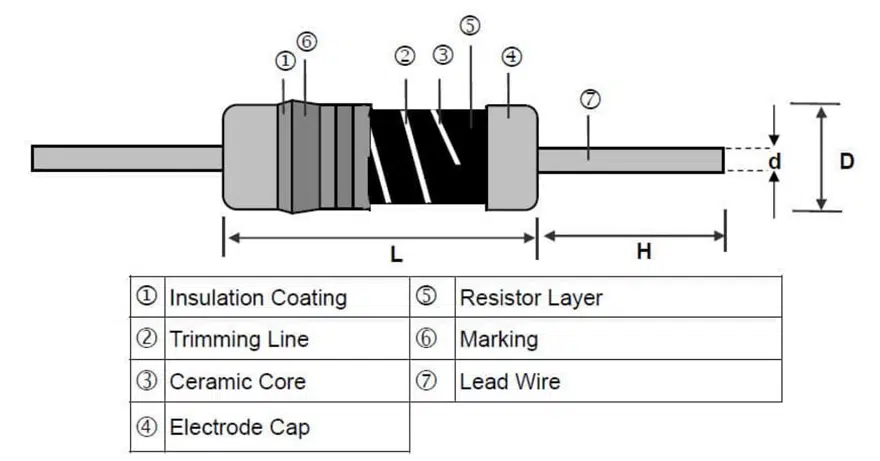
A standard thick-film chip resistor consists of a ceramic substrate, conductive end terminations, a fired resistive cermet film, a protective passivation system, and solderable external terminations. Alumina is widely used as the substrate material; 96% alumina is common, but construction details vary among product families and manufacturers.
- Ceramic substrate, usually alumina, providing mechanical support and a thermal path to the PCB.
- Printed and fired inner terminations that connect the resistive element to the end caps.
- Screen-printed resistive cermet film, commonly based on ruthenium-oxide-containing compositions and glass.
- Laser-trim geometry that adjusts the resistance upward to the final specified value.
- Glass passivation and, in many series, an additional polymer protective overcoat.
- Nickel barrier and tin-based solderable outer termination finish.
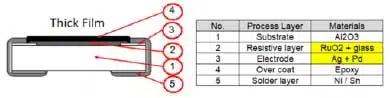
Manufacturing sequence
- Print and fire the conductive inner terminations on the ceramic substrate.
- Print the resistive paste in the required geometry, dry it, and fire it so that the glass frit sinters and bonds the film to the ceramic.
- Measure the resistance and laser trim the element from a slightly low pre-trim value upward to the specified value.
- Apply and cure the glass passivation and any additional protective coating.
- Form the external termination structure, including a nickel barrier and solderable outer finish.
Laser trimming is a major reason why electrical behaviour varies with resistance value and resistor family. The trim changes the current path and can concentrate electrical and thermal stress near the trimmed area. For pulse-, surge-, and high-stability applications, always use data for the exact resistance value and series rather than assuming that every part in the same package has identical performance.
SMD Chip Resistor Types
SMD resistor technology has diversified far beyond basic thick‑film chips, and choosing the right type is often more critical than simply picking an exact resistance value. The overview below summarizes the most common categories and their typical use cases.
The predominant part of all chips are manufactured with thick film, but thin film chips are becoming more and more common. Also metal foil exists as SMD. The construction is like the one in Figure 5. Certain types have an organic protection in one or two layers on top of the glass passivation.
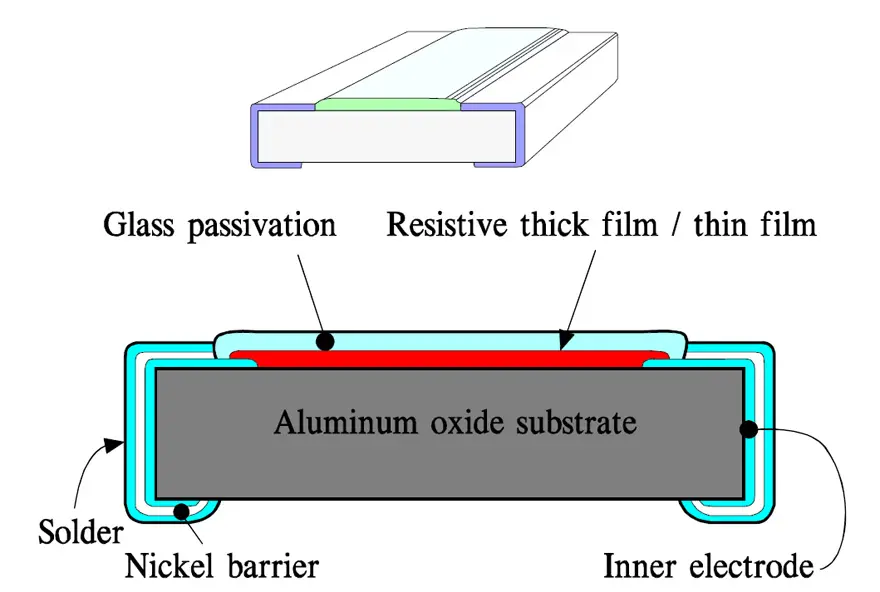

The substrates are screen printed either with a metal powder paste that is fired to a metal glaze / thick film. Or metal foils are glued on a substrate or metal films are vaporized or ion implanted on it.
The thick film is laser trimmed to the right resistance value by cutting a track in the long side of the film. Recent manufacturing improvements however begin making this laser trimming unnecessary. This approach without any trimming tracks will increase the pulse load capability by 2 to 3 times. The other films are designed to an inductance-reducing serpentine pattern according to Figure 4. and 5.
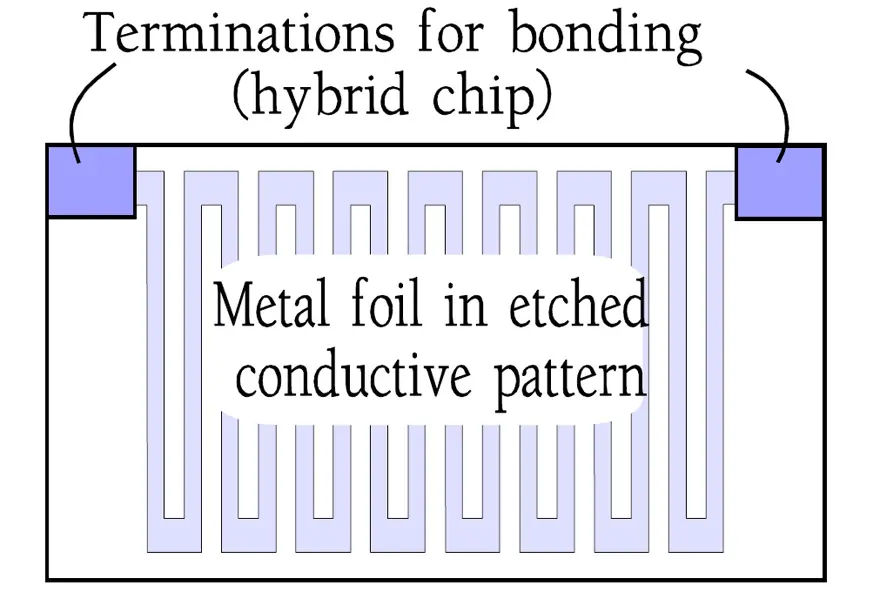
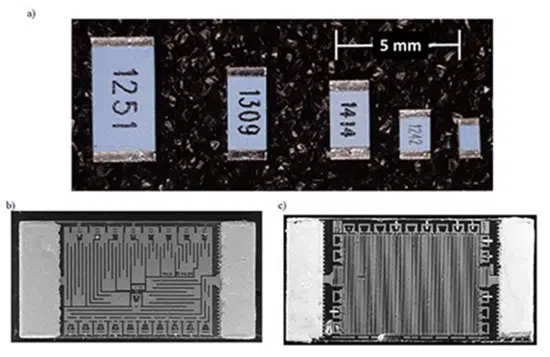
The metal foil pattern is etched chemically or patterned by means of an ion beam. The thin metal films are applied through a mask to the desired shape.
Thick-Film Chip Resistor Families
“Thick film” describes the resistive-element technology, not one uniform level of performance. Modern chip-resistor portfolios include several specialised families that use different geometries, termination systems, coatings, and qualification options.
| Resistor family | Primary design benefit | Typical applications and selection note |
|---|---|---|
| Standard general-purpose thick film | Lowest cost and broad availability | Biasing, pull-ups, pull-downs, LED current limiting, logic interfaces, general analogue functions. |
| High-power or long-side-termination chip resistor | Improved heat transfer from the resistive element into the PCB | Power supplies, current limiting, braking, discharge, and power-control circuits. Select from the manufacturer’s thermal derating data for the intended land pattern and copper area. |
| Pulse-proof or anti-surge thick film | Improved tolerance of specified pulse and surge stresses | Inrush limiting, pre-charge, snubbers, surge-exposed interfaces, and power converters. Verify the applicable waveform, pulse duration, repetition count, and permitted resistance change. |
| High-voltage thick film | Higher resistance values and voltage capability | Voltage dividers, HV measurement, discharge paths, industrial power supplies, and battery-management circuits. Check working voltage, overload voltage, creepage, and voltage coefficient. |
| Sulfur-resistant thick film | Improved resistance to sulfur-related corrosion mechanisms | Automotive, industrial, outdoor, and polluted environments where sulfur-bearing gases or contamination are credible risks. |
| Thick-film current-sense resistor | Cost-effective current measurement at moderate accuracy | Power electronics and battery systems where resistance, TCR, pulse capability, and terminal configuration meet the measurement budget. Compare against metal-element shunts for demanding low-ohmic sensing. |
| Resistor network or array | Reduced placement cost and potentially improved ratio tracking | Logic pull-up arrays, bus termination, divider networks, and moderately accurate analogue functions. Check power interaction and resistor-to-resistor tracking specifications. |
For corrosive-environment applications, see the dedicated guide to sulfur-resistant film resistors and sulfur-related failure mechanisms. Sulfur resistance is a construction and qualification feature; it should not be assumed solely because a resistor is described as thick film or automotive grade.
Package Sizes, Power Ratings and Derating
Chip size influences power rating, limiting voltage, thermal resistance, mechanical robustness, assembly yield, and parasitic behaviour. It does not, by itself, define the allowable operating condition: two 0805 resistors can have substantially different power, voltage, pulse, and endurance performance depending on their resistive system, terminal orientation, substrate, trim pattern, and intended application class.
| Parameter to check | Why it matters | Design action |
|---|---|---|
| Rated dissipation and derating curve | The published rating applies only under the manufacturer’s defined ambient and mounting conditions. | Use the exact series derating curve at the worst-case ambient temperature. |
| Limiting element voltage and maximum working voltage | Voltage stress can become the governing limit before steady-state power, especially at high resistance values. | Verify both values and use series strings or a dedicated HV resistor where necessary. |
| Permissible film or hot-spot temperature | Resistance drift and lifetime depend on element temperature, not only ambient temperature. | Estimate thermal conditions on the final PCB and allow margin for adjacent heat sources. |
| Pulse-load curve | Average power does not demonstrate tolerance of inrush, surge, discharge, or repetitive switching pulses. | Check the relevant single-pulse and repetitive-pulse curves for the exact resistance value. |
| Endurance resistance change | Nominal power rating does not define acceptable long-term parametric drift. | Compare the datasheet endurance limit with the circuit’s lifetime accuracy budget. |
| Recommended land pattern and copper area | PCB pads and copper spreading materially affect solder-joint reliability and thermal performance. | Use the supplier footprint and validate the temperature rise in the intended assembly. |
Power derating
Power rating is normally specified at a reference ambient temperature, often 70 °C, and is derated toward zero at the series maximum ambient or element-temperature limit. The exact curve, reference condition, and maximum temperature differ among manufacturers and resistor families.
Do not apply one universal operating percentage to all resistors. In a high-reliability or accuracy-sensitive design, additional margin may be appropriate; in a high-power application, the decision must be based on the actual thermal path, PCB copper, airflow, enclosure temperature, resistor drift limit, and mission profile.
For a structured method covering average power, limiting voltage, pulse energy, temperature derating, layout, and qualification, see the resistor pulse-load, power, and voltage-derating design guide.
Thick Film Networks and Arrays
Thick film technology naturally lends itself to resistor networks and arrays because multiple resistive elements can be screen‑printed on a single substrate before singulation or encapsulation.
Typical network types:
- Isolated arrays (same or different values, separate resistors).
- Bussed (one common node, individual taps).
- Ladder / R‑2R digital‑to‑analog structures.
- Custom networks integrated with other thick‑film components (for example jumpers, fuses, terminations).
Advantages:
- Better ratio matching than discrete components, because elements share substrate, firing, and environment.
- Reduced PCB area and placement cost.
- Simplified BOM and logistics.
Use thick film networks for pull‑up/pull‑down arrays, address/data bus terminations, voltage dividers, and moderately accurate analog functions where absolute tolerance demands are moderate but ratio matching is important.
Electrical Parameters That Matter in Design
Thick-film resistor data should be read as a combination of electrical, thermal, environmental, and mechanical limits. The nominal resistance value and tolerance are only the starting point.
| Parameter | What it describes | Why it matters |
|---|---|---|
| Resistance tolerance | Allowed resistance deviation at the specified reference temperature. | Sets initial circuit accuracy and production spread. |
| TCR | Resistance change with temperature, normally expressed in ppm/°C. | Sets temperature-related gain, bias, current-limit, and divider error. |
| Voltage coefficient of resistance, VCR | Resistance change with applied voltage or electric field. | Can affect high-voltage dividers, precision measurement chains, and linearity-sensitive circuits. |
| Power coefficient and self-heating | Resistance change caused by dissipation and resulting element-temperature rise. | Important in loaded dividers, current limiting, sensing, and gain-setting functions. |
| Excess noise | Noise generated by the resistive element in addition to thermal noise. | Important in low-level sensor, audio, and precision analogue circuits. |
| Limiting voltage | Maximum voltage sustainable by the resistive element under stated conditions. | May be more restrictive than the power rating for high-resistance components. |
| Single-pulse and repetitive-pulse capability | Permitted electrical stress for a defined waveform, duration, and repetition count. | Essential for inrush, discharge, surge, snubber, and switching applications. |
| Endurance and environmental resistance shift | Permitted change after specified high-temperature, humidity, temperature-cycle, or operational-life tests. | Connects component selection to field-life and accuracy requirements. |
Typical thick-film availability spans broad ranges, but the exact combination of resistance value, tolerance, TCR, voltage rating, power rating, pulse capability, and qualification status must be verified in the datasheet for the selected series and part number.
- Do not design at both the maximum resistance and maximum voltage of a general-purpose series without voltage and stability margin.
- For low-ohmic current sensing, compare thick-film current-sense devices with dedicated metal-element or metal-foil shunts; the optimum choice depends on resistance, TCR, power, pulse stress, accuracy, and Kelvin-terminal requirements.
- For precision dividers and gain-setting networks, specify absolute tolerance, ratio tolerance, ratio TCR tracking, VCR, self-heating, and drift—not only the individual resistor TCR.
Noise, Voltage Coefficient and Stability
Excess noise and linearity
Thick-film resistors have a granular cermet conduction path. Compared with precision thin-film and metal-foil resistors, this structure can produce higher excess low-frequency noise and a larger resistance change with applied voltage or current. The magnitude depends on the resistive material, resistance value, element geometry, trimming, applied stress, and measurement method.
For low-noise analogue, low-level sensor, precision ADC/DAC, precision reference-divider, or demanding audio circuits, evaluate the required noise, linearity, voltage coefficient, and drift budget before selecting thick film. A precision thin-film or foil resistor is often the better choice when these parameters dominate the system error.
Voltage coefficient of resistance
Voltage coefficient of resistance, VCR, describes a resistance change associated with applied voltage or electric field. It is especially relevant in high-resistance and high-voltage applications, including measurement dividers, high-voltage power supplies, battery-management sensing, and protection circuits.
Where gain or divider accuracy matters, calculate the maximum voltage across each resistor, consider the distribution of voltage in series strings, and obtain VCR data for the exact product family. PCB surface leakage, contamination, and humidity can create larger errors than the resistor VCR itself in very high-impedance circuits.
Long-term stability
Long-term resistance change is affected by film composition, laser-trim geometry, applied power, element temperature, voltage stress, humidity, contamination, thermal cycling, and solder/PCB mechanical stress. A published endurance limit is meaningful only together with its test conditions, such as duration, ambient temperature, applied power, and permitted resistance change.
Use the datasheet’s endurance, damp-heat, temperature-cycle, and operational-life data to decide whether a standard thick-film resistor is adequate. For applications with a tight lifetime accuracy budget, reduce electrical and thermal stress or select a technology with better documented stability.
Pulse Load, Surge and ESD Capability
Pulse capability is not a generic material property that can be inferred from package size or steady-state power rating. It depends on the resistor series, resistance value, trim geometry, pulse waveform, pulse duration, peak voltage, peak current, repetition rate, PCB thermal environment, and the allowable resistance change after the specified test.
Dedicated pulse-proof or anti-surge thick-film resistors can provide substantially better performance than standard general-purpose parts. They should be selected when the circuit must withstand inrush current, capacitor discharge, switching transients, surge events, snubber stress, or repetitive pulse duty.
Pulse-load selection method
- Define the waveform: rectangular, exponential, capacitor discharge, surge, inrush, switching pulse, or application-specific transient.
- Determine the worst-case peak voltage, peak current, pulse width, repetition rate, number of pulses over life, and source impedance.
- Calculate instantaneous power using P(t) = V(t) × I(t) and pulse energy using E = ∫P(t)dt.
- Check average dissipation separately from peak power and pulse energy.
- Verify maximum working voltage, limiting element voltage, peak current, and the manufacturer’s single-pulse and repetitive-pulse curves.
- Use curves for the exact resistor value, not merely the same package size, because trimming and element geometry can affect pulse withstand.
- Confirm the permitted resistance change after the required pulse count and validate the assembled PCB under realistic thermal conditions.
Very short and very long pulses can stress resistor technologies differently, but no universal thick-film-versus-thin-film ranking applies to every waveform and product family. Use dedicated pulse data for the candidate parts, and consider resistor networks, series strings, or alternative technologies where voltage, energy, or fault duty exceeds a single component’s limits.
MELF means Metal Electrode Leadless Face. MELF resistors are cylindrical components, not capacitors. Their geometry can provide favourable pulse-load behaviour in specific product families, but pulse, high-frequency, and stability performance must still be verified from the individual datasheet.
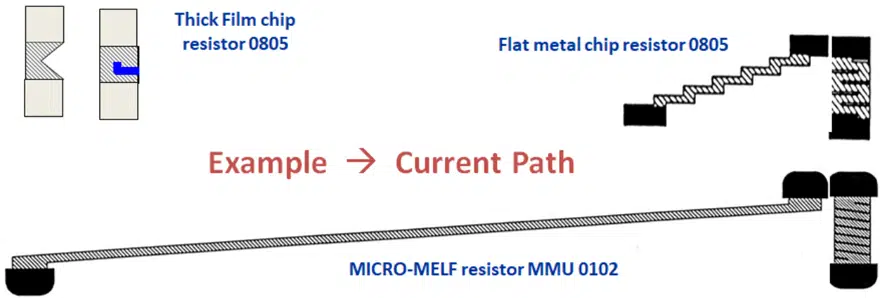
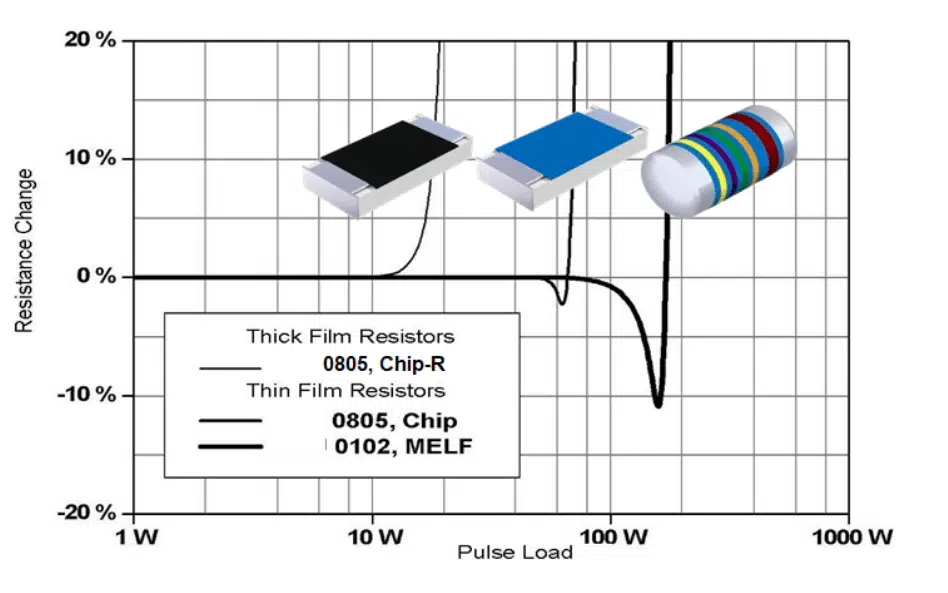
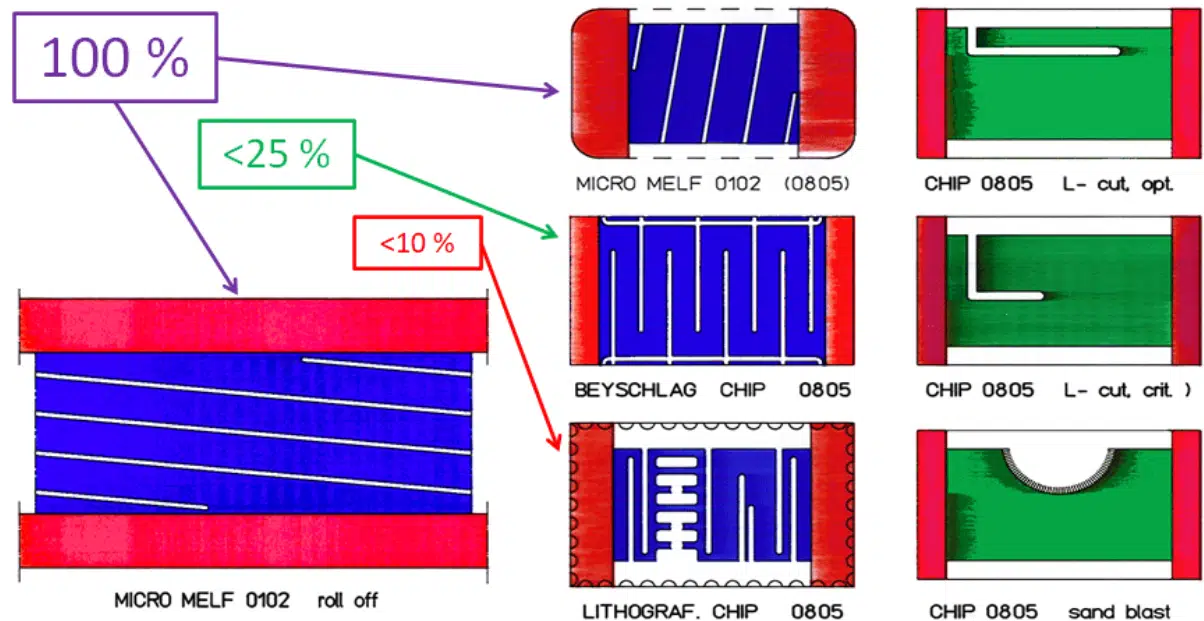
The differences in effective current length path are also reflected in the possible surface loads [W/mm2]. See the Figure 8. below.
Failure Modes and Reliability Considerations
Thick-film chip resistors can fail catastrophically or experience gradual parametric change. The dominant mechanism depends on electrical stress, thermal conditions, PCB design, assembly process, mechanical loading, humidity, contamination, and the resistor construction.
Common failure and degradation mechanisms
- Open circuit: cracked ceramic body, damaged termination, solder-joint failure, severe overload, or local film damage.
- Resistance increase: pulse-induced film damage, microcrack growth, excessive element temperature, trim-area stress, or long-term material relaxation.
- Resistance decrease or leakage-related error: conductive contamination, moisture, ionic residues, or PCB surface leakage in high-impedance circuits.
- Intermittent behaviour: cracked solder joints, board-flex damage, thermomechanical stress, or marginal termination integrity.
- Environmental degradation: humidity, corrosive gases, sulfur exposure, temperature cycling, and contamination acting on the resistor, solder joint, or PCB surface.
Reliability design rules
- Use the selected series’ power derating curve, voltage limits, pulse-load curves, and endurance data rather than applying a universal percentage of rated power.
- Keep resistor element temperature, voltage stress, and pulse stress within the required lifetime and resistance-drift budget.
- Follow the manufacturer’s recommended land pattern, soldering profile, cleaning guidance, and PCB handling requirements.
- Keep chip resistors away from PCB edges, panel break-off areas, mounting holes, connectors, heat sinks, and other locations subject to bending or local strain.
- For high-voltage circuits, provide adequate creepage, clearance, cleanliness, and—where justified—conformal coating or other environmental protection.
- For safety-related or fault-critical functions, analyse the required failure behaviour and consider redundancy, series/parallel arrangements, or a resistor technology better suited to the fault duty.
Standards, Qualification and Environmental Requirements
Resistor selection for demanding applications requires more than checking resistance, power, and package size. Qualification status, test conditions, production controls, environmental exposure, and customer-specific acceptance criteria can be decisive.
- IEC 60115 provides the general framework for fixed resistors and associated performance tests.
- IEC 60068 environmental test methods are commonly used for temperature cycling, damp heat, vibration, mechanical shock, and related stresses.
- AEC-Q200 is a stress-test-based qualification framework widely used for automotive passive components. It supports component qualification but does not eliminate the need for application-specific validation.
- Automotive sourcing may additionally require traceability, process-change notification, PPAP documentation, quality-system requirements, and agreed acceptance criteria.
- High-voltage and safety-related circuits must also meet the applicable end-equipment requirements for insulation coordination, creepage, clearance, fault behaviour, and PCB material performance.
AEC-Q200 should therefore be read as evidence that a component family has completed defined qualification stresses; it is not a blanket guarantee that every value, package, mission profile, or end-equipment safety requirement is automatically satisfied. For further context, see AEC-Q200 and high-reliability qualification requirements compared with MIL specifications.
Environmental selection checklist
- Maximum and minimum operating temperature, including self-heating and nearby heat sources.
- Temperature cycling, board bending, vibration, shock, and solder-joint stress.
- Humidity, condensation, ionic contamination, and PCB surface leakage.
- Sulfur-bearing gases and other corrosive atmospheres.
- Required lifetime, allowable resistance shift, lot traceability, and change-control requirements.
PCB Layout Guidelines for Chip Resistors
PCB layout strongly influences thermal behaviour, solder‑joint reliability, and parasitic effects.
Key guidelines:
- Land patterns: follow the resistor manufacturer’s recommended pad dimensions and solder mask openings; excessive pad size increases solder volume and risk of tombstoning.
- Thermal balance: ensure symmetrical copper areas on both terminals to avoid skewed wetting forces and tombstoning, especially on small sizes (0201–0603).
- Current handling: for high current, widen traces to reduce I²R loss and ensure the copper width matches the resistor’s current capability (for low‑value shunts, refer to dedicated shunt guidelines).
- High voltage: increase creepage distance between pads and to adjacent conductors; avoid solder mask slivers that can trap contamination.
- Thermal coupling: avoid placing sensitive thick film resistors directly adjacent to hot components; keep sufficient spacing or provide thermal relief to minimise temperature gradients.
- Mechanical stress: do not place resistors across PCB slots, panel v‑grooves, or board edges; these areas see higher bending stress and can crack chips.
For wave soldering of larger chip sizes, use pad geometries and solder volume that minimise tombstoning; reflow is preferred for small case sizes.
High‑Voltage and High‑Frequency Design Aspects
High‑voltage aspects
Thick film is frequently used in high‑ohmic and high‑voltage resistors due to the possibility of very high sheet resistance and good environmental robustness.
Design points:
- Observe both maximum working voltage and overload voltage from datasheets; do not exceed either limit.
- For very high voltage dividers, use larger chip sizes, series chains of resistors, or dedicated HV thick‑film parts with extended creepage and optimised geometry.
- Consider voltage coefficient and its effect on accuracy in high‑voltage measurement dividers.
- Control surface contamination and humidity with conformal coating or proper creepage distances; even glassy thick film can be compromised by surface leakage across the PCB.
High-frequency aspects
At high frequency, a chip resistor is not an ideal resistance. Its terminal structure, element geometry, parasitic inductance, parasitic capacitance, mounting pads, and nearby PCB conductors determine the impedance response. The transition from predominantly inductive to predominantly capacitive behaviour depends on the resistor value, package, construction, and frequency range.
- Use manufacturer impedance, S-parameter, or RF-characterisation data when the resistor is part of an RF path, a fast gate-drive loop, a transmission-line termination, or a high-speed measurement fixture.
- Minimise pad and trace inductance in fast switching loops; the PCB layout can dominate the component’s intrinsic parasitics.
- For high-frequency precision, microwave, or low-distortion RF functions, assess dedicated thin-film or RF resistor series rather than assuming a standard thick-film chip is adequate.
- Do not assume that MELF geometry automatically gives lower inductance or better RF performance than every rectangular chip resistor; compare series-specific data.
Typical Applications for Thick Film Resistors
Representative use‑cases where thick film is usually preferred:
- General‑purpose pull‑ups/pull‑downs and bias networks in digital and mixed‑signal designs.
- Load, sense (moderate accuracy) and damping resistors in power supplies and converters.
- Input and feedback resistors where 1–2% tolerance and modest drift are acceptable.
- LED current limiting in consumer and industrial equipment.
- Automotive ECUs where cost, temperature range, and moisture robustness matter more than metrology‑grade stability, often in qualified AEC‑Q200 thick film series.
- Resistor arrays for bus terminators, series damping, and general I/O conditioning.
Avoid thick film for:
- Precision instrumentation amplifiers, gain‑setting networks for 16‑bit+ converters, or precision reference dividers.
- Lowest‑noise audio paths and low‑level sensor front ends.
- Circuits demanding ppm‑class long‑term stability or ultra‑low TCR over wide temperature spans.
Thick Film Versus Thin Film: Selection Matrix
The table below summarises key selection criteria.
| Design requirement | Thick film is often suitable when | Consider thin film, foil, or another specialised technology when |
|---|---|---|
| Initial tolerance | ±1% to ±5% is sufficient. | The circuit needs tighter initial accuracy or tightly controlled resistor ratios. |
| TCR and thermal accuracy | Moderate temperature-related error is acceptable. | Low TCR, ratio tracking, or wide-temperature measurement accuracy is required. |
| Noise and linearity | The circuit is not sensitive to excess low-frequency noise or voltage-dependent resistance. | Low-level analogue, precision conversion, reference-divider, or low-distortion functions dominate. |
| Lifetime stability | The application has a practical drift budget and the part is suitably derated. | Long-term stability is a primary performance requirement. |
| Pulse and surge stress | A dedicated pulse-proof thick-film series meets the exact datasheet pulse curves. | Required pulse voltage, energy, repetition count, or fault duty exceeds the candidate part’s documented limits. |
| Power dissipation | A standard or high-power thick-film family meets thermal and endurance targets on the intended PCB. | Very high power, low-ohmic accuracy, thermal EMF, or extreme pulse performance requires a metal-element, wirewound, foil, or chassis-mounted solution. |
| High voltage | A dedicated HV thick-film resistor or correctly designed resistor string satisfies voltage and creepage limits. | Required insulation coordination, voltage coefficient, or lifetime accuracy cannot be achieved. |
| Harsh environment | The series has suitable humidity, temperature-cycle, and—where necessary—sulfur-resistance data. | The environment requires a specific coating, qualification level, hermeticity, or high-reliability construction not provided by the standard series. |
Practical rule: Start with a standard thick-film resistor only after checking the complete electrical and environmental requirement. Upgrade to a specialised thick-film series, thin film, metal foil, metal element, wirewound, or a resistor network when a defined performance limit requires it.
Conclusion
Thick-film chip resistors remain the most broadly useful resistor technology for general SMT electronics because they offer an effective balance of cost, availability, resistance range, assembly compatibility, and practical robustness. Their suitability should be evaluated from the complete application requirement—not from package size and nominal wattage alone.
For standard biasing, logic, current limiting, damping, and moderately accurate analogue functions, a general-purpose thick-film series is often appropriate. For power, pulse, high voltage, sulfur exposure, current sensing, tight accuracy, low noise, or high lifetime stability, select a purpose-designed resistor family and verify its part-specific datasheet limits.
Further Reading on Passive Components Blog
The following related guides provide deeper background on resistor technologies, selection, qualification, pulse loading, and harsh-environment design.
- Resistor Technology Selection and Benchmark Guidelines — structured selection across resistance, tolerance, TCR, power, voltage, pulses, noise, stability, frequency, environment, and cost.
- Thin Film and Metal Film Resistors — comparison of thin film, metal film, foil, thick film, and carbon resistor technologies.
- Resistor Pulse Load, Power and Voltage Derating Design Guide — practical treatment of steady-state power, pulse stress, voltage limits, thermal derating, and PCB implementation.
- Sulfur-Resistant Film Resistors — sulfur-related corrosion mechanisms and selection of anti-sulfur resistor constructions.
- MIL Specifications and Automotive AEC-Q200 Qualification Explained — how automotive passive-component qualification differs from high-reliability and military requirements.
- Resistor Types and Construction Fundamentals — construction principles, technology families, and broad resistor comparisons.
- What Is a Resistor? Basic Principles, Functions and Parameters — introductory reference for readers who need circuit-level resistor fundamentals.
FAQ: Thick Film Resistors
A thick-film chip resistor is an SMD resistor made by screen printing a resistive cermet paste onto a ceramic substrate, firing the film, trimming it to value, applying protective coatings, and adding solderable end terminations. It is the most common general-purpose resistor technology in surface-mount electronics.
Use a thick-film resistor when its tolerance, TCR, voltage rating, power rating, pulse capability, noise, stability, and environmental performance meet the circuit requirement with margin. Standard thick film is widely used for bias networks, pull-ups, pull-downs, LED current limiting, logic interfaces, damping, and many power-electronics support functions.
Pulse-proof or anti-surge thick-film resistors are designed and specified for improved withstand of defined pulse conditions. Their suitability must be checked using the manufacturer’s waveform-specific pulse curves, maximum voltage, peak-current limits, repetition conditions, and permitted resistance shift.
AEC-Q200 is an automotive passive-component qualification framework based on defined stress tests. It is useful evidence of component-family qualification, but the final design must still verify the exact package, value, mission profile, environmental exposure, and customer-specific requirements.
They can be, particularly when a dedicated high-voltage thick-film series or a correctly designed series-resistor chain is used. Check limiting voltage, working voltage, overload voltage, voltage coefficient, resistor power, PCB creepage, clearance, contamination, humidity, and voltage distribution across the chain.
They can be suitable for moderate-accuracy functions, but precision analogue circuits may require thin-film or foil resistors because thick film can have higher excess noise, voltage coefficient, temperature coefficient, and long-term resistance drift.
Sulfur-resistant resistors use modified internal termination structures or protective barrier systems to reduce corrosion risk in sulfur-containing environments. They are useful in automotive, industrial, outdoor, and polluted environments when sulfur exposure is a credible reliability concern.
Start with the manufacturer’s derating curve for the selected resistor series. Then consider the final PCB copper area, pad design, airflow, enclosure temperature, nearby heat sources, element-temperature limit, required lifetime, and allowable resistance drift.
Thick-film current-sense resistors can be a cost-effective choice where moderate resistance accuracy, TCR, and pulse performance are sufficient. For very low resistance, low temperature coefficient, high current, Kelvin sensing, low thermal EMF, or high lifetime accuracy, compare them with metal-element, metal-strip, or foil shunt resistors.
No. ESD, EFT, surge, capacitor discharge, inrush, and repetitive switching pulses have different waveforms, source impedances, peak currents, energy levels, and test conditions. A resistor rated for one stress type should not automatically be assumed suitable for another; use the relevant product data and system-level protection design.
Board flex during depanelisation, mounting, connector insertion, handling, or thermal cycling can crack ceramic chips, stress terminations, or damage solder joints. Keep resistors away from high-strain areas, orient them appropriately relative to the board bend axis, and use recommended footprints and assembly processes.
Larger chip resistors may use three-digit, four-digit, or EIA-96 value markings, while many small packages have no visible marking. The definitive identification is the full manufacturer part number, including resistance, tolerance, TCR, package, termination finish, qualification, and any pulse, sulfur-resistance, or high-voltage suffix.
How to Select and Specify Thick Film Chip Resistors
- Define the electrical function.
Identify whether the resistor is used for biasing, damping, current limiting, gain setting, voltage division, current sensing, discharge, snubbing, surge handling, or another function.
- Set resistance and accuracy requirements.
Specify nominal resistance, initial tolerance, temperature range, TCR, ratio accuracy where relevant, and allowable lifetime drift.
- Calculate continuous electrical stress.
Determine worst-case voltage, current, and dissipation using supply tolerances, resistor tolerance, temperature effects, expected operating modes, and credible fault conditions. For a resistor, continuous dissipation can be checked using P = V²/R or P = I²R.
- Check voltage limits independently of power.
Verify maximum working voltage, limiting element voltage, overload voltage, and voltage distribution in any resistor series string.
- Select package and thermal design.
Use the series derating curve and recommended land pattern, then account for PCB copper area, ambient temperature, airflow, enclosure heating, and adjacent power components.
- Evaluate pulse, surge, ESD and fault stress.
Define the applicable waveform, source impedance, pulse width, repetition rate, peak current, peak voltage, energy, and expected event count. Do not treat ESD, EFT, surge, capacitor discharge, inrush, and repetitive switching pulses as equivalent stresses; use the relevant product curves and system-level test requirements.
- Check accuracy-sensitive effects.
Evaluate TCR, VCR, self-heating, excess noise, ratio tracking, and long-term stability where the resistor affects measurement, regulation, or signal integrity.
- Review environmental and mechanical conditions.
Consider temperature cycling, humidity, sulfur exposure, vibration, board bending, solder-joint stress, contamination, and PCB surface leakage.
- Select qualification and documentation level.
Confirm the required automotive, industrial, medical, safety, high-reliability, traceability, and process-change-control requirements for the actual customer and end equipment.
- Validate the final assembly.
Verify the selected part in the final PCB layout and thermal environment. Where the design is high power, high voltage, pulse loaded, precision critical, or safety related, include application-level testing rather than relying on catalogue ratings alone.
References
- IEC 60115 series — Fixed resistors for use in electronic equipment. Consult the applicable current part, including the specification relevant to fixed surface-mount resistors.
- IEC 60068 series — Environmental testing. Reference for environmental test methods such as temperature cycling, damp heat, vibration, and mechanical shock.
- Automotive Electronics Council — AEC-Q200 Stress Test Qualification for Passive Components. Consult the current revision and the applicable device-specific requirements.
- Vishay Intertechnology — Fixed Resistors Product Portfolio and Datasheets. Source for series-specific ratings, derating curves, pulse-load data, qualification status, and construction details.
- YAGEO Group — Chip Resistor Product Information and Datasheets. Source for standard, automotive, high-power, anti-surge, high-voltage, and sulfur-resistant chip-resistor series.
- Panasonic Industry — Chip Resistor Product Information and Datasheets. Source for thick-film chip resistor construction, qualification data, and high-temperature automotive product families.
- KOA Speer Electronics — Chip Resistor Product Information and Technical Documentation. Source for pulse/surge, wide-terminal, precision, and automotive resistor product series.
- Passive Components Blog — Resistor Technology Selection and Benchmark Guidelines. Editorial source used for the general selection workflow and technology comparison context.
- Passive Components Blog — Resistor Pulse Load, Power and Voltage Derating Design Guide. Editorial source used for pulse-load, voltage, and derating design context.
Reference note: Product specifications, qualification status, resistance ranges, power ratings, voltage limits, pulse-load curves, and environmental-test limits are series- and part-number-specific. Always use the current manufacturer datasheet and the applicable standard revision for final component selection and design verification.