






Passive Components Blog
No Result
View All Result
  • Home
  • NewsFilter
    • All
    • Aerospace & Defence
    • Antenna
    • Applications
    • Automotive
    • Capacitors
    • Circuit Protection Devices
    • electro-mechanical news
    • Filters
    • Fuses
    • Inductors
    • Industrial
    • Integrated Passives
    • inter-connect news
    • Market & Supply Chain
    • Market Insights
    • Medical
    • Modelling and Simulation
    • New Materials & Supply
    • New Technologies
    • Non-linear Passives
    • Oscillators
    • Passive Sensors News
    • Resistors
    • RF & Microwave
    • Telecommunication
    • Weekly Digest

    Stackpole Releases High-Frequency Thin Film Chip Resistors for RF up to 50 GHz

    Knowles Expands High‑Q Ceramic Core Inductors for RF designs

    Vishay Unveils 1.5 kV IHDV High Voltage Power Inductors for EV and Industrial Converters

    SCHURTER Introduces PPTC Resettable Overcurrent Protection for Compact Electronics

    TrendForce: CSP in‑house AI ASIC Boom Reshapes Capacitor Demand

    Würth Elektroniks Flexible EMI Shielding Sheets Provides Quick and Easy Schielding Solution

    Samsung Introduces Automotive 1206 100uF X7T MLCC for Power Rails in ADAS and SoCs

    Hirose Releases Ultra‑low Profile FPC‑to‑board Connector

    YMIN Hybrid Aluminum Capacitors for Automotive LiDAR Power Rails

    Trending Tags

    • Ripple Current
    • RF
    • Leakage Current
    • Tantalum vs Ceramic
    • Snubber
    • Low ESR
    • Feedthrough
    • Derating
    • Dielectric Constant
    • New Products
    • Market Reports
  • VideoFilter
    • All
    • Antenna videos
    • Capacitor videos
    • Circuit Protection Video
    • Filter videos
    • Fuse videos
    • Inductor videos
    • Inter-Connect Video
    • Non-linear passives videos
    • Oscillator videos
    • Passive sensors videos
    • Resistor videos

    Why Isolated DC/DC Power Supplies Fail Late, Würth Elektronik Podcast

    Designing 800 V DC EMC Filters: Calculation, Simulation and Measurement

    Current Sense Transformer Datasheet and Design‑in Guide

    Designing a USB Type‑C Flyback Planar Transformer with Frenetic’s Planar Tool

    Magnetics Design in High‑Frequency GaN Converters

    Qi2 Wireless Charging: Inductors, Capacitors and EMC Filters

    Two‑capacitor paradox explained for engineers

    Capacitances of Nonlinear MLCCs: What Datasheets Don’t Tell You

    Tapped Inductor Buck Converter Fundamentals

    Trending Tags

    • Capacitors explained
    • Inductors explained
    • Resistors explained
    • Filters explained
    • Application Video Guidelines
    • EMC
    • New Products
    • Ripple Current
    • Simulation
    • Tantalum vs Ceramic
  • Knowledge Blog
  • DossiersNew
  • Suppliers
    • Who is Who
  • PCNS
    • PCNS 2025
    • PCNS 2023
    • PCNS 2021
    • PCNS 2019
    • PCNS 2017
  • Events
  • Home
  • NewsFilter
    • All
    • Aerospace & Defence
    • Antenna
    • Applications
    • Automotive
    • Capacitors
    • Circuit Protection Devices
    • electro-mechanical news
    • Filters
    • Fuses
    • Inductors
    • Industrial
    • Integrated Passives
    • inter-connect news
    • Market & Supply Chain
    • Market Insights
    • Medical
    • Modelling and Simulation
    • New Materials & Supply
    • New Technologies
    • Non-linear Passives
    • Oscillators
    • Passive Sensors News
    • Resistors
    • RF & Microwave
    • Telecommunication
    • Weekly Digest

    Stackpole Releases High-Frequency Thin Film Chip Resistors for RF up to 50 GHz

    Knowles Expands High‑Q Ceramic Core Inductors for RF designs

    Vishay Unveils 1.5 kV IHDV High Voltage Power Inductors for EV and Industrial Converters

    SCHURTER Introduces PPTC Resettable Overcurrent Protection for Compact Electronics

    TrendForce: CSP in‑house AI ASIC Boom Reshapes Capacitor Demand

    Würth Elektroniks Flexible EMI Shielding Sheets Provides Quick and Easy Schielding Solution

    Samsung Introduces Automotive 1206 100uF X7T MLCC for Power Rails in ADAS and SoCs

    Hirose Releases Ultra‑low Profile FPC‑to‑board Connector

    YMIN Hybrid Aluminum Capacitors for Automotive LiDAR Power Rails

    Trending Tags

    • Ripple Current
    • RF
    • Leakage Current
    • Tantalum vs Ceramic
    • Snubber
    • Low ESR
    • Feedthrough
    • Derating
    • Dielectric Constant
    • New Products
    • Market Reports
  • VideoFilter
    • All
    • Antenna videos
    • Capacitor videos
    • Circuit Protection Video
    • Filter videos
    • Fuse videos
    • Inductor videos
    • Inter-Connect Video
    • Non-linear passives videos
    • Oscillator videos
    • Passive sensors videos
    • Resistor videos

    Why Isolated DC/DC Power Supplies Fail Late, Würth Elektronik Podcast

    Designing 800 V DC EMC Filters: Calculation, Simulation and Measurement

    Current Sense Transformer Datasheet and Design‑in Guide

    Designing a USB Type‑C Flyback Planar Transformer with Frenetic’s Planar Tool

    Magnetics Design in High‑Frequency GaN Converters

    Qi2 Wireless Charging: Inductors, Capacitors and EMC Filters

    Two‑capacitor paradox explained for engineers

    Capacitances of Nonlinear MLCCs: What Datasheets Don’t Tell You

    Tapped Inductor Buck Converter Fundamentals

    Trending Tags

    • Capacitors explained
    • Inductors explained
    • Resistors explained
    • Filters explained
    • Application Video Guidelines
    • EMC
    • New Products
    • Ripple Current
    • Simulation
    • Tantalum vs Ceramic
  • Knowledge Blog
  • DossiersNew
  • Suppliers
    • Who is Who
  • PCNS
    • PCNS 2025
    • PCNS 2023
    • PCNS 2021
    • PCNS 2019
    • PCNS 2017
  • Events
No Result
View All Result
Passive Components Blog
No Result
View All Result

Understanding capacitor ESR in electrolytic capacitors

1.6.2022
Reading Time: 6 mins read
A A

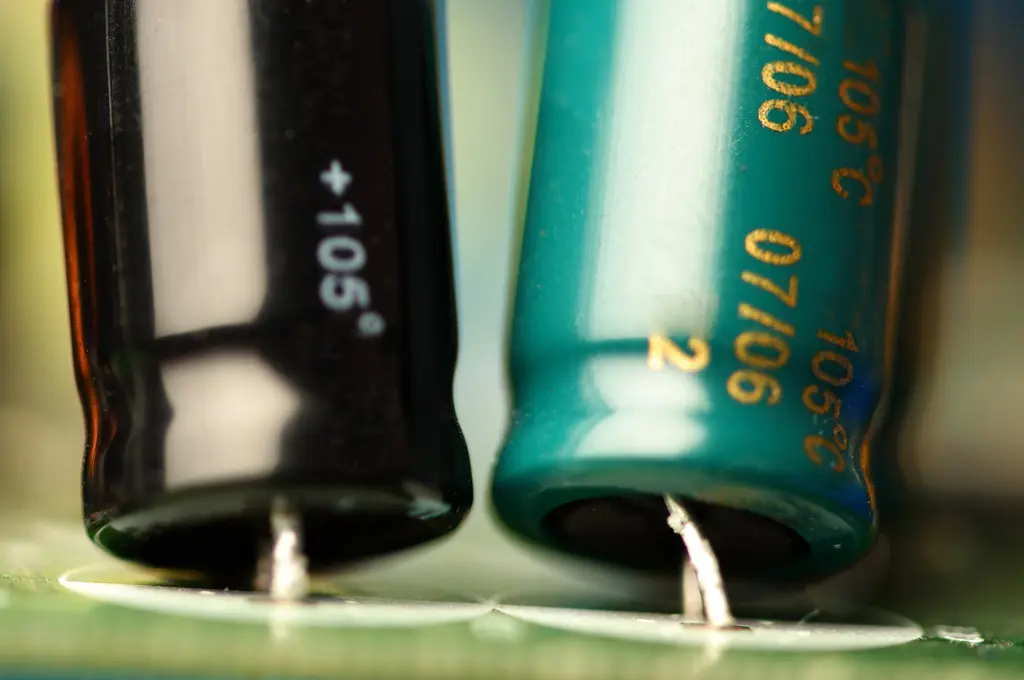
Today’s microprocessor-based systems require power sources that deliver high current and ultra-fast transient performance, with tight regulation.  This creates a need for cost-effective, compact capacitors with high capacitance values. Electrolytic capacitors are the solution of choice but it’s important to go beyond specifying capacitance and voltage to consider equivalent series resistance (ESR) as a figure of merit.

ESR: Easier to define than specify

RelatedPosts

KEMET Design it Day: Capacitors and Inductors Selection Guide for Decoupling And Filtering

How to determine and measure MLCC ripple current and ESR

Degradation of ESR in Polymer Tantalum Capacitors during High Temperature Storage BEST PAPER AWARD

The capacitor equivalent circuit comprises four elements (Figure 1, right): capacitance, equivalent series inductance (ESL) – the sum of inductive elements including leads, a high-resistance DC path (Rp) in parallel with the capacitance, and equivalent series resistance (ESR) – the series resistive effects combined into a single element.

ESR is frequency-dependent, temperature-dependent, and changes as components age. It is usually only an important consideration in selecting electrolytic capacitors.

Constructing the capacitor

‘Wet’ aluminium electrolytic capacitors have an anode plate comprising an electrochemically-etched aluminium foil, a dielectric formed as an oxide layer on this foil, a paper spacer to hold conductive fluid that forms the cathode, and a second foil that connects the electrolyte and the device’s terminal.

Fluid electrolyte penetrates the pores of the oxidised anode foil, so contact area, and hence capacitance, are maximised. The electrolyte’s temperature-dependent conductivity is a major contributor to ESR. Ohmic losses produced by the aluminium oxide layer are frequency-dependent, reducing as frequency increases. Fluid electrolyte is lost over time by vaporisation and diffusion, causing a gradual reduction in the amount of conducting material, reducing the contact area, increasing the ESR and reducing capacitance.
This “drying out” process is temperature dependent and accelerates in components used at higher temperatures or subjected to higher ripple currents, which dissipate more heat as part of their circuit function.

In aluminium electrolytics, ESR falls as temperature increases – its effects reduce as assemblies warm up.

Drying out is irrelevant in solid aluminium electrolytics, or ‘hybrid’ capacitors, where a polymerised organic semiconductor material replaces liquid electrolyte. This technology exhibits a specific conductance of around 10,000 times that of a liquid electrolyte. As Figure 2 shows, overall equivalent series resistance is reduced substantially, most significantly at low temperatures.

Tantalum technology

Tantalum capacitor electrolytics have tantalum anodes of either sintered powder, or plain or etched foil. The insulator is an oxide layer on the anode surface. In foil devices the second conductor is an electrolyte held in a spacer. A deposit of manganese dioxide covers the oxide layer in solid versions.

The component’s terminations are substantial contributors to ESR. In a solid capacitor the manganese dioxide is commonly covered with carbon and then a metal such as silver, which is soldered to the negative lead or case. In the foil style, the positive connection is a welded nickel or steel wire connected to a tantalum wire on the anode. Such devices also contain a second tantalum foil in contact with the electrolyte.
At low frequencies, the oxide losses are most significant. But their contribution decreases inversely with frequency, eventually becoming small compared with the contact material resistance (Figure 3).

Figure 3: Typical relationship beween ESR and frequency for tantalum capacitors (AVX)

Why is ESR important?

Electrolytic capacitors are used as input buffers to supply energy when the mains input voltage is too low, store energy while an AC/DC converter adapts to a new power level, and prevent switching noise from the converter reaching the power source. On the output of a converter, they act as a filter and current sink for inductive elements, and, in DC/DC conversion, function as an energy buffer when the power output demand changes.

In both cases, losses due to ESR will inhibit a capacitor’s ability to quickly source or sink charge. At the input, increasing ESR increases high frequency noise across the capacitor, decreasing filtering effectiveness. At the output, higher ESR causes more ripple, influencing stability of the control loop.

ESR is particularly important in applications with low duty-cycle, high-frequency current pulses. Here, the ripple voltage due to the ESR will be greater than expected based on capacitance alone, although the negative correlation of ESR with temperature means that ripple decreases as the assembly warms up.

Also, the introduction of a resistive element into what designers may assume is a purely reactive circuit can lead to unexpected shifts in phase response, again affecting stability.

What can be done?

Some capacitors are designed specifically for low-ESR, but manufacturers of aluminium electrolytic capacitors do not specify ESR consistently. The value at 25°C and 100kHz is commonly quoted, with a formula provided to calculate the value at the operating frequency. Some suppliers specify at 120Hz; others leave the designer to calculate the figure at the frequency of interest from the dissipation factor (tan∂) and specified maximum ripple current. Furthermore, for capacitors of comparable size and CV, a device with higher capacitance and lower voltage rating will have lower ESR and ESR tends to be lower for aluminium electrolytic devices with long, thin cases because the resistance of the foil is reduced. Larger overall case sizes can cut ESR too.

Also, several smaller-value components can be used in parallel to achieve lower high-frequency ESR, at the expense of board space.

Other advances

Several manufacturers of aluminium electrolytic capacitors have been combining solid and liquid electrolytes to produce hybrid components with ultra-low ESR (low tens of milliohms), with minimal temperature variation, while increasing withstand voltage and accommodating high ripple current.

As ESR varies with external surface area tantalum capacitor manufacturers produce multi-anode devices for high-reliability markets that may point the way to developments for more mainstream applications.

But low ESR is not always the primary consideration and, in a development outside of electrolytic devices, Murata has actually increased ESR of some of its multilayer ceramic chip capacitors, in order to control unwanted resonances that can reduce the decoupling performance at peak frequencies.

Conclusion

There has never been a more diverse range of electrolytic technologies for engineers to choose from. For power applications in particular, the data printed on the component is rarely sufficient to make an informed choice. Talking to an independent specialist that can offer components from a selection of the world’s largest capacitor manufacturers is the surest and quickest route to finding the most appropriate device for any given application.

Written by Adam Chidley Avnet Abacus European Senior Product Manager

Related

Source: AVNET ABACUS

Recent Posts

Knowles Expands High‑Q Ceramic Core Inductors for RF designs

19.6.2026
7

TrendForce: CSP in‑house AI ASIC Boom Reshapes Capacitor Demand

18.6.2026
28

Würth Elektroniks Flexible EMI Shielding Sheets Provides Quick and Easy Schielding Solution

17.6.2026
30

Samsung Introduces Automotive 1206 100uF X7T MLCC for Power Rails in ADAS and SoCs

17.6.2026
24

YMIN Hybrid Aluminum Capacitors for Automotive LiDAR Power Rails

17.6.2026
25

Samsung Presents Ultra‑Thin Silicon Capacitors for AI and Server PDN

17.6.2026
35

YAGEO Introduces 310VAC SMD Y2 Safety MP Capacitors for Compact EMI Filtering

16.6.2026
28

DMASS: European Components Distribution Returns To Growth In Q1 2026

16.6.2026
32

German Component Distribution Market Rebounds in Q1 2026 According to FBDi

16.6.2026
29

Upcoming Events

Jul 14
16:00 - 17:00 CEST

EMC Design Essentials: Mastering Varistors and Common Mode Chokes

Jul 21
16:00 - 17:00 CEST

Safety by design: X and Y Interference suppression capacitors for power line filters

View Calendar

Popular Posts

  • Boost Converter Design and Calculation

    0 shares
    Share 0 Tweet 0
  • Buck Converter Design and Calculation

    0 shares
    Share 0 Tweet 0
  • LLC Resonant Converter Design and Calculation

    0 shares
    Share 0 Tweet 0
  • Flyback Converter Design and Calculation

    0 shares
    Share 0 Tweet 0
  • MLCC and Ceramic Capacitors

    0 shares
    Share 0 Tweet 0
  • Earthing Systems and IEC Classification Explained

    0 shares
    Share 0 Tweet 0
  • Dual Active Bridge (DAB) Topology

    0 shares
    Share 0 Tweet 0
  • SEPIC Converter Design and Calculation

    0 shares
    Share 0 Tweet 0
  • MLCC Case Sizes Standards Explained

    0 shares
    Share 0 Tweet 0
  • What Electronics Engineer Needs to Know About Passive Low Pass Filters

    0 shares
    Share 0 Tweet 0

Newsletter Subscription


Passive Components Blog

© EPCI - Leading Passive Components Educational and Information Site

  • Home
  • Privacy Policy
  • EPCI Membership & Advertisement
  • About

No Result
View All Result
  • Home
  • Knowledge Blog
  • Dossiers
  • PCNS

© EPCI - Leading Passive Components Educational and Information Site

This website uses cookies. By continuing to use this website you are giving consent to cookies being used. Visit our Privacy and Cookie Policy.
Go to mobile version