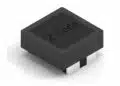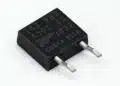











The SMD 0603 ST is a Pt1000 platinum resistance temperature detector (RTD) in an 0603 surface-mount body, intended for temperature measurement on printed circuit boards, board protection and temperature compensation.
YAGEO has introduced it as the first product of the new SMD ST series.
Its terminations cover the top, the bottom and the end faces of the chip but not the side walls, which is the standard termination layout of SMD chip components. The part is supplied in blister reels for automated pick-and-place assembly and reflow soldering lines.
Key Features and Benefits
- Pt1000 element: nominal resistance R0 = 1000 Ω at 0 °C.
- Two tolerance classes: F 0.3 (B) and F 0.6 (2B), corresponding to ±0.3 K and ±0.6 K at 0 °C.
- Operating temperature: −50 °C to +150 °C.
- Standard SMD termination: end terminations without sideplating, galvanically tin-plated over a nickel barrier, Pb-free.
- Assembly: blister reel packaging for standard pick-and-place tools.
- Automotive option: AEC-Q200 qualification available on request.

Technical Highlights
| Parameter | SMD 0603 ST |
|---|---|
| Sensing element | Platinum RTD, Pt1000 |
| Nominal resistance R0 | 1000 Ω at 0 °C |
| Tolerance class | F 0.3 (B), F 0.6 (2B) |
| Operating temperature | −50 °C to +150 °C |
| Case size | 0603 |
| Termination | Top, bottom and end faces; no sideplating |
| Termination finish | Galvanic tin over Ni barrier, Pb-free |
| Packaging | Blister reel |
| Qualification | AEC-Q200 on request |
Pt1000 Characteristic
A Pt1000 element follows the platinum resistance–temperature characteristic of IEC 60751 (DIN EN IEC 60751). Below 0 °C the resistance is given by the Callendar–Van Dusen equation
and from 0 °C upwards by the quadratic form
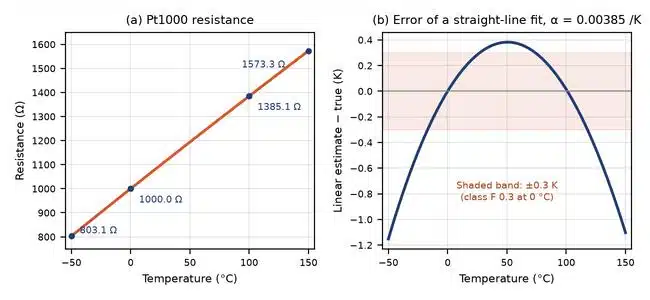
where Rt is the resistance at temperature t in °C, R0 = 1000 Ω, A = 3.9083 × 10⁻³ °C−1, B = −5.775 × 10⁻⁷ °C−2 and C = −4.183 × 10⁻¹² °C−4. The resistance rises from 1000 Ω at 0 °C to 1385.05 Ω at 100 °C, which gives the mean temperature coefficient of 3850 ppm/K. Table 2 gives values calculated from Eqs. (1) and (2) across the operating range of the SMD 0603 ST.
| Temperature | Resistance Rt | Sensitivity dR/dt |
|---|---|---|
| −50 °C | 803.06 Ω | 3.97 Ω/K |
| 0 °C | 1000.00 Ω | 3.91 Ω/K |
| 25 °C | 1097.35 Ω | 3.88 Ω/K |
| 100 °C | 1385.05 Ω | 3.79 Ω/K |
| 125 °C | 1479.51 Ω | 3.76 Ω/K |
| 150 °C | 1573.25 Ω | 3.74 Ω/K |
At 0 °C the sensitivity is 3.91 Ω/K, so class F 0.3 corresponds to about ±1.17 Ω and class F 0.6 to about ±2.34 Ω at the reference point. The characteristic is slightly curved. A straight line through 0 °C and 100 °C with α = 0.00385 /K reads 0.38 K too high at 50 °C and about 1.1 K too low at −50 °C and at +150 °C (Figure 2). Firmware that targets class F 0.3 accuracy over the full range should therefore use Eq. (1) and Eq. (2) or a lookup table, not a linear conversion.
Standard Termination Without Sideplating
The metallization of the SMD 0603 ST is on the top, bottom and end faces of the chip, as on standard chip resistors. The solder joint therefore forms on the bottom electrode and the end face, and the part enters the same 0603 placement, reflow and inspection flow as other chip components on the board. The land pattern and reflow profile should still be taken from the product drawing and process recommendations of the SMD 0603 ST.
Typical Applications
Target applications are HVAC, consumer electronics, power supplies, cost-sensitive devices, and medical and industrial systems.
- HVAC controls: the −50 °C to +150 °C operating range covers outdoor-air, supply-air and electronics-board measurement points in heating, ventilation and air-conditioning units.
- Power supplies: a board-mounted Pt1000 next to power semiconductors, magnetics or electrolytic capacitors provides the PCB temperature for derating and over-temperature shutdown up to 150 °C.
- Consumer and cost-sensitive devices: class F 0.6 (±0.6 K at 0 °C) suits monitoring and protection channels where class F 0.3 accuracy is not required.
- Medical and industrial systems: class F 0.3 (±0.3 K at 0 °C) and the standardized IEC 60751 curve support interchangeable sensors without individual calibration of each board.
- Automotive electronics: AEC-Q200 qualification is available on request.
Application Fit
Compared with an NTC thermistor, a platinum RTD has a lower sensitivity of about 0.39 %/K but follows a standardized, almost linear characteristic. Any IEC 60751 Pt1000 element within the same tolerance class can therefore replace another without changing the conversion table. The 1000 Ω value keeps the influence of trace and connection resistance small: in a two-wire circuit, 1 Ω of series resistance adds an error of about 0.26 K, compared with about 2.6 K for a Pt100.
Within the YAGEO board-level portfolio, the SMD 0603 ST is positioned as a standard-termination 0603 option alongside the smaller SMD 0402 FC Pt temperature sensor and the wired Pt-RTD elements with Ni wires for probe assemblies.
AEC-Q200 is a stress-test qualification for passive components. It covers the component, not the vehicle-level approval of the module in which the component is used.
Design-In Notes for Engineers
- Excitation current and self-heating: the excitation current dissipates I2R in the element, for example 40 µW at 0.2 mA and 1 kΩ. Keep the current low or pulsed and check the self-heating coefficient of the SMD 0603 ST for the required accuracy.
- Thermal coupling: the chip measures the temperature of its pads and the surrounding copper. Place it close to the point of interest and use copper areas to connect it thermally to the heat source, or isolate it if ambient air temperature is the target.
- Wiring: 1 Ω of series resistance corresponds to about 0.26 K. Use a ratiometric measurement with a reference resistor, and use three- or four-wire connection when long traces or connectors add resistance.
- Conversion: use Eq. (1) and Eq. (2) or an IEC 60751 table instead of a linear approximation when the tolerance budget is below about 1 K.
- Tolerance class: select F 0.3 or F 0.6 based on the total error budget, including ADC, reference resistor and self-heating contributions.
- Automotive use: request the AEC-Q200 version early in the project.
- Final selection should be validated under the actual operating conditions.
Further Reading
- Thermistor-Based Temperature Sensing System Explained
- Yageo to Acquire Heraeus Nexensos
- Murata World First 008004 NTC Thermistors for Temperature Sensing
Source
This article is based on the YAGEO product announcement and official product documentation. Engineers should refer to the current manufacturer datasheet for final design and qualification.
References
- Pt 1000 SMD-ST 0603, YAGEO Group, Resource Library, 2026.
- Product Brief: SMD ST, Sensors – Temperature, YAGEO Group, Rev. A (7.25).
- Sensors – Temperature, series SMD 0603 ST, YAGEO Group product finder.
- Reference Tables and Tolerances – Temperature Sensors, YAGEO Group Technical Sensor Academy.
- YAGEO – EPCI premium supplier page, Passive Components Blog.