




Passive Components Blog
No Result
View All Result
  • Home
  • NewsFilter
    • All
    • Aerospace & Defence
    • Antenna
    • Applications
    • Automotive
    • Capacitors
    • Circuit Protection Devices
    • electro-mechanical news
    • Filters
    • Fuses
    • Inductors
    • Industrial
    • Integrated Passives
    • inter-connect news
    • Market & Supply Chain
    • Market Insights
    • Medical
    • Modelling and Simulation
    • New Materials & Supply
    • New Technologies
    • Non-linear Passives
    • Oscillators
    • Passive Sensors News
    • Resistors
    • RF & Microwave
    • Telecommunication
    • Weekly Digest

    Molex Extends Cardinal Multi‑Port Coax Assemblies to 145 GHz for AI and 6G Test

    Samsung Launches Worlds First Automotive 47uF 4V MLCC in 0805 Size

    Würth Elektronik Present in IEEE APEC

    Samsung Three Pillars MLCC Strategy for AI Hardware Topology

    Bourns Releases High Clearance Transformer for Isolated DC/DC Supplies

    KYOCERA AVX Extends Ultra‑Broadband RF Capacitor Series

    Earthing Systems and IEC Classification Explained

    Smiths Interconnect invests £2m in Costa Rica electronics plant

    Kyocera Offers Small SAW Filters for IoT RF Modules

    Trending Tags

    • Ripple Current
    • RF
    • Leakage Current
    • Tantalum vs Ceramic
    • Snubber
    • Low ESR
    • Feedthrough
    • Derating
    • Dielectric Constant
    • New Products
    • Market Reports
  • VideoFilter
    • All
    • Antenna videos
    • Capacitor videos
    • Circuit Protection Video
    • Filter videos
    • Fuse videos
    • Inductor videos
    • Inter-Connect Video
    • Non-linear passives videos
    • Oscillator videos
    • Passive sensors videos
    • Resistor videos

    2026 Power Magnetics Design Trends: Flyback, DAB and Planar

    Enabling Software‑Defined Vehicle Architectures: Automotive Ethernet and Zonal Smart Power

    Calculating Resistance Value of a Flyback RC Snubber 

    One‑Pulse Characterization of Nonlinear Power Inductors

    Thermistor Linearization Challenges

    Coaxial Connectors and How to Connect with PCB

    PCB Manufacturing, Test Methods, Quality and Reliability

    Transformer Behavior – Current Transfer and Hidden Feedback

    Choosing the Right Capacitor: The Importance of Accurate Measurements

    Trending Tags

    • Capacitors explained
    • Inductors explained
    • Resistors explained
    • Filters explained
    • Application Video Guidelines
    • EMC
    • New Products
    • Ripple Current
    • Simulation
    • Tantalum vs Ceramic
  • Knowledge Blog
  • DossiersNew
  • Suppliers
    • Who is Who
  • PCNS
    • PCNS 2025
    • PCNS 2023
    • PCNS 2021
    • PCNS 2019
    • PCNS 2017
  • Events
  • Home
  • NewsFilter
    • All
    • Aerospace & Defence
    • Antenna
    • Applications
    • Automotive
    • Capacitors
    • Circuit Protection Devices
    • electro-mechanical news
    • Filters
    • Fuses
    • Inductors
    • Industrial
    • Integrated Passives
    • inter-connect news
    • Market & Supply Chain
    • Market Insights
    • Medical
    • Modelling and Simulation
    • New Materials & Supply
    • New Technologies
    • Non-linear Passives
    • Oscillators
    • Passive Sensors News
    • Resistors
    • RF & Microwave
    • Telecommunication
    • Weekly Digest

    Molex Extends Cardinal Multi‑Port Coax Assemblies to 145 GHz for AI and 6G Test

    Samsung Launches Worlds First Automotive 47uF 4V MLCC in 0805 Size

    Würth Elektronik Present in IEEE APEC

    Samsung Three Pillars MLCC Strategy for AI Hardware Topology

    Bourns Releases High Clearance Transformer for Isolated DC/DC Supplies

    KYOCERA AVX Extends Ultra‑Broadband RF Capacitor Series

    Earthing Systems and IEC Classification Explained

    Smiths Interconnect invests £2m in Costa Rica electronics plant

    Kyocera Offers Small SAW Filters for IoT RF Modules

    Trending Tags

    • Ripple Current
    • RF
    • Leakage Current
    • Tantalum vs Ceramic
    • Snubber
    • Low ESR
    • Feedthrough
    • Derating
    • Dielectric Constant
    • New Products
    • Market Reports
  • VideoFilter
    • All
    • Antenna videos
    • Capacitor videos
    • Circuit Protection Video
    • Filter videos
    • Fuse videos
    • Inductor videos
    • Inter-Connect Video
    • Non-linear passives videos
    • Oscillator videos
    • Passive sensors videos
    • Resistor videos

    2026 Power Magnetics Design Trends: Flyback, DAB and Planar

    Enabling Software‑Defined Vehicle Architectures: Automotive Ethernet and Zonal Smart Power

    Calculating Resistance Value of a Flyback RC Snubber 

    One‑Pulse Characterization of Nonlinear Power Inductors

    Thermistor Linearization Challenges

    Coaxial Connectors and How to Connect with PCB

    PCB Manufacturing, Test Methods, Quality and Reliability

    Transformer Behavior – Current Transfer and Hidden Feedback

    Choosing the Right Capacitor: The Importance of Accurate Measurements

    Trending Tags

    • Capacitors explained
    • Inductors explained
    • Resistors explained
    • Filters explained
    • Application Video Guidelines
    • EMC
    • New Products
    • Ripple Current
    • Simulation
    • Tantalum vs Ceramic
  • Knowledge Blog
  • DossiersNew
  • Suppliers
    • Who is Who
  • PCNS
    • PCNS 2025
    • PCNS 2023
    • PCNS 2021
    • PCNS 2019
    • PCNS 2017
  • Events
No Result
View All Result
Passive Components Blog
No Result
View All Result

Vishay Launches Industry’s First AEC-Q200 Qualified Ceramic Disc Capacitors for Class X1 / Y1 Applications

26.3.2019
Reading Time: 2 mins read
A A

Source: Vishay news

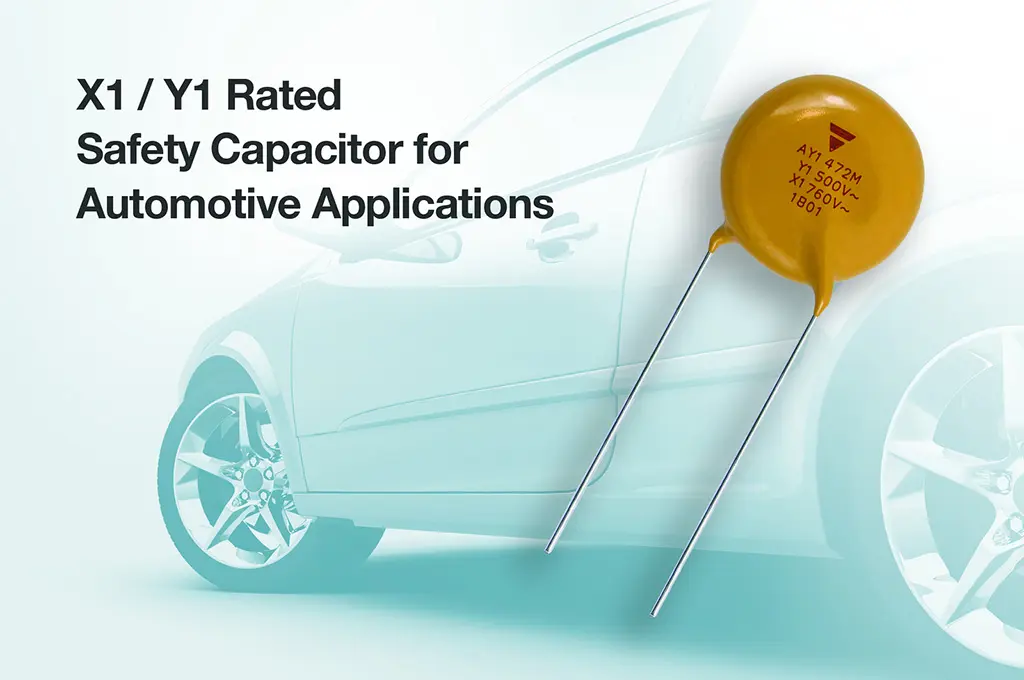
MALVERN, Pa. — Mar. 25, 2019 — Vishay Intertechnology, Inc. (NYSE: VSH) today introduced a new series of Automotive Grade AC line rated ceramic disc safety capacitors that are the industry’s first such devices to offer AEC-Q200 qualification for Class X1 (760 VAC) / Y1 (500 VAC) applications in accordance with IEC 60384-14.4.

RelatedPosts

Molex Extends Cardinal Multi‑Port Coax Assemblies to 145 GHz for AI and 6G Test

Samsung Launches Worlds First Automotive 47uF 4V MLCC in 0805 Size

Würth Elektronik Present in IEEE APEC

For electric (EV), hybrid electric (HEV), and plug-in-electric vehicles (PHEV), Vishay BCcomponents AY1 series devices are optimized for AC line filtering and primary / secondary coupling in on-board chargers and DC/DC converters. With the ability to withstand 85 / 85 / 1000 h biased humidity testing, 1000 temperature cycles from -55 °C to +125 °C, and ten 10 kV pulses per polarity, the devices deliver high reliability for these applications.

AY1 series capacitors feature a capacitance range from 470 pF to 4700 pF, with tolerances of ± 20 %. The devices consist of a copper-plated ceramic disc with tinned copper-clad steel connection leads offering 0.6 mm or 0.8 mm diameters, and are available with straight leads with spacing of 10 mm or 12.5 mm. RoHS-compliant, halogen-free, and Vishay Green, the components’ encapsulation is made of flame-resistant epoxy resin in accordance with UL 94 V-0.

In parallel to the AY1, Vishay’s existing AY2 series of Automotive Grade AC line rated ceramic disc safety capacitors has been extended with two new components offering capacitance to 6.8 nF and 10 nF, respectively. The industry’s first such components to offer AEC-Q200 qualification for Class X1 (440 VAC) / Y2 (300 VAC) applications in accordance with IEC 60384-14.4.

Device Specification Table:

Series AY1
Ceramic class 2
Ceramic dielectric Y5U
Voltage (VAC) 500 760
Min. capacitance (pF) 470
Max. capacitance (pF) 4700
Mounting Radial

Samples and production quantities of the AY1 series are available now, with lead times of eight weeks.


Related

Recent Posts

Samsung Launches Worlds First Automotive 47uF 4V MLCC in 0805 Size

24.2.2026
15

Würth Elektronik Present in IEEE APEC

24.2.2026
11

Samsung Three Pillars MLCC Strategy for AI Hardware Topology

24.2.2026
26

KYOCERA AVX Extends Ultra‑Broadband RF Capacitor Series

24.2.2026
17

TDK Releases DC Link Aluminum Capacitors for EV On‑Board Chargers

23.2.2026
12

Capacitech C-Link Supercapacitors for AI Data Center Voltage Spikes Mitigation

23.2.2026
22
Researchers developed a polymer capacitor by combining two cheap, commercially available plastics. The new polymer capacitor makes use of the transparent material — pictured here, with vintage Penn State athletic marks visible through it — to store four times the energy and withstand significantly more heat.  Credit: Penn State

Penn State Demonstrated Polymer Alloy Capacitor Film with 4× Energy Density up to 250C

19.2.2026
43

Vishay Unveils Ultra-Compact 0201 Thick Film Chip Resistors

19.2.2026
18

Würth Elektronik Component Data Live in Accuris

19.2.2026
17

Upcoming Events

Mar 3
16:00 - 17:00 CET

Cybersecurity at the Eleventh Hour – from RED to CRA – Information and Discussion

Mar 21
All day

PSMA Capacitor Workshop 2026

Apr 21
16:00 - 17:00 CEST

Heatsink Solutions: Thermal Management in electronic devices

View Calendar

Popular Posts

  • Buck Converter Design and Calculation

    0 shares
    Share 0 Tweet 0
  • Boost Converter Design and Calculation

    0 shares
    Share 0 Tweet 0
  • Flyback Converter Design and Calculation

    0 shares
    Share 0 Tweet 0
  • LLC Resonant Converter Design and Calculation

    0 shares
    Share 0 Tweet 0
  • MLCC Manufacturers Consider Price Increase as AI Demand Outpaces Supply

    0 shares
    Share 0 Tweet 0
  • Dual Active Bridge (DAB) Topology

    0 shares
    Share 0 Tweet 0
  • Ripple Current and its Effects on the Performance of Capacitors

    3 shares
    Share 3 Tweet 0
  • What is a Dielectric Constant and DF of Plastic Materials?

    4 shares
    Share 4 Tweet 0
  • MLCC and Ceramic Capacitors

    0 shares
    Share 0 Tweet 0
  • MLCC Case Sizes Standards Explained

    0 shares
    Share 0 Tweet 0

Newsletter Subscription


Passive Components Blog

© EPCI - Leading Passive Components Educational and Information Site

  • Home
  • Privacy Policy
  • EPCI Membership & Advertisement
  • About

No Result
View All Result
  • Home
  • Knowledge Blog
  • PCNS

© EPCI - Leading Passive Components Educational and Information Site

This website uses cookies. By continuing to use this website you are giving consent to cookies being used. Visit our Privacy and Cookie Policy.
Go to mobile version