






Passive Components Blog
No Result
View All Result
  • Home
  • News
    • All
    • Aerospace & Defence
    • Antenna
    • Applications
    • Automotive
    • Capacitors
    • Circuit Protection Devices
    • electro-mechanical news
    • Filters
    • Fuses
    • Inductors
    • Industrial
    • Integrated Passives
    • inter-connect news
    • Market & Supply Chain
    • Market Insights
    • Medical
    • Modelling and Simulation
    • New Materials & Supply
    • New Technologies
    • Non-linear Passives
    • Optoelectronics and Isolation
    • Oscillators
    • Passive Sensors News
    • Resistors
    • RF & Microwave
    • Telecommunication
    • Weekly Digest

    Transformer Losses and Thermal Design: Modelling and Validation

    DMASS Europe Q3 2026 electronic component distribution market overview

    European Component Distribution Jumps 42.7% in Q3 2026

    Bourns MSF series four-terminal current-sense shunt resistor with radial PCB terminals

    Bourns Introduces Four-Terminal Shunt Resistors for Current Sensing

    Würth Elektronik WE-SLSP SMT common-mode choke with a square package and four terminals.

    Würth Elektronik Releases Common-Mode Chokes for 100 V Data and Power Lines

    Assorted electronic connectors for USB, audio, video and power interfaces

    Top 10 Connector Manufacturers 2025: Amphenol Takes the Lead

    Samtec AcceleRate mP UDM6 and UDF6 board-to-board connectors with signal-contact arrays and power blades

    Samtec AcceleRate mP 10 mm Signal and Power Connectors

    Schematic diagrams illustrating the physical model of the stripline microinductor.

    Stripline Microinductors with Nickel–Iron Oxide Cores

    Würth Elektronik WE-LHMI and WE-HCI power inductor comparison slide showing current ratings and maximum operating temperatures

    Power Inductor Selection: Ferrite vs Powder Core Trade-Offs, Würth Elektronik Webinar

    Bourns PWR163 DPAK-style surface-mount power resistor with moulded housing, metal backplate and terminals

    Bourns Releases Power Resistor Adds Reverse-Pin Configuration

    Trending Tags

    • Ripple Current
    • RF
    • Leakage Current
    • Tantalum vs Ceramic
    • Snubber
    • Low ESR
    • Feedthrough
    • Derating
    • Dielectric Constant
    • New Products
    • Market Reports
  • Knowledge Blog
  • Dossiers
    • Aerospace and Defense Passive Components Dossier
    • AI Hardware Dossier
    • Automotive Dossier
    • Industrial Robotics Dossier
    • Power Converter Dossier
    • Capacitor Dossier
    • Circuit Protection Dossier
    • Inductor Dossier
    • Resistor Dossier
    • Silicon Capacitors and Integrated Passives Dossier
  • Suppliers
    • Who is Who
  • PCNS
    • PCNS 2025
    • PCNS 2023
    • PCNS 2021
    • PCNS 2019
    • PCNS 2017
  • Events
No Result
View All Result
Passive Components Blog
No Result
View All Result

What is RF Connector

17.12.2024
Reading Time: 2 mins read
A A

What is an RF Signal?

First, we should define what RF stands for. An RF (Radio Frequency) signal refers to an alternating current (AC) signal characterized by its frequency falling within the radio frequency range. This typically includes frequencies from 3 kHz (kilohertz) to 300 GHz (gigahertz).

RF signals are widely used in various communication systems, such as radio broadcasting, television, wireless communication, and radar.

RelatedPosts

Polymer Materials and Processing

Connector Materials and Processes

Copper Alloy Metallurgy and Processing

If you look across the broader electromagnetic spectrum the selection of the 3 kHz to 300 GHz frequency range for RF signals is a result of a balance between propagation characteristics, data transmission requirements, regulatory allocations, and the compatibility of electronic components and devices.

This range effectively covers a wide array of applications, making it a standard for RF communication and technology.

What is an RF Connector?

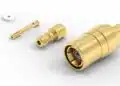
An RF connector is simply a device used to connect or terminate coaxial cables, providing a pathway for RF signals between electronic devices. These connectors play a crucial role in ensuring a reliable and efficient transfer of RF signals. RF connectors come in various types, each designed for specific applications and frequencies.

They often have a coaxial structure, consisting of a central conductor, insulating material, and an outer conductor that serves as a shield. The choice of RF connector depends on factors such as frequency, power, and environmental conditions. RF connectors are widely used in telecommunications, broadcast equipment, aerospace, medical devices, and other industries where high-frequency signal transmission is essential.

How are RF Connectors made?

Most RF connectors are manufactured using precision machining processes. The production typically involves the use of high-quality materials like brass, stainless steel, or aluminum. Automated machining tools, including CNC (Computer Numerical Control) machines, cut and shape the connector components to exact specifications. These CNC screw machines are where the cylindrical stock spins as a host of cutting tools work around the central axis.

The connectors consist of a central conductor, insulating material, and an outer conductor, often in the form of a threaded outer shell. Advanced techniques such as electroplating may be employed to enhance conductivity and protect against corrosion. Tight tolerances are maintained to ensure optimal performance and impedance matching. The result is a reliable and durable RF connector ready to facilitate the seamless transmission of high-frequency signals in various electronic applications.

Related

Recent Posts

Molex Extends Cardinal Multi‑Port Coax Assemblies to 145 GHz for AI and 6G Test

25.2.2026
75

Circular Connectors Coding

26.11.2025
323

Connector PCB Design Challenges

3.10.2025
150

Würth Elektronik Releases High-Frequency Connectors for Antenna Cables

9.7.2025
31

Non-Magnetic Interconnects

23.4.2025
76

Molex Releases Ruggedized EMI-Filtered Interconnects for Aerospace and Defense Applications 

14.3.2025
75

10 Tips for Ensuring Reliability of Discrete Wire Assemblies

20.2.2025
101

binder Releases M12-X Connectors for Rail and Transport Applications

3.2.2025
38

Molex Releases Innovative Power over Coax Solution to Ensure Reliable RF Connections

28.1.2025
53

Upcoming Events

Nov 24
16:00 - 17:00 CET

Select the Correct Components for Your DC/DC Converter

Dec 1
16:00 - 17:00 CET

Developing low-noise mixed-signal systems

Dec 8
16:00 - 17:00 CET

WE-CCMF: Design Principles, Layout Guidelines and Measurement Results for High-Speed EMI Filtering

View Calendar

Popular Posts

  • Buck Converter Design and Calculation

    0 shares
    Share 0 Tweet 0
  • Boost Converter Design and Calculation

    0 shares
    Share 0 Tweet 0
  • September 2026 Interconnect, Passives and Electromechanical Components Market Insights

    0 shares
    Share 0 Tweet 0
  • LLC Resonant Converter Design and Calculation

    0 shares
    Share 0 Tweet 0
  • Capacitor Charging and Discharging

    0 shares
    Share 0 Tweet 0
  • RF Connector Types: How To Choose the Right One

    0 shares
    Share 0 Tweet 0
  • Flyback Converter Design and Calculation

    0 shares
    Share 0 Tweet 0
  • Passive Low Pass Filters: Fundamentals and EMI Design

    0 shares
    Share 0 Tweet 0
  • MLCC and Ceramic Capacitors

    0 shares
    Share 0 Tweet 0
  • Audio Capacitors: Choosing Capacitors for Crossover Circuits

    0 shares
    Share 0 Tweet 0

Newsletter Subscription


Passive Components Blog

© 2015–2026
All rights reserved

  • Home
  • Privacy Policy
  • EPCI Membership & Advertisement
  • About

No Result
View All Result
  • Home
  • Knowledge Blog
  • Dossiers
  • PCNS

© 2015–2026
All rights reserved