
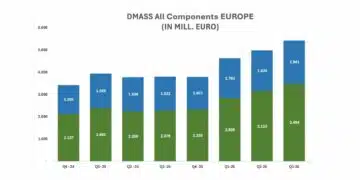




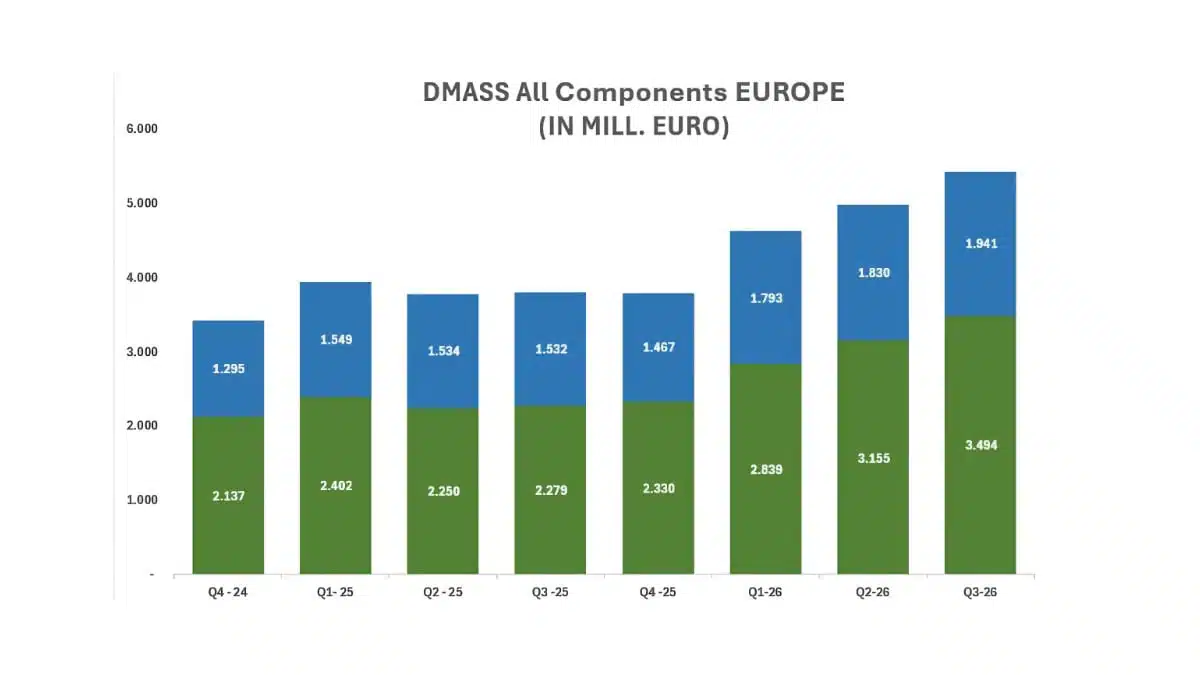
European electronic component distribution reached €5.4 billion in the third quarter of 2026, up 42.7% compared with Q3 2025, according to DMASS Europe.
The strong quarter lifted sales for the first nine months of the year to €15.0 billion, an increase of 30.2%.
For the passive component industry, the key development is the breadth of the recovery. Passives recorded 22.8% year-on-year growth in the first nine months, while the wider interconnect, passive and electromechanical components segment expanded by 20.3%. DMASS attributes this performance to demand across industrial equipment, energy infrastructure, automation and transportation.
Semiconductors remained the largest growth engine, although exceptional memory revenue growth means the headline market figures need to be interpreted alongside product-level trends.
Key figures at a glance
- Total component distribution: €5.4 billion in Q3 2026, up 42.7% year on year.
- First-nine-month distribution sales: €15.0 billion, up 30.2%.
- Semiconductor distribution: €3.5 billion in Q3, up 53.3%; first-nine-month sales reached €9.5 billion, up 36.9%.
- Interconnect, passive and electromechanical components: first-nine-month sales of €5.6 billion, up 20.3%, with Q3 growth of 26.9%.
- Passive components: first-nine-month sales growth of 22.8%.
- Power supplies: first-nine-month sales growth of 19.8%.
Figures are reported as published by DMASS. Rounded segment values may not sum exactly to the rounded market total. Unless otherwise stated, the product and regional growth rates below compare January–September 2026 with the same period in 2025.
Passive Components Highlight Broader Industrial Recovery
Passive component growth outpaced the overall IP&E segment by 2.5 percentage points. DMASS identifies passives as the largest contributor to IP&E growth, supported by demand across several industrial and infrastructure applications rather than a single end market.
Power supplies also recorded strong growth of 19.8%, which DMASS links to electrification, energy efficiency, data-centre infrastructure and industrial modernisation. Electromechanical components increased by 18.9% and remained the largest reported IP&E product group by value, with sales exceeding €3.1 billion.
Together, these results suggest that the European recovery extends beyond memory-led semiconductor growth. For readers examining the underlying application mix, the industrial passive components market and technology overview provides context on how energy infrastructure, automation, EV charging and AI data centres shape demand for capacitors, resistors and inductors.
What the figures do—and do not—show
The 22.8% passive component growth figure is a distribution sales-value measure. It should not be interpreted as an equivalent increase in component unit shipments, nor as evidence that every passive technology is growing at the same rate.
The release does not provide separate growth figures for capacitors, resistors or inductors, or a breakdown by component grade and application. It therefore supports a conclusion of stronger aggregate passive component distribution activity, but not a technology-by-technology assessment of demand, pricing or availability.
Memory Leads Semiconductor Growth
European semiconductor distribution increased by 36.9% in the first nine months of 2026. Memory was the standout category, with revenue growth of 189.4%, supported by both pricing effects and recovering demand, according to DMASS.
Other semiconductor categories also contributed:
| Component category | Growth |
|---|---|
| Discrete components | +30.8% |
| MOS Micro Logic | +26.6% |
| Analog | +24.9% |
| Other Logic | +23.9% |
| Sensors and actuators | +17.0% |
| Standard Logic | +14.7% |
| Power products | +11.5% |
| Programmable Logic | +8.1% |
| Optoelectronics | +1.7% |
The contrast matters when assessing the strength of the recovery. Memory revenue growth reflects pricing as well as demand, while positive results across analog, discrete and IP&E products indicate broader participation. DMASS nevertheless notes that inventory normalisation appears to remain underway in selected semiconductor segments.
Regional Growth Extends Across the Distribution Market
Germany, the largest European semiconductor distribution market, recorded total component sales growth of 33.0% in the first nine months. Semiconductor sales increased by 39.4%, while IP&E advanced by 21.5%.
Eastern Europe also delivered broad growth, with total component distribution up 30.9% and IP&E up 27.6%. Other notable IP&E results included:
| Country / Region | Growth |
|---|---|
| Turkey | +34.4% |
| Israel | +25.4% |
| Switzerland | +23.3% |
| Ireland | +23.0% |
| Austria | +21.1% |
| Iberia | +20.8% |
| Nordics | +20.4% |
| Italy | +13.7% |
| France | +12.5% |
Across all component categories, Israel recorded the strongest growth highlighted in the release at 50.7%. Ireland increased by 35.9%, the Nordics by 35.4% and Switzerland by 35.2%.
These regional results show that growth is not confined to one national market. However, the figures cover the markets included in DMASS reporting, including countries outside the European Union; they are not an EU-only measure.
What the Results Mean for Component Buyers and Suppliers
The main takeaway is a strengthening distribution market with two distinct growth characteristics: exceptional memory revenue expansion and a more balanced recovery across industrially exposed component categories.
For passive component suppliers, the results point to improving aggregate channel demand. For purchasing teams, however, a growing market does not by itself establish whether an individual component is readily available or supply-constrained. The release contains no part-number-level lead times, order-book data or inventory measurements.
A useful companion perspective is the shift described in Passive Components in 2026: Commodity to Design Parameter: application requirements and substitution limits make technology-specific sourcing assessments more informative than a single market growth figure.
Outlook: stronger momentum, but risks remain
“The European electronics market has entered a phase of accelerated recovery, with growth strengthening throughout 2026 and extending across both semiconductor and IP&E technologies,” said Hermann Reiter, Chairman of DMASS Europe.
DMASS describes Q3 as the strongest quarterly performance since the recovery began. It also cautions that geopolitical developments, trade uncertainty and potential energy-market disruptions could affect business confidence and investment.
The association identifies innovation, supply-chain resilience and the adoption of advanced digital and AI-enabled technologies as priorities for converting the current recovery into lasting European competitiveness.
About DMASS Europe
DMASS Europe e.V. is a non-profit industry association founded in 1989. It compiles quarterly electronic component distribution statistics by country and product group.
Its November 2026 release states that DMASS represents approximately 88% of the European distribution total available market, or DTAM. The reported figures describe the distribution channel rather than the entire electronics market, including all direct manufacturer sales.
Further reading
Source
This article is based on the DMASS Europe press release issued on 4 November 2026 covering European electronic component distribution in Q3 and the first nine months of 2026. Additional editorial context distinguishes distribution sales value from unit demand and highlights the limits of the published product-level data.