








Passive Components Blog
No Result
View All Result
  • Home
  • NewsFilter
    • All
    • Aerospace & Defence
    • Antenna
    • Applications
    • Automotive
    • Capacitors
    • Circuit Protection Devices
    • electro-mechanical news
    • Filters
    • Fuses
    • Inductors
    • Industrial
    • Integrated Passives
    • inter-connect news
    • Market & Supply Chain
    • Market Insights
    • Medical
    • Modelling and Simulation
    • New Materials & Supply
    • New Technologies
    • Non-linear Passives
    • Oscillators
    • Passive Sensors News
    • Resistors
    • RF & Microwave
    • Telecommunication
    • Weekly Digest

    Binder Hybrid Connector Simplifies One Cable Automation

    Tapped Inductor Buck Converter Fundamentals

    TAIYO YUDEN Releases Mini Metal Power Inductors

    Molecular Memristor Shows Record 145 kH Emergent Inductance

    Planar vs Conventional Transformer: When it Make Sense

    Researchers Propose Next‑Gen Compact Memory Using Ultra-thin Ferroelectric Capacitors

    Nichicon ADN Automotive Hybrid Aluminum Capacitors Now Available in EMEA

    Wk 19 Electronics Supply Chain Digest

    Electrocaloric Multilayer Capacitors: Towards Quiet, Solid‑State Cooling Around Room Temperature

    Trending Tags

    • Ripple Current
    • RF
    • Leakage Current
    • Tantalum vs Ceramic
    • Snubber
    • Low ESR
    • Feedthrough
    • Derating
    • Dielectric Constant
    • New Products
    • Market Reports
  • VideoFilter
    • All
    • Antenna videos
    • Capacitor videos
    • Circuit Protection Video
    • Filter videos
    • Fuse videos
    • Inductor videos
    • Inter-Connect Video
    • Non-linear passives videos
    • Oscillator videos
    • Passive sensors videos
    • Resistor videos

    Tapped Inductor Buck Converter Fundamentals

    Planar vs Conventional Transformer: When it Make Sense

    Modeling Fringing Field Losses in Inductors & Transformers

    Why Power Inductors Use a Ferrite Core With an Air Gap

    Transformer-Based Power-Line Harvester Magnetic Design

    Thermal Modeling of Magnetics

    Standard vs Planar LLC transformers Comparison for Battery Chargers

    How Modern Tools Model Magnetic Components for Power Electronics

    Advanced Loss Modeling for Planar Magnetics in the Frenetic Planar Tool

    Trending Tags

    • Capacitors explained
    • Inductors explained
    • Resistors explained
    • Filters explained
    • Application Video Guidelines
    • EMC
    • New Products
    • Ripple Current
    • Simulation
    • Tantalum vs Ceramic
  • Knowledge Blog
  • DossiersNew
  • Suppliers
    • Who is Who
  • PCNS
    • PCNS 2025
    • PCNS 2023
    • PCNS 2021
    • PCNS 2019
    • PCNS 2017
  • Events
  • Home
  • NewsFilter
    • All
    • Aerospace & Defence
    • Antenna
    • Applications
    • Automotive
    • Capacitors
    • Circuit Protection Devices
    • electro-mechanical news
    • Filters
    • Fuses
    • Inductors
    • Industrial
    • Integrated Passives
    • inter-connect news
    • Market & Supply Chain
    • Market Insights
    • Medical
    • Modelling and Simulation
    • New Materials & Supply
    • New Technologies
    • Non-linear Passives
    • Oscillators
    • Passive Sensors News
    • Resistors
    • RF & Microwave
    • Telecommunication
    • Weekly Digest

    Binder Hybrid Connector Simplifies One Cable Automation

    Tapped Inductor Buck Converter Fundamentals

    TAIYO YUDEN Releases Mini Metal Power Inductors

    Molecular Memristor Shows Record 145 kH Emergent Inductance

    Planar vs Conventional Transformer: When it Make Sense

    Researchers Propose Next‑Gen Compact Memory Using Ultra-thin Ferroelectric Capacitors

    Nichicon ADN Automotive Hybrid Aluminum Capacitors Now Available in EMEA

    Wk 19 Electronics Supply Chain Digest

    Electrocaloric Multilayer Capacitors: Towards Quiet, Solid‑State Cooling Around Room Temperature

    Trending Tags

    • Ripple Current
    • RF
    • Leakage Current
    • Tantalum vs Ceramic
    • Snubber
    • Low ESR
    • Feedthrough
    • Derating
    • Dielectric Constant
    • New Products
    • Market Reports
  • VideoFilter
    • All
    • Antenna videos
    • Capacitor videos
    • Circuit Protection Video
    • Filter videos
    • Fuse videos
    • Inductor videos
    • Inter-Connect Video
    • Non-linear passives videos
    • Oscillator videos
    • Passive sensors videos
    • Resistor videos

    Tapped Inductor Buck Converter Fundamentals

    Planar vs Conventional Transformer: When it Make Sense

    Modeling Fringing Field Losses in Inductors & Transformers

    Why Power Inductors Use a Ferrite Core With an Air Gap

    Transformer-Based Power-Line Harvester Magnetic Design

    Thermal Modeling of Magnetics

    Standard vs Planar LLC transformers Comparison for Battery Chargers

    How Modern Tools Model Magnetic Components for Power Electronics

    Advanced Loss Modeling for Planar Magnetics in the Frenetic Planar Tool

    Trending Tags

    • Capacitors explained
    • Inductors explained
    • Resistors explained
    • Filters explained
    • Application Video Guidelines
    • EMC
    • New Products
    • Ripple Current
    • Simulation
    • Tantalum vs Ceramic
  • Knowledge Blog
  • DossiersNew
  • Suppliers
    • Who is Who
  • PCNS
    • PCNS 2025
    • PCNS 2023
    • PCNS 2021
    • PCNS 2019
    • PCNS 2017
  • Events
No Result
View All Result
Passive Components Blog
No Result
View All Result

Würth Elektronik Expanded Capacity for Validation and Services in Asia

16.4.2026
Reading Time: 6 mins read
A A

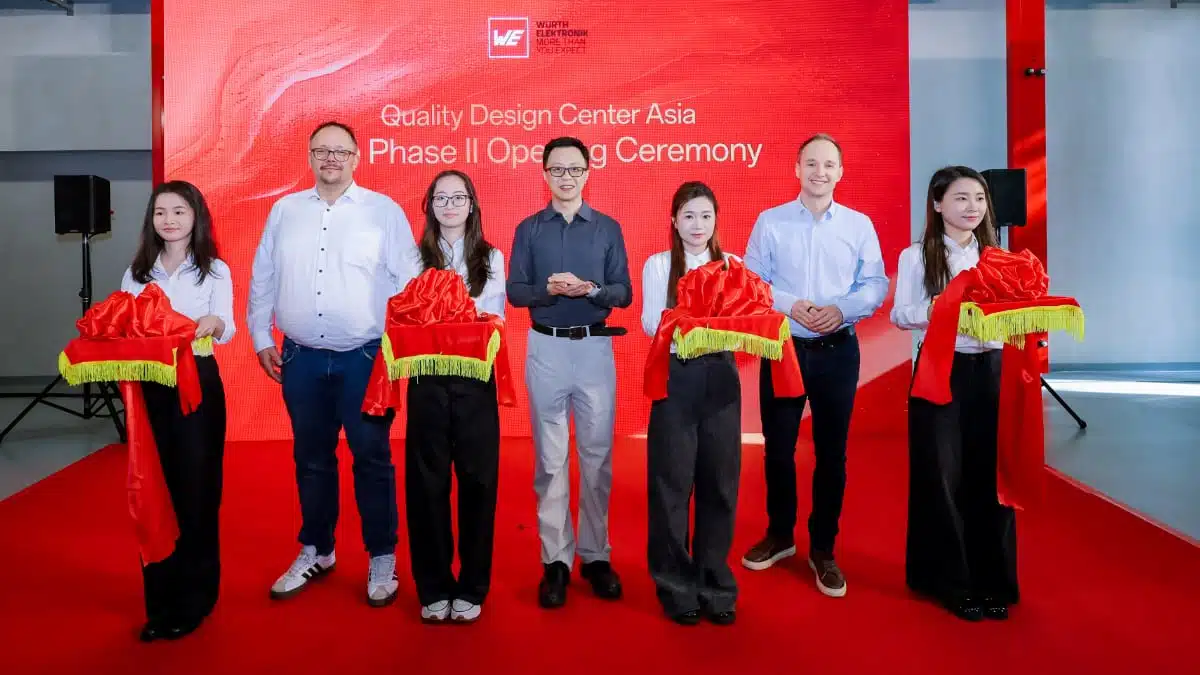
Würth Elektronik has significantly expanded its Asia Quality Design Center (QDC Asia) in Shenzhen, China, officially inaugurating Laboratory Phase II on March 5, 2026.

The Würth Elektronik opening was celebrated with a ribbon‑cutting ceremony attended by CEO Thomas Garz, COO Dirk Knorr, and Head of QDC Asia Yangyang Chen, underscoring the strategic role of the upgraded facility in the group’s global operations.

RelatedPosts

Würth Elektronik Introduces Compact Flat-wire SMT Power Inductors for Automotive

Heatsink Design and Thermal Interface Materials for Reliable Electronics

Würth Elektronik Releases Heat Sinks for TO and IC packages

Established in August 2008, QDC Asia today covers around 4,700 m², including a 1,700 m² dedicated testing area equipped with more than 300 high‑precision test systems. The center operates under ISO/IEC 17025 and ISO/IEC 17043, and is recognized by VDE (TDAP), UL (WTDP) and IEC (CTF2) as a competent laboratory and proficiency testing provider.

From Shipment Control to Full-Service Qualification Hub

Originally focused on pre‑shipment inspection for production, the Shenzhen laboratory has evolved into a comprehensive testing and qualification hub. Its current service portfolio covers:

  • Incoming goods inspection and release testing
  • Design change and design verification testing
  • Reliability and lifetime testing
  • Product conformity and compliance evaluation
  • Material compliance checks
  • Failure analysis and root‑cause investigations

With the existing laboratory area operating at full utilization, further expansion was essential to keep pace with rising test volumes, shorter innovation cycles, and tight customer time‑to‑market requirements.

Strategic Investment in Speed, Capacity and Customer Service

In the words of COO Dirk Knorr, the expansion in Shenzhen represents a targeted investment in additional testing capacity, faster validation processes and enhanced customer service, positioning QDC Asia as a key pillar of Würth Elektronik’s global quality and development strategy. The reinforced lab setup in Asia supports the company’s ambition to deliver high reliability, short response times and strong technical support across worldwide electronics markets.

Future Environmental Testing Capacity to Increase by 170%

The new 352 m² laboratory segment has been designed specifically to extend environmental and electrical performance testing capabilities. The infrastructure includes:

  • An energy‑efficient VFD chiller with magnetic bearing technology for stable and sustainable thermal management
  • A scalable electrical power system dimensioned to cover future peak load requirements of the test fields

This architecture allows Würth Elektronik to integrate additional test chambers and power‑hungry equipment without compromising uptime, stability or energy efficiency.

Phased Equipment Expansion for Optimal Utilization

In the expanded area, a total of 38 additional test systems will be installed in phases, closely aligned with real project and customer demand.

  • Phase 1: Deployment of 19 test systems on the ground floor
  • Phase 2: Subsequent installation of 19 further systems on a second level

This phased build‑up allows QDC Asia to balance capacity growth with cost‑effectiveness while ensuring that the infrastructure can flexibly follow the evolving technology mix in the product portfolio.

170% Throughput Gain in Environmental Testing

With the new laboratory in operation, environmental test throughput is expected to increase by around 170% compared to the current capacity. This significant gain supports:

  • Shorter validation and qualification lead times
  • More parallel testing for different projects and customer designs
  • Higher overall availability for complex multi‑step environmental test campaigns

For customers, this translates into accelerated design validation, reduced time‑to‑approval and more robust qualification data for demanding applications.

QDC Asia as an Integrated Partner in the Electronics Value Chain

QDC Asia serves as the quality backbone for Würth Elektronik’s Asian manufacturing locations, performing in‑depth testing and documentation close to production. By combining advanced measurement technology, international accreditation and local presence, the center supports:

  • Consistent component quality across global production networks
  • Early detection of process deviations and continuous improvement
  • Compliance with international customer and regulatory requirements

The laboratory’s ISO/IEC 17025 and ISO/IEC 17043 accreditations, along with recognition by VDE, UL and IEC, provide customers with independent, internationally accepted test evidence.

With the expanded laboratory infrastructure, Würth Elektronik can further intensify technical collaboration with customers in areas such as:

  • Application‑specific stress profiles and custom environmental test programs
  • Co‑engineering of qualification plans for new platforms and product generations
  • Fast feedback loops between design, lab testing and production ramp‑up

This aligns the Shenzhen site with the company’s broader strategy of service‑oriented engineering support, where laboratory capacity is directly linked to design‑in success and long‑term field reliability.

Source

The information in this article is based on the official manufacturer press release from Würth Elektronik about the expansion of its Quality Design Center laboratory in Shenzhen, China.

References

  1. Würth Elektronik press release – Expanded capacity for validation and serviceswe-online
  2. Würth Elektronik – QDC Asia and China locations overview (electronica China press info)we-online
  3. Würth Elektronik – Quality Design Center for Asia production (PCB services)we-online

Related

Recent Posts

European Components Distribution Shows Strong Q1 2026 Growth Amid Geopolitical Uncertainty

7.5.2026
72

Würth Elektronik Introduces Compact Flat-wire SMT Power Inductors for Automotive

5.5.2026
50

KYOCERA AVX Extends MLV Varistors for 48V Automotive Protection

5.5.2026
27

Murata Introduces Crystal and NTC Set for Automotive UWB Timing

30.4.2026
31

DigiKey Adds 31k New In‑Stock Parts in Q1 2026

29.4.2026
16

Murata New MLCC Bulk Case Packaging Cuts Packaging Material by 99%

27.4.2026
105

April 2026 Interconnect, Passives and Electromechanical Components Market Insights

22.4.2026
141

KYOCERA AVX Introduces Traction‑Grade DC Link Film Capacitors

21.4.2026
65

YAGEO Q1 2026 Results: AI Servers and Pricing Power Behind a Moderate Q2 Outlook

16.4.2026
142

Upcoming Events

May 19
16:00 - 17:00 CEST

Designing Qi2 Wireless Power Systems: Practical Development and EMC Optimization

Jun 2
16:00 - 17:00 CEST

Calculation, Simulation and Measurement of 800V EMC Filters

Jun 16
16:00 - 17:00 CEST

EMC with EMC – EMC‑compliant design with electromechanical connectors

View Calendar

Popular Posts

  • Buck Converter Design and Calculation

    0 shares
    Share 0 Tweet 0
  • Boost Converter Design and Calculation

    0 shares
    Share 0 Tweet 0
  • Flyback Converter Design and Calculation

    0 shares
    Share 0 Tweet 0
  • LLC Resonant Converter Design and Calculation

    0 shares
    Share 0 Tweet 0
  • MLCC and Ceramic Capacitors

    0 shares
    Share 0 Tweet 0
  • Dual Active Bridge (DAB) Topology

    0 shares
    Share 0 Tweet 0
  • Capacitor Charging and Discharging

    0 shares
    Share 0 Tweet 0
  • What Electronics Engineer Needs to Know About Passive Low Pass Filters

    0 shares
    Share 0 Tweet 0
  • Ripple Current and its Effects on the Performance of Capacitors

    3 shares
    Share 3 Tweet 0
  • MLCC Case Sizes Standards Explained

    0 shares
    Share 0 Tweet 0

Newsletter Subscription


Passive Components Blog

© EPCI - Leading Passive Components Educational and Information Site

  • Home
  • Privacy Policy
  • EPCI Membership & Advertisement
  • About

No Result
View All Result
  • Home
  • Knowledge Blog
  • PCNS

© EPCI - Leading Passive Components Educational and Information Site

This website uses cookies. By continuing to use this website you are giving consent to cookies being used. Visit our Privacy and Cookie Policy.
Go to mobile version