




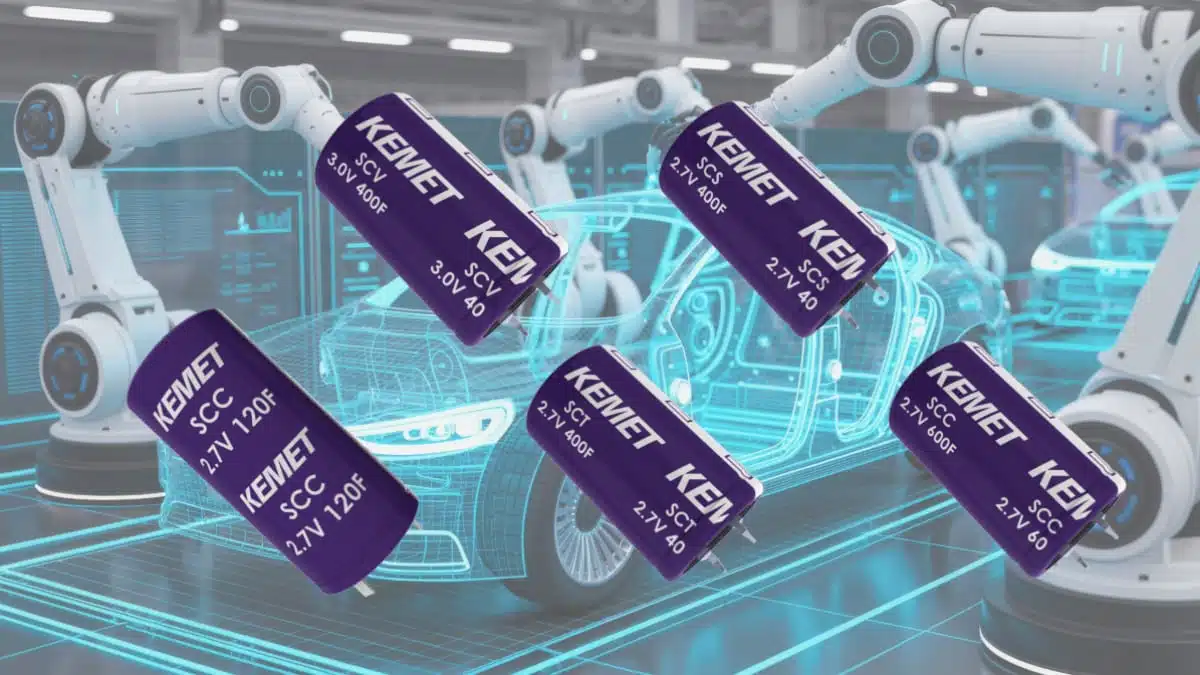
YAGEO Group’s Aluminum Electrolytic division has introduced a structured portfolio of electric double‑layer capacitor (EDLC) supercapacitors grouped into five series: SCS, SCC, SCE, SCV and SCT.
This YAGEO supercapacitor family targets short‑term energy storage, power buffering and backup in applications where instant power delivery, long lifetime and system resilience are critical across automotive, industrial, energy and infrastructure systems.
Key features and benefits
- EDLC technology for high power density short‑duration energy storage and fast response during peak load events.
- Ultra‑low ESR options (notably the SCE series) for high pulse current capability and rapid charge/discharge cycles in power buffering and backup rails.
- High power density, reaching the kW/kg range for short bursts, helping reduce the number or size of traditional battery packs in hold‑up or peak‑assist functions.
- Long cycle life, with operation described up to hundreds of thousands to millions of cycles, supporting designs that demand frequent charge/discharge events across many years of service.
- Maintenance‑free operation, suitable for systems where regular service is difficult or costly, such as remote infrastructure or data center equipment.
- Wide operating temperature and robust construction, including an AEC‑Q200 qualified high‑temperature series (SCT) for harsh automotive and industrial environments.
- RoHS‑compliant, halogen‑free materials, supporting sustainable and regulatory‑aligned product selections.
- Snap‑in constructions available, simplifying mechanical design and assembly into power PCBs or busbar‑based assemblies.
These attributes collectively position the SCS, SCC, SCE, SCV and SCT series as building blocks for energy buffering, backup power and instantaneous power support where conventional aluminum electrolytics or batteries alone may not meet lifetime or dynamic performance targets.
Structured portfolio: series overview
YAGEO organizes its supercapacitor offering into five clearly differentiated families to simplify design choices:
| Series | Design focus | Typical priority |
|---|---|---|
| SCS | Standard EDLC series | Balanced performance and cost for general purpose supercapacitor use |
| SCC | High capacitance | Maximum energy storage in a compact footprint for extended backup or buffering |
| SCE | Low ESR | High pulse current and fast charge/discharge for dynamic power rails and hold‑up |
| SCV | High voltage | Higher operating voltages to reduce series cell count in multi‑cell stacks |
| SCT | High temperature, automotive compliant | AEC‑Q200 qualified, high‑temperature and harsh‑environment operation |
- SCS – Standard Series: Designed for general purpose supercapacitor applications, combining capacitance, reliability and cost efficiency for mainstream buffering and backup functions.
- SCC – High Capacitance Series: Optimized for maximum energy storage where designers need longer backup times or larger energy buffers without expanding PCB area.
- SCE – Low ESR Series: Targeted at high pulse current and rapid charge/discharge, ideal for bridging brief input dips, providing peak‑assist power, or stabilizing dynamic rails.
- SCV – High Voltage Series: Supports higher operating voltages, which can reduce the required number of series‑connected cells, simplifying balancing networks and system architecture.
- SCT – High Temperature / Automotive Compliant Series: Qualified to AEC‑Q200 and tailored for elevated temperatures and demanding environments such as automotive ECUs and industrial control units.
This structured approach allows engineers to choose a series based on the primary constraint: capacitance density, temperature rating, voltage level, ESR/pulse performance or cost‑optimized standard behavior.
Typical applications
Supercapacitors in this portfolio are aimed at short‑duration, high‑reliability energy delivery rather than long‑term energy storage. Typical applications include:
- Automotive systems such as infotainment backup, safety/latch modules and power hold‑up for critical ECUs that must ride through cranking or brief power interruptions.
- Server and data center power hold‑up stages, where a supercapacitor bank can sustain supply rails during transfer events or ride‑through short input glitches until UPS or redundancy mechanisms take over.
- Industrial and power supply buffering, for example in factory automation, PLCs, drives and inverters requiring instantaneous power support or controlled shutdown capability.
- Backup power and power hold‑up systems in communication infrastructure, gateways and networking equipment that must remain operational during short outages.
- Energy buffering in systems with intermittent sources (such as load‑leveling or peak‑shaving functions) requiring efficient charge/discharge and high cycle life.
In practice, these use cases benefit from the combination of high power density, fast response and long cycle life, making EDLC supercapacitors a complementary technology alongside aluminum electrolytics and batteries.
Technical highlights
While detailed ratings such as capacitance, voltage range and mechanical sizes are defined per series and part number in the manufacturer datasheets, the press release and associated product brief highlight several common technical aspects:
- Electric double‑layer capacitor (EDLC) technology for high power density and high cycle life energy storage.
- Ultra‑low ESR variants (especially within the SCE series) for minimized losses during high current pulses and improved efficiency in charge/discharge cycles.
- High charge/discharge efficiency typically in the 85–98% range, supporting energy buffering designs where round‑trip efficiency is important.
- Long storage life, with performance described as not decaying over time in theory, making these suitable for rarely used but always‑ready backup functions.
- Snap‑in construction configurations available, which are well suited for through‑hole mounting on power boards with thick copper or busbars.
- RoHS compliance and halogen‑free materials, aligning with global environmental standards and corporate sustainability requirements.
For exact voltage ratings, capacitance values, dimensions and temperature limits of each family and individual part number, engineers should refer directly to the relevant YAGEO supercapacitor product brief and full datasheets, as these parameters are specified according to the manufacturer documentation.
Features
- EDLC technology supercapacitors.
- RoHS compliant and halogen‑free.
- Available in snap‑in construction.
- Ultra‑low ESR.
- High power density.
- Fast charge and discharge capability.
- Robust, maintenance‑free solid‑state design.
- Long cycle life and stable electrical performance.
These characteristics make the series particularly attractive for power electronics designs that must combine fast dynamics with long‑term reliability.
Customer value and system‑level benefits
From a system and life‑cycle perspective, YAGEO highlights several customer‑oriented benefits:
- Fast response and efficient power delivery during peak loads, improving the robustness of server, data center and industrial systems against transient events.
- Reliable backup power and energy buffering for critical electronics, ensuring controlled shutdown or continuous operation during short interruptions.
- Long‑term operation with little to no maintenance, which reduces service visits and total cost of ownership, especially in inaccessible or distributed installations.
- Reduced replacement and service requirements thanks to long cycle life and stable electrical behavior, contributing to lower lifecycle costs and improved system uptime.
- Reliable performance under demanding environmental conditions, particularly when using the SCT high‑temperature automotive compliant series.
- Global availability and supply assurance via YAGEO Group’s distribution and sales network, supporting volume production and multi‑region deployment.
For purchasing teams, the combination of a structured series portfolio, global distribution and standard compliance (such as AEC‑Q200 for SCT) simplifies qualification and standardization efforts across multiple product platforms.
Design‑in notes for engineers
When designing these EDLC supercapacitors into power electronics, the following practical considerations can help:
- Define the primary constraint first:
- Choose SCC when energy storage and backup duration are dominant.
- Choose SCE when ESR and pulse current capability are critical for the design.
- Choose SCV when higher system voltage and reduced series cell count simplify the architecture.
- Choose SCT when high temperature and automotive qualification (AEC‑Q200) are mandatory.
- Choose SCS for cost‑efficient, general purpose buffering and backup.
- Consider ESR and pulse requirements:
For power buffering and hold‑up rails, low ESR translates into lower voltage droop during high current transients and lower self‑heating under repetitive pulses. Selecting SCE or other low‑ESR options is recommended for these scenarios. - Plan for voltage derating and balancing:
In multi‑cell stacks, especially with SCV devices at higher voltages, cell balancing and appropriate voltage derating should be implemented according to the manufacturer datasheet to maintain reliability and lifetime. - Account for temperature environment:
In automotive or industrial installations with elevated ambient temperatures, the SCT series provides AEC‑Q200 qualified operation and high‑temperature robustness, making it the preferred choice for safety‑relevant or mission‑critical ECUs. - Mechanical and layout considerations:
Snap‑in constructions are suited to power boards with thicker copper and higher mechanical demands. Ensure sufficient creepage/clearance at higher voltages and consider the mechanical stability of tall can devices under vibration. - Integration with existing electrolytics and batteries:
Supercapacitors are typically used alongside aluminum electrolytics for filtering and batteries for longer‑term energy storage. The EDLC bank can handle fast transients and high cycle events, while other components provide bulk energy and regulation. - Lifetime and maintenance strategy:
Because these supercapacitors are designed for long cycle life and maintenance‑free operation, they fit designs where replacement intervals must be minimized. Proper thermal management and adherence to datasheet conditions are essential to achieve the specified lifetime.
For detailed electrical and environmental limits—such as maximum operating voltage, temperature range and expected lifetime curves—engineers should rely on the manufacturer datasheets corresponding to each series and specific part number.
Source
This article is based on information provided by YAGEO Group in their official press release and associated product brief for the SCS, SCC, SCE, SCV and SCT supercapacitor series, complemented by general guidance from the manufacturer’s resource library and product pages.