





Passive Components Blog
No Result
View All Result
  • Home
  • News
    • All
    • Aerospace & Defence
    • Antenna
    • Applications
    • Automotive
    • Capacitors
    • Circuit Protection Devices
    • electro-mechanical news
    • Filters
    • Fuses
    • Inductors
    • Industrial
    • Integrated Passives
    • inter-connect news
    • Market & Supply Chain
    • Market Insights
    • Medical
    • Modelling and Simulation
    • New Materials & Supply
    • New Technologies
    • Non-linear Passives
    • Optoelectronics and Isolation
    • Oscillators
    • Passive Sensors News
    • Resistors
    • RF & Microwave
    • Telecommunication
    • Weekly Digest
    Reference and proposed SVG DC-side circuits showing a supercapacitor bank in series with a converter-regulated electrolytic-capacitor branch

    Hybrid capacitor topology cuts SVG supercapacitor cell count

    Amphenol Industrial Operations HDPC 64 Pin Series rectangular wire-to-board connector with central jackscrew locking

    Amphenol Introduces 64-Pin Connectors for Vehicle and Industrial Controls

    Bourns 04775x common mode choke illustration showing coupled windings and a magnetic core

    Bourns Extends Nanocrystalline Common Mode Chokes

    electronic components market survey ECIA

    ECIA October 2026: Passive Component Sales Outlook Turns Neutral

    connector-manufacturers-regional-rankings-2025

    Top 10 Connector Manufacturers by Region: 2025 Rankings

    bourns-hvma03f30a-lp8s-automotive-flyback-transformer

    Bourns Introduces HVMA03F30A-LP8S 3 W Automotive Flyback Transformer

    Amphenol Amphe-Lite HV circular power connectors with metal shells and mating interfaces

    Amphenol Releases Amphe-Lite HV Connectors for Electric Aircraft

    Conceptual illustration of Modelithics Library for MATLAB v26.6 with surface-mount capacitors, inductors and resistors on an RF PCB

    Modelithics MATLAB v26.6 Adds RF Passive Component Models

    binder series 707 M5 male and female field-wireable cable connectors with metal housings

    binder Introduces M5 Field-Wireable Connectors for Sensors and Robotics

    Trending Tags

    • Ripple Current
    • RF
    • Leakage Current
    • Tantalum vs Ceramic
    • Snubber
    • Low ESR
    • Feedthrough
    • Derating
    • Dielectric Constant
    • New Products
    • Market Reports
  • Knowledge Blog
  • Dossiers
    • Aerospace and Defense Passive Components Dossier
    • AI Hardware Dossier
    • Automotive Dossier
    • Industrial Robotics Dossier
    • Power Converter Dossier
    • Capacitor Dossier
    • Circuit Protection Dossier
    • Inductor Dossier
    • Resistor Dossier
    • Silicon Capacitors and Integrated Passives Dossier
  • Suppliers
    • Who is Who
  • PCNS
    • PCNS 2025
    • PCNS 2023
    • PCNS 2021
    • PCNS 2019
    • PCNS 2017
  • Events
No Result
View All Result
Passive Components Blog
No Result
View All Result

Creepage and Clearance of Connector

25.7.2025
Reading Time: 2 mins read
A A

This video from Würth Elektronik elaborates on clearance and creepage distance and solid insulation materials.

Many applications of fire are productive and warming. Fire can be a real risk if the components on pcb has not been selected correctly for high voltages.

RelatedPosts

IQD Releases TCXOs for GNSS and RF Timing

SMPS Topology Selection: From Buck and Boost to Flyback and LLC

Würth Elektronik Launches ABC of Thermal Management Guide

In some circumstances, incorrectly selected components can create Transient voltage, which could cause damage to the board and even leads to spark fire. To achieve electric shock protection, electronic equipment must have an effective insulation method, which can be divided in to clearance and creepage distance and solid insulation materials.

Creepage and Clearance

Creepage and clearance are crucial product safety terms and requirements for various products, assemblies, and components. Regulatory agencies like IEC, UL, and CSA establish specific product application guidelines and requirements that must be met to sell products in many countries.

Creepage and clearance standards ensure safe operation, reducing the risk of electric shocks or other injuries to end users and minimizing fire hazards. Additionally, these standards protect other components in close proximity to those being rated or tested to prevent a failure from spreading throughout the system. This discussion will focus on power interconnects, printed wiring boards (PWB/PCB), and cable assemblies.

What is Creepage?

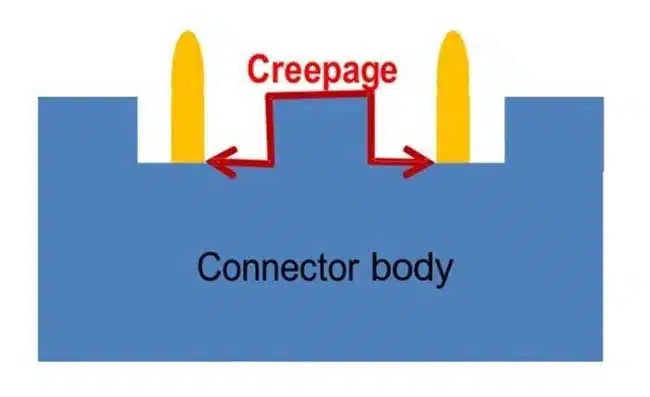
Creepage refers to the linear distance along all insulating surfaces between two electrical conductors (as seen in Figure below). In terms of electrical measurements, this parameter essentially equates to a surface insulation resistance measurement (SIR or IR). It’s important to note that since creepage encompasses the entire surface distance between the conductors, it significantly exceeds the clearance distance of the same contacts.
What is Clearance?

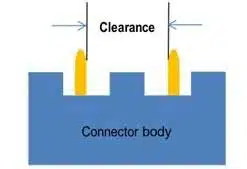
Clearance refers to the distance between two electrical conductors in the air. In simpler terms, it represents the distance a spark needs to travel to cause a dielectric breakdown, as illustrated in Figure below.
Related

Source: Würth Elektronik

Recent Posts

Circular Connectors Coding

26.11.2025
347

Connector PCB Design Challenges

3.10.2025
167

Non-Magnetic Interconnects

23.4.2025
78

10 Tips for Ensuring Reliability of Discrete Wire Assemblies

20.2.2025
109

What is RF Connector

17.12.2024
111

RF Connector Types: How To Choose the Right One

3.11.2026
2.1k

Connector Temperature Rise and Derating

13.1.2023
94

Connector Temperature and Current Ratings Challenges

13.1.2023
142

Connector Inrush Current Explained

17.12.2024
56

Upcoming Events

Dec 1
16:00 - 17:00 CET

Developing low-noise mixed-signal systems

Dec 8
16:00 - 17:00 CET

WE-CCMF: Design Principles, Layout Guidelines and Measurement Results for High-Speed EMI Filtering

Dec 8
16:00 - 17:00 CET

Design Principles, Layout Guidelines and Measurement Results for High-Speed EMI Filtering

View Calendar

Popular Posts

  • Buck Converter Design and Calculation

    0 shares
    Share 0 Tweet 0
  • Boost Converter Design and Calculation

    0 shares
    Share 0 Tweet 0
  • Capacitor Charging and Discharging

    0 shares
    Share 0 Tweet 0
  • RF Connector Types: How To Choose the Right One

    0 shares
    Share 0 Tweet 0
  • September 2026 Interconnect, Passives and Electromechanical Components Market Insights

    0 shares
    Share 0 Tweet 0
  • LLC Resonant Converter Design and Calculation

    0 shares
    Share 0 Tweet 0
  • Passive Low Pass Filters: Fundamentals and EMI Design

    0 shares
    Share 0 Tweet 0
  • Flyback Converter Design and Calculation

    0 shares
    Share 0 Tweet 0
  • Dual Active Bridge (DAB) Topology

    0 shares
    Share 0 Tweet 0
  • Capacitance and its Calculation

    0 shares
    Share 0 Tweet 0

Newsletter Subscription


Passive Components Blog

© 2015–2026
All rights reserved

  • Home
  • Privacy Policy
  • EPCI Membership & Advertisement
  • About

No Result
View All Result
  • Home
  • Knowledge Blog
  • Dossiers
  • PCNS

© 2015–2026
All rights reserved