


The transition to 800V electrical architectures in aviation, defense and eVTOL platforms is driving a need for compact, high‑reliability filtering capacitors and magnetics that can safely operate at elevated DC bus voltages.
Exxelia positions its film capacitors, bus bar solutions and integrated magnetics as building blocks for DC links, inverters and auxiliary systems on these new platforms.
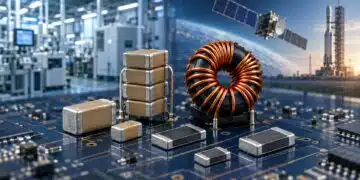
This article summarizes the key elements of their offering and adds context for design engineers and purchasing teams working on high‑voltage aerospace power equipment.
Key features and benefits
CF‑PP140 high‑temperature film capacitors (1200V)
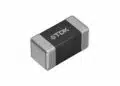
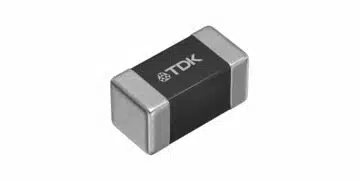
- Radial and SMD film capacitors designed for 1200V operation on 800V DC bus systems, targeting filtering and DC link roles in inverters and converters.
- Up to 30% smaller and lighter than typical alternative solutions according to Exxelia, which helps reduce volume in dense electronics bays and nacelles.
- High‑temperature capability supports demanding aerospace environments (generator interfaces, fuselage heaters, actuators) where ambient and self‑heating are both significant.
- Film dielectric offers low loss and stable capacitance versus voltage compared to many ceramic high‑voltage options, simplifying thermal design and lifetime prediction.
1200V bus bar capacitors
- Custom bus‑bar‑mount film capacitor assemblies for 1200V DC links, designed to achieve maximum volumetric density.
- Exxelia states up to 60% smaller and lighter assemblies compared with conventional discrete bus‑connected capacitor banks, enabling more compact inverter and converter layouts.
- Integration directly onto bus bars reduces stray inductance and loop area, improving switching performance and easing EMC and overshoot control in fast power stages.
- Mechanical integration can simplify assembly and reduce the number of interconnects, which is beneficial for vibration robustness and long‑term reliability.
Overvoltage protection up to 5kV
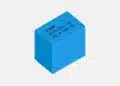
- Common‑mode film capacitors based on CM HVLP technology, specified for high‑voltage overvoltage and surge protection up to several kilovolts depending on part number.
- Complementary high‑voltage ceramic capacitors from the C48X C‑series provide compact common‑mode filtering and surge handling at similar voltage levels.
- These devices are intended to clamp overvoltage events and filter common‑mode noise on 800V networks, protecting 1200V filtering capacitors and power electronics from transient stress.
- Film plus ceramic options allow engineers to balance energy handling, size and frequency performance across PFC stages, DC links and EMI filters.
Smart integrated magnetics
- Integrated transformer–inductor devices for space‑constrained SMPS and power conversion, combining multiple magnetic functions in a single component.
- Reduced footprint and part count versus separate transformer and inductor designs, helping shrink converter PCBs and improve power density.
- Co‑designed magnetics can be tuned to match specific converter topologies and switching schemes used on 800V platforms, which is helpful for LLC, phase‑shifted full bridge or advanced DC‑DC stages.
Platform‑level advantages
- AS9100/EN9100 qualified solutions across the capacitor and magnetics portfolio support aerospace quality and traceability requirements.
- Custom screening levels allow tailoring of qualification (burn‑in, environmental tests) to mission profile and reliability targets.
- Long‑term “no‑obsolescence” policy and dual manufacturing (Europe and US) aim to stabilize supply chains and provide ITAR‑free options where needed.
Typical applications
These components are aimed at a wide range of 800V aerospace and defense applications:
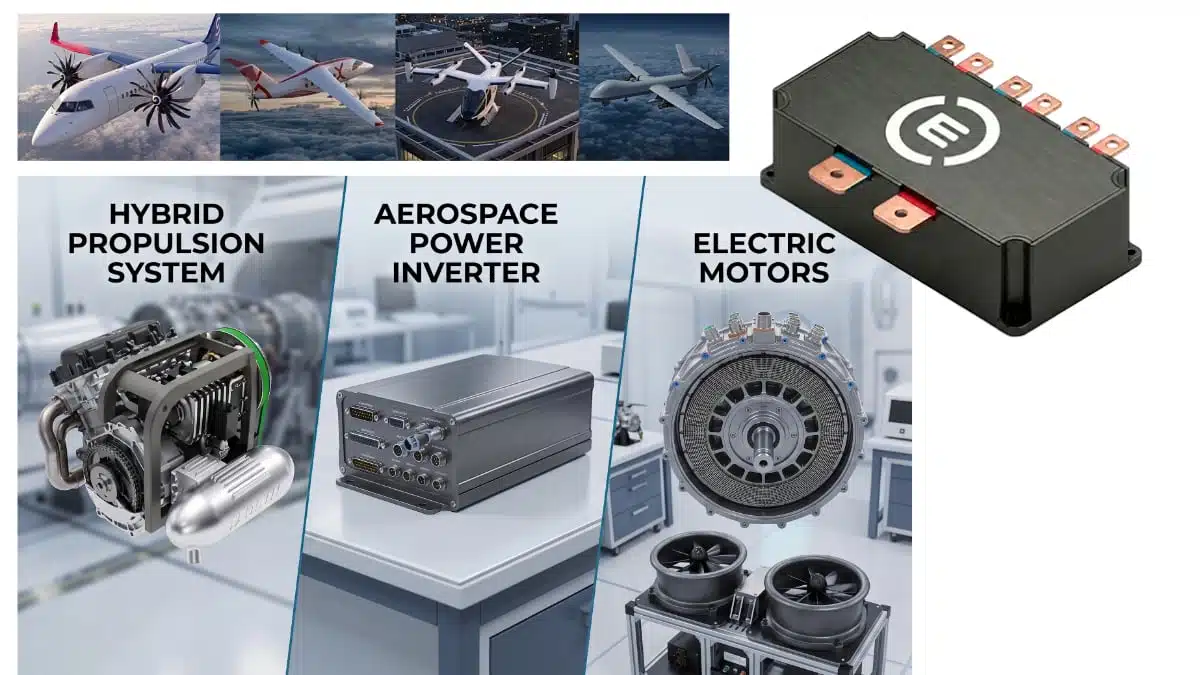
- Primary power generation systems such as electric motors and hybrid propulsion generators, where 800V DC links feed traction inverters.
- Auxiliary systems including fuselage heating, environmental control (air conditioning), and electro‑mechanical actuators that require compact, high‑voltage converters.
- eVTOL aircraft powertrains with distributed propulsion, where multiple 800V inverters share DC link and filtering components on weight‑critical platforms.
- Next‑generation drones with high‑power payloads or propulsion systems that benefit from elevated bus voltage to reduce current and conductor size.
- Defense and mission‑critical platforms with long program lifetimes, where stable sourcing and ITAR‑free component options are important.
Where these components fit in real circuits
- DC link stages in traction inverters for electric and hybrid aircraft, using CF‑PP140 radial/SMD capacitors or bus bar capacitors for bulk energy storage and ripple filtering.
- Input and output filters of high‑voltage DC‑DC converters on 800V networks, where film and ceramic capacitors combine to manage common‑mode and differential‑mode noise.
- PFC and front‑end filtering in ground support or on‑board energy systems interfacing with 800V battery packs or generators.
- EMI filters and surge suppression networks protecting avionics and mission systems from transients on high‑voltage distribution buses.
Technical highlights
While the press release focuses on platform positioning rather than full datasheet detail, several technical themes are clear:
Voltage classes and architecture fit
- 800V system architectures typically require main filtering components rated at least 1200V DC to provide margin for transients, bus overshoot and altitude‑related insulation considerations.
- Overvoltage and surge protection stages, particularly for common‑mode events, may need ratings up to 2kV–5kV depending on standards and worst‑case scenarios; Exxelia’s CM HVLP and C48X C‑series parts target this range.
- In practice, engineers should confirm exact voltage ratings, test waveforms and creepage/clearance requirements in the manufacturer datasheets for each series and part number.
Film versus ceramic common‑mode capacitors
- Film common‑mode capacitors (such as CM HVLP devices) offer high energy handling and robust self‑healing behavior, which is valuable for surge suppression on long harnesses.
- Ceramic common‑mode capacitors (C48X C‑series) provide compact size and good high‑frequency performance, making them suitable where PCB real estate is constrained or wide‑band EMI attenuation is required.
- A mixed approach—film near cable entries and ceramic near converter stages—can optimize EMC and reliability on 800V aircraft platforms.
Integration on bus bars
Below is a simplified view of traditional discrete capacitor banks versus integrated bus bar capacitor solutions:
| Aspect | Discrete capacitor bank | Integrated 1200V bus bar capacitor |
|---|---|---|
| Connection style | Wires/lugs to bus bars | Direct mounting on bus bar |
| Stray inductance | Higher due to loop and leads | Lower due to compact geometry |
| Volume and weight | Larger, more distributed | Up to 60% smaller and lighter |
| Assembly complexity | Multiple fasteners and terminations | Fewer interfaces, simplified build |
| Vibration robustness | More potential weak points | More consolidated mechanical design |
For fast‑switching converters (SiC‑based traction inverters, for example), reduced stray inductance helps limit overshoot and ringing, and can ease snubber design.
Availability and qualification
- Components are offered with AS9100/EN9100 qualification frameworks, supporting aerospace program documentation and audits.
- Custom screening levels (for example, enhanced burn‑in or environmental stress) can be specified to align with particular aircraft or defense standards.
- Manufacturing is available in Europe and the USA, with options designed to avoid ITAR constraints for international programs.
Design‑in notes for engineers
Voltage margin and insulation coordination
- For 800V DC buses, selecting 1200V rated capacitors provides margin for transients, altitude effects and long‑term degradation; always cross‑check with system‑level insulation coordination and applicable standards.
- Overvoltage protection up to 2–5kV is particularly relevant on long harnesses and between subsystems where lightning, switching surges or fault conditions can create high‑energy spikes.
Thermal and environmental considerations
- High‑temperature film capacitors like CF‑PP140 are well‑suited to environments near power electronics, but layout should minimize direct hot‑spot exposure and allow airflow or conduction paths.
- When integrating bus bar capacitors, consider thermal interfaces to the bus bar itself, as conduction through the metal can either help or hinder temperature management depending on overall design.
EMI and common‑mode filtering strategy
- Use film common‑mode capacitors where surge energy capability and self‑healing behavior are priorities (for example, at cable entries or on harness interfaces).
- Use ceramic common‑mode capacitors near converters or controllers where space is tight and high‑frequency attenuation is needed, taking into account possible microphonics and mechanical stress.
- Combine both types with proper shielding and ferrites to meet stringent aerospace EMI requirements on 800V platforms.
Mechanical integration and serviceability
- Custom bus bar capacitor assemblies can streamline mechanical design, but plan early for maintenance and replacement strategies (modular assemblies, access panels).
- Radial and SMD CF‑PP140 parts should be placed to minimize vibration stress; use proven mounting techniques and, where appropriate, additional mechanical support for large or heavy components.
Supply chain and lifecycle planning
- For long‑life aerospace programs, leverage Exxelia’s no‑obsolescence approach and dual‑region manufacturing to define second sources and risk mitigation strategies.
- Document custom screening levels and qualification results in program records to maintain traceability across decades of platform operation.
Source
This article is based on information provided in Exxelia’s technical guide on 800V platforms and associated product pages for capacitors and magnetics, interpreted for design engineers and purchasers. Detailed numerical specifications should be confirmed against the latest manufacturer datasheets for each series and part number.
References
- Are you developing power equipment for a new 800V platform? – Exxelia
- CF‑PP140 – high‑temperature film capacitors
- CM HVLP – high‑voltage film common‑mode capacitors
- High‑voltage ceramic capacitors C‑series (including C48X)
- Smart integrated magnetics for space power conversion
- AS9100/EN9100 quality certificates – Exxelia