

Passive Components Blog
No Result
View All Result
  • Home
  • NewsFilter
    • All
    • Aerospace & Defence
    • Antenna
    • Applications
    • Automotive
    • Capacitors
    • Circuit Protection Devices
    • electro-mechanical news
    • Filters
    • Fuses
    • Inductors
    • Industrial
    • Integrated Passives
    • inter-connect news
    • Market & Supply Chain
    • Market Insights
    • Medical
    • Modelling and Simulation
    • New Materials & Supply
    • New Technologies
    • Non-linear Passives
    • Oscillators
    • Passive Sensors News
    • Resistors
    • RF & Microwave
    • Telecommunication
    • Weekly Digest

    2026 Power Magnetics Design Trends: Flyback, DAB and Planar

    Vishay Releases Sulfur‑Resistant Chip Resistors

    Würth Elektronik Introduces Lead-Free SMT Spacers

    Schurter Releases EKO HV Fuses up to 1000 VDC, 1100 A

    Empower Releases High-Density Embedded Silicon Capacitors

    TDK Unveils 125C Compact DC Link Film Capacitors

    SCHURTER Releases Coin Cell Supercapacitors for Backup Power

    Skeleton Technologies Expands in U.S. to Power AI Data Centers

    TDK Releases Stackable µPOL 25A Power Modules

    Trending Tags

    • Ripple Current
    • RF
    • Leakage Current
    • Tantalum vs Ceramic
    • Snubber
    • Low ESR
    • Feedthrough
    • Derating
    • Dielectric Constant
    • New Products
    • Market Reports
  • VideoFilter
    • All
    • Antenna videos
    • Capacitor videos
    • Circuit Protection Video
    • Filter videos
    • Fuse videos
    • Inductor videos
    • Inter-Connect Video
    • Non-linear passives videos
    • Oscillator videos
    • Passive sensors videos
    • Resistor videos

    2026 Power Magnetics Design Trends: Flyback, DAB and Planar

    Enabling Software‑Defined Vehicle Architectures: Automotive Ethernet and Zonal Smart Power

    Calculating Resistance Value of a Flyback RC Snubber 

    One‑Pulse Characterization of Nonlinear Power Inductors

    Thermistor Linearization Challenges

    Coaxial Connectors and How to Connect with PCB

    PCB Manufacturing, Test Methods, Quality and Reliability

    Transformer Behavior – Current Transfer and Hidden Feedback

    Choosing the Right Capacitor: The Importance of Accurate Measurements

    Trending Tags

    • Capacitors explained
    • Inductors explained
    • Resistors explained
    • Filters explained
    • Application Video Guidelines
    • EMC
    • New Products
    • Ripple Current
    • Simulation
    • Tantalum vs Ceramic
  • Knowledge Blog
  • DossiersNew
  • Suppliers
    • Who is Who
  • PCNS
    • PCNS 2025
    • PCNS 2023
    • PCNS 2021
    • PCNS 2019
    • PCNS 2017
  • Events
  • Home
  • NewsFilter
    • All
    • Aerospace & Defence
    • Antenna
    • Applications
    • Automotive
    • Capacitors
    • Circuit Protection Devices
    • electro-mechanical news
    • Filters
    • Fuses
    • Inductors
    • Industrial
    • Integrated Passives
    • inter-connect news
    • Market & Supply Chain
    • Market Insights
    • Medical
    • Modelling and Simulation
    • New Materials & Supply
    • New Technologies
    • Non-linear Passives
    • Oscillators
    • Passive Sensors News
    • Resistors
    • RF & Microwave
    • Telecommunication
    • Weekly Digest

    2026 Power Magnetics Design Trends: Flyback, DAB and Planar

    Vishay Releases Sulfur‑Resistant Chip Resistors

    Würth Elektronik Introduces Lead-Free SMT Spacers

    Schurter Releases EKO HV Fuses up to 1000 VDC, 1100 A

    Empower Releases High-Density Embedded Silicon Capacitors

    TDK Unveils 125C Compact DC Link Film Capacitors

    SCHURTER Releases Coin Cell Supercapacitors for Backup Power

    Skeleton Technologies Expands in U.S. to Power AI Data Centers

    TDK Releases Stackable µPOL 25A Power Modules

    Trending Tags

    • Ripple Current
    • RF
    • Leakage Current
    • Tantalum vs Ceramic
    • Snubber
    • Low ESR
    • Feedthrough
    • Derating
    • Dielectric Constant
    • New Products
    • Market Reports
  • VideoFilter
    • All
    • Antenna videos
    • Capacitor videos
    • Circuit Protection Video
    • Filter videos
    • Fuse videos
    • Inductor videos
    • Inter-Connect Video
    • Non-linear passives videos
    • Oscillator videos
    • Passive sensors videos
    • Resistor videos

    2026 Power Magnetics Design Trends: Flyback, DAB and Planar

    Enabling Software‑Defined Vehicle Architectures: Automotive Ethernet and Zonal Smart Power

    Calculating Resistance Value of a Flyback RC Snubber 

    One‑Pulse Characterization of Nonlinear Power Inductors

    Thermistor Linearization Challenges

    Coaxial Connectors and How to Connect with PCB

    PCB Manufacturing, Test Methods, Quality and Reliability

    Transformer Behavior – Current Transfer and Hidden Feedback

    Choosing the Right Capacitor: The Importance of Accurate Measurements

    Trending Tags

    • Capacitors explained
    • Inductors explained
    • Resistors explained
    • Filters explained
    • Application Video Guidelines
    • EMC
    • New Products
    • Ripple Current
    • Simulation
    • Tantalum vs Ceramic
  • Knowledge Blog
  • DossiersNew
  • Suppliers
    • Who is Who
  • PCNS
    • PCNS 2025
    • PCNS 2023
    • PCNS 2021
    • PCNS 2019
    • PCNS 2017
  • Events
No Result
View All Result
Passive Components Blog
No Result
View All Result

H2-Assisted Thermal Treatment of Electrode Materials Increases Supercapacitors Energy Density

13.5.2025
Reading Time: 3 mins read
A A

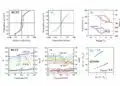
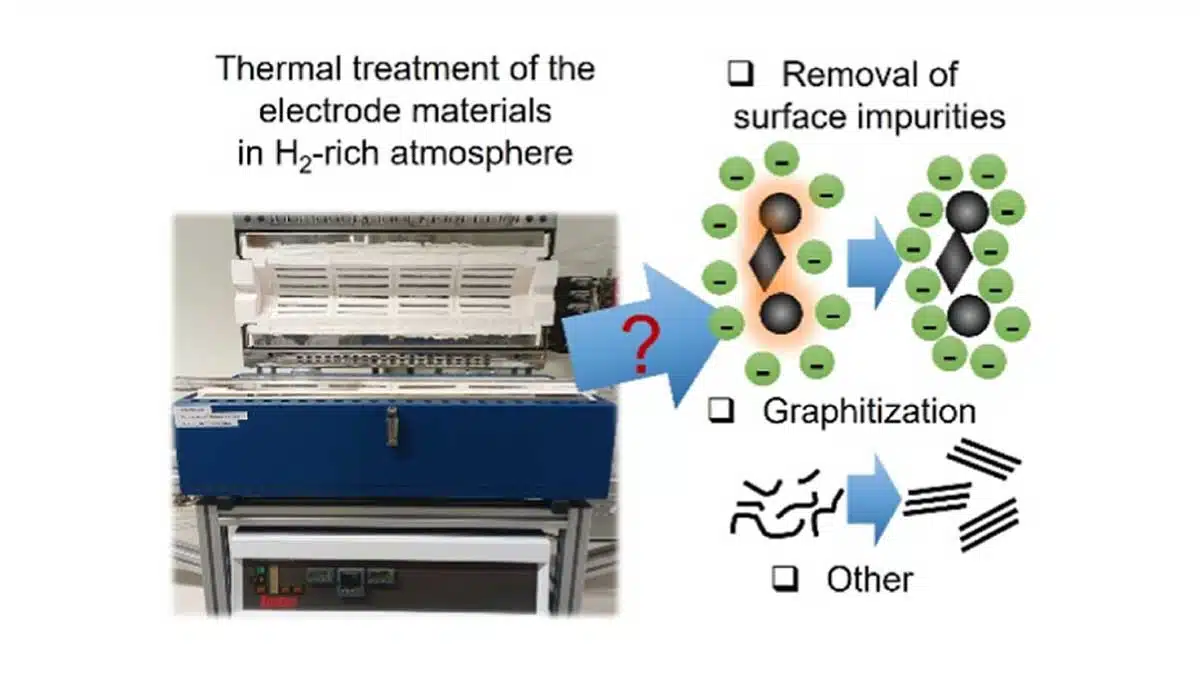
Researchers from Italy published by ACS Appl. Mater. Interfaces conducted a systematic study of H2-assisted thermal treatment on activated carbon and corresponding electrodes for electrochemical double-layer supercapacitors (EDLCs).

The treatment improved EDLC performance by eliminating surface impurities, increasing surface capacitance, and altering active material and binder contents. This study provides insights into the relationship between electrode material modifications and EDLC performance.

RelatedPosts

2026 Power Magnetics Design Trends: Flyback, DAB and Planar

Vishay Releases Sulfur‑Resistant Chip Resistors

Würth Elektronik Introduces Lead-Free SMT Spacers

Introduction:

Electrochemical Double-Layer Capacitors (EDLCs) are vital energy storage devices, relying on the electric double-layer mechanism at the interface of carbon-based electrodes and electrolytes.

This mechanism emphasizes the significance of high-surface-area carbon materials. However, current limitations in capacitance due to inaccessible micropores, quantum capacitance effects, and surface impurities hinder their full potential.

The study focuses on the role of hydrogen-assisted (H₂-assisted) thermal treatment in enhancing EDLC performance.

Key Points:

  1. Challenges in EDLCs: Limited capacitance due to micropores, quantum effects, and impurities.
  2. H₂-Assisted Thermal Treatment: A method to improve surface properties and capacitance.
  3. Experimental Approach: Systematic treatment of activated carbon electrodes at varying temperatures (500–800°C).
  4. Results: Up to 35% energy density improvement, with significant increases in surface and gravimetric capacitance.
  5. Conclusions: Enhanced EDLC performance through impurity removal and surface modification.

Extended Summary:

The article presents a comprehensive study on improving the performance of EDLCs through H₂-assisted thermal treatment of activated carbon electrodes. EDLCs store energy via ion adsorption at electrode interfaces, and their efficiency is influenced by the surface area, porosity, electronic properties, and the presence of surface contaminants.

The research addresses key limiting factors such as inaccessible micropores that restrict ion flow, quantum capacitance effects that reduce overall capacitance, and surface impurities like hydrocarbons and adsorbed species that form dielectric barriers. These barriers impede effective ion adsorption, thereby lowering the EDLC’s performance.

To tackle these issues, the study applies H₂-assisted thermal treatments to activated carbon electrodes, aiming to remove surface impurities and enhance the electrode’s electrochemical properties. The materials were treated at varying temperatures (500°C, 600°C, 700°C, and 800°C), and their chemical, structural, and thermal properties were analyzed using advanced characterization techniques including X-ray photoelectron spectroscopy, Raman spectroscopy, and thermogravimetric analysis.

The results illustrate that the thermal treatment leads to significant improvements in EDLC performance. Notably, the treated electrodes exhibited over 35% higher energy density compared to untreated ones. Surface capacitance (CsurfAC) improved by approximately 37% due to the removal of impurities, which reduced the dielectric barrier effect and enhanced ion accessibility. Gravimetric capacitance (CgAC), normalized to the activated carbon mass, also rose by 28%, demonstrating improved charge storage capacity.

Interestingly, the study challenges prior assumptions about graphitization during thermal treatment, finding that the observed performance gains are mainly due to impurity desorption rather than structural graphitization. The treated materials showed slight densification but retained high surface areas conducive to charge storage.

Conclusion:

The research confirms that H₂-assisted thermal treatment is an effective post-production process for enhancing EDLC electrode performance. This method improves both the chemical surface properties and electrochemical capabilities of activated carbon electrodes by eliminating surface impurities and optimizing active material content. These findings offer valuable insights for developing high-performance, energy-dense EDLCs, potentially advancing energy storage technologies.

Read the full paper:

Matteo Gentile, et col,. Bedimensional.it. Hydrogen-Assisted Thermal Treatment of Electrode Materials for Electrochemical Double-Layer Capacitors, ACS Appl. Mater. Interfaces 2024, 16, 11, 13706–13718, https://doi.org/10.1021/acsami.3c18629

Related

Source: ACS Appl. ?ater. Interfaces

Recent Posts

Empower Releases High-Density Embedded Silicon Capacitors

11.2.2026
31

TDK Unveils 125C Compact DC Link Film Capacitors

11.2.2026
20

SCHURTER Releases Coin Cell Supercapacitors for Backup Power

10.2.2026
17

Skeleton Technologies Expands in U.S. to Power AI Data Centers

9.2.2026
22

Smoltek CNF-MIM Capacitors Hit 1,000x Lower Leakage

6.2.2026
21

Murata Opens New Ceramic Capacitor Manufacturing and R&D Center in Japan

5.2.2026
85

Murata Publishes Power Delivery Guide for AI Servers

4.2.2026
115

Mechanical Drift Indicator of Tantalum Capacitor Anodes Degradation under Reverse Bias

3.2.2026
44

Enabling Software‑Defined Vehicle Architectures: Automotive Ethernet and Zonal Smart Power

2.2.2026
35

Upcoming Events

Feb 24
16:00 - 17:00 CET

Designing Qi2 Wireless Power Systems: Practical Development and EMC Optimization

Mar 3
16:00 - 17:00 CET

Cybersecurity at the Eleventh Hour – from RED to CRA – Information and Discussion

Mar 21
All day

PSMA Capacitor Workshop 2026

View Calendar

Popular Posts

  • Buck Converter Design and Calculation

    0 shares
    Share 0 Tweet 0
  • Boost Converter Design and Calculation

    0 shares
    Share 0 Tweet 0
  • LLC Resonant Converter Design and Calculation

    0 shares
    Share 0 Tweet 0
  • Flyback Converter Design and Calculation

    0 shares
    Share 0 Tweet 0
  • Ripple Current and its Effects on the Performance of Capacitors

    3 shares
    Share 3 Tweet 0
  • Dual Active Bridge (DAB) Topology

    0 shares
    Share 0 Tweet 0
  • MLCC and Ceramic Capacitors

    0 shares
    Share 0 Tweet 0
  • What is a Dielectric Constant and DF of Plastic Materials?

    4 shares
    Share 4 Tweet 0
  • MLCC Case Sizes Standards Explained

    0 shares
    Share 0 Tweet 0
  • How Metal Prices Are Driving Passive Component Price Hikes

    0 shares
    Share 0 Tweet 0

Newsletter Subscription


Passive Components Blog

© EPCI - Leading Passive Components Educational and Information Site

  • Home
  • Privacy Policy
  • EPCI Membership & Advertisement
  • About

No Result
View All Result
  • Home
  • Knowledge Blog
  • PCNS

© EPCI - Leading Passive Components Educational and Information Site

This website uses cookies. By continuing to use this website you are giving consent to cookies being used. Visit our Privacy and Cookie Policy.
Go to mobile version