





Passive Components Blog
No Result
View All Result
  • Home
  • NewsFilter
    • All
    • Aerospace & Defence
    • Antenna
    • Applications
    • Automotive
    • Capacitors
    • Circuit Protection Devices
    • electro-mechanical news
    • Filters
    • Fuses
    • Inductors
    • Industrial
    • Integrated Passives
    • inter-connect news
    • Market & Supply Chain
    • Market Insights
    • Medical
    • Modelling and Simulation
    • New Materials & Supply
    • New Technologies
    • Non-linear Passives
    • Oscillators
    • Passive Sensors News
    • Resistors
    • RF & Microwave
    • Telecommunication
    • Weekly Digest

    Modelithics Releases COMPLETE v26.1 for Keysight ADS

    April 2026 Interconnect, Passives and Electromechanical Components Market Insights

    SPICE Simulation of Non-Linear Resistors: Vishay’s Thermistor and PPTC Modelling Ecosystem

    KYOCERA AVX Introduces Traction‑Grade DC Link Film Capacitors

    When More Capacitance Hurts Reliability: The Role of the Metallic Skeleton in Tantalum Anodes

    Why Power Inductors Use a Ferrite Core With an Air Gap

    Wk 16 Electronics Supply Chain Digest

    YAGEO Introduces High‑Current Y2/X1 Film Capacitors for Wide-bandgap Power Systems

    Amphenol Explanded Liquid Cooling Connectors for AI, ESS and EV Systems

    Trending Tags

    • Ripple Current
    • RF
    • Leakage Current
    • Tantalum vs Ceramic
    • Snubber
    • Low ESR
    • Feedthrough
    • Derating
    • Dielectric Constant
    • New Products
    • Market Reports
  • VideoFilter
    • All
    • Antenna videos
    • Capacitor videos
    • Circuit Protection Video
    • Filter videos
    • Fuse videos
    • Inductor videos
    • Inter-Connect Video
    • Non-linear passives videos
    • Oscillator videos
    • Passive sensors videos
    • Resistor videos

    Why Power Inductors Use a Ferrite Core With an Air Gap

    Transformer-Based Power-Line Harvester Magnetic Design

    Thermal Modeling of Magnetics

    Standard vs Planar LLC transformers Comparison for Battery Chargers

    How Modern Tools Model Magnetic Components for Power Electronics

    Advanced Loss Modeling for Planar Magnetics in the Frenetic Planar Tool

    2026 Power Magnetics Design Trends: Flyback, DAB and Planar

    Enabling Software‑Defined Vehicle Architectures: Automotive Ethernet and Zonal Smart Power

    Calculating Resistance Value of a Flyback RC Snubber 

    Trending Tags

    • Capacitors explained
    • Inductors explained
    • Resistors explained
    • Filters explained
    • Application Video Guidelines
    • EMC
    • New Products
    • Ripple Current
    • Simulation
    • Tantalum vs Ceramic
  • Knowledge Blog
  • DossiersNew
  • Suppliers
    • Who is Who
  • PCNS
    • PCNS 2025
    • PCNS 2023
    • PCNS 2021
    • PCNS 2019
    • PCNS 2017
  • Events
  • Home
  • NewsFilter
    • All
    • Aerospace & Defence
    • Antenna
    • Applications
    • Automotive
    • Capacitors
    • Circuit Protection Devices
    • electro-mechanical news
    • Filters
    • Fuses
    • Inductors
    • Industrial
    • Integrated Passives
    • inter-connect news
    • Market & Supply Chain
    • Market Insights
    • Medical
    • Modelling and Simulation
    • New Materials & Supply
    • New Technologies
    • Non-linear Passives
    • Oscillators
    • Passive Sensors News
    • Resistors
    • RF & Microwave
    • Telecommunication
    • Weekly Digest

    Modelithics Releases COMPLETE v26.1 for Keysight ADS

    April 2026 Interconnect, Passives and Electromechanical Components Market Insights

    SPICE Simulation of Non-Linear Resistors: Vishay’s Thermistor and PPTC Modelling Ecosystem

    KYOCERA AVX Introduces Traction‑Grade DC Link Film Capacitors

    When More Capacitance Hurts Reliability: The Role of the Metallic Skeleton in Tantalum Anodes

    Why Power Inductors Use a Ferrite Core With an Air Gap

    Wk 16 Electronics Supply Chain Digest

    YAGEO Introduces High‑Current Y2/X1 Film Capacitors for Wide-bandgap Power Systems

    Amphenol Explanded Liquid Cooling Connectors for AI, ESS and EV Systems

    Trending Tags

    • Ripple Current
    • RF
    • Leakage Current
    • Tantalum vs Ceramic
    • Snubber
    • Low ESR
    • Feedthrough
    • Derating
    • Dielectric Constant
    • New Products
    • Market Reports
  • VideoFilter
    • All
    • Antenna videos
    • Capacitor videos
    • Circuit Protection Video
    • Filter videos
    • Fuse videos
    • Inductor videos
    • Inter-Connect Video
    • Non-linear passives videos
    • Oscillator videos
    • Passive sensors videos
    • Resistor videos

    Why Power Inductors Use a Ferrite Core With an Air Gap

    Transformer-Based Power-Line Harvester Magnetic Design

    Thermal Modeling of Magnetics

    Standard vs Planar LLC transformers Comparison for Battery Chargers

    How Modern Tools Model Magnetic Components for Power Electronics

    Advanced Loss Modeling for Planar Magnetics in the Frenetic Planar Tool

    2026 Power Magnetics Design Trends: Flyback, DAB and Planar

    Enabling Software‑Defined Vehicle Architectures: Automotive Ethernet and Zonal Smart Power

    Calculating Resistance Value of a Flyback RC Snubber 

    Trending Tags

    • Capacitors explained
    • Inductors explained
    • Resistors explained
    • Filters explained
    • Application Video Guidelines
    • EMC
    • New Products
    • Ripple Current
    • Simulation
    • Tantalum vs Ceramic
  • Knowledge Blog
  • DossiersNew
  • Suppliers
    • Who is Who
  • PCNS
    • PCNS 2025
    • PCNS 2023
    • PCNS 2021
    • PCNS 2019
    • PCNS 2017
  • Events
No Result
View All Result
Passive Components Blog
No Result
View All Result

Jianghai-Europe Offers Environmentally Friendly High Energy-C Hybrid LiC Capacitor Solutions for EV Applications

5.1.2022
Reading Time: 3 mins read
A A

For electrically powered vehicles, energy storage is one of the biggest challenges. Jianghai has been manufacturing lithium-ion capacitors (LiC) from the Energy-C family for years, which are increasingly being used for e-mobility as described in its technical note written by Alexander Schedlock, Jianghai Europe Electronic Components GmbH.
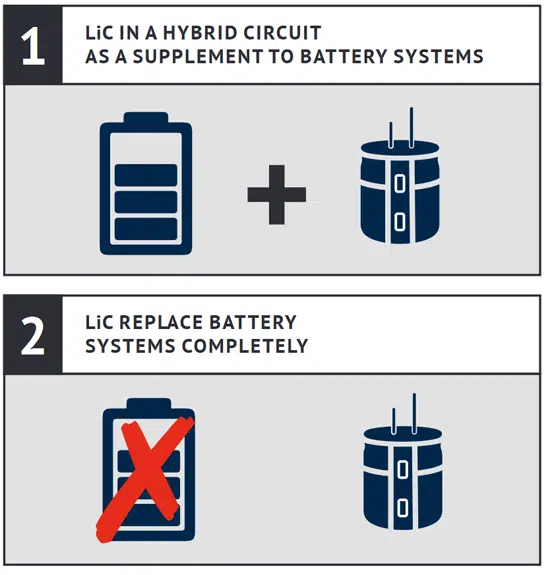
Lithium-ion capacitors (LiC) are used for e-mobility application in two different concepts – see Figure on right.

RelatedPosts

Jianghai Vibration‑Resistant Aluminum Capacitors Guidelines for Industrial Electronics

Jianghai Offers Custom Bottom Cooled Screw Aluminum Capacitors

The Benefits of Using Film Capacitor Modules For Modern Power Semiconductors

While in the first concept the properties of the high number of cycles and fast charging of LiC are primarily used (e.g., for energy recuperation when braking, support during acceleration) and thus helps to reduce the size of the heavy and large battery and to support it electrically, the second concept will be presented here:

The development goals for electric vehicles are largely similar to the requirements for vehicles with combustion engines: long range and fast charging are so much in focus that the ecological benefits run the risk of getting lost. Concessions to the technology require the necessary thermal management for the battery, the losses of the battery charging system and the relatively low charge and discharge cycle number of batteries available today. The size and weight of the batteries, their ecologically questionable production including the use of rare raw materials and the risk of fire in the event of destruction or malfunction are unfavorable.

Advantages of Li-C hybrid capacitors

  • Energy storage in an electric field rather than chemical reactions inside a battery
  • Up to 500,000 charge and discharge cycles
  • Significantly higher power density
  • Intrinsic safety: Even in the event of mechanical damage, electrical overload or operation at over- or low temperatures, there is no risk of fire
  • Doping with lithium ions conserves resources and solves the supply problem with the valuable raw material lithium
  • Very high charge and discharge currents due to low loss electrolytes and electrodes
  • Weight reduction: a halving of the mass compared to a battery of the same volume is possible
  • Charging times in the minute range

Example
A closer look at the development goals of electric cars reveals that high ranges rarely occur in practice in the everyday operation of many vehicles. Statistically, most (small) vehicles drive a maximum of 25 km to work or cover only approximately the same distance for purposes such as shopping, school and kindergarten trips1.

Let‘s illustrate this with the example of a common 75 kWh battery with dimensions L x W x H = 2670mm * 1540mm * 150mm. A single cell package of this battery has dimensions L x W x H = 69 mm * 31 mm * 80 mm with a capacity of 5.2 kWh. In addition, there is the volume of the necessary electronics for balancing, charge management, safety and thermal monitoring. For simplicity, however, here we consider only a single cell package
without control and monitoring. In the same volume, 32 cells of a lithium-ion capacitor (LiC) from Jianghai could be placed (series HAA, e.g. 16,000 F) including the mounting frames.

The storable energy is 693Wh. This amount of energy corresponds to about 15% of the energy stored in the battery cell package. If we assume the range of a battery-powered vehicle at 580 km, a vehicle designed with capacitors would only achieve around 15% of the range: ~80 km (with a single charge). This range is more than sufficient for a variety of applications. With existing charging stations, a recharge would be possible within minutes,
a shorter time than a purchase in the supermarket. The road block lies in the acceptance of the alternative usage concept. Electric vehicles based only on capacitors are not an alternative for long-distance applications. However, these are today‘s battery-powered vehicles on honest view only to a limited extent.

CONCLUSION

Jianghai sees two important, different usage concepts with two different marketing strategies. The capacitor technology opens up the opportunity for very cost-effective and environmentally friendly second cars for short distances, at the latest when the battery vehicles have to be put under discussion in the view of increasing environmental and sustainability requirements.

The hybrid solution helps long-distance vehicles to save energy and to extend their range. With regard to Europe, it should be noted that the technology presented here is already in use in China.


Related

Source: Jianghai-Europe

Recent Posts

Modelithics Releases COMPLETE v26.1 for Keysight ADS

23.4.2026
9

April 2026 Interconnect, Passives and Electromechanical Components Market Insights

22.4.2026
29

KYOCERA AVX Introduces Traction‑Grade DC Link Film Capacitors

21.4.2026
36

When More Capacitance Hurts Reliability: The Role of the Metallic Skeleton in Tantalum Anodes

20.4.2026
32

Why Power Inductors Use a Ferrite Core With an Air Gap

20.4.2026
32

YAGEO Introduces High‑Current Y2/X1 Film Capacitors for Wide-bandgap Power Systems

17.4.2026
29

YAGEO Introduces High Rel MLCCs Beyond MIL-Spec Limits

16.4.2026
51

Samsung Introduces Ultra-High-Voltage 1500 V MLCCs for xEV Powertrains

16.4.2026
26

YAGEO Q1 2026 Results: AI Servers and Pricing Power Behind a Moderate Q2 Outlook

16.4.2026
69

Upcoming Events

Apr 27
15:00 - 16:00 CEST

Commercial Space Screening Approach for Agile, High-Reliability Payloads

Apr 29
10:00 - 11:00 CDT

SEPIC Design Done Right

Apr 30
10:00 - 11:00 CDT

Programming Embedded Systems

View Calendar

Popular Posts

  • Buck Converter Design and Calculation

    0 shares
    Share 0 Tweet 0
  • Boost Converter Design and Calculation

    0 shares
    Share 0 Tweet 0
  • Flyback Converter Design and Calculation

    0 shares
    Share 0 Tweet 0
  • LLC Resonant Converter Design and Calculation

    0 shares
    Share 0 Tweet 0
  • MLCC and Ceramic Capacitors

    0 shares
    Share 0 Tweet 0
  • Dual Active Bridge (DAB) Topology

    0 shares
    Share 0 Tweet 0
  • Capacitor Charging and Discharging

    0 shares
    Share 0 Tweet 0
  • What Electronics Engineer Needs to Know About Passive Low Pass Filters

    0 shares
    Share 0 Tweet 0
  • Ripple Current and its Effects on the Performance of Capacitors

    3 shares
    Share 3 Tweet 0
  • MLCC Case Sizes Standards Explained

    0 shares
    Share 0 Tweet 0

Newsletter Subscription


Passive Components Blog

© EPCI - Leading Passive Components Educational and Information Site

  • Home
  • Privacy Policy
  • EPCI Membership & Advertisement
  • About

No Result
View All Result
  • Home
  • Knowledge Blog
  • PCNS

© EPCI - Leading Passive Components Educational and Information Site

This website uses cookies. By continuing to use this website you are giving consent to cookies being used. Visit our Privacy and Cookie Policy.
Go to mobile version