




Passive Components Blog
No Result
View All Result
  • Home
  • NewsFilter
    • All
    • Aerospace & Defence
    • Antenna
    • Applications
    • Automotive
    • Capacitors
    • Circuit Protection Devices
    • electro-mechanical news
    • Filters
    • Fuses
    • Inductors
    • Industrial
    • Integrated Passives
    • inter-connect news
    • Market & Supply Chain
    • Market Insights
    • Medical
    • Modelling and Simulation
    • New Materials & Supply
    • New Technologies
    • Non-linear Passives
    • Oscillators
    • Passive Sensors News
    • Resistors
    • RF & Microwave
    • Telecommunication
    • Weekly Digest

    Panasonic Releases Relays for IEC 62955 Compliant Single‑Phase EV Wallboxes

    KYOCERA AVX Releases NTN Antenna Selection Guide Brochure

    Coilcraft Releases 0402 Ferrite-Core Wirewound Chip Inductors for RF and EMI Control

    DigiKey Releases Season Two of Sustainable Futures Series

    Using a Virtual Anode Thermal Model to Evaluate Miniaturization Risk in Tantalum Capacitors

    Bourns Introduced High-Current Coupled Inductor for 48 V Hybrid and IBC Converters

    Würth Elektronik Expands Nanocrystalline Cable Cores for Broadband EMI Suppression

    High‑Speed Supercapacitor Balancing for AI Data Center Power Systems

    Bourns Introduced Automotive TVS Diodes for Compact ESD Protection

    Trending Tags

    • Ripple Current
    • RF
    • Leakage Current
    • Tantalum vs Ceramic
    • Snubber
    • Low ESR
    • Feedthrough
    • Derating
    • Dielectric Constant
    • New Products
    • Market Reports
  • VideoFilter
    • All
    • Antenna videos
    • Capacitor videos
    • Circuit Protection Video
    • Filter videos
    • Fuse videos
    • Inductor videos
    • Inter-Connect Video
    • Non-linear passives videos
    • Oscillator videos
    • Passive sensors videos
    • Resistor videos

    EMC‑Compliant PCB and Connector Design Guidelines

    Why Isolated DC/DC Power Supplies Fail Late, Würth Elektronik Podcast

    Designing 800 V DC EMC Filters: Calculation, Simulation and Measurement

    Current Sense Transformer Datasheet and Design‑in Guide

    Designing a USB Type‑C Flyback Planar Transformer with Frenetic’s Planar Tool

    Magnetics Design in High‑Frequency GaN Converters

    Qi2 Wireless Charging: Inductors, Capacitors and EMC Filters

    Two‑capacitor paradox explained for engineers

    Capacitances of Nonlinear MLCCs: What Datasheets Don’t Tell You

    Trending Tags

    • Capacitors explained
    • Inductors explained
    • Resistors explained
    • Filters explained
    • Application Video Guidelines
    • EMC
    • New Products
    • Ripple Current
    • Simulation
    • Tantalum vs Ceramic
  • Knowledge Blog
  • DossiersNew
  • Suppliers
    • Who is Who
  • PCNS
    • PCNS 2025
    • PCNS 2023
    • PCNS 2021
    • PCNS 2019
    • PCNS 2017
  • Events
  • Home
  • NewsFilter
    • All
    • Aerospace & Defence
    • Antenna
    • Applications
    • Automotive
    • Capacitors
    • Circuit Protection Devices
    • electro-mechanical news
    • Filters
    • Fuses
    • Inductors
    • Industrial
    • Integrated Passives
    • inter-connect news
    • Market & Supply Chain
    • Market Insights
    • Medical
    • Modelling and Simulation
    • New Materials & Supply
    • New Technologies
    • Non-linear Passives
    • Oscillators
    • Passive Sensors News
    • Resistors
    • RF & Microwave
    • Telecommunication
    • Weekly Digest

    Panasonic Releases Relays for IEC 62955 Compliant Single‑Phase EV Wallboxes

    KYOCERA AVX Releases NTN Antenna Selection Guide Brochure

    Coilcraft Releases 0402 Ferrite-Core Wirewound Chip Inductors for RF and EMI Control

    DigiKey Releases Season Two of Sustainable Futures Series

    Using a Virtual Anode Thermal Model to Evaluate Miniaturization Risk in Tantalum Capacitors

    Bourns Introduced High-Current Coupled Inductor for 48 V Hybrid and IBC Converters

    Würth Elektronik Expands Nanocrystalline Cable Cores for Broadband EMI Suppression

    High‑Speed Supercapacitor Balancing for AI Data Center Power Systems

    Bourns Introduced Automotive TVS Diodes for Compact ESD Protection

    Trending Tags

    • Ripple Current
    • RF
    • Leakage Current
    • Tantalum vs Ceramic
    • Snubber
    • Low ESR
    • Feedthrough
    • Derating
    • Dielectric Constant
    • New Products
    • Market Reports
  • VideoFilter
    • All
    • Antenna videos
    • Capacitor videos
    • Circuit Protection Video
    • Filter videos
    • Fuse videos
    • Inductor videos
    • Inter-Connect Video
    • Non-linear passives videos
    • Oscillator videos
    • Passive sensors videos
    • Resistor videos

    EMC‑Compliant PCB and Connector Design Guidelines

    Why Isolated DC/DC Power Supplies Fail Late, Würth Elektronik Podcast

    Designing 800 V DC EMC Filters: Calculation, Simulation and Measurement

    Current Sense Transformer Datasheet and Design‑in Guide

    Designing a USB Type‑C Flyback Planar Transformer with Frenetic’s Planar Tool

    Magnetics Design in High‑Frequency GaN Converters

    Qi2 Wireless Charging: Inductors, Capacitors and EMC Filters

    Two‑capacitor paradox explained for engineers

    Capacitances of Nonlinear MLCCs: What Datasheets Don’t Tell You

    Trending Tags

    • Capacitors explained
    • Inductors explained
    • Resistors explained
    • Filters explained
    • Application Video Guidelines
    • EMC
    • New Products
    • Ripple Current
    • Simulation
    • Tantalum vs Ceramic
  • Knowledge Blog
  • DossiersNew
  • Suppliers
    • Who is Who
  • PCNS
    • PCNS 2025
    • PCNS 2023
    • PCNS 2021
    • PCNS 2019
    • PCNS 2017
  • Events
No Result
View All Result
Passive Components Blog
No Result
View All Result

KEMET Enters $5 Billion Circuit Protection Market

20.12.2016
Reading Time: 5 mins read
A A

source: TTI Market Eye article

by Dennis M. Zogbi, Paumanok Publications, Inc.

RelatedPosts

Panasonic Releases Relays for IEC 62955 Compliant Single‑Phase EV Wallboxes

KYOCERA AVX Releases NTN Antenna Selection Guide Brochure

Coilcraft Releases 0402 Ferrite-Core Wirewound Chip Inductors for RF and EMI Control

(Messee Munchen, Germany) KEMET Electronics Corporation unveiled their much anticipated line of automotive varistors at the Electronica 2016 fairgrounds in Messee Munchen Germany in November 2016, and officially entered the $5 billion* global market for circuit protection components.

Traditionally KEMET has been a global manufacturer of capacitors, dominating the world market for tantalum and plastic film capacitors; and competing in specialty segments of the ceramic and aluminum electrolytic capacitor markets worldwide, moreover, with the acquisition of NEC Corporation’s Tokin Subsidiary, a major manufacturer of components other than capacitors, KEMET has accessed new markets in a variety of electronic market sub-sets that it had not been exposed to before. Being one of the oldest and most respected electronic component companies in the world, its evolution into circuit protection has been long in coming and we are excited to see another quality vendor in the space.

Paumanok Publications, Inc. estimates the global market for circuit protection components at $5 billion USD in market value worldwide for FY 2016.
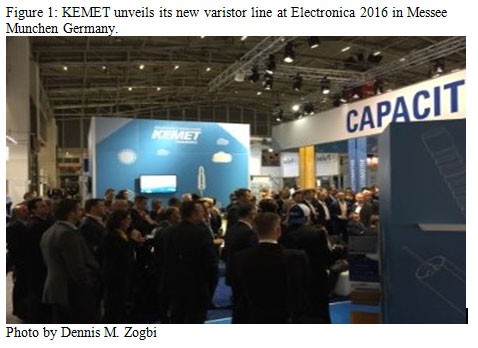
 chart1

KEMET has entered the circuit protection market by pinpointing a specific need in the supply chain to provide automotive grade varistors, which are used for electrostatic discharge protection and overvoltage protection in multiple locations on the automobile (See Figure 2).
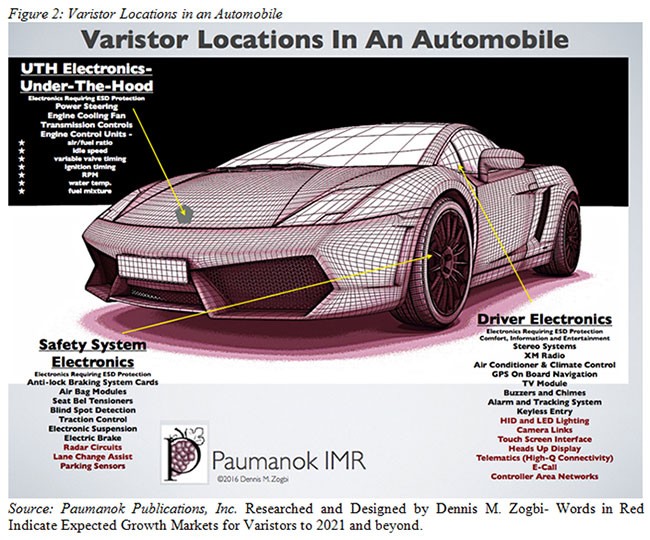
 chart2

Automotive Applications for Varistors

To better understand why companies like KEMET are needed for helping major sub-assembly manufacturers such as Robert Bosch, Continental, Nippon Denso, Delphi and Visteon protect their sensitive electronic systems from the unique environments in piston powered and electric vehicles through the application of ceramic based varistors. Automotive companies traditionally prefer using ceramic components because of their reliability during the unique combination of heat and vibration for extended periods of time. The following are circuit applications requiring protection from electrostatic discharge or from an overcurrent event brought about by a load dump (such as jump starting a car).

1) DRIVER ELECTRONICS

Driver Comfort, information and Entertainment

There are numerous motor and drive assemblies within an automobile requiring protection from unwanted transients such as the mirror motors, seat motors, sun roof motor, wiper motor and window motors. Paumanok research estimates there are 14 dc motors on average per automobile (sedan and lite truck), with some automobiles having as many as 24 dc motors. (This makes the market for varistors consumed for DC motor protection in the automobile at about 1.3 billion pieces for FY 2016.)

The passenger compartment is also varistor intensive, and includes applications in the air conditioner/climate control systems, stereo system, TV module, buzzers and chimes, and keyless entry. We also include the alarm system and trunk latch control unit in this category for varistor consumption, as well as the tire pressure monitoring system. Additional emerging growth markets in this category include telematics (RF Connectivity), E-Call and tracking devices. The other areas of focused interest are the unique requirements for circuit protection of High Speed Bus Systems (CAN-Controller Area Networks) which allow microcontrollers to operate independently from a host computer inside the car or truck; the high intensity discharge lighting systems (which require higher heat handling components), the camera links, and all touch screen interfaces. (See Figure 2)

2) UTH ELECTRONICS

Under the Hood Electronics Demand for automotive varistors for use in under-the-hood applications has increased over the past decade to protect various harsh environment electronic systems, units and modules from the affects of tribioelectricity. The major consumer (in dollar value) for varistors are for protection of the engine control units that are application specific to functions of the engine such as ECU’s that control the air/fuel ratio, the idle speed, the variable valve timing, the ignition timing, the revolutions per minute, water temperature, fuel acceleration enrichment, turbocharger waste gate control, as well as specialty engine functions on racing cars. All modern engine control units have a central processing unit that requires circuit protection. Varistors are available in 125° C and 150° C designs to operate effectively in the harsh UTH environment. Additional powertrain applications for varistors include the power steering, engine cooling fan, and transmission controls. (See Figure 2)

3) SAFETY ELECTRONICS

Air bag and Restraint Systems
Passenger safety is of primary concern to automotive manufacturers, and these systems are protected from overvoltage transients by varistors. The anti-lock braking system cards, the air bag module, the seat belt tensioner, the parking sensor, the blind spot detection, the radar circuits and lane change assist modules, as well as traction control circuits, electronic suspension, electric brake require varistor protection. (See Figure 2)

NEW MARKET OPPORTUNITIES FOR KEMET

In the National Electric Manufacturing Initiative report, Delphi Electronics, one of the world’s largest manufacturers of automotive electronic subassemblies reiterated the need for increased protection for automotive circuits in general purpose and harsh environment applications over the next five to ten years.

Paumanok estimates the global varistor market for automotive electronic subassemblies at approximately $90 million US dollars for FY 2016 with approximately 3 billion varistors consumed in class 3 to 8 cars and trucks. This also translates into 30 varistors per automobile, on average (with about 3.2 million sedans and class 8 trucks produced that require almost twice that number), and this actually translates into approximately $1 dollar in varistor content per car.

Based on my granular analysis of the varistor content per sub-assembly in the automobile, I can make a determination that 1) DRIVER ELECTRONICS is the largest sub-segment in the car and the area with the largest potential growth rate over the next five to ten years. Within the Driver Electronics segment, I can see that the protection of DC motors is a key product sub-market. Almost as lucrative a sub-segment is the 2) UNDER-THE-HOOD markets which require higher heat operation and are more expensive per part, although less parts are required. The engine control units are subjected to a variety of unusual and harsh environment parameters, one of which is the susceptibility of the ECU’s to the affects of electrical transients. And finally, the 3) SAFETY ELECTRONICS segment is also important for varistors, especially for air bag igniters circuits and ABS cards.

The new varistors from KEMET include dual-function varistor-capacitors that combine transient and EMI protection, and plastic-enclosed varistors for increased reliability in humid environments.

The dual-function devices integrate a capacitor to suppress interference from devices such as DC electric motors and are AEC-Q200 qualified. Compact in size, these devices are ideal for protecting sensitive automotive electronics against electric-motor noise as well as potentially damaging high-energy transients. In addition, KEMET has introduced five new surface-mount varistors, including four which are AEC-Q200 qualified. This product line features devices capable of high temperature operation for use in automotive and industrial applications, as well as plastic encapsulations that offer superior humidity resistance.

GROWTH MARKETS FOR AUTO VARISTORS: 2016-2021

Figure 2. above also reveals Paumanok’s estimation of where new slots will emerge in the car that will require electrostatic discharge protection. In Driver Electronics we forecast that Heads Up Displays, Telematics, E-Call and CAN Networks will lead the way in a growing field of specific areas within and around the car that need taming, such as lighting, which seems to improve and differentiate at a much faster pace than in commercial or residential lighting. Safety Electronics also hold new slots for circuit protection needed for driver assist circuits, especially radar circuits and proximity sensors.

KEMET’s automotive varistors are available at Mouser Electronics.
Dennis M. Zogbi
Related

Recent Posts

Panasonic Releases Relays for IEC 62955 Compliant Single‑Phase EV Wallboxes

25.6.2026
6

DigiKey Releases Season Two of Sustainable Futures Series

24.6.2026
10

Bourns Introduced Automotive TVS Diodes for Compact ESD Protection

23.6.2026
11

Bourns Releases Automotive Gate Driver Transformer for Isolated Power

22.6.2026
20

Stackpole Releases High-Frequency Thin Film Chip Resistors for RF up to 50 GHz

19.6.2026
11

Vishay Unveils 1.5 kV IHDV High Voltage Power Inductors for EV and Industrial Converters

19.6.2026
34

TrendForce: CSP in‑house AI ASIC Boom Reshapes Capacitor Demand

18.6.2026
115

Samsung Introduces Automotive 1206 100uF X7T MLCC for Power Rails in ADAS and SoCs

17.6.2026
34

YMIN Hybrid Aluminum Capacitors for Automotive LiDAR Power Rails

17.6.2026
30

Upcoming Events

Jun 30
17:00 - 18:00 CEST

PSMA Capacitor Committee Webinar: High Voltage Pulse Capacitors

Jul 14
16:00 - 17:00 CEST

EMC Design Essentials: Mastering Varistors and Common Mode Chokes

Jul 21
16:00 - 17:00 CEST

Safety by design: X and Y Interference suppression capacitors for power line filters

View Calendar

Popular Posts

  • Boost Converter Design and Calculation

    0 shares
    Share 0 Tweet 0
  • Buck Converter Design and Calculation

    0 shares
    Share 0 Tweet 0
  • LLC Resonant Converter Design and Calculation

    0 shares
    Share 0 Tweet 0
  • Flyback Converter Design and Calculation

    0 shares
    Share 0 Tweet 0
  • MLCC and Ceramic Capacitors

    0 shares
    Share 0 Tweet 0
  • Earthing Systems and IEC Classification Explained

    0 shares
    Share 0 Tweet 0
  • Nvidia Vera Rubin: Why One AI Rack Needs So Many More MLCC Capacitors

    0 shares
    Share 0 Tweet 0
  • Dual Active Bridge (DAB) Topology

    0 shares
    Share 0 Tweet 0
  • SEPIC Converter Design and Calculation

    0 shares
    Share 0 Tweet 0
  • MLCC Case Sizes Standards Explained

    0 shares
    Share 0 Tweet 0

Newsletter Subscription


Passive Components Blog

© EPCI - Leading Passive Components Educational and Information Site

  • Home
  • Privacy Policy
  • EPCI Membership & Advertisement
  • About

No Result
View All Result
  • Home
  • Knowledge Blog
  • Dossiers
  • PCNS

© EPCI - Leading Passive Components Educational and Information Site

This website uses cookies. By continuing to use this website you are giving consent to cookies being used. Visit our Privacy and Cookie Policy.
Go to mobile version