



Passive Components Blog
No Result
View All Result
  • Home
  • News
    • All
    • Aerospace & Defence
    • Antenna
    • Applications
    • Automotive
    • Capacitors
    • Circuit Protection Devices
    • electro-mechanical news
    • Filters
    • Fuses
    • Inductors
    • Industrial
    • Integrated Passives
    • inter-connect news
    • Market & Supply Chain
    • Market Insights
    • Medical
    • Modelling and Simulation
    • New Materials & Supply
    • New Technologies
    • Non-linear Passives
    • Oscillators
    • Passive Sensors News
    • Resistors
    • RF & Microwave
    • Telecommunication
    • Weekly Digest

    Samsung MLCC Revenue Seen Above KRW 8T by 2027, Murata EOL Actions Reshape Supply

    ROHM SDR01 high anti-surge thick-film chip resistor in 1005 metric 0402 package with 0.33 W rated power

    ROHM Introduces Anti-Surge 0402 Resistors Rated at 0.33 W

    ECIA Industry Pulse Q3 2026 chart showing passive components, semiconductors and electro-mechanical component market sentiment and lead-time pressure

    ECIA Industry Pulse Moderates as Passive Lead Times Tighten

    LG Innotek Demonstrates FC-BGA Substrates With Embedded Silicon Capacitors for AI Power Delivery

    On-Chip 3D-Printed Copper Microinductors: A New Route to Compact RF Electronics

    Emerging Capacitor Markets in Fusion Energy

    Murata DLW32SH_MF 1210 surface-mount common mode choke coil with metal terminals for automotive CAN FD signal-line noise suppression

    Murata Introduces Common Mode Chokes for Automotive CAN FD up to 150°C

    onsemi solid-state transformer concept for 800 V HVDC AI data center power conversion with SiC modules, DC-link capacitors and high-frequency magnetics

    Solid-State Transformers for 800 V AI Data Centers: Passive Component Design Considerations

    Littelfuse TX00AT314AMA omnipolar TMR magnetic switch sensor in a leaded TO-92-3 through-hole package

    Littelfuse Expands Omnipolar TMR Switch with Leaded TO-92 Package Option

    Trending Tags

    • Ripple Current
    • RF
    • Leakage Current
    • Tantalum vs Ceramic
    • Snubber
    • Low ESR
    • Feedthrough
    • Derating
    • Dielectric Constant
    • New Products
    • Market Reports
  • Knowledge Blog
  • Dossiers
    • AI Hardware Dossier
    • Automotive Dossier
    • Industrial Robotics Dossier
    • Power Converter Dossier
    • Capacitor Dossier
    • Resistor Dossier
    • Inductor Dossier
    • Circuit Protection Dossier
  • Suppliers
    • Who is Who
  • PCNS
    • PCNS 2025
    • PCNS 2023
    • PCNS 2021
    • PCNS 2019
    • PCNS 2017
  • Events
  • Home
  • News
    • All
    • Aerospace & Defence
    • Antenna
    • Applications
    • Automotive
    • Capacitors
    • Circuit Protection Devices
    • electro-mechanical news
    • Filters
    • Fuses
    • Inductors
    • Industrial
    • Integrated Passives
    • inter-connect news
    • Market & Supply Chain
    • Market Insights
    • Medical
    • Modelling and Simulation
    • New Materials & Supply
    • New Technologies
    • Non-linear Passives
    • Oscillators
    • Passive Sensors News
    • Resistors
    • RF & Microwave
    • Telecommunication
    • Weekly Digest

    Samsung MLCC Revenue Seen Above KRW 8T by 2027, Murata EOL Actions Reshape Supply

    ROHM SDR01 high anti-surge thick-film chip resistor in 1005 metric 0402 package with 0.33 W rated power

    ROHM Introduces Anti-Surge 0402 Resistors Rated at 0.33 W

    ECIA Industry Pulse Q3 2026 chart showing passive components, semiconductors and electro-mechanical component market sentiment and lead-time pressure

    ECIA Industry Pulse Moderates as Passive Lead Times Tighten

    LG Innotek Demonstrates FC-BGA Substrates With Embedded Silicon Capacitors for AI Power Delivery

    On-Chip 3D-Printed Copper Microinductors: A New Route to Compact RF Electronics

    Emerging Capacitor Markets in Fusion Energy

    Murata DLW32SH_MF 1210 surface-mount common mode choke coil with metal terminals for automotive CAN FD signal-line noise suppression

    Murata Introduces Common Mode Chokes for Automotive CAN FD up to 150°C

    onsemi solid-state transformer concept for 800 V HVDC AI data center power conversion with SiC modules, DC-link capacitors and high-frequency magnetics

    Solid-State Transformers for 800 V AI Data Centers: Passive Component Design Considerations

    Littelfuse TX00AT314AMA omnipolar TMR magnetic switch sensor in a leaded TO-92-3 through-hole package

    Littelfuse Expands Omnipolar TMR Switch with Leaded TO-92 Package Option

    Trending Tags

    • Ripple Current
    • RF
    • Leakage Current
    • Tantalum vs Ceramic
    • Snubber
    • Low ESR
    • Feedthrough
    • Derating
    • Dielectric Constant
    • New Products
    • Market Reports
  • Knowledge Blog
  • Dossiers
    • AI Hardware Dossier
    • Automotive Dossier
    • Industrial Robotics Dossier
    • Power Converter Dossier
    • Capacitor Dossier
    • Resistor Dossier
    • Inductor Dossier
    • Circuit Protection Dossier
  • Suppliers
    • Who is Who
  • PCNS
    • PCNS 2025
    • PCNS 2023
    • PCNS 2021
    • PCNS 2019
    • PCNS 2017
  • Events
No Result
View All Result
Passive Components Blog
No Result
View All Result

Minimizing Capacitor Leakage Saves Lives

27.11.2019
Reading Time: 5 mins read
A A

Source: Electronics 360 news

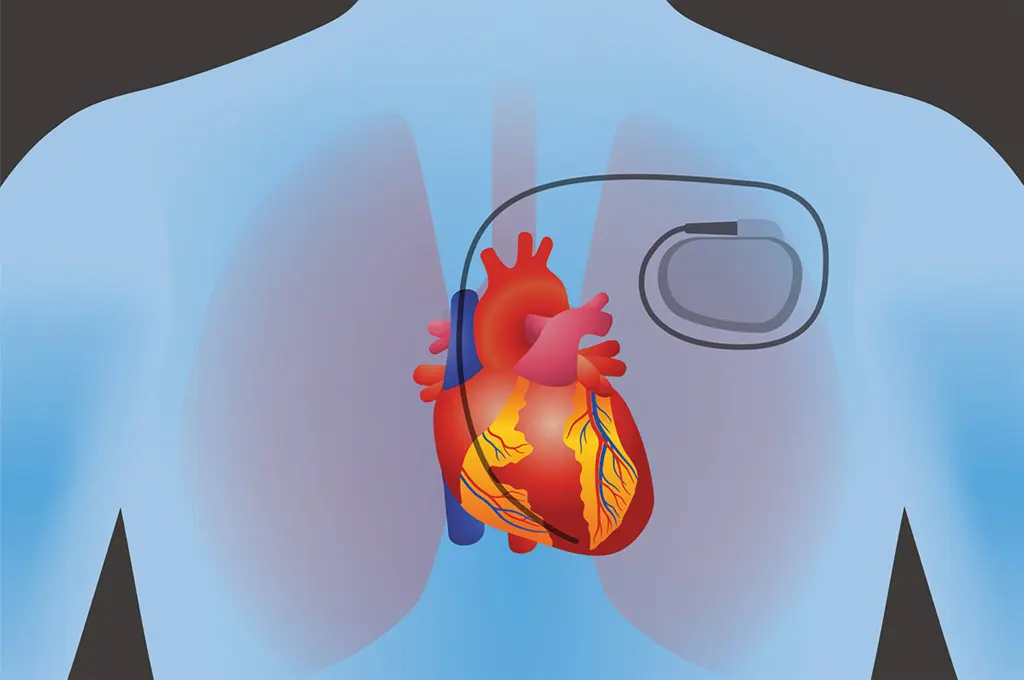
Surface-mounted passive components, like solid tantalum capacitors, are among the most critical parts in implantable devices, especially heart defibrillators. Due to the life-or-death nature of these devices, the government has strict regulations on their design and manufacture, requiring manufacturers to take measures to insure highest levels of quality, including full lot traceability, stringent process controls, process change notification mandates and long record retention. Not every manufacturer wants to or is able to participate in this highly regulated business.

RelatedPosts

Failure Analysis of Capacitors and Inductors

Schaffner introduces low leakage current 3phase EMI filter

Understanding Capacitor Leakage Current

Did you know that implantable devices make up the lion’s share (28 percent) of the market — $160 billion worth — for Class III medical devices, according to Global MedTech Market Development? Class III implantable medical devices undergo careful scrutiny by the FDA because they go inside the human body.

The key to meeting these stiff regulations for implantable devices is improving overall system reliability. For capacitors, this means improving reliability and reducing leakage current to its lowest level possible. Leakage and reliability are related and are affected by a number of other issues, which is why it’s helpful to have a basic understanding of tantalum capacitors.

Back to Basics
To appreciate the relationship between current leakage and reliability issues, one must first understand how tantalum capacitors are made. Both the construction and manufacturing details are fairly complex, and vary depending on the type of capacitor, but for now only the necessary attributes of implantable, low-leakage tantalum capacitors need to be considered.

Any capacitor consists of a cathode and an anode separated by a dielectric. What makes tantalum capacitors unique is a small pellet of tantalum that acts as the anode for the capacitor. This anode is covered by an oxide layer that functions as a dielectric, which in turn is surrounded by a conductive MnO2 cathode.

The tantalum pellet looks like a very tiny sponge. Its structure enables a high surface area for the dielectric, which means higher capacitance levels in a much smaller size than other capacitor technologies (see Fig.2.).
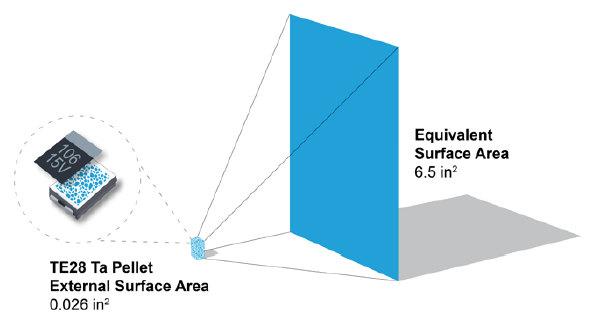
Figure 2. The dielectric surface area of a tantalum capacitor anode compared to its finished size. Source: AVX

Figure 2. The dielectric surface area of a tantalum capacitor anode compared to its finished size. Source: AVX

On the packaging side, there are options for traditional leaded configurations, but more recent technology advancements have seen the introduction of more size-efficient configurations.

Implantable Device Needs
Medical devices differ significantly from their consumer counterparts in terms of reliability. Medical electronics, especially for implantable medical devices, require a high degree of reliability, near-zero defects and long lives. Conversely, the main driver in consumer devices is low cost and high volume.

Life sustaining devices such as defibrillators and pacemakers get their power from non-rechargeable batteries. The lifecycle of these batteries are expected to be 10 years or more. In addition to long life, implantable batteries must be as small and compact as possible, which can greatly limit their energy capacity. Effective power management is the only way to ensure a long battery life in these circumstances.

An important source of power drain in implantable devices comes from current leakage in the capacitors. Current leakages also cause instability and component failure. Thus, controlling leakage maximizes the useful life, ensuring device stability, mitigating component failure and increasing the overall reliability of the device.

The primary culprit behind leakage currents is the presence of impurities in the tantalum capacitor’s dielectric layer. Traditionally, these capacitors were subject to burn-in conditioning and testing to identify parts with an unacceptable level of impurities. Today, statistical screening methods complement burn-in testing to ensure the highest reliability.

Beyond Burn-In

“The tantalum capacitor industry settled on Weibull burn-in and grading for quantifying quality and performance for various applications, not just medical,” explained Kevin Walker, business development manager of medical at AVX. “The Weibull grading process involves an 85C [sic] temperature burn-in cycle at up to 1.5 times the rated voltage.”

The Weibull grading test is an acknowledged technique that allows selection and reliability rating of solid tantalum capacitors. The Weibull burn-in, combined with statistical screening is very helpful to identify and remove components with unacceptable DC leakage (DCL).

DCL is a measure of efficiency in tantalum capacitors, an expression of the loss of power via current leakage through the dielectric. It is a measure of the quality of the dielectric, and thus the integrity of a capacitor. Implantable devices need the lowest leakage possible in order to extend precious battery life as long as possible.

Tantalum capacitor DCL is typically specified in microamps (μA). For example, the DCL of a 10 microfarad (μF), 10 V capacitor would be: 0.01 × 10 μF × 10 V = 1.0 μA

Reliability-sensitive passive component manufacturers use a wide variety of techniques to minimize DCL. To further improve component yields, AVX — a leading manufacturer of advanced electronic components — also implemented more conservative design rules, improved process control at critical manufacturing steps, maverick lot detection, and statistical screening to three-sigma limits to remove non-normal parts from the population, as well as leakage testing at multiple temperatures. Additionally, they restrict changes in materials, manufacturing and testing in order to comply with FDA requirements for effective change control.

The actual distribution of DCL across hundreds of manufacturing lots, compared to the common commercial specification limit of 1.0 μA and a typical medical customer specification limit of 0.250 μA, is shown in Figure 3.
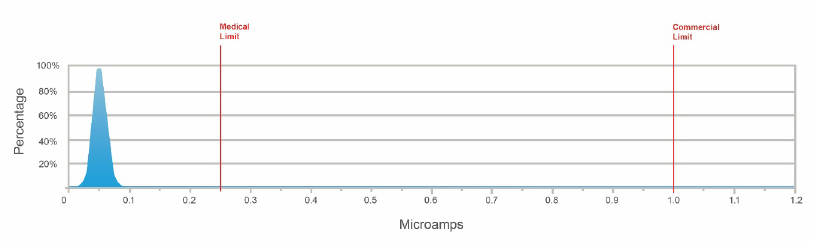
Figure 3. DCL distribution of AVX 10 μf /10 V medical grade capacitors in blue. Source: AVX

Figure 3. DCL distribution of AVX 10 μf /10 V medical grade capacitors in blue. Source: AVX

As AVX improved it’s tantalum manufacturing processes over time, defect levels were reduced, and the early life failures assumed by Weibull grading were dramatically decreased. This led the company to explore alternative methods for burn-in testing. They found that a higher temperature of 125° C system burn-in at rated voltage or less, coupled with three-sigma statistical screening, was as effective as Weibull grading at removing failing components. Importantly, this optimized burn-in approach also provides a lower level of DCL and a more consistent distribution of DCL values than can be found elsewhere.

For critical applications such as defibrillators, operating on primary cell power, this low and more consistent distribution of DCL improves overall device predictability, while minimizing battery leakage.

AVX patented the above approach as their “Q-Process,” which incorporated a number of design, process, screening and conditioning enhancements. The Q-Process gives a more normal DCL population with lower probability of component failures and a reduced number of intrinsic dielectric defects within each lot. It has helped to produce medical capacitors with the lowest DCL in the industry.

Summary
Implantable medical devices must be designed and manufactured to maximize the systems operational life. Minimizing tantalum capacitor current leakage is critical to achieving maximum life from the device’s non-rechargeable battery.

AVX has a unique quality process, known as the Q-process, for ensuring the lowest leakage and highest reliability of these critical capacitors. Learn more on the AVX tantalum capacitors web page.

Related

Recent Posts

Samsung MLCC Revenue Seen Above KRW 8T by 2027, Murata EOL Actions Reshape Supply

11.9.2026
15

LG Innotek Demonstrates FC-BGA Substrates With Embedded Silicon Capacitors for AI Power Delivery

10.9.2026
26

Emerging Capacitor Markets in Fusion Energy

10.9.2026
32
Murata DLW32SH_MF 1210 surface-mount common mode choke coil with metal terminals for automotive CAN FD signal-line noise suppression

Murata Introduces Common Mode Chokes for Automotive CAN FD up to 150°C

10.9.2026
11
onsemi solid-state transformer concept for 800 V HVDC AI data center power conversion with SiC modules, DC-link capacitors and high-frequency magnetics

Solid-State Transformers for 800 V AI Data Centers: Passive Component Design Considerations

9.9.2026
67

SCHURTER THT DIP Switches Support Hardware-Level Configuration

9.9.2026
3
TDK CN series 10 µF 100 V X7R soft-termination multilayer ceramic capacitor in 3225 EIA 1210 package

TDK Releases 100 V Soft-Termination X7R MLCCs 10 uF in 3225 Package

9.9.2026
14
Compact inductive rotary position encoder sensor near a motor shaft, representing the Vishay RAIK045I MP encoder category

Vishay Introduces 16-Bit Inductive Encoder for Motor-Adjacent Position Sensing

9.9.2026
15
Overview of fabricated ferroelectric capacitors improving hyperdimensional computing task learning accuracy. a The experimental work reported in this study comprises ferroelectric capacitor (FeCAP) device fabrication, structural and electrical characterization, analog state identification and their reliability study. b The computational part of the work explores the benefits of using characteristics from the fabricated devices in a hyperdimensional computing scheme; source: authors

High-Precision Hyperdimensional Computing with Multi-Level Ferroelectric HZO Capacitors

7.9.2026
23

Upcoming Events

Sep 16
17:00 - 18:00 CEST

Designing a 5 kW, 800 V-to-50 V PSFB Converter for Next-Generation Data Centers

Sep 29
16:00 - 17:00 CEST

Cybersecurity 2026

Nov 24
16:00 - 17:00 CET

Component selection with the WE REDEXPERT® DC-DC Converter Designer Tool

View Calendar

Popular Posts

  • Buck Converter Design and Calculation

    0 shares
    Share 0 Tweet 0
  • LLC Resonant Converter Design and Calculation

    0 shares
    Share 0 Tweet 0
  • Boost Converter Design and Calculation

    0 shares
    Share 0 Tweet 0
  • Flyback Converter Design and Calculation

    0 shares
    Share 0 Tweet 0
  • Earthing Systems and IEC Classification Explained

    0 shares
    Share 0 Tweet 0
  • MLCC and Ceramic Capacitors

    0 shares
    Share 0 Tweet 0
  • Resistor Symbols

    0 shares
    Share 0 Tweet 0
  • Capacitor Charging and Discharging

    0 shares
    Share 0 Tweet 0
  • Audio Capacitors: Choosing Capacitors for Crossover Circuits

    0 shares
    Share 0 Tweet 0
  • Capacitor Symbols

    0 shares
    Share 0 Tweet 0

Newsletter Subscription


Passive Components Blog

© 2015–2026
All rights reserved

  • Home
  • Privacy Policy
  • EPCI Membership & Advertisement
  • About

No Result
View All Result
  • Home
  • Knowledge Blog
  • Dossiers
  • PCNS

© 2015–2026
All rights reserved