









Passive Components Blog
No Result
View All Result
  • Home
  • NewsFilter
    • All
    • Aerospace & Defence
    • Antenna
    • Applications
    • Automotive
    • Capacitors
    • Circuit Protection Devices
    • electro-mechanical news
    • Filters
    • Fuses
    • Inductors
    • Industrial
    • Integrated Passives
    • inter-connect news
    • Market & Supply Chain
    • Market Insights
    • Medical
    • Modelling and Simulation
    • New Materials & Supply
    • New Technologies
    • Non-linear Passives
    • Oscillators
    • Passive Sensors News
    • Resistors
    • RF & Microwave
    • Telecommunication
    • Weekly Digest

    Inductors and Ferrite Beads Price Hikes 

    TDK Extends Compact ThermoFuse Varistors up to 50 kA

    Samtec ANSI/VITA 90 Connectors: Rugged Small Form Factor Standard

    Resistor Technology Dossier

    Würth Elektronik IQD Awarded by EcoVadis Gold Sustainability Medal

    Advanced Loss Modeling for Planar Magnetics in the Frenetic Planar Tool

    AI Servers Demand is Driving Tantalum Capacitor Price Hikes

    DMASS Reports Europe Components Up 9.8% in Q4 2025

    Bourns Extends PPTC Resettable High‑Power, High‑Voltage Protection Fuses

    Trending Tags

    • Ripple Current
    • RF
    • Leakage Current
    • Tantalum vs Ceramic
    • Snubber
    • Low ESR
    • Feedthrough
    • Derating
    • Dielectric Constant
    • New Products
    • Market Reports
  • VideoFilter
    • All
    • Antenna videos
    • Capacitor videos
    • Circuit Protection Video
    • Filter videos
    • Fuse videos
    • Inductor videos
    • Inter-Connect Video
    • Non-linear passives videos
    • Oscillator videos
    • Passive sensors videos
    • Resistor videos

    Advanced Loss Modeling for Planar Magnetics in the Frenetic Planar Tool

    2026 Power Magnetics Design Trends: Flyback, DAB and Planar

    Enabling Software‑Defined Vehicle Architectures: Automotive Ethernet and Zonal Smart Power

    Calculating Resistance Value of a Flyback RC Snubber 

    One‑Pulse Characterization of Nonlinear Power Inductors

    Thermistor Linearization Challenges

    Coaxial Connectors and How to Connect with PCB

    PCB Manufacturing, Test Methods, Quality and Reliability

    Transformer Behavior – Current Transfer and Hidden Feedback

    Trending Tags

    • Capacitors explained
    • Inductors explained
    • Resistors explained
    • Filters explained
    • Application Video Guidelines
    • EMC
    • New Products
    • Ripple Current
    • Simulation
    • Tantalum vs Ceramic
  • Knowledge Blog
  • DossiersNew
  • Suppliers
    • Who is Who
  • PCNS
    • PCNS 2025
    • PCNS 2023
    • PCNS 2021
    • PCNS 2019
    • PCNS 2017
  • Events
  • Home
  • NewsFilter
    • All
    • Aerospace & Defence
    • Antenna
    • Applications
    • Automotive
    • Capacitors
    • Circuit Protection Devices
    • electro-mechanical news
    • Filters
    • Fuses
    • Inductors
    • Industrial
    • Integrated Passives
    • inter-connect news
    • Market & Supply Chain
    • Market Insights
    • Medical
    • Modelling and Simulation
    • New Materials & Supply
    • New Technologies
    • Non-linear Passives
    • Oscillators
    • Passive Sensors News
    • Resistors
    • RF & Microwave
    • Telecommunication
    • Weekly Digest

    Inductors and Ferrite Beads Price Hikes 

    TDK Extends Compact ThermoFuse Varistors up to 50 kA

    Samtec ANSI/VITA 90 Connectors: Rugged Small Form Factor Standard

    Resistor Technology Dossier

    Würth Elektronik IQD Awarded by EcoVadis Gold Sustainability Medal

    Advanced Loss Modeling for Planar Magnetics in the Frenetic Planar Tool

    AI Servers Demand is Driving Tantalum Capacitor Price Hikes

    DMASS Reports Europe Components Up 9.8% in Q4 2025

    Bourns Extends PPTC Resettable High‑Power, High‑Voltage Protection Fuses

    Trending Tags

    • Ripple Current
    • RF
    • Leakage Current
    • Tantalum vs Ceramic
    • Snubber
    • Low ESR
    • Feedthrough
    • Derating
    • Dielectric Constant
    • New Products
    • Market Reports
  • VideoFilter
    • All
    • Antenna videos
    • Capacitor videos
    • Circuit Protection Video
    • Filter videos
    • Fuse videos
    • Inductor videos
    • Inter-Connect Video
    • Non-linear passives videos
    • Oscillator videos
    • Passive sensors videos
    • Resistor videos

    Advanced Loss Modeling for Planar Magnetics in the Frenetic Planar Tool

    2026 Power Magnetics Design Trends: Flyback, DAB and Planar

    Enabling Software‑Defined Vehicle Architectures: Automotive Ethernet and Zonal Smart Power

    Calculating Resistance Value of a Flyback RC Snubber 

    One‑Pulse Characterization of Nonlinear Power Inductors

    Thermistor Linearization Challenges

    Coaxial Connectors and How to Connect with PCB

    PCB Manufacturing, Test Methods, Quality and Reliability

    Transformer Behavior – Current Transfer and Hidden Feedback

    Trending Tags

    • Capacitors explained
    • Inductors explained
    • Resistors explained
    • Filters explained
    • Application Video Guidelines
    • EMC
    • New Products
    • Ripple Current
    • Simulation
    • Tantalum vs Ceramic
  • Knowledge Blog
  • DossiersNew
  • Suppliers
    • Who is Who
  • PCNS
    • PCNS 2025
    • PCNS 2023
    • PCNS 2021
    • PCNS 2019
    • PCNS 2017
  • Events
No Result
View All Result
Passive Components Blog
No Result
View All Result

New Conductive Polymer Materials Enhance Reliability of Aluminum and Tantalum Polymer Capacitors

5.2.2025
Reading Time: 7 mins read
A A
Full pdf paper download

Polymer capacitors replaced electrolytic aluminum capacitors and manganese tantalum capacitors in many applications. While this trend was driven mainly by low equivalent series resistance (ESR) requirements in the past, high reliability performance is additionally requested for polymer capacitors nowadays. The development of new conductive polymers has opened the field of high reliability applications for polymer capacitors such as automotive, space and telecommunication. Even in consumer electronics, a trend to design in polymer capacitors having a higher reliability can be seen.

This paper presents the superior performance of new conductive polymer materials regarding harsh conditions such as elevated temperature and high humidity. State-of-the-art conductive polymers can not only achieve an intrinsically higher reliability but being much more environmentally friendly compared to previous polymer technologies.

RelatedPosts

Advances in the Environmental Performance of Polymer Capacitors

How to Manage Supercapacitors Leakage Current and Self Discharge 

Qualification of Commercial Supercapacitors for Space Applications

The paper was presented by Udo Merker from Heraeus Epurio, Leverkusen, Germany at the 3rd PCNS 7-10th September 2021, Milano, Italy as paper No.1.5.

MARKET TRENDS & CONDUCTIVE POLYMERS’ EVOLUTION

MARKET TRENDS

For more than 25 years, applications of polymer aluminum and tantalum capacitors have been driven by low ESR requirements. Traditional electrolytic capacitors were not able to meet these requirements of modern electronic circuits like motherboards. However, the application field of polymer capacitors was limited to consumer electronics mainly due to the lack of high voltage capability, relatively high DC leakage current (DCL) and low reliability performance.

During the last decade, these restrictions of polymer capacitors have been overcome and high voltage, low DCL and high reliability applications could be accessed. The rated voltage range of polymer capacitors has been extended from maximum of about 25 V to 400 V. In combination with a superior DCL performance, the new polymer capacitors have been introduced in high reliability applications such as automotive and space.

While the COVID-19 pandemic has given an additional boost to the demand from consumer electronics in 2020/21, a strong and steady growth is emerging from automotive, communication infrastructure and industrial applications.

For capacitors used in such applications, the trend towards lower ESR, higher voltages and a higher capacitance density is ongoing and additionally a much higher reliability is needed. Life-time requirement can be as long as 10 years at a 100% duty cycle for telecommunication infrastructure. Temperature ratings of more than 150°C are requested in automotive. A high stability at harsh conditions like 85°C/85% relative humidity (RH) is necessary when for example air conditioning and cooling of data centers are omitted for energy saving reasons.

The development of conductive polymer dispersions for capacitor application paved the way for polymer capacitors to enter high reliability applications. Further material improvement is necessary to cope with future reliability requirements.

CONDUCTIVE POLYMERS’ EVOLUTION

Conductive polymers are applied as cathode material in electrolytic capacitors to achieve low ESR (Fig. 1). Traditional cathode materials like liquid electrolytes or manganese dioxide have orders of magnitude lower conductivity.
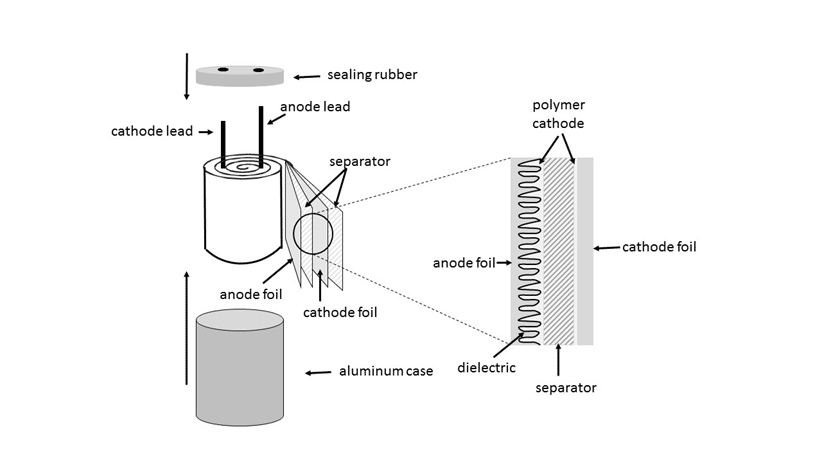
Fig. 1: Structure of an aluminum radial polymer capacitor (winding type).

For aluminum and tantalum capacitors, a conductive polymer film is deposited by chemical in-situ polymerization of the monomer 3,4-ethylenedioxythiophene (EDOT) or from PEDOT:PSS conductive polymer dispersions on the dielectric which was formed by anodization of a porous aluminum or tantalum electrode (Fig. 2).
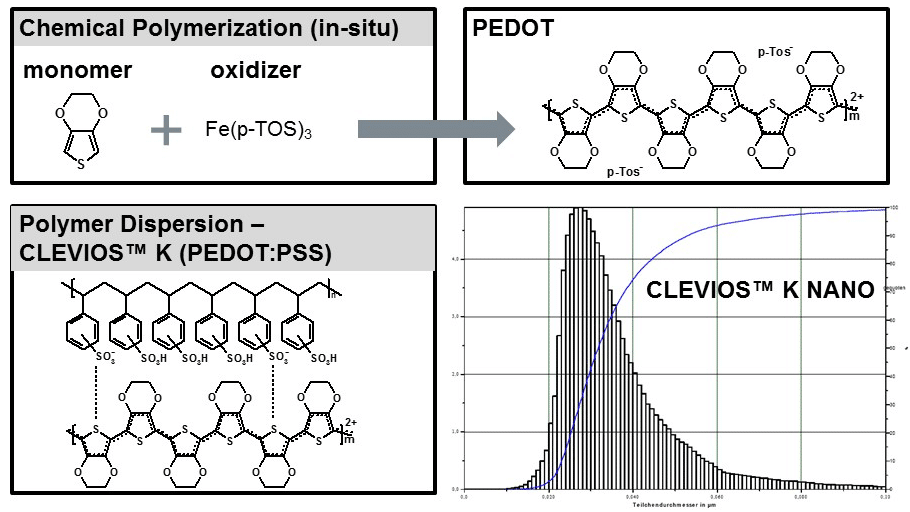
Fig. 2: PEDOT conductive polymer: chemical polymerization (upper) and polymer dispersion (lower).

When conductive polymer dispersions are applied, the manufacturing process of polymer capacitors can be significantly simplified compared to in-situ polymerization by a dip and dry process without any chemical reactions. Furthermore, conductive polymer dispersions are water-borne and therefore environmentally friendly compared to organic solvent-based precursors for in-situ polymerization.

Besides process and environmental aspects, capacitors made with conductive polymer dispersions exhibit significant performance advantages over those for which an in-situ chemical process is applied.

The by far superior voltage performance is the most striking difference. With in-situ polymerization, voltage ratings only up to about 35V can be realized in an acceptable quality, while 400V is achieved with polymer dispersion. The difference in performance is attributed to the particle nature of the polymer dispersions. In contrary to molecules used for in-situ polymerization, such particles cannot enter pinholes in the dielectric and do not deteriorate the break-down voltage (BDV) of the dielectric.

RELIABILITY ASSESSMENT & CONCLUSIONS

RELIABILITY

The conductive polymer as an organic material is the most sensitive part of the capacitor when exposed to high temperature or harsh conditions like 85°C/85%RH. The sheet resistance of films made from conductive polymer dispersions exhibit an extremely better stability at high temperature or 85°C/85%RH compared to in-situ polymerized films. A temperature rating of up to 175°C for polymer capacitors seems feasible with such polymers in future.

We applied two approaches to further enhance the reliability of polymer capacitors: reducing the thermal load in the polymer layer and increasing the thermal stability of the polymer. A thermal load is induced within the conductive polymer by surge or ripple currents. A higher conductivity and a higher content of the PEDOT:PSS conductive polymer lower the resistance of the polymer cathode and thus limit the temperature rise when high electrical currents pass the capacitor. Additionally, we increased the density of the polymer cathode to dissipate the generated heat faster. The thermal stability was improved by reducing the oxidation potential of the polymer layer.

We have tested our newly developed Clevios K conductive polymer dispersion in aluminum radial capacitors. A lifetime over 1000h at 150°C without bias voltage could be achieved which is more than double the lifetime realized with a state-of-the-art polymer dispersion (Fig. 3). Actually, the lifetime was not limited by our new conductive polymer but rather the integrity of the rubber sealing after 1000 hours.
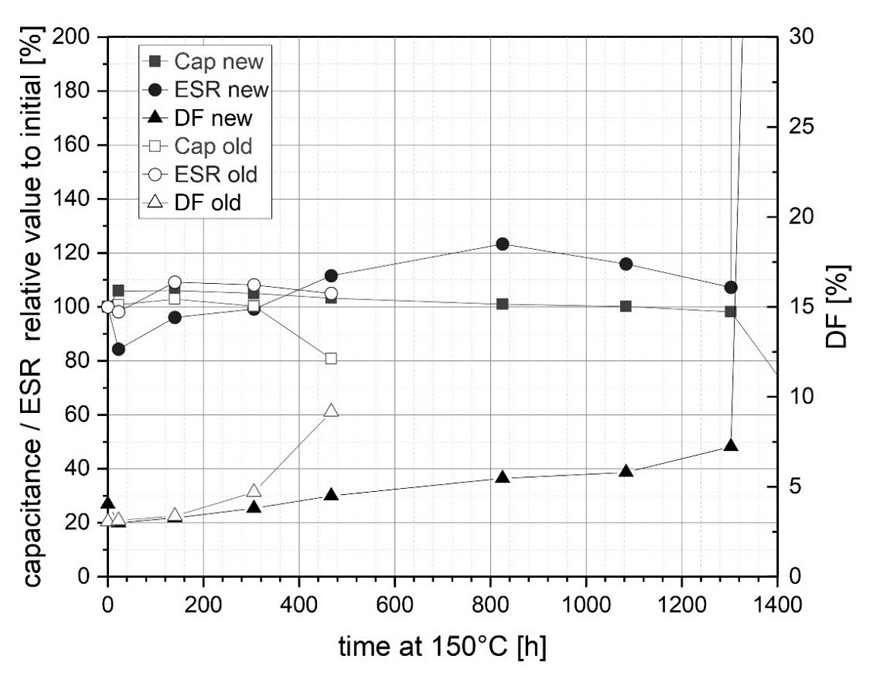
Fig. 3: Change of relative capacitance (square), ESR (circle) and absolute dissipation factor (DF, triangle) of aluminum radial capacitors made with new polymer dispersion (filled symbols) and state-of-the-art dispersion (open symbol) over time at 150°C without bias voltage.

The aluminum capacitors made with our new polymer were stressed in a surge test by applying voltage cycles of 10s on/10s off with a peak current of 80A in each cycle. The capacitors withstood up to 2000 cycles while capacitors made with a state-of-the-art polymer dispersion showed significant capacitance loss already after 500 cycles (Fig. 4).

For some aluminum radial capacitor designs, a significant capacitance loss is observed at low temperature when conductive polymer dispersions are used. This limits the applications in automotive and industrial out-door applications. Our new product overcomes such limitation and exhibits a capacitance loss of less than 10% at -55°C (Fig. 5).
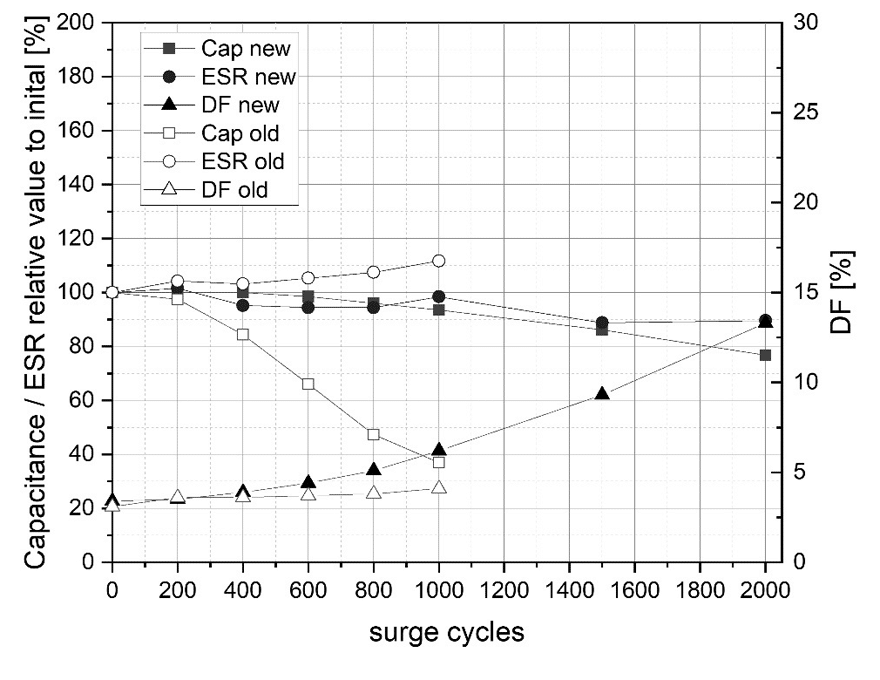
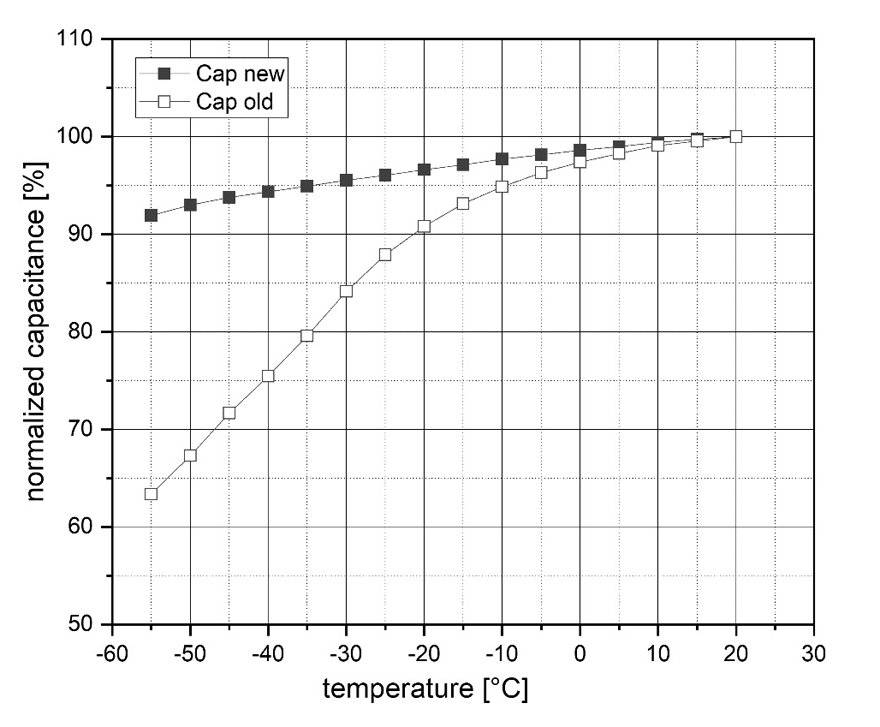
Fig 4.: Change of relative capacitance (square), ESR (circle) and absolute dissipation factor (DF, triangle) of aluminum radial capacitors made with new polymer dispersion (filled symbols) and state-of-the-art dispersion (open symbol) over number of surge cycles with voltage 10s on/10s off and 80A peak current.
Fig. 5: Change of relative capacitance of aluminum radial capacitors made with new polymer dispersion (filled symbols) and state-of-the-art dispersion (open symbol) over temperature.

CONCLUSIONS

Conductive polymer dispersions have boosted the reliability performance of polymer capacitors significantly. Our next generation Clevios K conductive polymer dispersions further improves the high temperature stability as well as the surge and low temperature performance of polymer capacitors. This development supports the ongoing penetration of polymer capacitors into applications that require high reliability such as automotive, 5G telecommunication and industrial.


Related

Source: EPCI

Recent Posts

Inductors and Ferrite Beads Price Hikes 

5.3.2026
0

TDK Extends Compact ThermoFuse Varistors up to 50 kA

5.3.2026
1

Samtec ANSI/VITA 90 Connectors: Rugged Small Form Factor Standard

5.3.2026
1

Resistor Technology Dossier

4.3.2026
8

Advanced Loss Modeling for Planar Magnetics in the Frenetic Planar Tool

4.3.2026
9

AI Servers Demand is Driving Tantalum Capacitor Price Hikes

5.3.2026
46

DMASS Reports Europe Components Up 9.8% in Q4 2025

3.3.2026
12

Bourns Extends PPTC Resettable High‑Power, High‑Voltage Protection Fuses

2.3.2026
8

Mastering Galvanic Isolation in Power Electronics: Methods, Standards, and Implementation

2.3.2026
21

Upcoming Events

Mar 19
13:00 - 14:00 CDT

Smart Consideration of Inductor Thermal Performance

Mar 21
All day

PSMA Capacitor Workshop 2026

Apr 21
16:00 - 17:00 CEST

Heatsink Solutions: Thermal Management in electronic devices

View Calendar

Popular Posts

  • Buck Converter Design and Calculation

    0 shares
    Share 0 Tweet 0
  • Boost Converter Design and Calculation

    0 shares
    Share 0 Tweet 0
  • Flyback Converter Design and Calculation

    0 shares
    Share 0 Tweet 0
  • LLC Resonant Converter Design and Calculation

    0 shares
    Share 0 Tweet 0
  • MLCC Manufacturers Consider Price Increase as AI Demand Outpaces Supply

    0 shares
    Share 0 Tweet 0
  • Dual Active Bridge (DAB) Topology

    0 shares
    Share 0 Tweet 0
  • Ripple Current and its Effects on the Performance of Capacitors

    3 shares
    Share 3 Tweet 0
  • MLCC and Ceramic Capacitors

    0 shares
    Share 0 Tweet 0
  • What is a Dielectric Constant and DF of Plastic Materials?

    4 shares
    Share 4 Tweet 0
  • MLCC Case Sizes Standards Explained

    0 shares
    Share 0 Tweet 0

Newsletter Subscription


Passive Components Blog

© EPCI - Leading Passive Components Educational and Information Site

  • Home
  • Privacy Policy
  • EPCI Membership & Advertisement
  • About

No Result
View All Result
  • Home
  • Knowledge Blog
  • PCNS

© EPCI - Leading Passive Components Educational and Information Site

This website uses cookies. By continuing to use this website you are giving consent to cookies being used. Visit our Privacy and Cookie Policy.
Go to mobile version