





Passive Components Blog
No Result
View All Result
  • Home
  • News
    • All
    • Aerospace & Defence
    • Antenna
    • Applications
    • Automotive
    • Capacitors
    • Circuit Protection Devices
    • electro-mechanical news
    • Filters
    • Fuses
    • Inductors
    • Industrial
    • Integrated Passives
    • inter-connect news
    • Market & Supply Chain
    • Market Insights
    • Medical
    • Modelling and Simulation
    • New Materials & Supply
    • New Technologies
    • Non-linear Passives
    • Oscillators
    • Passive Sensors News
    • Resistors
    • RF & Microwave
    • Telecommunication
    • Weekly Digest
    onsemi solid-state transformer concept for 800 V HVDC AI data center power conversion with SiC modules, DC-link capacitors and high-frequency magnetics

    Solid-State Transformers for 800 V AI Data Centers: Passive Component Design Considerations

    Littelfuse TX00AT314AMA omnipolar TMR magnetic switch sensor in a leaded TO-92-3 through-hole package

    Littelfuse Expands Omnipolar TMR Switch with Leaded TO-92 Package Option

    SCHURTER THT DIP Switches Support Hardware-Level Configuration

    TDK CN series 10 µF 100 V X7R soft-termination multilayer ceramic capacitor in 3225 EIA 1210 package

    TDK Releases 100 V Soft-Termination X7R MLCCs 10 uF in 3225 Package

    Compact inductive rotary position encoder sensor near a motor shaft, representing the Vishay RAIK045I MP encoder category

    Vishay Introduces 16-Bit Inductive Encoder for Motor-Adjacent Position Sensing

    Hirose FH51 automotive FPC/FFC connector with low-profile receptacle construction and top-and-bottom contact arrangement

    Hirose Automotive FPC/FFC Connector Adds One-Action Mating up to 125°C

    Overview of fabricated ferroelectric capacitors improving hyperdimensional computing task learning accuracy. a The experimental work reported in this study comprises ferroelectric capacitor (FeCAP) device fabrication, structural and electrical characterization, analog state identification and their reliability study. b The computational part of the work explores the benefits of using characteristics from the fabricated devices in a hyperdimensional computing scheme; source: authors

    High-Precision Hyperdimensional Computing with Multi-Level Ferroelectric HZO Capacitors

    Coilcraft Introduces Automotive Common Mode Chokes Target CISPR 25 Class 5 EMC Compliance

    Murata Expands Automotive Metal Power Inductor Range

    Trending Tags

    • Ripple Current
    • RF
    • Leakage Current
    • Tantalum vs Ceramic
    • Snubber
    • Low ESR
    • Feedthrough
    • Derating
    • Dielectric Constant
    • New Products
    • Market Reports
  • Knowledge Blog
  • Dossiers
    • AI Hardware Dossier
    • Automotive Dossier
    • Industrial Robotics Dossier
    • Power Converter Dossier
    • Capacitor Dossier
    • Resistor Dossier
    • Inductor Dossier
    • Circuit Protection Dossier
  • Suppliers
    • Who is Who
  • PCNS
    • PCNS 2025
    • PCNS 2023
    • PCNS 2021
    • PCNS 2019
    • PCNS 2017
  • Events
  • Home
  • News
    • All
    • Aerospace & Defence
    • Antenna
    • Applications
    • Automotive
    • Capacitors
    • Circuit Protection Devices
    • electro-mechanical news
    • Filters
    • Fuses
    • Inductors
    • Industrial
    • Integrated Passives
    • inter-connect news
    • Market & Supply Chain
    • Market Insights
    • Medical
    • Modelling and Simulation
    • New Materials & Supply
    • New Technologies
    • Non-linear Passives
    • Oscillators
    • Passive Sensors News
    • Resistors
    • RF & Microwave
    • Telecommunication
    • Weekly Digest
    onsemi solid-state transformer concept for 800 V HVDC AI data center power conversion with SiC modules, DC-link capacitors and high-frequency magnetics

    Solid-State Transformers for 800 V AI Data Centers: Passive Component Design Considerations

    Littelfuse TX00AT314AMA omnipolar TMR magnetic switch sensor in a leaded TO-92-3 through-hole package

    Littelfuse Expands Omnipolar TMR Switch with Leaded TO-92 Package Option

    SCHURTER THT DIP Switches Support Hardware-Level Configuration

    TDK CN series 10 µF 100 V X7R soft-termination multilayer ceramic capacitor in 3225 EIA 1210 package

    TDK Releases 100 V Soft-Termination X7R MLCCs 10 uF in 3225 Package

    Compact inductive rotary position encoder sensor near a motor shaft, representing the Vishay RAIK045I MP encoder category

    Vishay Introduces 16-Bit Inductive Encoder for Motor-Adjacent Position Sensing

    Hirose FH51 automotive FPC/FFC connector with low-profile receptacle construction and top-and-bottom contact arrangement

    Hirose Automotive FPC/FFC Connector Adds One-Action Mating up to 125°C

    Overview of fabricated ferroelectric capacitors improving hyperdimensional computing task learning accuracy. a The experimental work reported in this study comprises ferroelectric capacitor (FeCAP) device fabrication, structural and electrical characterization, analog state identification and their reliability study. b The computational part of the work explores the benefits of using characteristics from the fabricated devices in a hyperdimensional computing scheme; source: authors

    High-Precision Hyperdimensional Computing with Multi-Level Ferroelectric HZO Capacitors

    Coilcraft Introduces Automotive Common Mode Chokes Target CISPR 25 Class 5 EMC Compliance

    Murata Expands Automotive Metal Power Inductor Range

    Trending Tags

    • Ripple Current
    • RF
    • Leakage Current
    • Tantalum vs Ceramic
    • Snubber
    • Low ESR
    • Feedthrough
    • Derating
    • Dielectric Constant
    • New Products
    • Market Reports
  • Knowledge Blog
  • Dossiers
    • AI Hardware Dossier
    • Automotive Dossier
    • Industrial Robotics Dossier
    • Power Converter Dossier
    • Capacitor Dossier
    • Resistor Dossier
    • Inductor Dossier
    • Circuit Protection Dossier
  • Suppliers
    • Who is Who
  • PCNS
    • PCNS 2025
    • PCNS 2023
    • PCNS 2021
    • PCNS 2019
    • PCNS 2017
  • Events
No Result
View All Result
Passive Components Blog
No Result
View All Result

New Magnetic Honeycomb Device Could Increase Battery Life of Electronic Devices by More Than a Hundred-fold

31.5.2018
Reading Time: 3 mins read
A A

Source: University of Missoury news

MU researchers developed a magnetic material that employs a unique structure – a “honeycomb” lattice that exhibits distinctive electronic properties and are working to commercialize it.

RelatedPosts

Solid-State Transformers for 800 V AI Data Centers: Passive Component Design Considerations

Littelfuse Expands Omnipolar TMR Switch with Leaded TO-92 Package Option

SCHURTER THT DIP Switches Support Hardware-Level Configuration

COLUMBIA, Mo. – Among the chief complaints for smartphone, laptop and other battery-operated electronics users is that the battery life is too short and—in some cases—that the devices generate heat. Now, a group of physicists led by Deepak K. Singh, associate professor of physics and astronomy at the University of Missouri, has developed a device material that can address both issues. The team has applied for a patent for a magnetic material that employs a unique structure—a “honeycomb” lattice that exhibits distinctive electronic properties.

“Semiconductor diodes and amplifiers, which often are made of silicon or germanium, are key elements in modern electronic devices,” said Singh, who also serves as the principal investigator of the Magnetism and Superconductivity Research Laboratory at MU. “A diode normally conducts current and voltage through the device along only one biasing direction, but when the voltage is reversed, the current stops. This switching process costs significant energy due to dissipation, or the depletion of the power source, thus affecting battery life. By substituting the semiconductor with a magnetic system, we believed we could create an energetically effective device that consumes much less power with enhanced functionalities.”

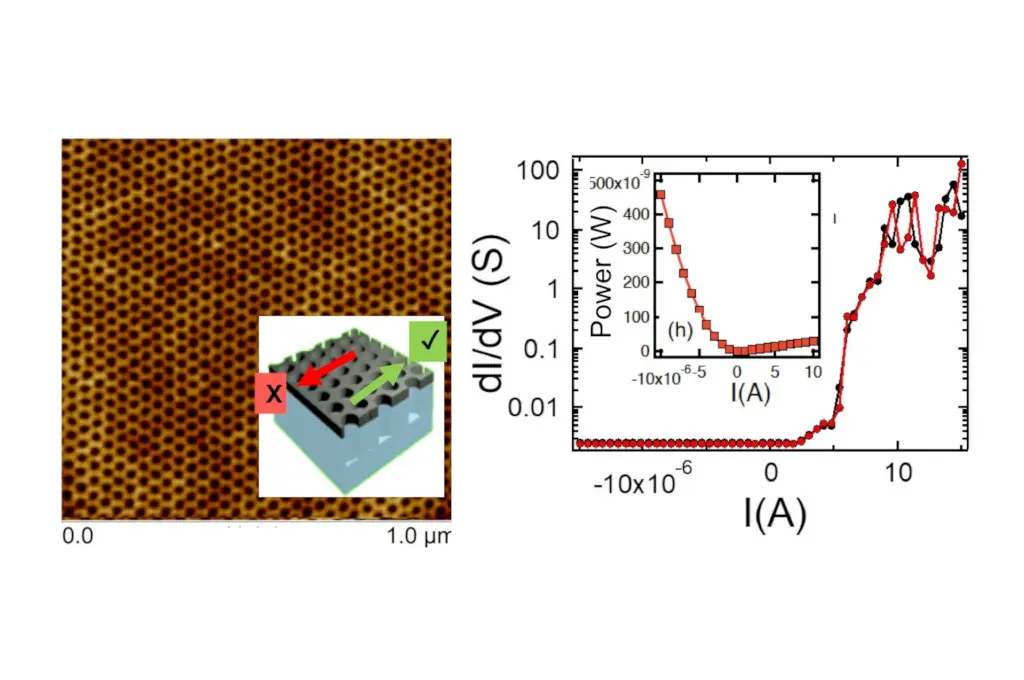
Singh’s team developed a two-dimensional, nanostructured material created by depositing a magnetic alloy, or permalloy, on the honeycomb structured template of a silicon surface. The new material conducts unidirectional current, or currents that only flow one way. The material also has significantly less dissipative power compared to a semiconducting diode, which is normally included in electronic devices.

The magnetic diode paves the way for new magnetic transistors and amplifiers that dissipate very little power, thus increasing the efficiency of the power source. This could mean that designers could increase the life of batteries by more than a hundred-fold. Less dissipative power in computer processors could also reduce the heat generated in laptop or desktop CPUs.

“Although more works need to be done to develop the end product, the device could mean that a normal 5-hour charge could increase to more than a 500-hour charge,” Singh said. “The device could also act as an ‘on/off switch’ for other periphery components such as closed-circuit cameras or radio frequency attenuators, which reduces power flowing through a device. We have applied for a U.S. patent and have begun the process of incorporating a spin-off company to help us take the device to market.”

The proposed startup company associated with this research, highlights the university’s impact on the state’s economic development efforts, including commercialization of research conducted at Mizzou, workforce development and job growth, quality of life improvements for residents, and attracting corporations and businesses to the state. Companies commercializing MU technologies have secured hundreds of millions of dollars in investments and grants to advance their commercialization efforts. In 2017, the Office of Technology Management and Industry Relations reported that 31 U.S. patents were issued to members of the MU community.

The studies, “Magnetic Diode Behavior at Room Temperature in 2D Honeycombs” and “Spin Solid versus Magnetic Charge Ordered State in Artificial Honeycomb Lattice of Connected Elements,” were published in Advanced Electronic Materials and Advanced Science, respectively. The U.S. Department of Energy, Office of Basic Energy Sciences (DE-SC0014461) provided funding for this research. The content is solely the responsibility of the authors and does not necessarily represent the official views of the funding agencies.

featured image:

Honeycomb Structure

The left shows the atomic force micrograph, exhibiting honeycomb structure pattern behind a magnetic device. Inset shows the schematic of current flow direction. On the right: electrical data reveals diode-type behavior of current flowing in one direction. Inset shows that the dissipative power is of the order of nano-watt in the current flowing direction, which is at least three orders of magnitude smaller than the semiconductor diode. Credit: Deepak Singh


Related

Recent Posts

onsemi solid-state transformer concept for 800 V HVDC AI data center power conversion with SiC modules, DC-link capacitors and high-frequency magnetics

Solid-State Transformers for 800 V AI Data Centers: Passive Component Design Considerations

9.9.2026
15

Coilcraft Introduces Automotive Common Mode Chokes Target CISPR 25 Class 5 EMC Compliance

7.9.2026
15

Murata Expands Automotive Metal Power Inductor Range

7.9.2026
31

August 2026 Interconnect, Passives and Electromechanical Components Market Insights

4.9.2026
35

Vishay Extends High-Current Common-Mode Chokes with 30 A EMI Filtering up to 150 °C

3.9.2026
33

B–H Curve-Based Inductor Modelling in LTspice: A Current-Dependent Magnetic Model

31.8.2026
55

Vishay IFBT SMT Flyback Transformers Target PoE and Isolated DC/DC Designs up to 30 W

28.8.2026
23

Bourns Automotive BMS Signal Transformer Combines Reinforced Isolation and Common-Mode Noise Rejection

27.8.2026
27

Vishay Introduces Automotive Low Loss SMD Common-Mode Chokes

26.8.2026
36

Upcoming Events

Sep 10
11:00 - 12:00 CEST

Equipment models and model strategies for Space Missions

Sep 16
17:00 - 18:00 CEST

Designing a 5 kW, 800 V-to-50 V PSFB Converter for Next-Generation Data Centers

Sep 29
16:00 - 17:00 CEST

Cybersecurity 2026

View Calendar

Popular Posts

  • Buck Converter Design and Calculation

    0 shares
    Share 0 Tweet 0
  • LLC Resonant Converter Design and Calculation

    0 shares
    Share 0 Tweet 0
  • Boost Converter Design and Calculation

    0 shares
    Share 0 Tweet 0
  • Flyback Converter Design and Calculation

    0 shares
    Share 0 Tweet 0
  • Earthing Systems and IEC Classification Explained

    0 shares
    Share 0 Tweet 0
  • MLCC and Ceramic Capacitors

    0 shares
    Share 0 Tweet 0
  • Resistor Symbols

    0 shares
    Share 0 Tweet 0
  • Capacitor Charging and Discharging

    0 shares
    Share 0 Tweet 0
  • Audio Capacitors: Choosing Capacitors for Crossover Circuits

    0 shares
    Share 0 Tweet 0
  • Thermistors Basics, NTC and PTC Thermistors

    0 shares
    Share 0 Tweet 0

Newsletter Subscription


Passive Components Blog

© 2015–2026
All rights reserved

  • Home
  • Privacy Policy
  • EPCI Membership & Advertisement
  • About

No Result
View All Result
  • Home
  • Knowledge Blog
  • Dossiers
  • PCNS

© 2015–2026
All rights reserved