





Passive Components Blog
No Result
View All Result
  • Home
  • News
    • All
    • Aerospace & Defence
    • Antenna
    • Applications
    • Automotive
    • Capacitors
    • Circuit Protection Devices
    • electro-mechanical news
    • Filters
    • Fuses
    • Inductors
    • Industrial
    • Integrated Passives
    • inter-connect news
    • Market & Supply Chain
    • Market Insights
    • Medical
    • Modelling and Simulation
    • New Materials & Supply
    • New Technologies
    • Non-linear Passives
    • Optoelectronics and Isolation
    • Oscillators
    • Passive Sensors News
    • Resistors
    • RF & Microwave
    • Telecommunication
    • Weekly Digest
    binder series 707 M5 male and female field-wireable cable connectors with metal housings

    binder Introduces M5 Field-Wireable Connectors for Sensors and Robotics

    Hybrid 2:1 switched-capacitor converter schematic showing a flying capacitor, four switches, an output inductor and a diode freewheeling path

    Hybrid Switched-Capacitor Converters: Lower-Loss Regulation

    Wk 47 Electronics Supply Chain Digest

    Miba Resistors SC-55 surface-mount thick-film power resistor with its body and connection pads visible

    Miba Unveils 55 W SMD Thick-Film Power Resistor in TO-263

    CapXon PM and EV surface-mount capacitors with cylindrical cans and rectangular mounting bases

    CapXon Extends Polymer and SMD Aluminum Capacitors

    YAGEO Group KEMET VW80808 automotive MLCC illustration with rectangular ceramic bodies and metal end terminations

    YAGEO Expands VW80808 Automotive MLCCs with X8R, X8G and C0G

    Kyocera SD25 duplexers and SF25/SF20 SAW filters in surface-mount packages, shown in top and underside views.

    Kyocera Expanded SAW Filters and Duplexers for Base Stations

    IQD IQXT-601 and IQXT-602 surface-mount TCXOs in rectangular ceramic packages

    IQD Releases TCXOs for GNSS and RF Timing

    Vishay VJ series surface-mount ceramic safety capacitors with rectangular bodies and metal end terminations

    Vishay Introduces X1 Safety MLCCs for AC Line Filtering

    Trending Tags

    • Ripple Current
    • RF
    • Leakage Current
    • Tantalum vs Ceramic
    • Snubber
    • Low ESR
    • Feedthrough
    • Derating
    • Dielectric Constant
    • New Products
    • Market Reports
  • Knowledge Blog
  • Dossiers
    • Aerospace and Defense Passive Components Dossier
    • AI Hardware Dossier
    • Automotive Dossier
    • Industrial Robotics Dossier
    • Power Converter Dossier
    • Capacitor Dossier
    • Circuit Protection Dossier
    • Inductor Dossier
    • Resistor Dossier
    • Silicon Capacitors and Integrated Passives Dossier
  • Suppliers
    • Who is Who
  • PCNS
    • PCNS 2025
    • PCNS 2023
    • PCNS 2021
    • PCNS 2019
    • PCNS 2017
  • Events
No Result
View All Result
Passive Components Blog
No Result
View All Result

Non-destructive internal inspection of EEE parts and passive components

9.4.2020
Reading Time: 7 mins read
A A

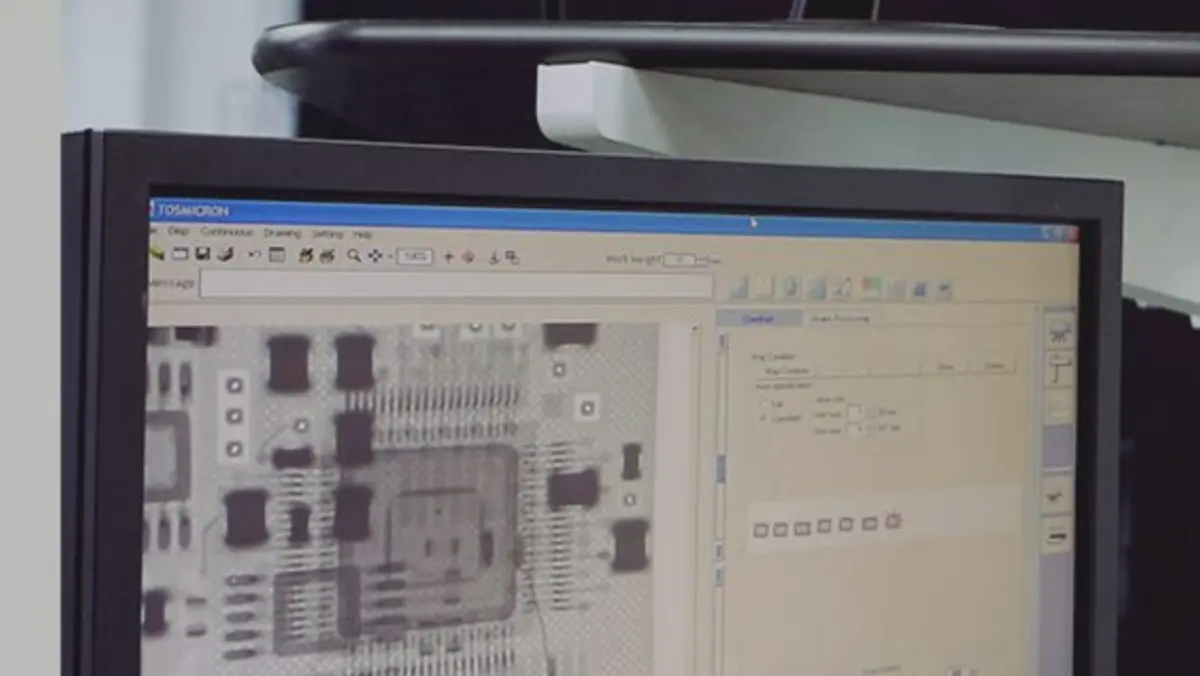
Francisco Javier Aparicio Rebollo, Alter Technology’s Senior Materials and Test Engineer is introducing overview of non-destructive inspection of electronic components including passives.

Non-destructive testing methods are critical for the screening, inspection and failure analysis of plastic encapsulated and other EEE systems. Typical non-destructive testing activities involving EEE parts are grouped in three main categories:

RelatedPosts

binder Introduces M5 Field-Wireable Connectors for Sensors and Robotics

Hybrid Switched-Capacitor Converters: Lower-Loss Regulation

Wk 47 Electronics Supply Chain Digest

  • Functional inspection (electrical tests to find functional failures)
  • External inspection of the package
  • Internal inspection of the structure

The present post addresses and compares three differed non-destructive inspection methods used in Alter Technology for such activities.

  • Acoustic Microscopy 
  • X-ray inspection
  • Lock-in Infrared Thermography

These and other inspection methods are combined with other destructive and functional tests used for the detailed analysis and study of:
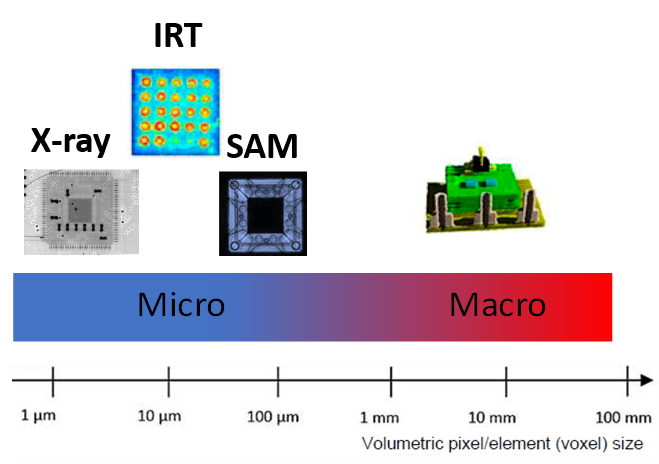
Non-destructive inspection test
Figure 1. Non-destructive inspection tests vs spatial resolution adapted from “Sensors 2018, 18, 1981; doi:10.3390/s18071981”
  • Plastic encapsulated IC
  • Flip Chip systems (CGA, FCBGA, PBGA, FPBGA…)
  • Bonded Wafers
  • Printed Circuit Boards
  • Capacitors
  • MEMS

Next figure shows the state of the start of each non-destructive inspection method in terms of spatial resolution and compared to typical sizes in the current IC packed technology according to a recent review published in Sensors (Sensors 2018, 18, 1981; doi:10.3390/s18071981).

X-Ray Inspection

When an X-ray beam propagates through the specimen a percentage of the X-ray photons interact with the media and are absorbed by the sample. Thus, the intensity of the transmitted X-ray beam depends on the elemental composition of the material and geometry of the specimen. Thus, internal features modify the intensity of X-ray beam registered at the receiver. Based on this mechanism the density and shape of internal objects can be measured and inspected by X-ray. Typical X-ray inspection systems consist of three components: X-ray tube (source), X-ray detector and test fixture used to fix and control the position of the sample in relation to the X-ray probe. In these systems the spatial resolution is mainly dictated by the size of the irradiation spot (focalization system) and the source emitting-area.
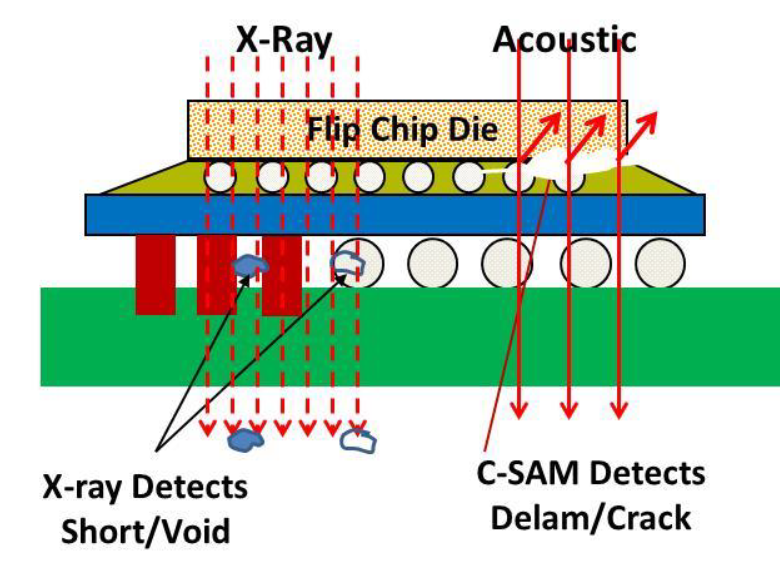
X-ray vs. csam
Figure 2. X-ray vs Acoustic Microscopy reprinted from “ECS Transactions, 33 (4) 47-57 (2010)”

When an X-ray beam propagates through the specimen a percentage of the X-ray photons interact with the media and are absorbed by the sample. Thus, the intensity of the transmitted X-ray beam depends on the elemental composition of the material and geometry of the specimen. Thus, internal features modify the intensity of X-ray beam registered at the receiver. Based on this mechanism the density and shape of internal objects can be measured and inspected by X-ray. Typical X-ray inspection systems consist of three components: X-ray tube (source), X-ray detector and test fixture used to fix and control the position of the sample in relation to the X-ray probe. In these systems the spatial resolution is mainly dictated by the size of the irradiation spot (focalization system) and the source emitting-area.
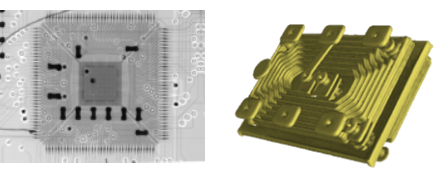
X-ray
Figure 3. 2D (left) and 3D (right) X-ray non verification

2D X-ray inspection is one of the oldest and more consolidated methods for non-destructive internal inspection of not only EEE parts but also raw materials. As it is illustrated in Figure 2, which compares X-ray inspection with CSAM microscopy, one of the main advantage of this technique relies on the capability to pass through thick objects and to detect sub-millimetric vertical features by recording top-down views of the samples However such planar views (Figure 3 right) do not provide enough information about internal structure of complex 3D assemblies and 3D reconstruction techniques are becoming a useful tool for the comprehensive inspection of such systems (Figure 3 right).

Scanning Acoustic Microscopy (C-SAM)

Scanning acoustic microscopy (SAM), also known as acoustic micro imaging (AMI) and scanning acoustic tomography (SAT), is currently a worldwide accepted technique for non-destructive verification, and inspection of microelectronic components and materials. It is commonly used for quality control, screening tasks and failure analysis as well as within DPA test flows, for instance in the case of plastic encapsulated integrated circuits (see Figure 4).
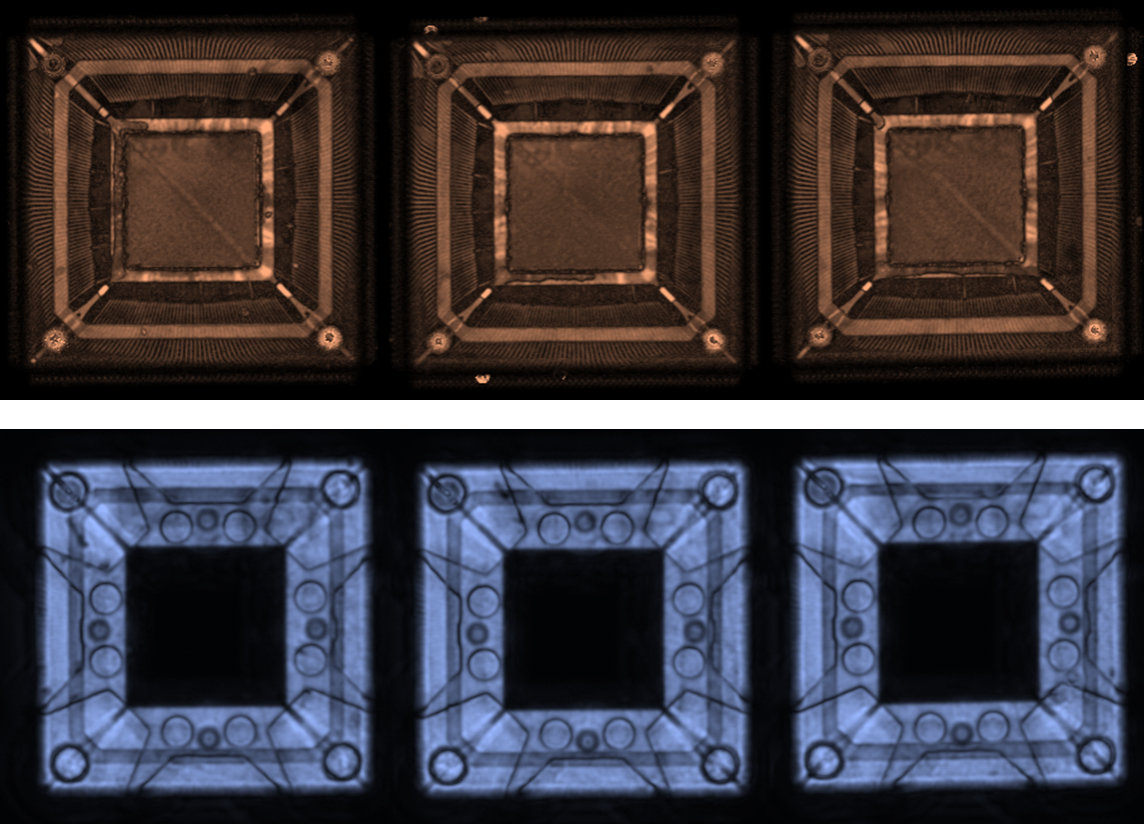
CSAM
Figure 4. top and bottom C-SAM assessment of FPGAs; source: Alter Technology

As it is illustrated in Figure 5, the working concept of the technique is based on the reflection that acoustic waves experience at the interface between different media and density irregularities, more information about the physics principles and instrumentation here (link to post How it works). Thus, the approach makes use of focalized ultrasound (MHz to GHz) pulses to image material interfaces and boundaries as well as hidden physical damages (voids, cracks, delamination, and others), either generated during manufacturing or induced after environmental testing or prolonged operation. The most important part of an acoustic microscope is the transducer, which is used as both source and receptor for acoustic to electrical signal conversion.

In this technique the delay between the reflected pulses generated at different interfaces the relative intensities are analysed for the reconstruction and inspection of the internal topography. In addition, it also provides very relevant information about other interface characteristics. Thereby, strong reflections (high reflection amplitude) are due to a high contrast between the materials properties, being material to air contrast the one providing more intense echoes as illustrates in Figure 5. Therefore, the technique is particularly suitable for the detection of ultrathin planar air features such as delaminations.
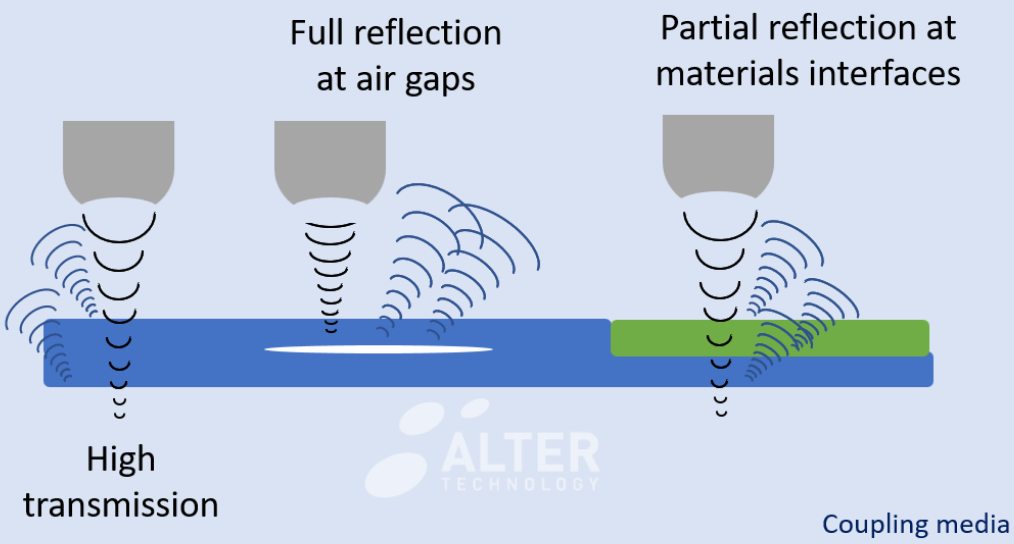
Physic Principle C-SAM
Figure 5. Physic principle of non-destructive C-SAM inspection; source: Alter Technology

Lock-in Thermography

Infrared thermography (IRT) is also amongst the most commonly used non-destructive tests and inspection methods either for EEE components and materials evaluation. In this technique the heat luminance from the surface is accurately measured within the infrared electromagnetic spectral region (2–14 μm). As in the case of other thermal microscopy techniques such precise measurements are used to analyse and record the temperature distribution of the surface but with a resolution than can reach the 0.020 ◦C to 0.075 ◦C range depending on the used detector.

Lock-in thermography
Figure 6. Lock-in thermographic inspection of connectors; source: Alter Technology

Either active or passive thermography techniques are used for the inspection of microelectronic as well as passive components. On the one hand passive methods analyse the natural thermal emittance from the different structures within the components without an external stimulus. On the other hand, active methods apply external heat to the inspected system by optical, mechanical or electromagnetic heat sources. Therefore, thermal waves are generated on the surface of the specimen, and these will be scatted at surface defects and subsequently detected. Active thermography methods are used in the detection of delamination and moisture in composites and for the inspection of high-density IC packages.

Pulsed and lock-in approaches are the main active-thermography techniques. In the case of pulsed thermography, a single heating pulse is used; whereas in the lock-in counterpart, the sample surface is periodically heated. In the latter cases when the heat wave reaches a thermophysical inhomogeneity (e.g., delaminations or inclusions), the input wave is reflected and modifies the surface temperature distribution. As the reflected wave oscillates at the same frequency as the excitation wave, it can be easily identified.

Stress test

In Alter Technology these non-destructive inspection techniques are combined with different stress and environmental tests to analyse the effect on the system integrity and performance

  • Humidity, moisture and thermal test.
  • Thermal-vacuum testing 
  • Temperature cycling 
  • Thermal shock 
  • Vibration testing 

For further references and links to Alter Technology capability please click on the link below.

Related

Source: Alter Technology

Recent Posts

Hybrid 2:1 switched-capacitor converter schematic showing a flying capacitor, four switches, an output inductor and a diode freewheeling path

Hybrid Switched-Capacitor Converters: Lower-Loss Regulation

23.11.2026
5
CapXon PM and EV surface-mount capacitors with cylindrical cans and rectangular mounting bases

CapXon Extends Polymer and SMD Aluminum Capacitors

20.11.2026
12
YAGEO Group KEMET VW80808 automotive MLCC illustration with rectangular ceramic bodies and metal end terminations

YAGEO Expands VW80808 Automotive MLCCs with X8R, X8G and C0G

20.11.2026
16
Vishay VJ series surface-mount ceramic safety capacitors with rectangular bodies and metal end terminations

Vishay Introduces X1 Safety MLCCs for AC Line Filtering

20.11.2026
12
Illustrative aerospace electronics assembly with board-to-board connectors, coaxial RF cables and optical links.

Military and Aerospace Interconnect Design: Key Trade-offs

19.11.2026
20

Samsung Introduces 630V X7T Molded Frame Capacitor for Automotive

19.11.2026
47

Exxelia Presents Disc Capacitors and Integrated Magnetics for Space

18.11.2026
44
Vishay 259 PHM-SI cylindrical aluminum electrolytic capacitors with blue insulating sleeves and snap-in terminals

Vishay Adds 550 V and 600 V Snap-In Capacitors

18.11.2026
27
illustrative image of film capacitors close to a circuit board

2026 Capacitor Price Shock: Where Film Capacitors Fit

17.11.2026
75

Upcoming Events

Nov 24
16:00 - 17:00 CET

Select the Correct Components for Your DC/DC Converter

Dec 1
16:00 - 17:00 CET

Developing low-noise mixed-signal systems

Dec 8
16:00 - 17:00 CET

WE-CCMF: Design Principles, Layout Guidelines and Measurement Results for High-Speed EMI Filtering

View Calendar

Popular Posts

  • Buck Converter Design and Calculation

    0 shares
    Share 0 Tweet 0
  • Boost Converter Design and Calculation

    0 shares
    Share 0 Tweet 0
  • September 2026 Interconnect, Passives and Electromechanical Components Market Insights

    0 shares
    Share 0 Tweet 0
  • Capacitor Charging and Discharging

    0 shares
    Share 0 Tweet 0
  • RF Connector Types: How To Choose the Right One

    0 shares
    Share 0 Tweet 0
  • Passive Low Pass Filters: Fundamentals and EMI Design

    0 shares
    Share 0 Tweet 0
  • LLC Resonant Converter Design and Calculation

    0 shares
    Share 0 Tweet 0
  • Flyback Converter Design and Calculation

    0 shares
    Share 0 Tweet 0
  • Capacitance and its Calculation

    0 shares
    Share 0 Tweet 0
  • Capacitor Symbols

    0 shares
    Share 0 Tweet 0

Newsletter Subscription


Passive Components Blog

© 2015–2026
All rights reserved

  • Home
  • Privacy Policy
  • EPCI Membership & Advertisement
  • About

No Result
View All Result
  • Home
  • Knowledge Blog
  • Dossiers
  • PCNS

© 2015–2026
All rights reserved