









Passive Components Blog
No Result
View All Result
  • Home
  • NewsFilter
    • All
    • Aerospace & Defence
    • Antenna
    • Applications
    • Automotive
    • Capacitors
    • Circuit Protection Devices
    • electro-mechanical news
    • Filters
    • Fuses
    • Inductors
    • Industrial
    • Integrated Passives
    • inter-connect news
    • Market & Supply Chain
    • Market Insights
    • Medical
    • Modelling and Simulation
    • New Materials & Supply
    • New Technologies
    • Non-linear Passives
    • Oscillators
    • Passive Sensors News
    • Resistors
    • RF & Microwave
    • Telecommunication
    • Weekly Digest

    Smoltek CNF-MIM Capacitors Hit 1,000x Lower Leakage

    DigiKey Expands Line Card with 108K Stock Parts and 364 Suppliers

    Würth Elektronik Announces Partner Program

    Vishay Releases Compact 0806 Low‑DCR Power Inductor

    Murata Opens New Ceramic Capacitor Manufacturing and R&D Center in Japan

    Murata Publishes Power Delivery Guide for AI Servers

    Selecting Current Sense Transformers with Würth Elektronik REDEXPERT

    Mechanical Drift Indicator of Tantalum Capacitor Anodes Degradation under Reverse Bias

    Enabling Software‑Defined Vehicle Architectures: Automotive Ethernet and Zonal Smart Power

    Trending Tags

    • Ripple Current
    • RF
    • Leakage Current
    • Tantalum vs Ceramic
    • Snubber
    • Low ESR
    • Feedthrough
    • Derating
    • Dielectric Constant
    • New Products
    • Market Reports
  • VideoFilter
    • All
    • Antenna videos
    • Capacitor videos
    • Circuit Protection Video
    • Filter videos
    • Fuse videos
    • Inductor videos
    • Inter-Connect Video
    • Non-linear passives videos
    • Oscillator videos
    • Passive sensors videos
    • Resistor videos

    Enabling Software‑Defined Vehicle Architectures: Automotive Ethernet and Zonal Smart Power

    Calculating Resistance Value of a Flyback RC Snubber 

    One‑Pulse Characterization of Nonlinear Power Inductors

    Thermistor Linearization Challenges

    Coaxial Connectors and How to Connect with PCB

    PCB Manufacturing, Test Methods, Quality and Reliability

    Transformer Behavior – Current Transfer and Hidden Feedback

    Choosing the Right Capacitor: The Importance of Accurate Measurements

    RF Inductors: Selection and Design Challenges for High-Frequency Circuits

    Trending Tags

    • Capacitors explained
    • Inductors explained
    • Resistors explained
    • Filters explained
    • Application Video Guidelines
    • EMC
    • New Products
    • Ripple Current
    • Simulation
    • Tantalum vs Ceramic
  • Knowledge Blog
  • DossiersNew
  • Suppliers
    • Who is Who
  • PCNS
    • PCNS 2025
    • PCNS 2023
    • PCNS 2021
    • PCNS 2019
    • PCNS 2017
  • Events
  • Home
  • NewsFilter
    • All
    • Aerospace & Defence
    • Antenna
    • Applications
    • Automotive
    • Capacitors
    • Circuit Protection Devices
    • electro-mechanical news
    • Filters
    • Fuses
    • Inductors
    • Industrial
    • Integrated Passives
    • inter-connect news
    • Market & Supply Chain
    • Market Insights
    • Medical
    • Modelling and Simulation
    • New Materials & Supply
    • New Technologies
    • Non-linear Passives
    • Oscillators
    • Passive Sensors News
    • Resistors
    • RF & Microwave
    • Telecommunication
    • Weekly Digest

    Smoltek CNF-MIM Capacitors Hit 1,000x Lower Leakage

    DigiKey Expands Line Card with 108K Stock Parts and 364 Suppliers

    Würth Elektronik Announces Partner Program

    Vishay Releases Compact 0806 Low‑DCR Power Inductor

    Murata Opens New Ceramic Capacitor Manufacturing and R&D Center in Japan

    Murata Publishes Power Delivery Guide for AI Servers

    Selecting Current Sense Transformers with Würth Elektronik REDEXPERT

    Mechanical Drift Indicator of Tantalum Capacitor Anodes Degradation under Reverse Bias

    Enabling Software‑Defined Vehicle Architectures: Automotive Ethernet and Zonal Smart Power

    Trending Tags

    • Ripple Current
    • RF
    • Leakage Current
    • Tantalum vs Ceramic
    • Snubber
    • Low ESR
    • Feedthrough
    • Derating
    • Dielectric Constant
    • New Products
    • Market Reports
  • VideoFilter
    • All
    • Antenna videos
    • Capacitor videos
    • Circuit Protection Video
    • Filter videos
    • Fuse videos
    • Inductor videos
    • Inter-Connect Video
    • Non-linear passives videos
    • Oscillator videos
    • Passive sensors videos
    • Resistor videos

    Enabling Software‑Defined Vehicle Architectures: Automotive Ethernet and Zonal Smart Power

    Calculating Resistance Value of a Flyback RC Snubber 

    One‑Pulse Characterization of Nonlinear Power Inductors

    Thermistor Linearization Challenges

    Coaxial Connectors and How to Connect with PCB

    PCB Manufacturing, Test Methods, Quality and Reliability

    Transformer Behavior – Current Transfer and Hidden Feedback

    Choosing the Right Capacitor: The Importance of Accurate Measurements

    RF Inductors: Selection and Design Challenges for High-Frequency Circuits

    Trending Tags

    • Capacitors explained
    • Inductors explained
    • Resistors explained
    • Filters explained
    • Application Video Guidelines
    • EMC
    • New Products
    • Ripple Current
    • Simulation
    • Tantalum vs Ceramic
  • Knowledge Blog
  • DossiersNew
  • Suppliers
    • Who is Who
  • PCNS
    • PCNS 2025
    • PCNS 2023
    • PCNS 2021
    • PCNS 2019
    • PCNS 2017
  • Events
No Result
View All Result
Passive Components Blog
No Result
View All Result

Samsung Electro-Mechanics Develops World’s Smallest Power Inductor

14.9.2020
Reading Time: 3 mins read
A A

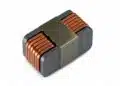
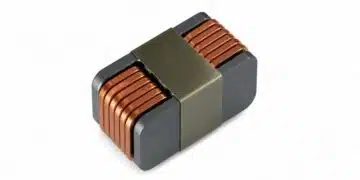
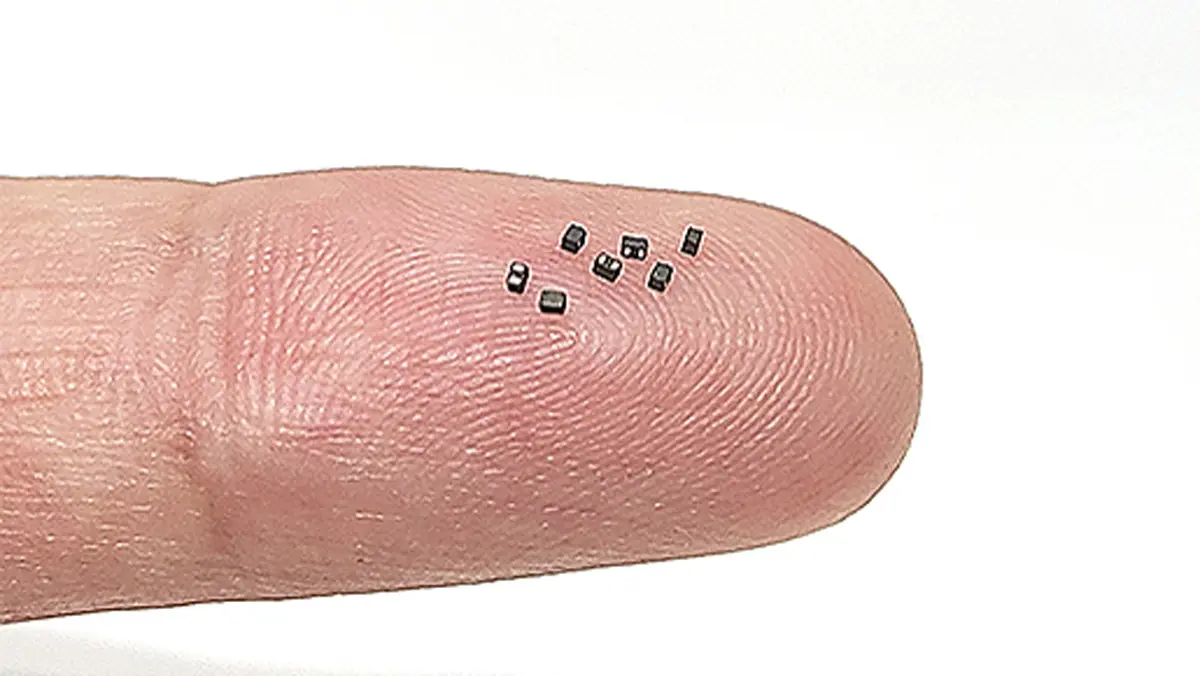
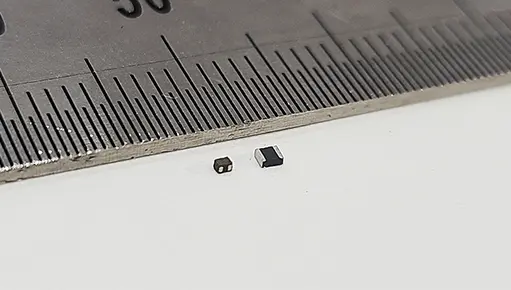
Samsung Electro-Mechanics revealed that it had developed the world’s smallest 0804 size power inductor.

The power inductor that was developed is of 0804 size (width 0.8mm, length 0.4mm), which is a significant decrease in area compared to the previously most smallest product of size 1210 (width 1.2mm, length 1.0mm), with a thickness of only 0.65mm. Samsung Electro-Mechanics is planning to supply this product global mobile companies.
 
The power inductor is a core component necessary to supply stable electricity (power) coming from the battery to the semiconductor, and it is a necessity used in smart phones, wearable devices, and electric vehicles. Recently, with the gradual trend towards light weight and size reduction of IT devices and increase in the number of multifunctional and high-performance components installed in 5G telecommunications and multi-cameras, the internal storage space for components has decreased, requiring miniature products. Moreover, with an improvement in component specs, power usage has increased, resulting in the need for power inductors that can withstand high currents.
 
The performance of the power inductor is generally determined based on the magnetic substance material (an object with magnetic characteristics) and the number of coils (copper wires) that can be internally winded. That is, in order to improve the performance of the power inductor, it is necessary to improve the magnetic substance characteristics and wrap more coils within a limited space.
 
Based on its material technology and semiconductor substrate manufacturing method accumulated through MLCC< Samsung Electro-Mechanics was able to reduce the size by approx. 50% and improve electricity loss. Moreover, rather than generally processing the power inductor in individual units, Samsung Electro-Mechanics manufactured them in substrate units to improve productivity and develop a thin product.
RelatedPosts

NIC Components Extends SMD High Voltage MLCC Offering

Stackpole Offers RoHS Compliant Lead-Free Thick Film Chip Resistors

Smiths Interconnect’s SMD Power Resistors with Heat Sink Qualified to Space Flights

Samsung Electro-Mechanics developed materials that applied nano-grade, ultra-microscopic powder in-house and succeeded in realizing finely spaced coils by applying the dimming technology (manufacturing method using light to mark circuits) applied in semiconductor manufacturing.
 
Kang Heon Hur, Vice President and Head of the Central Research Institute at Samsung Electro-Mechanics, revealed, “As the performance for electronic products increase and functionalities diversify, the size of the internal components must decrease along with an improvement in performance and volume. To do this, differentiating technology is necessary. Samsung Electro-Mechanics has been enhancing its product competitiveness through conversion and integration of technologies as the only company that possesses both material technology and micro engineering technology.”   
 
Since 1996, Samsung Electro-Mechanics has been developing and manufacturing inductors, and it has been recognized for its industry-leading technology in miniaturization. Samsung Electro-Mechanics plans to expand its product line-up and market share through material development and super-differential technology, such as ultrafine engineering method.
 
With the high-performance and multifunctionality of electronic devices, activation of 5G telecommunications, and growth of the wearable device market, the demand for super-small power inductors is expected to grow at a rapid pace, and its installment within electronic devices is forecasted to grow by at least 20% per year.
 
※ Reference
Both the MLCC and power inductors are passive components that control voltage/current to allow for smooth operation of electronic devices. Because each component has its own characteristics, they must both be installed in the electronic device. Generally, the capacitator serves a role in supplying voltage and the inductor serves a role in supplying stable energy to the semiconductor by preventing sudden changes in the current. 
Related

Source: Samsung Electro-Mechanics

Recent Posts

Vishay Releases Compact 0806 Low‑DCR Power Inductor

5.2.2026
25

Murata Publishes Power Delivery Guide for AI Servers

4.2.2026
84

Selecting Current Sense Transformers with Würth Elektronik REDEXPERT

3.2.2026
22

Enabling Software‑Defined Vehicle Architectures: Automotive Ethernet and Zonal Smart Power

2.2.2026
28

Bourns Releases High‑Q Air Coil Inductors for RF Aplications

29.1.2026
43

CMSE 2026 Announces Call for Presentations on High-Reliability Military and Space Electronics

28.1.2026
51

ESA Call for Papers 6th Space Passive Component Days – SPCD 2026

28.1.2026
46

Würth Elektronik Developed a Custom Transformer for Active Hand Orthosis

26.1.2026
47

Passive Components in Quantum Computing

22.1.2026
162

Upcoming Events

Feb 11
16:00 - 17:00 CET

What’s Next in Power Electronics Design

Feb 24
16:00 - 17:00 CET

Designing Qi2 Wireless Power Systems: Practical Development and EMC Optimization

Mar 3
16:00 - 17:00 CET

Cybersecurity at the Eleventh Hour – from RED to CRA – Information and Discussion

View Calendar

Popular Posts

  • Buck Converter Design and Calculation

    0 shares
    Share 0 Tweet 0
  • Boost Converter Design and Calculation

    0 shares
    Share 0 Tweet 0
  • LLC Resonant Converter Design and Calculation

    0 shares
    Share 0 Tweet 0
  • Flyback Converter Design and Calculation

    0 shares
    Share 0 Tweet 0
  • Ripple Current and its Effects on the Performance of Capacitors

    3 shares
    Share 3 Tweet 0
  • Dual Active Bridge (DAB) Topology

    0 shares
    Share 0 Tweet 0
  • MLCC and Ceramic Capacitors

    0 shares
    Share 0 Tweet 0
  • How Metal Prices Are Driving Passive Component Price Hikes

    0 shares
    Share 0 Tweet 0
  • What is a Dielectric Constant and DF of Plastic Materials?

    4 shares
    Share 4 Tweet 0
  • Degradation of Capacitors and its Failure Mechanisms

    0 shares
    Share 0 Tweet 0

Newsletter Subscription


Passive Components Blog

© EPCI - Leading Passive Components Educational and Information Site

  • Home
  • Privacy Policy
  • EPCI Membership & Advertisement
  • About

No Result
View All Result
  • Home
  • Knowledge Blog
  • PCNS

© EPCI - Leading Passive Components Educational and Information Site

This website uses cookies. By continuing to use this website you are giving consent to cookies being used. Visit our Privacy and Cookie Policy.
Go to mobile version