


Passive Components Blog
No Result
View All Result
  • Home
  • NewsFilter
    • All
    • Aerospace & Defence
    • Antenna
    • Applications
    • Automotive
    • Capacitors
    • Circuit Protection Devices
    • electro-mechanical news
    • Filters
    • Fuses
    • Inductors
    • Industrial
    • Integrated Passives
    • inter-connect news
    • Market & Supply Chain
    • Market Insights
    • Medical
    • Modelling and Simulation
    • New Materials & Supply
    • New Technologies
    • Non-linear Passives
    • Oscillators
    • Passive Sensors News
    • Resistors
    • RF & Microwave
    • Telecommunication
    • Weekly Digest

    Würth Elektronik Updates REDEXPERT DC‑DC Converter Designer

    Stackpole Unveils High-Temperature Automotive Thick Film Chip Resistors for Harsh Environments

    Molex Presents MiniMix Hybrid Power and Signal Connectors for Compact Humanoid Joints

    Bourns Releases Custom SiC AFE/PFC Power Inductor for High‑Voltage Designs

    Littelfuse Releases Toggle Safety Covers for Reliable Control Panels

    Bourns Expanded Blend‑Balance Guitar Potentiometers Resistance Range

    TDK Extends Vibration‑Resistant Axial Aluminum Capacitors for Compact DC‑links

    YAGEO Releases SMD 0402 Pt Temperature Sensors for Space‑Constrained Designs

    Bourns Introduces Automotive Wide Terminal Metal Foil Current Sense Resistors for High‑Reliability Designs

    Trending Tags

    • Ripple Current
    • RF
    • Leakage Current
    • Tantalum vs Ceramic
    • Snubber
    • Low ESR
    • Feedthrough
    • Derating
    • Dielectric Constant
    • New Products
    • Market Reports
  • VideoFilter
    • All
    • Antenna videos
    • Capacitor videos
    • Circuit Protection Video
    • Filter videos
    • Fuse videos
    • Inductor videos
    • Inter-Connect Video
    • Non-linear passives videos
    • Oscillator videos
    • Passive sensors videos
    • Resistor videos

    Current Sense Transformers: Ferrite vs Nanocrystalline Cores for Accurate Current Measurement

    EMC Design Fundamentals: Safe Use of Varistors and Common Mode Chokes in Mains and Data-Line Filters

    Ferrite versus Nanocrystalline Power Inductor Cores: Turns, Gap and Size

    KYOCERA AVX Presents Antenna Integrator Studio Tutorial for Antenna Placement and RF Design

    Power Design Simulation Tools for Faster Inductor Selection and Loss Optimization

    EMC‑Compliant PCB and Connector Design Guidelines

    Why Isolated DC/DC Power Supplies Fail Late, Würth Elektronik Podcast

    Designing 800 V DC EMC Filters: Calculation, Simulation and Measurement

    Current Sense Transformer Datasheet and Design‑in Guide

    Trending Tags

    • Capacitors explained
    • Inductors explained
    • Resistors explained
    • Filters explained
    • Application Video Guidelines
    • EMC
    • New Products
    • Ripple Current
    • Simulation
    • Tantalum vs Ceramic
  • Knowledge Blog
  • Dossiers
    • AI Hardware Dossier
    • Power Converter Dossier
    • Automotive Dossier
    • Capacitor Dossier
    • Resistor Dossier
    • Inductor Dossier
    • Circuit Protection Dossier
  • Suppliers
    • Who is Who
  • PCNS
    • PCNS 2025
    • PCNS 2023
    • PCNS 2021
    • PCNS 2019
    • PCNS 2017
  • Events
  • Home
  • NewsFilter
    • All
    • Aerospace & Defence
    • Antenna
    • Applications
    • Automotive
    • Capacitors
    • Circuit Protection Devices
    • electro-mechanical news
    • Filters
    • Fuses
    • Inductors
    • Industrial
    • Integrated Passives
    • inter-connect news
    • Market & Supply Chain
    • Market Insights
    • Medical
    • Modelling and Simulation
    • New Materials & Supply
    • New Technologies
    • Non-linear Passives
    • Oscillators
    • Passive Sensors News
    • Resistors
    • RF & Microwave
    • Telecommunication
    • Weekly Digest

    Würth Elektronik Updates REDEXPERT DC‑DC Converter Designer

    Stackpole Unveils High-Temperature Automotive Thick Film Chip Resistors for Harsh Environments

    Molex Presents MiniMix Hybrid Power and Signal Connectors for Compact Humanoid Joints

    Bourns Releases Custom SiC AFE/PFC Power Inductor for High‑Voltage Designs

    Littelfuse Releases Toggle Safety Covers for Reliable Control Panels

    Bourns Expanded Blend‑Balance Guitar Potentiometers Resistance Range

    TDK Extends Vibration‑Resistant Axial Aluminum Capacitors for Compact DC‑links

    YAGEO Releases SMD 0402 Pt Temperature Sensors for Space‑Constrained Designs

    Bourns Introduces Automotive Wide Terminal Metal Foil Current Sense Resistors for High‑Reliability Designs

    Trending Tags

    • Ripple Current
    • RF
    • Leakage Current
    • Tantalum vs Ceramic
    • Snubber
    • Low ESR
    • Feedthrough
    • Derating
    • Dielectric Constant
    • New Products
    • Market Reports
  • VideoFilter
    • All
    • Antenna videos
    • Capacitor videos
    • Circuit Protection Video
    • Filter videos
    • Fuse videos
    • Inductor videos
    • Inter-Connect Video
    • Non-linear passives videos
    • Oscillator videos
    • Passive sensors videos
    • Resistor videos

    Current Sense Transformers: Ferrite vs Nanocrystalline Cores for Accurate Current Measurement

    EMC Design Fundamentals: Safe Use of Varistors and Common Mode Chokes in Mains and Data-Line Filters

    Ferrite versus Nanocrystalline Power Inductor Cores: Turns, Gap and Size

    KYOCERA AVX Presents Antenna Integrator Studio Tutorial for Antenna Placement and RF Design

    Power Design Simulation Tools for Faster Inductor Selection and Loss Optimization

    EMC‑Compliant PCB and Connector Design Guidelines

    Why Isolated DC/DC Power Supplies Fail Late, Würth Elektronik Podcast

    Designing 800 V DC EMC Filters: Calculation, Simulation and Measurement

    Current Sense Transformer Datasheet and Design‑in Guide

    Trending Tags

    • Capacitors explained
    • Inductors explained
    • Resistors explained
    • Filters explained
    • Application Video Guidelines
    • EMC
    • New Products
    • Ripple Current
    • Simulation
    • Tantalum vs Ceramic
  • Knowledge Blog
  • Dossiers
    • AI Hardware Dossier
    • Power Converter Dossier
    • Automotive Dossier
    • Capacitor Dossier
    • Resistor Dossier
    • Inductor Dossier
    • Circuit Protection Dossier
  • Suppliers
    • Who is Who
  • PCNS
    • PCNS 2025
    • PCNS 2023
    • PCNS 2021
    • PCNS 2019
    • PCNS 2017
  • Events
No Result
View All Result
Passive Components Blog
No Result
View All Result

Samsung Electro-Mechanics Focuses MLCCs on AI servers and Automotive

22.7.2025
Reading Time: 6 mins read
A A

Samsung Electro-Mechanics is investing significantly in MLCC ceramic capacitor technology for AI servers and automotive electronics.

This strategic move aims to reshape its business model by focusing on high-growth sectors such as AI servers and automotive electronics. Samsung is particularly drawn to MLCC’s ability to provide best-in-class ultra-small, high-capacity technologies.

RelatedPosts

Samsung Introduces Ultra‑compact, High‑Capacitance MLCCs for AI Edge and Wearable designs

June 2026: AI Demand Pushes Japanese and Korean MLCC Makers to Five‑Year Shipment High

Samsung Introduces 1000V C0G and X7 MLCCs for 800V DC Systems

Focusing on AI Servers and Automotive Electronics with Best-in-Class Ultra-Small, High-Capacity Technologies

Its core business, MLCC (Multi-Layer Ceramic Capacitor), is expanding from its traditional role in IT sectors like smartphones into future-driven industries such as AI servers, xEVs (electric vehicles), advanced driver assistance systems (ADAS), and autonomous driving. Samsung Electro-Mechanics is focusing its capabilities on these areas with an emphasis on advanced, high-margin technologies.

Driven by the spread of AI, rising EV adoption, and the evolution of autonomous systems, the demand for MLCCs in AI servers and automotive electronics is expected to grow significantly. A single electric vehicle requires approximately 20,000 to 30,000 MLCCs, and state-of-the-art AI servers use more than ten times the MLCCs found in general-purpose servers.

AI servers require high-performance, densely integrated MLCCs—specifically, compact, high-capacity components that can withstand high temperatures (105°C). In contrast, automotive MLCCs, which are critical to human safety, demand high-capacitance, high-temperature (125–150°C), and high-voltage (<2000V) components with exceptional reliability.

In response, Samsung Electro-Mechanics is leading the market with high-performance MLCCs capable of enduring high temperatures (150°C), high voltages (2000V), shock, and humidity.

The company is also eyeing the humanoid robot sector, emerging as a next-generation electronics platform, and plans to leverage its high-reliability industrial and automotive technologies along with ultra-high-capacity IT solutions to gain early market dominance.

Advanced Technology in a Component Thinner Than a Hair

An MLCC (Multi-Layer Ceramic Capacitor) stores electrical energy and supplies it stably to active components like APs, CPUs, and GPUs, ensuring smooth operation. It also filters noise between signals, thereby improving device performance and stability.

MLCCs are essential to modern electronics—over 1,000 are used in a single smartphone, and tens of thousands are installed in electric vehicles.

Sizes range from 0.2mm x 0.1mm—thinner than a human hair (about 0.3mm)—to 5.7mm x 5.0mm, making many MLCCs barely visible to the naked eye.

Despite their minuscule size, MLCCs house 500 to 1,000 stacked layers of dielectric and electrode materials. Their density and complexity make them extremely high-value components—just 300ml, roughly the volume of a wine glass, can be worth hundreds of millions of Korean won.

MLCCs Demand the Highest Degree of Micro-Level Precision

The strength of MLCCs lies in storing large amounts of electricity in a small form factor. This is achieved by alternating layers of dielectric and electrode materials, requiring advanced material and manufacturing technology to stack layers evenly and interference-free.

If semiconductors present the highest barrier to entry at the nano scale, MLCCs do so at the micro scale, making the manufacturing process equally demanding.

MLCCs are produced by printing and stacking ultra-thin layers of ceramic and nickel, then firing them at high temperatures like ceramic pottery. The performance of each product depends heavily on what additives are mixed into the ceramic base and in what quantities—a critical proprietary technology for manufacturers.

The thinner and denser these internal layers, the greater the storage capacity—thus, extremely precise control over the manufacturing process is vital. These components must be fired at over 1,000°C, with carefully calibrated temperatures to compensate for differences in thermal expansion between ceramics and metal.

Any microcracks formed during firing can render an MLCC defective. Therefore, even if a product appears undamaged, it must undergo rigorous quality checks, including electrical property testing and visual inspection.

Samsung Electro-Mechanics began its MLCC business in 1988, launched industrial and automotive production in 2016, and established a dedicated automotive production line in Busan in 2018 to accelerate its efforts.

To strengthen competitiveness, the company also develops and manufactures its own core ceramic materials, a rare capability mastered by only a handful of companies globally. A dedicated raw materials plant for automotive applications was completed at the Busan site and began operations in 2020.

Currently, Samsung Electro-Mechanics conducts R&D and new product development in Suwon and Busan, and mass-produces MLCCs at its facilities in Tianjin, China, and the Philippines.

AI Server MLCCs: The Next High-Growth Market

AI server MLCCs are emerging as the next major market after automotive. Notably, the AI server sector is expected to grow faster than the general server market.

According to MarketsandMarkets, the global AI server market is projected to grow from $142.9 billion (about 196 trillion KRW) in 2024 to $837.8 billion (about 1,150 trillion KRW) in 2030.

MLCCs for servers require superior durability and resistance to temperature and humidity compared to those used in general IT environments. AI servers, in particular, demand greater computational power and massive data throughput, leading to higher power consumption and heat generation.

Thus, MLCCs for AI servers must operate reliably in extreme conditions, including high temperatures (105°C or above), high rated voltages (100V), and high bending strength (2mm).

As AI servers consume five to ten times more power than standard servers, they require more MLCCs. However, space for mounting MLCCs near GPUs is limited, necessitating compact, ultra-high-capacity designs. AI servers are typically designed with stacked boards containing multiple GPU modules, resulting in increased heat generation. Therefore, MLCCs that can operate in high-heat (105°C) environments are essential.
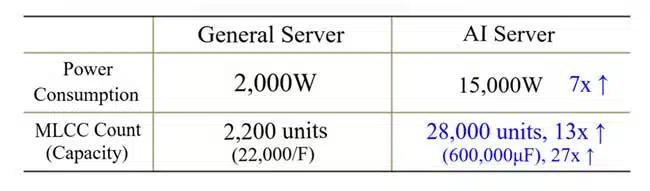
Comparison of MLCC Adoption in General Servers and AI Servers; source: Samsung Electro-Mechanics

Samsung Electro-Mechanics is expanding its product lineup with ultra-small, ultra-high-capacity, high-temperature, and high-voltage MLCCs. It currently holds approximately 40% of the global AI server MLCC market, cementing its position as a global leader.

Automotive MLCCs Require Extreme Reliability and Durability

Automotive MLCCs, similar to those used in IT products, operate in demanding conditions and are directly linked to human safety, necessitating exceptional durability and reliability.

These components must function consistently under extreme temperatures ranging from above 125°C to below -55°C, endure mechanical stress, and withstand humidity levels as high as 85%.

The development cycles for automotive MLCCs are approximately three times longer, and their prices are over three times higher compared to those of IT counterparts, underscoring their high value-added nature. With the emergence of ADAS (Advanced Driver Assistance Systems) as the backbone of autonomous vehicles, the demand for high-performance MLCCs continues to rise, as these systems require precise electronic control.

To meet the stringent automotive standards, materials must be engineered to withstand high temperatures and voltages, while microstructures must be optimized for shock and humidity resistance.

Furthermore, these MLCCs must adhere to AEC-Q200 certification, a stringent automotive quality standard, and undergo rigorous validation from each customer before entering production.

According to McKinsey, the adoption rate of ADAS Level 2 and above is projected to increase from 44% in 2025 to 65% by 2030, accompanied by a market value surge from $38.5 billion to $65 billion.

Samsung Electro-Mechanics has consistently advanced its automotive MLCC technology roadmap.

In 2021, the company developed two MLCCs specifically tailored for ADAS applications. The following year, it released 13 MLCC models for automotive powertrains. In 2024, the company introduced two 16V MLCCs for ADAS featuring the world’s highest capacitance, along with 2,000V-rated MLCCs for EVs.

Looking ahead, Samsung Electro-Mechanics plans to introduce the world’s first LiDAR-specific MLCCs in 2025, further solidifying its position as a technology leader in the automotive electronics market.


Related

Source: Samsung Electro-Mechanics

Recent Posts

Würth Elektronik Updates REDEXPERT DC‑DC Converter Designer

6.8.2026
26

Stackpole Unveils High-Temperature Automotive Thick Film Chip Resistors for Harsh Environments

6.8.2026
17

TDK Extends Vibration‑Resistant Axial Aluminum Capacitors for Compact DC‑links

4.8.2026
31

Bourns Introduces Automotive Wide Terminal Metal Foil Current Sense Resistors for High‑Reliability Designs

3.8.2026
29

YAGEO Extends Automotive Tantalum Polymer Capacitors for AI and ADAS Controllers

31.7.2026
105

Knowles Introduces PP Film Capacitors for High‑Stress Power Electronics

30.7.2026
61

AI Data Centers Push Aluminium Capacitor Prices Higher

30.7.2026
166

Murata Releases 1210 Metal Terminal Common Mode Choke for 10Base‑T1S In‑Vehicle Ethernet

30.7.2026
141

DigiKey Ads 27,000 New In-Stock Parts and 104 Additional Suppliers in Q2 2026

30.7.2026
25

Upcoming Events

Sep 10
11:00 - 12:00 CEST

Equipment models and model strategies for Space Missions

Sep 29
16:00 - 17:00 CEST

Cybersecurity 2026

Nov 24
16:00 - 17:00 CET

Component selection with the WE REDEXPERT® DC-DC Converter Designer Tool

View Calendar

Popular Posts

  • Buck Converter Design and Calculation

    0 shares
    Share 0 Tweet 0
  • Boost Converter Design and Calculation

    0 shares
    Share 0 Tweet 0
  • LLC Resonant Converter Design and Calculation

    0 shares
    Share 0 Tweet 0
  • Flyback Converter Design and Calculation

    0 shares
    Share 0 Tweet 0
  • YAGEO Announces July 2026 Capacitor Price Increase

    0 shares
    Share 0 Tweet 0
  • MLCC and Ceramic Capacitors

    0 shares
    Share 0 Tweet 0
  • MLCCs in the Age of AI: Q2 2026 Market Tightness

    0 shares
    Share 0 Tweet 0
  • Earthing Systems and IEC Classification Explained

    0 shares
    Share 0 Tweet 0
  • Dual Active Bridge (DAB) Topology

    0 shares
    Share 0 Tweet 0
  • Ripple Current and its Effects on the Performance of Capacitors

    3 shares
    Share 3 Tweet 0

Newsletter Subscription


Passive Components Blog

© EPCI - Leading Passive Components Educational and Information Site

  • Home
  • Privacy Policy
  • EPCI Membership & Advertisement
  • About

No Result
View All Result
  • Home
  • Knowledge Blog
  • Dossiers
  • PCNS

© EPCI - Leading Passive Components Educational and Information Site