


Passive Components Blog
No Result
View All Result
  • Home
  • NewsFilter
    • All
    • Aerospace & Defence
    • Antenna
    • Applications
    • Automotive
    • Capacitors
    • Circuit Protection Devices
    • electro-mechanical news
    • Filters
    • Fuses
    • Inductors
    • Industrial
    • Integrated Passives
    • inter-connect news
    • Market & Supply Chain
    • Market Insights
    • Medical
    • Modelling and Simulation
    • New Materials & Supply
    • New Technologies
    • Non-linear Passives
    • Oscillators
    • Passive Sensors News
    • Resistors
    • RF & Microwave
    • Telecommunication
    • Weekly Digest

    How Long-Term Storage Causes Aging in Electronic Components

    Nichicon Presents Self-Charging LTO Board for Maintenance-Free IoT Nodes

    Mechanical SSC Testing as a Structural Diagnostic Tool for Tantalum Capacitor Anodes

    Stackpole Introduces High‑Voltage Low VCR Chip Resistors

    GDT Gas Discharge Tubes: Surge Protection Fundamentals, Selection, and Design‑in Tips

    YMIN Introduces Vibration Resistant Compact Low ESR Aluminum Capacitors for Home Appliances

    Designing a Custom Core Transformer for 10 kW LLC Data Center Power Stages

    Magnetics Design in High‑Frequency GaN Converters

    ECIA Industry Pulse April 2026: Sentiment Cools but Stays Strong

    Trending Tags

    • Ripple Current
    • RF
    • Leakage Current
    • Tantalum vs Ceramic
    • Snubber
    • Low ESR
    • Feedthrough
    • Derating
    • Dielectric Constant
    • New Products
    • Market Reports
  • VideoFilter
    • All
    • Antenna videos
    • Capacitor videos
    • Circuit Protection Video
    • Filter videos
    • Fuse videos
    • Inductor videos
    • Inter-Connect Video
    • Non-linear passives videos
    • Oscillator videos
    • Passive sensors videos
    • Resistor videos

    Magnetics Design in High‑Frequency GaN Converters

    Qi2 Wireless Charging: Inductors, Capacitors and EMC Filters

    Two‑capacitor paradox explained for engineers

    Capacitances of Nonlinear MLCCs: What Datasheets Don’t Tell You

    Tapped Inductor Buck Converter Fundamentals

    Planar vs Conventional Transformer: When it Make Sense

    Modeling Fringing Field Losses in Inductors & Transformers

    Why Power Inductors Use a Ferrite Core With an Air Gap

    Transformer-Based Power-Line Harvester Magnetic Design

    Trending Tags

    • Capacitors explained
    • Inductors explained
    • Resistors explained
    • Filters explained
    • Application Video Guidelines
    • EMC
    • New Products
    • Ripple Current
    • Simulation
    • Tantalum vs Ceramic
  • Knowledge Blog
  • DossiersNew
  • Suppliers
    • Who is Who
  • PCNS
    • PCNS 2025
    • PCNS 2023
    • PCNS 2021
    • PCNS 2019
    • PCNS 2017
  • Events
  • Home
  • NewsFilter
    • All
    • Aerospace & Defence
    • Antenna
    • Applications
    • Automotive
    • Capacitors
    • Circuit Protection Devices
    • electro-mechanical news
    • Filters
    • Fuses
    • Inductors
    • Industrial
    • Integrated Passives
    • inter-connect news
    • Market & Supply Chain
    • Market Insights
    • Medical
    • Modelling and Simulation
    • New Materials & Supply
    • New Technologies
    • Non-linear Passives
    • Oscillators
    • Passive Sensors News
    • Resistors
    • RF & Microwave
    • Telecommunication
    • Weekly Digest

    How Long-Term Storage Causes Aging in Electronic Components

    Nichicon Presents Self-Charging LTO Board for Maintenance-Free IoT Nodes

    Mechanical SSC Testing as a Structural Diagnostic Tool for Tantalum Capacitor Anodes

    Stackpole Introduces High‑Voltage Low VCR Chip Resistors

    GDT Gas Discharge Tubes: Surge Protection Fundamentals, Selection, and Design‑in Tips

    YMIN Introduces Vibration Resistant Compact Low ESR Aluminum Capacitors for Home Appliances

    Designing a Custom Core Transformer for 10 kW LLC Data Center Power Stages

    Magnetics Design in High‑Frequency GaN Converters

    ECIA Industry Pulse April 2026: Sentiment Cools but Stays Strong

    Trending Tags

    • Ripple Current
    • RF
    • Leakage Current
    • Tantalum vs Ceramic
    • Snubber
    • Low ESR
    • Feedthrough
    • Derating
    • Dielectric Constant
    • New Products
    • Market Reports
  • VideoFilter
    • All
    • Antenna videos
    • Capacitor videos
    • Circuit Protection Video
    • Filter videos
    • Fuse videos
    • Inductor videos
    • Inter-Connect Video
    • Non-linear passives videos
    • Oscillator videos
    • Passive sensors videos
    • Resistor videos

    Magnetics Design in High‑Frequency GaN Converters

    Qi2 Wireless Charging: Inductors, Capacitors and EMC Filters

    Two‑capacitor paradox explained for engineers

    Capacitances of Nonlinear MLCCs: What Datasheets Don’t Tell You

    Tapped Inductor Buck Converter Fundamentals

    Planar vs Conventional Transformer: When it Make Sense

    Modeling Fringing Field Losses in Inductors & Transformers

    Why Power Inductors Use a Ferrite Core With an Air Gap

    Transformer-Based Power-Line Harvester Magnetic Design

    Trending Tags

    • Capacitors explained
    • Inductors explained
    • Resistors explained
    • Filters explained
    • Application Video Guidelines
    • EMC
    • New Products
    • Ripple Current
    • Simulation
    • Tantalum vs Ceramic
  • Knowledge Blog
  • DossiersNew
  • Suppliers
    • Who is Who
  • PCNS
    • PCNS 2025
    • PCNS 2023
    • PCNS 2021
    • PCNS 2019
    • PCNS 2017
  • Events
No Result
View All Result
Passive Components Blog
No Result
View All Result

Würth Elektronik and Texas Instruments introducing Inductors learning kit at APEC 2019

12.3.2019
Reading Time: 2 mins read
A A

Source: Würth Elektronik eiSos news

Waldenburg (Germany), 12 March 2019 – The TI-PMLK Buck Würth Elektronik Edition is a learning kit to autonomously study the impact of magnetics in a power supply using a buck board with adjustable operating conditions and a free experiment book.

RelatedPosts

How Long-Term Storage Causes Aging in Electronic Components

Nichicon Presents Self-Charging LTO Board for Maintenance-Free IoT Nodes

Mechanical SSC Testing as a Structural Diagnostic Tool for Tantalum Capacitor Anodes

Würth Elektronik eiSos will display the new TI-PMLK – Würth Elektronik Edition at APEC 2019 (Anaheim – California, USA). The TI-PMLK (Texas Instruments Power Management Lab Kit) Würth Elektronik Edition, developed in collaboration with Texas Instruments, is a learning kit that helps engineering students and electrical engineers to study and understand the impact of magnetics on a buck power supply.

“Most universities don’t have the resources to provide specific courses in the area of power management, especially those that address the challenges associated with design and optimization of the magnetics in a power supply, which is a key component in any electronic system,” said Alexander Gerfer, CTO at Würth Elektronik eiSos.

“The TI-PMLK Würth Elektronik Edition has been developed in collaboration with Professor Nicola Femia, from the University of Salerno, Italy, who has been teaching power board design for thepast 25 years. This learning kit is accessible for autonomous learning to most students and engineers, and includes a mix of theoretical learning and hands-on training using real-world application scenarios.”
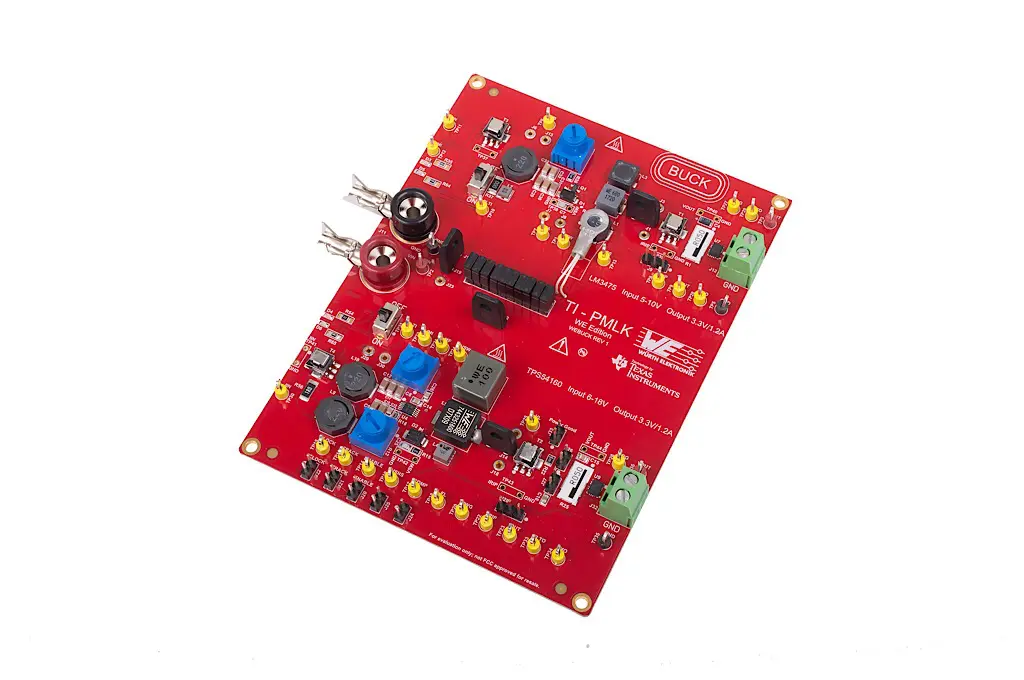
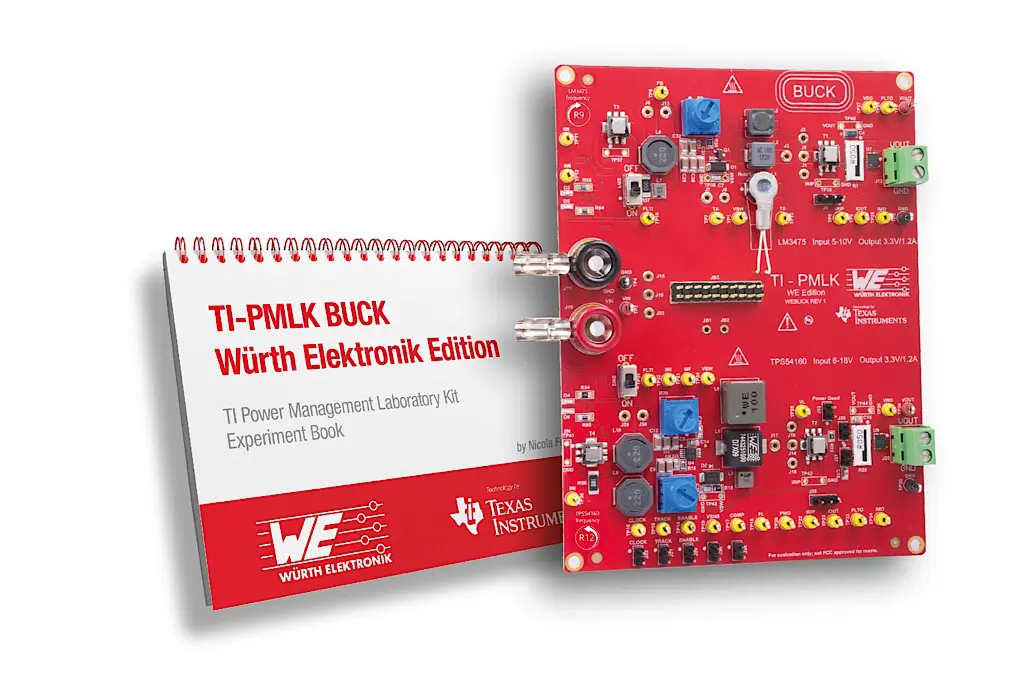
The TI-PMLK Würth Elektronik Edition comprises a buck board and a free editable experiment book.

The board consists of two independent buck circuits with six different inductors that can be individually selected. The hands-on kit allows the users to investigate the performances of inductors with different core materials, inductance, and size to analyze their impact on the static and dynamic performance of regulators.

The hardware has been designed to allow adjustable operating conditions such as switching frequency, EMI input filter, and ambient temperature control. Over-voltage, over-current and polarity reversal protection by eFuse protect the board from potential damage.

A free experiment book with structured labs completes the learning kit. This editable PDF experiments book allows for easy data entry and sharing ofresults. It can be downloaded at www.we-online.com/pmlk.

After a successful announcement at Electronica Munich 2018, the kit can now be ordered directly from the Würth Elektronik eiSos website for 119 euros or US$ 129.

 

Related

Recent Posts

How Long-Term Storage Causes Aging in Electronic Components

26.5.2026
13

Nichicon Presents Self-Charging LTO Board for Maintenance-Free IoT Nodes

26.5.2026
8

Stackpole Introduces High‑Voltage Low VCR Chip Resistors

25.5.2026
11

GDT Gas Discharge Tubes: Surge Protection Fundamentals, Selection, and Design‑in Tips

25.5.2026
18

Designing a Custom Core Transformer for 10 kW LLC Data Center Power Stages

22.5.2026
42

Magnetics Design in High‑Frequency GaN Converters

22.5.2026
38

Industrial Passive Components Markets and Technologies 2026

21.5.2026
106

Automotive Passive Components Technology Dossier

21.5.2026
66

Hirose Expands Compact High‑Voltage EV connectors

21.5.2026
18

Upcoming Events

May 27
17:00 - 17:30 CEST

When requirements change: Live Planar redesign under time pressure

Jun 2
16:00 - 17:00 CEST

Calculation, Simulation and Measurement of 800V EMC Filters

Jun 16
16:00 - 17:00 CEST

EMC with EMC – EMC‑compliant design with electromechanical connectors

View Calendar

Popular Posts

  • Buck Converter Design and Calculation

    0 shares
    Share 0 Tweet 0
  • Boost Converter Design and Calculation

    0 shares
    Share 0 Tweet 0
  • Flyback Converter Design and Calculation

    0 shares
    Share 0 Tweet 0
  • LLC Resonant Converter Design and Calculation

    0 shares
    Share 0 Tweet 0
  • MLCC and Ceramic Capacitors

    0 shares
    Share 0 Tweet 0
  • Capacitor Charging and Discharging

    0 shares
    Share 0 Tweet 0
  • What Electronics Engineer Needs to Know About Passive Low Pass Filters

    0 shares
    Share 0 Tweet 0
  • Dual Active Bridge (DAB) Topology

    0 shares
    Share 0 Tweet 0
  • Ripple Current and its Effects on the Performance of Capacitors

    3 shares
    Share 3 Tweet 0
  • Earthing Systems and IEC Classification Explained

    0 shares
    Share 0 Tweet 0

Newsletter Subscription


Passive Components Blog

© EPCI - Leading Passive Components Educational and Information Site

  • Home
  • Privacy Policy
  • EPCI Membership & Advertisement
  • About

No Result
View All Result
  • Home
  • Knowledge Blog
  • Dossiers
  • PCNS

© EPCI - Leading Passive Components Educational and Information Site

This website uses cookies. By continuing to use this website you are giving consent to cookies being used. Visit our Privacy and Cookie Policy.
Go to mobile version