






Passive Components Blog
No Result
View All Result
  • Home
  • NewsFilter
    • All
    • Aerospace & Defence
    • Antenna
    • Applications
    • Automotive
    • Capacitors
    • Circuit Protection Devices
    • electro-mechanical news
    • Filters
    • Fuses
    • Inductors
    • Industrial
    • Integrated Passives
    • inter-connect news
    • Market & Supply Chain
    • Market Insights
    • Medical
    • Modelling and Simulation
    • New Materials & Supply
    • New Technologies
    • Non-linear Passives
    • Oscillators
    • Passive Sensors News
    • Resistors
    • RF & Microwave
    • Telecommunication
    • Weekly Digest

    Nichicon Extends Rechargeable Batteries Temperature to Rival Supercapacitors

    Two‑capacitor paradox explained for engineers

    YAGEO Releases Compact RJ45 Connector for Multi‑Gigabit Ethernet

    Circuit Protection Technology Annual Dossier

    ESA SPCD 26 Registration Open

    Capacitances of Nonlinear MLCCs: What Datasheets Don’t Tell You

    Stackpole Releases Automotive Wide‑Termination Resistors

    How a Digital Structural Twin Can Predict Tantalum Capacitor Reliability

    SCHURTER Buys Biaodi to Boost High-Voltage Protection Portfolio

    Trending Tags

    • Ripple Current
    • RF
    • Leakage Current
    • Tantalum vs Ceramic
    • Snubber
    • Low ESR
    • Feedthrough
    • Derating
    • Dielectric Constant
    • New Products
    • Market Reports
  • VideoFilter
    • All
    • Antenna videos
    • Capacitor videos
    • Circuit Protection Video
    • Filter videos
    • Fuse videos
    • Inductor videos
    • Inter-Connect Video
    • Non-linear passives videos
    • Oscillator videos
    • Passive sensors videos
    • Resistor videos

    Two‑capacitor paradox explained for engineers

    Capacitances of Nonlinear MLCCs: What Datasheets Don’t Tell You

    Tapped Inductor Buck Converter Fundamentals

    Planar vs Conventional Transformer: When it Make Sense

    Modeling Fringing Field Losses in Inductors & Transformers

    Why Power Inductors Use a Ferrite Core With an Air Gap

    Transformer-Based Power-Line Harvester Magnetic Design

    Thermal Modeling of Magnetics

    Standard vs Planar LLC transformers Comparison for Battery Chargers

    Trending Tags

    • Capacitors explained
    • Inductors explained
    • Resistors explained
    • Filters explained
    • Application Video Guidelines
    • EMC
    • New Products
    • Ripple Current
    • Simulation
    • Tantalum vs Ceramic
  • Knowledge Blog
  • DossiersNew
  • Suppliers
    • Who is Who
  • PCNS
    • PCNS 2025
    • PCNS 2023
    • PCNS 2021
    • PCNS 2019
    • PCNS 2017
  • Events
  • Home
  • NewsFilter
    • All
    • Aerospace & Defence
    • Antenna
    • Applications
    • Automotive
    • Capacitors
    • Circuit Protection Devices
    • electro-mechanical news
    • Filters
    • Fuses
    • Inductors
    • Industrial
    • Integrated Passives
    • inter-connect news
    • Market & Supply Chain
    • Market Insights
    • Medical
    • Modelling and Simulation
    • New Materials & Supply
    • New Technologies
    • Non-linear Passives
    • Oscillators
    • Passive Sensors News
    • Resistors
    • RF & Microwave
    • Telecommunication
    • Weekly Digest

    Nichicon Extends Rechargeable Batteries Temperature to Rival Supercapacitors

    Two‑capacitor paradox explained for engineers

    YAGEO Releases Compact RJ45 Connector for Multi‑Gigabit Ethernet

    Circuit Protection Technology Annual Dossier

    ESA SPCD 26 Registration Open

    Capacitances of Nonlinear MLCCs: What Datasheets Don’t Tell You

    Stackpole Releases Automotive Wide‑Termination Resistors

    How a Digital Structural Twin Can Predict Tantalum Capacitor Reliability

    SCHURTER Buys Biaodi to Boost High-Voltage Protection Portfolio

    Trending Tags

    • Ripple Current
    • RF
    • Leakage Current
    • Tantalum vs Ceramic
    • Snubber
    • Low ESR
    • Feedthrough
    • Derating
    • Dielectric Constant
    • New Products
    • Market Reports
  • VideoFilter
    • All
    • Antenna videos
    • Capacitor videos
    • Circuit Protection Video
    • Filter videos
    • Fuse videos
    • Inductor videos
    • Inter-Connect Video
    • Non-linear passives videos
    • Oscillator videos
    • Passive sensors videos
    • Resistor videos

    Two‑capacitor paradox explained for engineers

    Capacitances of Nonlinear MLCCs: What Datasheets Don’t Tell You

    Tapped Inductor Buck Converter Fundamentals

    Planar vs Conventional Transformer: When it Make Sense

    Modeling Fringing Field Losses in Inductors & Transformers

    Why Power Inductors Use a Ferrite Core With an Air Gap

    Transformer-Based Power-Line Harvester Magnetic Design

    Thermal Modeling of Magnetics

    Standard vs Planar LLC transformers Comparison for Battery Chargers

    Trending Tags

    • Capacitors explained
    • Inductors explained
    • Resistors explained
    • Filters explained
    • Application Video Guidelines
    • EMC
    • New Products
    • Ripple Current
    • Simulation
    • Tantalum vs Ceramic
  • Knowledge Blog
  • DossiersNew
  • Suppliers
    • Who is Who
  • PCNS
    • PCNS 2025
    • PCNS 2023
    • PCNS 2021
    • PCNS 2019
    • PCNS 2017
  • Events
No Result
View All Result
Passive Components Blog
No Result
View All Result

Würth Elektronik eiSos and Analog Devices exhibit their demo kit Gleanergy: Development Platform for Wireless Sensor Nodes

1.3.2018
Reading Time: 2 mins read
A A

source: Würth Elektronik eiSos news

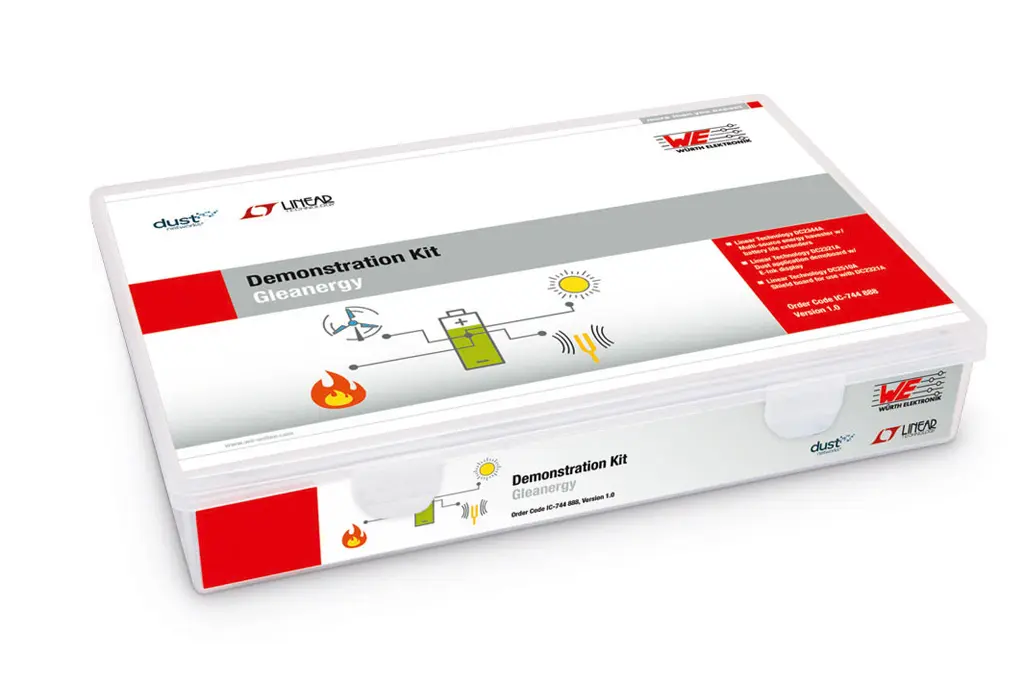
Waldenburg (Germany), 26 February 2018 – Würth Elektronik eiSos and Analog Devices (ADI) are exhibiting “Gleanergy” – the jointly developed energy harvesting demo kit – at embedded world (Nuremberg, February 27 to March 1).

RelatedPosts

Nichicon Extends Rechargeable Batteries Temperature to Rival Supercapacitors

Two‑capacitor paradox explained for engineers

YAGEO Releases Compact RJ45 Connector for Multi‑Gigabit Ethernet

It will be on display both at the Analog Devices booth (4A-629), as well as on the Würth Elektronik eiSos booth (3-247). Since its launch, the development platform has opened up the possibility of using several sources of ambient energy to operate a wireless sensor node as a means of extending battery life.

The “Gleanergy” demo kit – the name combines “glean” and “energy” – contains a thermogenerator, solar cells and an input for a piezoelectric generator. On the Energy Harvesting Power Board there is also a Li-ion rechargeable battery, a normal Li battery, ceramic capacitors and a super capacitor, as well as several switching controller ICs. With the Gleanergy Kit, developers can test scenarios to run a battery-operated device with the aid of ambient energy sources for as long as possible without maintenance. “We presume that the lifespan of the battery for an independent wireless sensor node can be extended up to 15 years if energy harvesting is used as the primary source of energy,” explains Lorandt Fölkel FAE (Field Application Engineer) at Würth Elektronik eiSos.

The application board contains an ARM Cortex-M3 processor, a SmartMesh network interface and an E-Ink display for indicating the battery charge level, etc. It also includes two coulomb counters for measuring the energy of the microprocessor. A wireless module in the form of a USB dongle allows data to be transmitted from the sensors connected to the demo kit onto a PC and displayed.

The complete package for the development of long-life sensor nodes is available at www.we-online.com/gleanergy.

The following offer also revolves around the Gleanergy Kit: the Würth Elektronik eiSos US subsidiary, Wurth Electronics Midcom, is staging an “Off The Clock Design Challenge” – those interested can sign up for before March 23, 2018 and develop their idea into an energy harvesting application based on the Gleanergy Kit (http://ow.ly/uZ9E30iq9CF).

Related

Recent Posts

Nichicon Extends Rechargeable Batteries Temperature to Rival Supercapacitors

19.5.2026
20

Two‑capacitor paradox explained for engineers

18.5.2026
45

ESA SPCD 26 Registration Open

15.5.2026
24

Capacitances of Nonlinear MLCCs: What Datasheets Don’t Tell You

14.5.2026
85

How a Digital Structural Twin Can Predict Tantalum Capacitor Reliability

14.5.2026
58

Researchers Propose Next‑Gen Compact Memory Using Ultra-thin Ferroelectric Capacitors

11.5.2026
51

Nichicon ADN Automotive Hybrid Aluminum Capacitors Now Available in EMEA

11.5.2026
45

Electrocaloric Multilayer Capacitors: Towards Quiet, Solid‑State Cooling Around Room Temperature

7.5.2026
231

KYOCERA 10 µF 0201 MLCC Brings High‑Capacitance into Mobile Designs

6.5.2026
67

Upcoming Events

Jun 2
16:00 - 17:00 CEST

Calculation, Simulation and Measurement of 800V EMC Filters

Jun 16
16:00 - 17:00 CEST

EMC with EMC – EMC‑compliant design with electromechanical connectors

View Calendar

Popular Posts

  • Buck Converter Design and Calculation

    0 shares
    Share 0 Tweet 0
  • Boost Converter Design and Calculation

    0 shares
    Share 0 Tweet 0
  • Flyback Converter Design and Calculation

    0 shares
    Share 0 Tweet 0
  • LLC Resonant Converter Design and Calculation

    0 shares
    Share 0 Tweet 0
  • MLCC and Ceramic Capacitors

    0 shares
    Share 0 Tweet 0
  • Capacitor Charging and Discharging

    0 shares
    Share 0 Tweet 0
  • What Electronics Engineer Needs to Know About Passive Low Pass Filters

    0 shares
    Share 0 Tweet 0
  • Dual Active Bridge (DAB) Topology

    0 shares
    Share 0 Tweet 0
  • Ripple Current and its Effects on the Performance of Capacitors

    3 shares
    Share 3 Tweet 0
  • Samsung Electro-Mechanics Releases High-Capacitance MLCCs for AI Server Applications

    0 shares
    Share 0 Tweet 0

Newsletter Subscription


Passive Components Blog

© EPCI - Leading Passive Components Educational and Information Site

  • Home
  • Privacy Policy
  • EPCI Membership & Advertisement
  • About

No Result
View All Result
  • Home
  • Knowledge Blog
  • PCNS

© EPCI - Leading Passive Components Educational and Information Site

This website uses cookies. By continuing to use this website you are giving consent to cookies being used. Visit our Privacy and Cookie Policy.
Go to mobile version